Home · The Ordane Journal · Rules and mechanics · Find a Prop Firm for Your Trading Style
Find a Prop Firm for Your Trading Style

Will your trading style guarantee a payout?
Your trading style will only lead to a payout if it strictly adheres to the firm's specific risk model and technical limitations. Ordane accounts operate on simulated capital. No live funds are traded and no deposits are accepted. Even a highly profitable strategy fails if it breaches execution rules.
Why natural strategies fail prop firm evaluations
Many traders build a strategy that works perfectly on their own platform, only to find that applying it elsewhere results in a denied withdrawal. Before committing to any firm, you must determine if your natural approach conflicts with their internal mechanics.
Traders often lose their accounts not because they took bad setups, but because their strategy naturally triggered a trailing drawdown limit or breached a daily loss rule based on intraday equity swings. Ordane sells one product, the Ordane Instant Account: direct access, no evaluation phase and no challenge, on simulated capital. When evaluating where to trade, you must read the contract to see exactly how your average trade duration and typical drawdown interact with the firm's specific thresholds. If your swing trades routinely dip into negative territory before hitting their targets, a firm with an aggressive trailing drawdown will close your account, even if the trade ultimately reaches your profit target.
To avoid this outcome, you need to dissect your own trading data before selecting a provider. Look at your average holding time, your peak adverse excursion, and your frequency of execution. Every withdrawal request is approved, or denied in writing citing the exact rule breached by section number, within 24 clock hours. Past that deadline the request is treated as approved and the G-1 clock starts. If you choose a firm whose rules contradict your data, you are setting yourself up for a denied payout.
How simulated execution punishes scalpers
A common issue arises when traders use high-frequency systems. Some firms actively ban approaches that rely on the imperfections of their test environments. Topstep (prop firm) lists scalping algorithms designed to exploit unrealistic simulated fills among prohibited simulator-manipulation examples (Topstep, retrieved 2026-09-03). If your strategy relies on execution speeds or fill prices that only exist in a simulation, the firm will classify it as manipulation rather than trading. Topstep says automated trading strategies are allowed with conditions (Topstep, retrieved 2026-09-03).
Scalpers execute multiple rapid trades to capture small price movements, which makes them highly sensitive to slippage and latency. In a live market, a massive volume of rapid orders interacts with an actual order book. In a simulated environment, those same orders fill against synthetic liquidity. When an algorithm detects this artificial liquidity and exploits it, the resulting profit is structurally impossible in the real world. Firms protect their business model by denying withdrawals generated through these methods.
What hidden rules force you to change your style?
Hidden rules force you to change your style by imposing strict time limits on position holding and restricting execution during specific market events. If a firm prohibits overnight holding or cancels profits made during news releases, you must alter your natural strategy to avoid automatic account termination.
Overnight and weekend holding restrictions
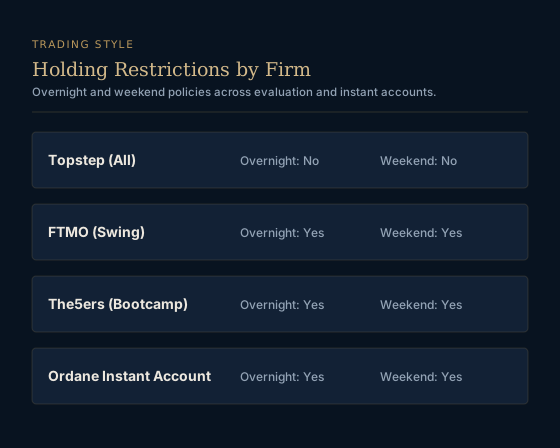
The most common restriction that forces a style change is the holding time limit. Swing traders rely on capturing multi-day trends, which inherently requires holding positions through market closes and over weekends. However, many prop firms cater exclusively to intraday trading and explicitly ban holding trades outside of the main session. Topstep requires positions to be closed by 3:10 PM CT each weekday and does not permit holding positions between sessions (Topstep, retrieved 2026-09-03). If you hold a position past this daily deadline, the system will liquidate your trade and you may lose the account entirely.
Conversely, other programs are designed specifically to accommodate longer holding periods. FTMO (prop firm) says its Swing account type has no restriction on holding positions overnight or over the weekend (FTMO, retrieved 2026-09-03). The5ers (prop firm) says its Bootcamp program allows positions to be held overnight and over the weekend (The5ers, retrieved 2026-09-03).
| Firm and Account Type | Overnight Holding | Weekend Holding |
|---|---|---|
| Topstep (All Programs) | Prohibited | Prohibited |
| FTMO (Swing Account) | Permitted | Permitted |
| The5ers (Bootcamp) | Permitted | Permitted |
| Ordane Instant Account | Permitted | Permitted |
Overnight and weekend holding is allowed at Ordane. It is not on the R-6 closed list, and what is not listed is not a violation. When you select a firm, you are selecting the holding duration they authorize.
News trading windows
News trading represents another major area where hidden rules dictate trader behavior. Market moving events like employment data or interest rate decisions create volatility that some traders specifically target. Yet, many firms view this volatility as an unacceptable risk to their simulated capital and enforce strict blackout windows.
Here is how different firms treat trading around high-impact economic events:
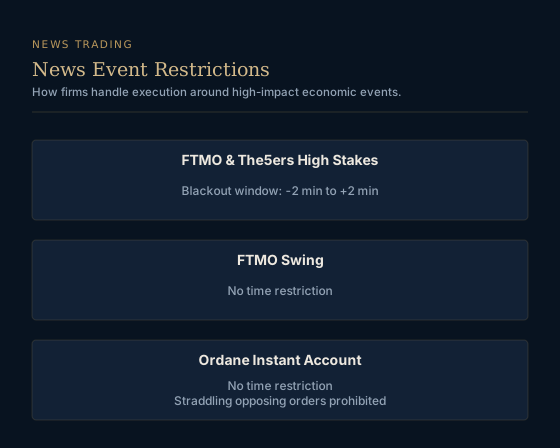
- FTMO specifies a restricted trading window from 2 minutes before until 2 minutes after selected news announcements for applicable FTMO Account trades (FTMO, retrieved 2026-09-03).
- The5ers High Stakes prohibits order execution from 2 minutes before until 2 minutes after high-impact news (The5ers, retrieved 2026-09-03).
- FTMO says its Swing account type has no restriction on trading during news releases (FTMO, retrieved 2026-09-03).
If you are a news trader, selecting a restricted account means you must manually close all positions before the release and wait until the window expires to re-enter, fundamentally altering your approach. At Ordane, clarity on these restrictions is built into the contract. Ordane's prohibited-practice list is closed. Clause R-6 names six practices: latency, reverse or hedge arbitrage; high-frequency or bulk automated exploitation; copy trading between Ordane accounts; straddling news releases with paired opposing orders; platform or data-feed exploitation; and gap abuse. If a behavior is not listed in that section, it is not a violation. Discretion is not a rule.
Ordane's rulebook does restrict one thing around news: clause R-6(d) prohibits straddling news releases with paired opposing orders. Because R-6 is a closed list, no other clause restricts trading during news or high-impact events.
Will the firm survive your long-term strategy?
A firm will only survive your long-term strategy if its business model relies on verifiable revenue and stable capital management rather than continuous evaluation failures. Firms that operate unsustainable models often close abruptly, leaving traders with unpaid balances regardless of how profitable their strategies were over time.
Regulatory warnings on simulated performance
When you trade a long-term strategy, you are committing months of effort to a single firm. The critical question is whether that entity will exist when it is time to process your withdrawal. The industry has a history of abrupt closures, often because the underlying mechanics of their simulated environments do not align with actual market realities. The CFTC warns that assumptions not subjected to actual market conditions may overestimate or underestimate a trading system's performance (CFTC, retrieved 2026-09-03).
Firms often restrict specific styles to protect their own infrastructure. They define trading parameters strictly to ensure that the simulated results they pay out on have some correlation to expected behavior in live markets. FTMO conditions strategy acceptance on legitimate trading, proper risk management, real-market conditions and avoidance of forbidden practices (FTMO, retrieved 2026-09-03). This requirement exists because strategies that generate massive simulated profits through arbitrage or unrealistic fills create liabilities the firm cannot actually sustain.
Understanding day trade margin definitions
For U.S. margin accounts, the SEC's investor bulletin quotes FINRA's definition of a day trade as buying and selling, or selling and buying, the same security on the same day (SEC, retrieved 2026-09-03). Firms use these regulatory definitions to categorize traders and apply specific risk limits based on holding times.
To ensure longevity, you must look for verifiable financial backing rather than promotional statements. Ordane's payout reserve is published at a public TRON address on ordanemarkets.com and in Rulebook v1.0 clause PR-1. The page carries a dated observed balance and states that the reserve is not a promise, it is an address. Payouts are paid in real money from company fee revenue. No client deposits are taken and no client capital is traded. Rulebook v1.0 clause PR-1 commits Ordane to publish the payout reserve on-chain; the live rulebook and homepage publish the TRON address.
If a firm cannot show you exactly where the funds for your payout reside, your long-term strategy is at risk of never being compensated. You should demand transparency in both the rules that govern your trading and the financial structure that supports the payouts.
Does a flexible trading style cost more?
A flexible trading style often costs more through lower leverage limits, stricter position sizing caps, and higher upfront evaluation fees. Firms offset the increased risk of allowing overnight holds, weekend exposure, and news trading by reducing your purchasing power and limiting your total market exposure per trade.
Leverage differences and position caps
When a firm removes restrictions on holding times or news trading, they absorb the risk of market gaps and extreme volatility. To manage this exposure, they adjust the account specifications, which directly impacts how you can deploy your strategy. A swing trader who wants the freedom to hold positions through the weekend will typically face lower leverage than a day trader operating in a restricted environment.
FTMO states that its Swing account type has leverage of up to 1:30 (FTMO, retrieved 2026-09-03). This is significantly lower than the leverage offered on heavily restricted intraday accounts across the industry. Lower leverage means you must commit more margin to open the same position size, which restricts your ability to scale into trades or manage multiple correlated positions simultaneously.
Similarly, firms may impose strict position caps on flexible accounts to prevent massive exposure during illiquid periods. The5ers Futures says its Swing program permits overnight holding of 1 mini or 10 micro contracts, while larger positions must close at least 10 minutes before market close (The5ers, retrieved 2026-09-03). If your strategy relies on building large positions over several days, these contractual caps force you to operate at a fraction of your intended capacity.
If you decide to purchase multiple accounts to diversify your strategies across different firm parameters, the costs scale directly.
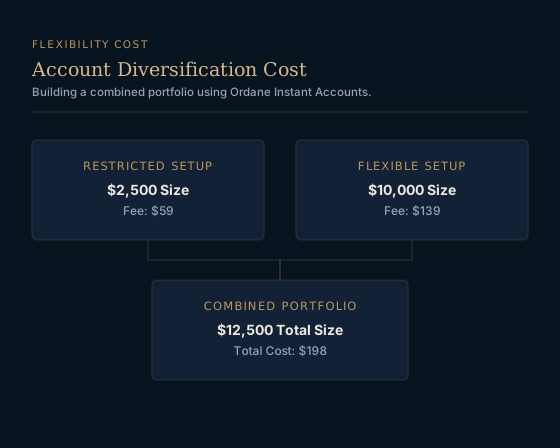
Declared inputs for this check: a $59 fee for the initial account, a $139 fee for the secondary account, and a $198 combined cost. Worked arithmetic: $59 + $139 = $198.
| Account Type | Size | Cost | Purpose |
|---|---|---|---|
| Ordane Instant Account | $2,500 | $59 | Restricted Setup |
| Ordane Instant Account | $10,000 | $139 | Flexible Setup |
| Combined Portfolio | $12,500 | $198 | Diversified Allocation |
At Ordane, the structure is designed for absolute clarity. Ordane Instant Account comes in five sizes: $2,500, $10,000, $25,000, $50,000 and $100,000. The fee is one-time: $59 for the $2,500 account, $139 for the $10,000 account, $299 for $25,000, $549 for $50,000 and $999 for $100,000. There are no recurring fees, no hidden tiers and no coupon games. Ordane charges no commission, no spread and no swap. The account fee is the only cost the trader pays. The reason is structural, not promotional: accounts run on simulated capital, so no order is routed to an exchange and nothing is financed overnight, which means neither line has an underlying bill behind it.
To enforce this structure, The Ordane Guarantee provides a strict timeline for your capital. A payout approved and not paid within 48 clock hours, not business hours, triggers automatic compensation: a 100 percent refund of the account fee, plus the payout owed in full. Read how to choose a prop firm account size to align your capital with your strategy, or review the full Ordane Rulebook.
Frequently Asked Questions
What is the best prop firm for swing traders?
The best prop firm for swing traders is one that permits holding positions overnight and through the weekend without arbitrary penalties. Swing traders hold positions for days or weeks to capture macro market movements, which requires a firm that does not force daily liquidations. You must verify the firm's specific policies on overnight margin and weekend holding before purchasing an evaluation.
What is the best prop firm for scalpers?
The best prop firm for scalpers is one that provides clear rules on high-frequency execution and simulated environment boundaries. Scalpers execute multiple rapid trades to capture small price movements. If a firm prohibits algorithms that exploit unrealistic simulated fills, scalpers must ensure their strategy relies on standard price action rather than latency arbitrage. You must read the firm's prohibited practices list carefully.
How do I choose a prop firm for my trading style?
You choose a prop firm for your trading style by mapping your average trade duration, maximum drawdown, and execution frequency against the firm's strict contractual limits. If you trade during news events, check their specific restricted windows. If you swing trade, verify their overnight holding rules. Select a firm whose risk model naturally accommodates your existing data rather than attempting to alter a profitable system.
What is the difference between scalping vs swing trading prop firm?
The difference lies in the restrictions the prop firm applies to holding times and execution speed. A firm catering to scalpers focuses on daily loss limits and may closely monitor execution for simulator exploitation. A firm accommodating swing traders focuses on overall drawdown and explicitly permits holding positions across market sessions and weekends without forcing liquidation.
Can I use automated strategies on a prop firm?
You can use automated strategies on a prop firm only if the specific algorithm complies with their terms of service regarding simulator manipulation. Many firms ban high-frequency bulk execution or arbitrage strategies that only function in simulated environments. Expert Advisors are fully permitted at Ordane: a trader may run an EA executing the trader's own strategy on an Ordane account. You must always review the firm's rulebook to confirm which automated approaches lead to account closure.
Sources
- Fraud Advisory: Commodity Trading Systems Sold on the Internet cftc.gov Retrieved 2026-09-03.
- Margin Rules for Day Trading investor.gov Retrieved 2026-09-03.
- FTMO Swing account type ftmo.com Retrieved 2026-09-03.
- Do I have to close my positions overnight or before the weekend? ftmo.com Retrieved 2026-09-03.
- Can I trade news? ftmo.com Retrieved 2026-09-03.
- What are the account specifications? ftmo.com Retrieved 2026-09-03.
- Which instruments can I trade and what strategies am I allowed to use? ftmo.com Retrieved 2026-09-03.
- When and What Products Can I Trade? help.topstep.com Retrieved 2026-09-03.
- Trading Combine® Parameters help.topstep.com Retrieved 2026-09-03.
- Prohibited Trading Strategies at Topstep help.topstep.com Retrieved 2026-09-03.
- Can I Hold Positions Overnight? the5ers.com Retrieved 2026-09-03.
- Can I Trade During News? the5ers.com Retrieved 2026-09-03.
- How does the Bootcamp Program work? the5ers.com Retrieved 2026-09-03.