Home · The Ordane Journal · Rules and mechanics · Best Prop Firms for Swing Trading
Best Prop Firms for Swing Trading
A swing trading prop firm account allows traders to hold open positions across multiple sessions, overnight, and over the weekend without incurring a rule breach. Ordane accounts operate on simulated capital. No live funds are traded and no deposits are accepted. (Ordane Rulebook v1.0, clause P-2, retrieved 2026-09-24)
Traders searching for the best prop firm for swing trading face a structural problem. Most firms run evaluation phases with tight timelines and restrictive overnight holding policies that force day trading.
Swing traders need specific conditions to hold positions across trading sessions without triggering a breach. The risk of hidden rules taking an account down overnight is the primary fear for those who hold trades for days.
What Is a Swing Trading Prop Firm Account?
Swing trading is defined as holding positions overnight or over several days. (CME Group Glossary, retrieved 2026-09-23) This approach requires a different set of risk management parameters compared to day trading or scalping. When a trader leaves a position open past the end of the server day, the account is exposed to rollover costs, swap rates, and potential price gaps when markets reopen.
Most proprietary trading firms restrict overnight holding because their risk models are built around flat end-of-day exposure. A firm that prohibits weekend holding will automatically close any open trades on Friday afternoon. If the trader attempts to hold the position, the automated risk system flags a violation and revokes the account. This forces traders to liquidate positions prematurely, absorbing spread costs and missing the intended market move.
Understanding the mechanics of overnight risk is critical for swing traders. The foreign exchange market operates continuously during the week, but liquidity drops significantly during the daily rollover period. Spreads widen, and holding a position through this window requires an account structure that absorbs these fluctuations without breaching the daily loss limit.
Ordane sells one product, the Ordane Instant Account: direct access, no evaluation phase and no challenge, on simulated capital. (Ordane Rulebook v1.0, section 1, retrieved 2026-09-24)
Swing traders also face the risk of weekend gaps. When markets close on Friday and reopen on Sunday, geopolitical events or economic news can cause the opening price to jump significantly away from the Friday closing price. If an account has a tight static drawdown limit, a weekend gap against the position can instantly breach the rules.
Therefore, evaluating a prop firm for swing trading goes beyond simply checking if overnight holding is allowed. It requires analyzing the drawdown calculation, the daily loss limit timing, and the specific clauses governing market gaps.
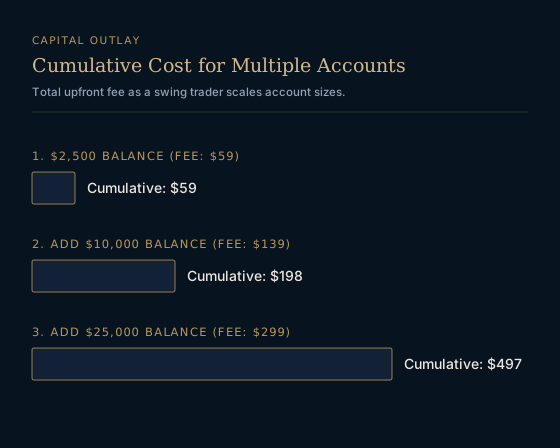
To illustrate the cost structure of acquiring multiple accounts for swing trading, we can calculate the cumulative capital outlay. Declared inputs for this check: a $59 fee for the first account, a $139 fee for the second account, and a $299 fee for the third account. Worked arithmetic: $59 + $139 + $299 = $497 total upfront cost.
| Account Tier | Single Fee | Cumulative Cost |
|---|---|---|
| $2,500 Balance | $59 | $59 |
| $10,000 Balance | $139 | $198 |
| $25,000 Balance | $299 | $497 |
This is the one-time ticket price; the fee breakdown for any charges that can appear after checkout is covered separately.
Before comparing specific firms, traders must evaluate the fundamental reliability of the provider. The first question is whether the firm actually pays its traders. Passing a challenge and accumulating simulated profit means nothing if the firm denies the withdrawal request. Ordane's payout reserve is published at a public TRON address on ordanemarkets.com and in Rulebook v1.0 clause PR-1.
The second fear involves hidden rules applied at the time of withdrawal. Many firms rely on discretionary clauses, such as banning certain trading styles retrospectively. Ordane's prohibited-practice list is closed. Clause R-6 names six practices: latency, reverse or hedge arbitrage; high-frequency or bulk automated exploitation; copy trading between Ordane accounts; straddling news releases with paired opposing orders; platform or data-feed exploitation; and gap abuse. If a behavior is not listed in that section, it is not a violation. Discretion is not a rule.
The third fear is longevity. Will the firm still exist in twelve months? The proprietary trading industry has seen numerous closures due to flawed business models or regulatory pressure. A sustainable firm must operate transparently. Rulebook v1.0 clause PR-3 commits Ordane to independent third-party attestation of payout records, entering effect per the public roadmap milestone.
Which Prop Firms Allow Overnight and Weekend Holding?
Traders must verify the exact clauses governing open positions. Policies vary significantly between providers, and relying on marketing summaries often leads to unexpected account closures.
FTMO Swing Account
FTMO (prop firm) operates an evaluation model with a two-step challenge phase. While their standard accounts restrict trading around high-impact news and prohibit holding trades over the weekend, they offer a distinct account variation for longer-term traders. FTMO offers a specific Swing account type that allows holding positions overnight and over the weekend. (FTMO Rules, retrieved 2026-09-23)
Traders selecting this option must explicitly choose the Swing account during the initial checkout process. This account type typically features lower leverage compared to their standard offering. The reduced leverage acts as a risk mitigation tool for the firm, protecting against massive market gaps that can occur while markets are closed. For a side-by-side comparison of Ordane's single instant-access model against FTMO's evaluation structure, see how the two firms differ.
For swing traders, the lower leverage is usually an acceptable trade-off. Holding positions for several days requires wider stop-loss orders to survive normal market volatility. Consequently, position sizes are smaller, making the reduction in maximum leverage less restrictive than it would be for a high-frequency day trader.
The 5%ers Holding Policy
The 5%ers (prop firm) operates with a different set of baseline rules. The 5ers allow traders to hold open positions overnight and during the weekend without penalties. (The5ers Trading Rules, retrieved 2026-09-23) This policy applies across their funding programs, removing the need for a trader to select a specific account type at checkout just to keep a trade open past Friday.
However, traders must still manage their risk within the boundaries of the firm's drawdown rules. Holding a trade over the weekend means exposing the account to unpredictable market gaps upon the Sunday open. If a market gaps heavily against the trader's position, the resulting floating loss is immediately calculated against the account's drawdown limit.
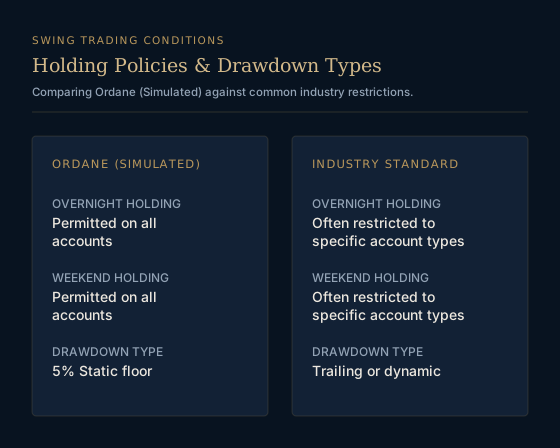
This highlights a critical mechanical difference in how prop firms calculate losses. A static drawdown limit provides a fixed floor, while a trailing drawdown moves up as the account balance reaches new high water marks. Ordane's maximum drawdown is 5 percent and static: account equity may never fall below 95 percent of the initial balance. The floor is fixed on day one, never trails upward, and a breach closes the account.
Traders must compare the specific holding policies of these firms based on verified data.
| Metric/Feature | Ordane (Simulated) | Industry Standard |
|---|---|---|
| Overnight Holding | Permitted on all accounts | Often restricted to specific account types |
| Weekend Holding | Permitted on all accounts | Often restricted to specific account types |
| Drawdown Type | 5% Static floor | Trailing or end-of-day dynamic |
The mechanics of the daily loss limit also affect swing traders. When a trade is held overnight, the floating profit or loss carries over into the new trading day. Firms measure the daily loss limit against the balance or equity at a specific rollover time, usually 00:00 server time.
If a swing trader holds a position with a significant floating loss into the new day, that starting equity becomes the baseline for the new daily limit. The Ordane daily loss limit is 3 percent, measured against the balance at the start of the server day. A breach closes the account. Understanding this timing is essential, as a sudden spike in volatility right after the server rollover can trigger a daily limit breach even if the overall account drawdown is far from the maximum limit.
Furthermore, swing trading requires precise risk management per position. Because the holding period exposes the trade to more fundamental variables, traders must calculate their exposure carefully. Maximum risk per trade is 1.5 percent of current balance and a stop-loss is mandatory at entry. Two maximum losses equal the daily limit, which is the design rather than an accident.
Overnight and weekend holding is allowed at Ordane. It is not on the R-6 closed list, and what is not listed is not a violation.
The cost of capital is another factor. The fee is one-time: $59 for the $2,500 account, $139 for the $10,000 account, $299 for the $25,000 account, $549 for the $50,000 account, $999 for the $100,000 account. There are no recurring fees, no hidden tiers and no charge to withdraw.
When a swing trader successfully navigates the market and generates simulated profit, the withdrawal mechanics become the priority. Every withdrawal request is approved, or denied in writing citing the exact rule breached by section number, within 12 clock hours. Past that deadline the request is treated as approved and the G-1 clock starts.
The Ordane Guarantee enforces the payment timeline. A payout approved and not paid within 24 clock hours, not business hours, triggers automatic compensation: a 100 percent refund of the account fee, plus the payout owed in full.
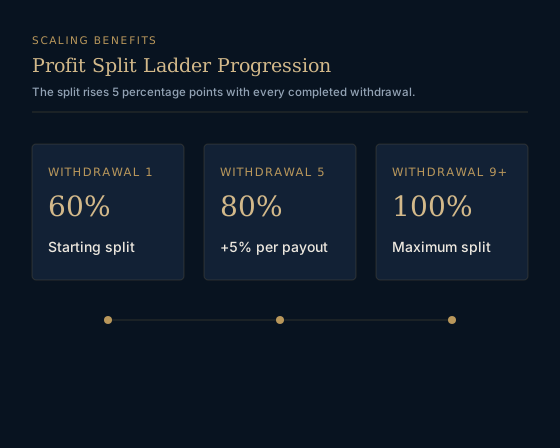
Ordane's profit split starts at 60 percent and rises 5 percentage points with every completed withdrawal, reaching 100 percent from the ninth withdrawal onward. The full mechanics behind each step of that ladder are covered in the Ordane profit split breakdown.
Swing traders must also consider the available instruments and leverage when selecting a firm. Ordane lists four asset classes: FX pairs (majors and minors), metals, indices and crypto. No exotics. The available leverage dictates the margin required to hold a position. Ordane's settled leverage is 1:50 on FX majors and minors. Leverage for metals, indices and crypto has not been set yet.
For a swing trader, lower leverage means more capital is tied up in margin for a given position size. This naturally restricts the ability to over-leverage the account, aligning with strict risk management practices. Since swing trading strategies aim for larger price targets over longer durations, the tight leverage constraints help prevent disastrous losses from sudden market shocks.
Another crucial mechanic for holding trades is the inactivity rule. Swing traders may wait days or even weeks for their specific setup to align. If a firm has an aggressive inactivity clause, the trader might be forced to take a suboptimal trade just to keep the account alive. Accounts with no trading activity for 30 consecutive days are closed. The 30 consecutive days in clause R-5 are calendar days, not business days. Under clause R-5, trading activity means at least one filled order. Pending orders and platform logins do not count.
Furthermore, traders executing multi-day strategies often use automated systems to manage trailing stops or partial take-profits while away from the terminal. Firms differ on their automation policies. Expert Advisors are fully permitted at Ordane: a trader may run an EA executing the trader's own strategy on an Ordane account. However, traders must ensure their automated systems do not violate core trading rules. Ordane's Appendix A, entry A-1, names a normal hedge of a single Ordane position with a stop-loss under R-3, with no cross-feed exploit, as an example that does NOT close the account.
When evaluating the withdrawal process for swing trading profits, the frequency of payouts is critical. Swing traders may have fewer winning trades, but with higher yields per trade, which is the profile the consistency rule is designed to address. The first withdrawal is available 7 calendar days after account activation, and the cycle thereafter is every 14 days. Withdrawals #1 and #2 are each capped at 3 percent of initial balance. From withdrawal #3 onward there is no cap. Withdrawals reduce the account balance, and the R-1 drawdown floor stays anchored to the initial balance.
Finally, the firm's structure determines the reliability of the trading environment. Ordane runs on a trading platform it designed and built with its own engineering team, and licenses no third-party terminal. Ordane owns the terminal its traders use, so no vendor can revoke it, reprice it, or decide it will no longer serve this industry.
Frequently Asked Questions
What Is the Best Prop Firm for Swing Trading?
The best prop firm for swing trading is one that explicitly permits overnight and weekend holding in its public rulebook without requiring specialized account types. Traders must verify the firm's policies on market gaps, rollover costs, and how floating losses interact with the daily loss limit during the server reset.
Do Prop Firms Allow Swing Trading?
Policies vary by firm. Some firms prohibit weekend holding entirely to mitigate gap risk, forcing traders to close all positions by Friday afternoon. Others permit weekend holding across all their programs. (The5ers Trading Rules, retrieved 2026-09-23) Certain firms require traders to purchase a specific account type to unlock swing trading capabilities.
Which Are the Best Swing Trading Prop Firms?
Firms that offer static drawdown limits and transparent rules regarding overnight holding are generally preferred by swing traders. A static floor provides a fixed reference point for risk management over a multi-day holding period. Trailing drawdowns, which lock in floating profits, can prematurely close an account during a normal market retracement.
Can I Hold Trades Over the Weekend on a Swing Trading Prop Firm Account?
Yes, provided the specific firm and account type allow it. FTMO requires traders to operate a dedicated Swing account to hold positions over the weekend. (FTMO Rules, retrieved 2026-09-23) Holding trades over the weekend exposes the account to opening price gaps on Sunday, which can trigger a drawdown breach if the market moves sharply against the position.
Sources
- CME Group Glossary cmegroup.com Retrieved 2026-09-23T18:36:51Z.
- FTMO Rules ftmo.com Retrieved 2026-09-23T18:36:51Z.
- The5ers Trading Rules the5ers.com Retrieved 2026-09-23T18:36:51Z.