Home · The Ordane Journal · Rules and mechanics · Pass a Prop Firm Challenge With an EA
Pass a Prop Firm Challenge With an EA
Proprietary firm Expert Advisor (EA) rules determine whether an automated trading algorithm represents legitimate market analysis or a prohibited technical exploit. Ordane accounts operate on simulated capital. No live funds are traded and no deposits are accepted.
Automated trading changes the mechanics of retail market participation. Traders look for algorithmic consistency to remove emotional variables from their execution process. When shifting from a standard retail brokerage to a proprietary trading environment, the rules governing automated software change significantly. The core difference lies in the nature of the liquidity feed and the execution model. This fundamental structure means that the firm evaluates risk based on simulated execution data, making the specific behavior of any automated system the primary factor in determining compliance. Traders must understand exactly how proprietary firms classify different algorithms, which strategies represent legitimate market analysis, and which systems cross the line into technical exploitation.
Do prop firms allow EAs during an evaluation?
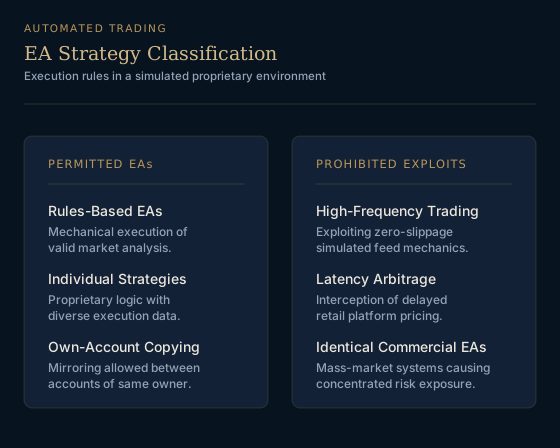
Proprietary trading firms generally allow traders to use Expert Advisors during evaluations, provided the automated algorithms do not exploit simulated market conditions. While firms permit discretionary rules-based bots, they strictly prohibit high-frequency trading, latency arbitrage, and commercially identical third-party systems that aggregate toxic order flow and create concentrated risk.
The distinction between a permitted algorithm and a prohibited exploit rests on the execution intent. A legitimate Expert Advisor functions as a mechanical trader. It reads price action, applies a predetermined set of technical criteria, calculates position sizing based on available equity, and submits orders that reflect normal human execution speeds. The firm accepts this because the resulting simulated trades provide a valid measure of the algorithm's statistical edge, the same edge that a prop firm calculator is built to estimate before an EA ever touches a funded account. Ordane sells one product, the Ordane Instant Account: direct access, no evaluation phase and no challenge, on simulated capital.
Other firms in the market take a similar stance on the basic use of automation. However, this general permission never serves as a blanket immunity for all algorithmic behavior. Firms monitor the specific execution patterns of every active bot. They measure the duration of trades, the frequency of order modifications, the distance between entry prices and stop-loss levels, and the correlation between the bot's execution timestamps and external macroeconomic data releases.
Which EA strategies will breach your account?
Proprietary trading firms enforce strict guidelines regarding the specific types of automated strategies they permit. The objective is to ensure that the simulated performance reflects genuine market analysis rather than the exploitation of technical infrastructure. The mechanics behind these bans reveal how the prop firm industry protects its simulated environments from technological exploitation.
High-Frequency Trading (HFT) bots
High-Frequency Trading algorithms rely on extreme execution speed to capture microscopic price movements. In institutional finance, HFT firms invest heavily in hardware co-location and direct market access to reduce execution latency to microseconds. In the retail proprietary trading sector, traders attempt to replicate this approach using commercially available bots on standard platforms. The problem arises because retail simulated feeds do not accurately replicate the order book depth and execution latency of tier-one institutional liquidity.
When an HFT bot operates in a simulated environment, it executes trades at the top-of-book price without experiencing the slippage that would naturally occur when consuming real liquidity. The bot generates simulated profits that are mathematically impossible to replicate in a live market. Firms identify these systems by analyzing the order density, the millisecond timestamps of entries and exits, and the average holding time of the positions. The same holding-time and order-density metrics are how a firm separates an HFT exploit from ordinary scalping, so a trader running a fast manual or semi-automated style should check that boundary directly. Operating an HFT bot violates the core premise of simulated evaluation, leading to immediate account closure and the forfeiture of any generated profits.
Latency and reverse arbitrage
Latency arbitrage involves exploiting the time delay between the proprietary firm's price feed and a faster, institutional-grade data feed. The algorithm detects a price movement on the faster feed milliseconds before that same movement reflects on the firm's platform. The bot then executes a trade on the lagging feed, knowing the future price with absolute certainty. This is not trading. It is the technical interception of delayed data.
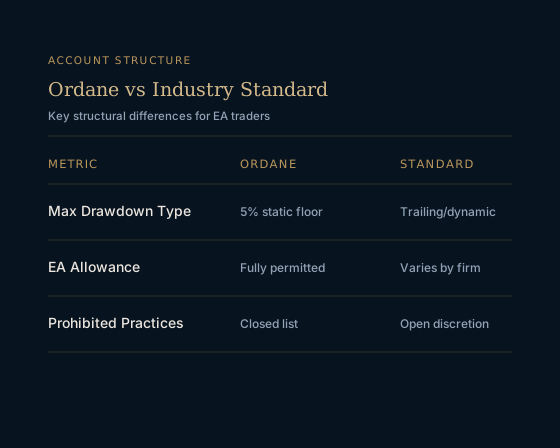
Reverse arbitrage applies a similar concept but exploits the differences between multiple retail platforms or brokerages, using one account to hedge against another across different environments. In a simulated context, latency arbitrage generates simulated profits without genuine market exposure because the trader is effectively trading against the firm's infrastructure rather than the market. Detection mechanisms for these strategies are highly advanced. Firms compare execution timestamps against historical tick data to identify patterns of trading that consistently occur in the microsecond window preceding a price update. Ordane's prohibited-practice list is closed. Clause R-6 names six practices: latency, reverse or hedge arbitrage; high-frequency or bulk automated exploitation; copy trading between Ordane accounts; straddling news releases with paired opposing orders; platform or data-feed exploitation; and gap abuse. If a behavior is not listed in that section, it is not a violation. Discretion is not a rule. For where an ordinary single-account hedge ends and the banned version of that practice begins, see Do Prop Firms Allow Hedging?
Commercially identical third-party EAs
Many traders purchase off-the-shelf automated systems from retail marketplaces. While the underlying logic of these bots might not violate HFT or latency rules, their widespread use presents a structural problem for the firm. According to Finance Magnates (trade press), retail prop firms limit the use of commercially identical third-party Expert Advisors (EAs) because multiple traders running the same algorithm creates concentrated risk exposure for the firm. (Finance Magnates, retrieved 2026-09-23)
If five hundred traders deploy the exact same commercial EA, they will all execute the exact same trades at the exact same price levels. This creates massive, concentrated simulated exposure on specific market movements. If the firm attempts to manage this risk in a live environment, the sudden aggregation of identical orders will cause severe slippage and execution failures. Proprietary firms require diverse, uncorrelated trading data. They reject identical third-party systems to prevent toxic order flow aggregation and to ensure that the simulated results they evaluate represent independent market analysis. A trader running the same commercial EA on accounts at more than one firm at once should also confirm the correlation and account-count limits covered in Can You Trade With Multiple Prop Firms at Once? Expert Advisors are fully permitted at Ordane: a trader may run an EA executing the trader's own strategy on an Ordane account.
How Do You Pass a Prop Firm Challenge With an EA?
Deploying an automated system requires a structured approach to risk management, technical compliance, and cost analysis. The trader must ensure that the algorithm aligns with the firm's specific regulations and that the mechanical execution parameters do not trigger automated breach protocols.
The first step involves a comprehensive review of the algorithm's source code and execution logic. The trader must confirm that the bot does not rely on tick scalping, latency exploitation, or high-frequency order modification. The system must utilize clear entry conditions based on price action, technical indicators, or fundamental data, and it must hold positions for a duration that reflects normal market exposure. If the bot averages a holding time of three seconds and relies on zero-slippage fills to show a positive expectancy, it will fail the compliance review.
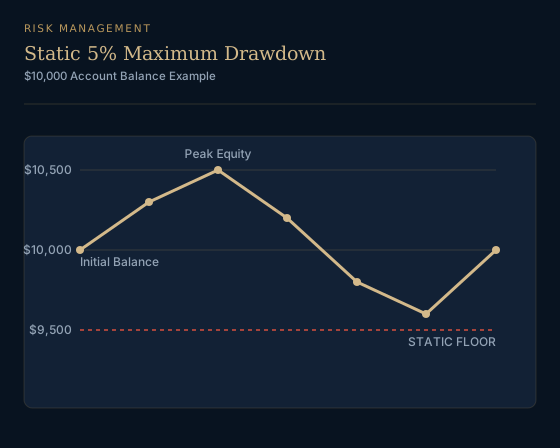
The second step requires a detailed analysis of the firm's drawdown parameters. Automated systems often experience consecutive losses during unfavorable market conditions. The mathematical expectancy of the algorithm dictates the required position sizing model. If the EA employs a high win-rate strategy with a negative risk-to-reward ratio, the trader must ensure that a statistically probable string of consecutive losses will not breach the maximum drawdown limits. Conversely, a trend-following system with a low win-rate and a high risk-to-reward ratio requires smaller position sizes to survive the inevitable drawdown periods. Systems built to double down after a loss instead of shrinking size, a martingale or grid approach, run into a stricter and often separate set of limits; see Martingale and Grid Rules at Prop Firms. The algorithm must continuously monitor the account's available equity and adjust its lot sizing dynamically. Ordane's maximum drawdown is 5 percent and static: account equity may never fall below 95 percent of the initial balance. The floor is fixed on day one, never trails upward, and a breach closes the account. The algorithm must incorporate hard stop-loss logic to prevent a single adverse market movement from breaching the daily or maximum loss limits. The difference between a broker-style margin call and this firm-side breach is covered in Prop Firm Margin Call vs Loss Limit, and the exact mechanics of the daily figure itself in Prop Firm Daily Loss Limit Explained.
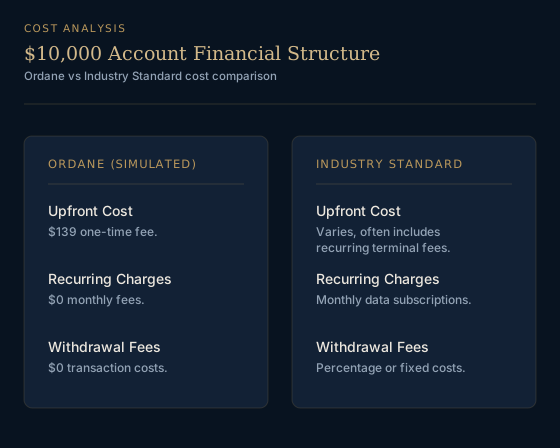
The third step involves understanding the financial structure of the account. Traders must evaluate the upfront costs against the firm's payout policies and guarantees. The evaluation of cost requires exact arithmetic based on the firm's published fee schedule. The fee is one-time: $59 for the $2,500 account, $139 for the $10,000 account, $299 for the $25,000 account, $549 for the $50,000 account, $999 for the $100,000 account. There are no recurring fees, no hidden tiers and no charge to withdraw. Since account size sets both the fee and the lot-size ceiling an EA can trade within, see How to Choose a Prop Firm Account Size before buying.
Declared inputs for this check: a $139 one-time fee for the $10,000 account, a $0 recurring fee, and a $0 charge to withdraw. Worked arithmetic: $139 + $0 = $139 total upfront cost.
| Metric/Feature | Ordane (Simulated) | Industry Standard |
|---|---|---|
| Discretionary EAs | Permitted | Generally permitted |
| Latency Arbitrage | Prohibited (Clause R-6) | Strictly banned |
| High-Frequency Trading | Prohibited (Clause R-6) | Strictly banned |
| Identical Commercial EAs | Permitted for individual strategy | Restricted due to concentrated risk |
| Copy Trading | Permitted between own accounts | Prohibited between different users |
| Upfront Cost ($10,000 Account) | $139 one-time fee | Varies, often includes recurring platform fees |
| Recurring Charges | $0 | Monthly data or terminal fees |
| Withdrawal Fees | $0 charge to withdraw | Percentage-based or fixed transaction costs |
Once the technical parameters and costs are established, the trader must confirm the firm's payout reliability. Passing the technical requirements means nothing if the firm fails to honor the payout request. Traders must look for contractual guarantees rather than marketing statements. The Ordane Guarantee enforces strict timelines on payment processing. A payout approved and not paid within 24 clock hours, not business hours, triggers automatic compensation: a 100 percent refund of the account fee, plus the payout owed in full.
FAQ
How to pass prop firm challenge with an ea?
Passing requires using an algorithm that executes legitimate market analysis rather than exploiting simulated feed mechanics. You must ensure your bot avoids high-frequency trading and latency arbitrage, maintains strict risk management to respect the firm's drawdown limits, and operates as a unique strategy rather than a commercially identical mass-market system. Continuous monitoring of the software ensures it adheres to the parameters set by the proprietary trading firm.
Which prop firms that allow ea?
Many proprietary trading firms permit automated trading under specific conditions. Other firms maintain similar policies, provided the bots adhere to their specific prohibited-practice lists and do not generate toxic order flow. Expert Advisors are fully permitted at Ordane: a trader may run an EA executing the trader's own strategy on an Ordane account.
Can you use an ea to pass a prop firm challenge?
Yes, you can use automated systems, provided the software complies with the firm's execution rules. The algorithm must trade in a manner that can be theoretically replicated in a live market, meaning it cannot depend on the artificial perfection of a simulated data feed or the absence of natural slippage. Algorithms built on technical or fundamental analysis generally operate without compliance issues.
Is a prop firm ea allowed?
A proprietary firm will allow an Expert Advisor if it functions as a mechanical execution tool for a valid trading strategy. It will ban the EA if it functions as an exploit designed to manipulate the evaluation environment. Firms rely on sophisticated detection tools to analyze execution timestamps and order modifications to enforce this distinction and protect their simulated order books from arbitrage.
Are third-party bots allowed?
The allowance of third-party systems depends heavily on the specific firm's risk management policies. Retail prop firms limit the use of commercially identical third-party Expert Advisors (EAs) because multiple traders running the same algorithm creates concentrated risk exposure for the firm. Traders should prioritize developing proprietary logic or customizing third-party frameworks to ensure their execution profile remains unique and does not trigger toxic flow alerts.
Sources
- Proprietary Trading Firm Risk Management financemagnates.com Retrieved 2026-09-23T18:13:22-03:00.