Home · The Ordane Journal · Before you pay · Are Prop Firms Regulated? Check the Service
Are Prop Firms Regulated? Check the Service
Ordane accounts operate on simulated capital. No live funds are traded and no deposits are accepted. Payouts depend on simulated performance under Rulebook v1.5; no level of performance is typical or assured.
Ordane sells one product, Instant Supreme: direct access, no evaluation phase and no challenge, on simulated capital.
ESMA's product-intervention notice states that CFDs are complex instruments and come with a high risk of losing money rapidly due to leverage (ESMA, retrieved 2026-08-10). That instrument-risk frame is independent of any prop-firm marketing page.
Check the service, not the brand: regulation attaches to a named entity, jurisdiction, and permission, and a simulated evaluation is not the same legal object as a brokerage account with client funds. Start by verifying the company behind the brand, then use the broader prop firm audit to test the contract and evidence.
Are Prop Firms Regulated?
The 50-word answer
Some are, for specific activities, through specific entities. Most evaluation products sold as "challenges" are not themselves regulated financial products. The only honest answer names four things: the jurisdiction, the legal entity, the exact service, and the permission that entity holds for that service.
Why There Is No Global Yes or No
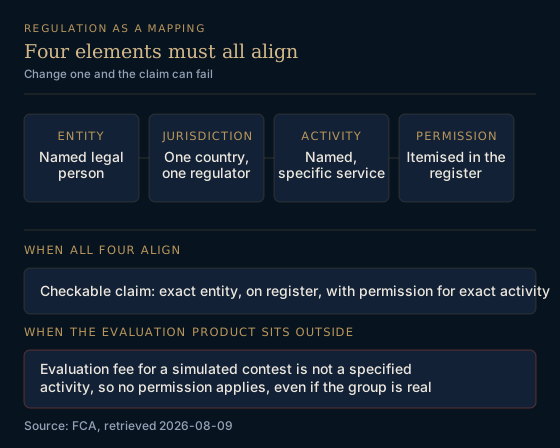
"Regulated" is not a badge a company earns once and wears everywhere. It is a mapping: one legal entity, authorised in one jurisdiction, for one or more named activities, under one regulator's permissions register. Change any one of those four elements and the mapping can fail even if the marketing copy stays identical.
A prop firm's holding company can be registered in one country. Its broker affiliate can be authorised in another. Its evaluation product, the thing you actually pay for, can sit outside all of it, because an evaluation fee for a simulated trading contest is not automatically a "specified investment" or "specified activity" under any regulator's rulebook. The FCA (UK financial regulator) states plainly that authorised firms can offer both regulated and unregulated products and services side by side (FCA, retrieved 2026-08-09). So a firm can be entirely real, entirely authorised for something, and still be selling you something that authorisation does not cover.
That is why "are prop firms regulated" cannot have one global answer. The honest version is conditional: regulated, for what, by whom, covering which product, in which country. Everything else is a label doing the work a contract should do.
That conditional answer is narrower than whether prop firms are legit as a category. Regulation can prove a permission; it cannot prove solvency or payment. The failure case is separate too: if a prop firm shuts down, account access and unpaid profit follow different paths.
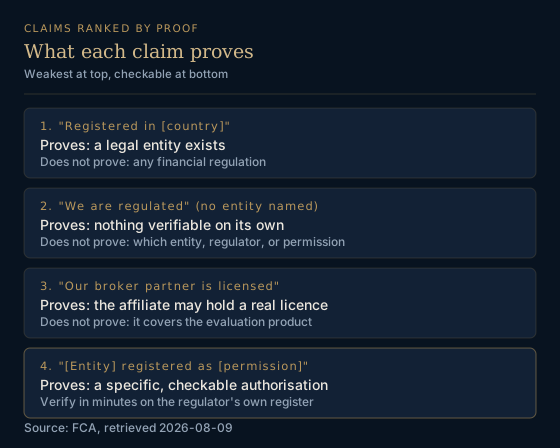
Table 1: Four Claims That Sound Alike but Prove Different Things
| Claim you see on a website | What it actually proves | What it does NOT prove |
|---|---|---|
| "Our company is registered in [country]" | The legal entity exists on a corporate registry | Nothing about financial regulation, permissions, or consumer protection |
| "We are regulated" (no entity, no permission named) | Nothing verifiable on its own | Which entity, which regulator, which permission, for which product |
| "Our broker partner is licensed by [regulator]" | The broker affiliate may hold a real licence for its own activity | That the licence extends to the evaluation product, or that the two entities are the same legal person |
| "[Entity] is registered with [regulator] as [specific permission]" | A specific, checkable authorisation for a specific activity, if the entity name matches exactly | That every product sold under the same brand shares that authorisation |
Only the fourth row is a claim you can verify in five minutes on a regulator's own site, and it is the only row that names a permission narrow enough to mean something.
Check this yourself. Trust claims without a checkable page are marketing. Open Ordane Verify, read why Ordane publishes the model in public, then compare the live Rulebook to whatever PDF another firm emailed you.
What Does a Regulator Actually Authorise?
The Entity on the Register
A regulator like the FCA does not authorise a brand, a website, or a marketing name. It authorises a specific legal entity, and it publishes that entity's status on a public register. The FCA's own guidance to consumers is to check that a firm is authorised using its Financial Services Register or the FCA Firm Checker, and to check for the firm's name and registration number before doing anything else (FCA, retrieved 2026-08-09).
That single step, matching the exact legal name on the register to the exact legal name on your checkout page, kills a large share of false claims before you read a single further word. Prop firm groups routinely operate under a holding company, one or more trading-software or broker affiliates, and a separate entity that sells the evaluation product. Only one of those, at most, might appear on a regulator's register. If it is not the entity you are about to pay, its authorisation says nothing about your transaction.
The Activities in Its Permissions
Being on the register is step one. Step two is permissions, and this is the step most buyers skip. The FCA is explicit that authorisation means a firm meets its standards and holds permission to provide specified products and services, not blanket permission to do anything financial (FCA, retrieved 2026-08-09). Its own Firm Checker tool instructs users to confirm both that the firm is authorised and that it holds permission for the specific service on offer (FCA, retrieved 2026-08-09).
In practice, a firm can be authorised to provide investment advice and simultaneously have no permission at all related to selling access to a simulated trading account. Permissions are itemised, not general. A prop firm claim that names a regulator but not a permission is incomplete by the regulator's own standard for what a complete check looks like.
Can an Authorised Firm Sell an Unregulated Product?
Yes, and the FCA says so without hedging: firms it authorises can offer both regulated and unregulated products and services at the same time (FCA, retrieved 2026-08-09). That single sentence is the reason "the company is FCA-authorised" and "the product I am buying is FCA-regulated" are not the same claim, even when both are true of the same corporate group.
The FCA adds a second, equally direct warning: using a firm that is authorised and has the correct permissions reduces risk, but it does not remove risk, and the regulator's own checker "can't confirm whether Financial Services Compensation Scheme or Financial Ombudsman Service protection will definitely apply" to your situation (FCA, retrieved 2026-08-09). Compensation schemes and ombudsman routes are tied to specific regulated activities and specific circumstances, not to a firm's name appearing on a register at all.
So even a fully authorised, fully legitimate firm can sell you something that carries none of the protections you associate with the word "regulated." Finding the name is the first check. Finding the permission for the specific product is the second, and it is the one that actually answers the question.
A Worked Example: Topstep, Topstep LLC and Topstep Brokerage LLC
Topstep's (prop firm) own published risk disclosure is a useful case because it states its structure plainly rather than leaving it to inference. The disclosure identifies Topstep Brokerage LLC as an affiliate of Topstep LLC, and states that Topstep Brokerage LLC is registered with the CFTC as an introducing broker and is a member of the National Futures Association under NFA ID 0567079 (Topstep, retrieved 2026-08-10).
That is a real, checkable, specific claim: one named entity, one named regulator relationship, one named permission (introducing broker), one membership ID that can be looked up directly on the NFA's own records. It is exactly the fourth row of the table above.
What the same disclosure does not do is publish an ownership chart, a parent-subsidiary hierarchy, or a control structure beyond the word "affiliate." Topstep LLC and Topstep Brokerage LLC are stated to be affiliated; the document does not disclose which entity owns which, in what proportion, or under what governance (Topstep, retrieved 2026-08-10). That gap matters, because it means a reader cannot responsibly extend Topstep Brokerage LLC's introducing-broker registration onto Topstep LLC's own evaluation product without more information than either company has published.
And that evaluation product, the Trading Combine, is separately and explicitly described in the same disclosure as a simulated program, with a direct statement that simulated results do not represent actual trading (Topstep, retrieved 2026-08-09). Put the two disclosed facts side by side: one affiliate holds a specific CFTC/NFA registration for introducing-broker activity, and the flagship evaluation product is, by the firm's own words, simulated. The registration and the product are not described as the same thing, because the company's own paperwork does not describe them as the same thing.
This is not a criticism of Topstep's disclosure. It is the opposite: it is a rare example of a firm stating its structure in checkable terms instead of a vague "we are regulated" banner. The lesson for a buyer generalises past this one company. Read the disclosure, not the homepage badge. Find the exact entity name, the exact regulator, and the exact permission. Then check separately whether that permission has any documented relationship to the specific product on the checkout page in front of you.
Table 2: Regulator-First Verification by Jurisdiction
| Jurisdiction | Where to check the entity | What to look for | Product/permission match required |
|---|---|---|---|
| United Kingdom | FCA Financial Services Register / FCA Firm Checker | Exact legal name, firm reference number, status "authorised" | Confirm the specific permission covers the specific service you are buying, not just that the firm appears (FCA, retrieved 2026-08-09) |
| United States (derivatives/futures) | NFA BASIC system and CFTC registration records | Exact legal name, NFA ID, registration category (e.g. introducing broker) | Confirm the registered entity is the one on your checkout receipt, and what activity the registration category actually covers, e.g. Topstep Brokerage LLC's introducing-broker registration under NFA ID 0567079 (Topstep, retrieved 2026-08-10) |
| Any jurisdiction, any firm's contract | The firm's own risk disclosure or terms document | Whether the disclosure names the evaluation product as simulated, and whether any regulatory statement is scoped to a named affiliate rather than the whole brand | Do not assume a disclosed affiliate registration extends automatically to the parent brand or the specific product |
How to Check a Prop Firm's Regulatory Claim in Seven Steps
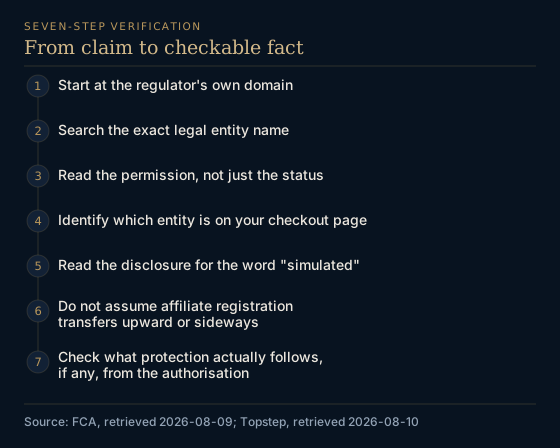
- Start at the regulator's own domain, not a review site, not the prop firm's own "as seen on" page. For UK claims, that means fca.org.uk directly. For US derivatives claims, that means the NFA's own BASIC lookup or the CFTC's own site.
- Search the exact legal entity name, character for character, as it appears in the firm's own terms or footer, not the marketing brand name. A brand and its legal entity are frequently not spelled the same way.
- Read the permission, not just the status. "Authorised" or "registered" tells you the entity passed some bar. The permission tells you for what. The FCA's own instruction is to check both the authorisation and the specific permission for the service you want (FCA, retrieved 2026-08-09).
- Identify which entity is on your checkout page. If the entity that is registered or authorised is not the entity you are about to pay, treat the authorisation as unrelated until you can prove otherwise from the firm's own documents.
- Read the firm's own risk disclosure for the word "simulated." If the evaluation account is described as simulated, as Topstep's disclosure describes its Trading Combine (Topstep, retrieved 2026-08-09), that description tells you what the regulator would likely see: a simulated performance product, not a brokered account with client funds, regardless of what any affiliate is registered to do.
- Do not assume affiliate registration transfers upward or sideways. An affiliate holding a specific registration, as Topstep Brokerage LLC does as an introducing broker (Topstep, retrieved 2026-08-10), is a fact about that affiliate. It is not, on its own, a fact about the parent company's evaluation product, because the disclosure itself does not draw that line (Topstep, retrieved 2026-08-10).
- Check what protection actually follows from the authorisation, if any. Even a matched entity and permission does not guarantee compensation-scheme or ombudsman coverage for your specific situation; the FCA says its own checker cannot confirm that (FCA, retrieved 2026-08-09). If a firm's marketing implies automatic consumer protection from regulation alone, that implication goes further than the regulator's own guidance does.
Entity-permission-product decision table
| Evidence found | What it proves | What remains unproved | Decision |
|---|---|---|---|
| Exact checkout entity appears on the regulator register | The contracting entity holds a recorded status | Whether its permission covers the paid service | Open the permission record |
| Permission names the paid service or activity | The entity is authorised for that activity | Whether protection schemes cover this transaction | Read the regulator's protection scope |
| Only an affiliate or broker appears | The affiliate holds its own status | Any transfer of that status to the seller or evaluation product | Treat the product as unmatched |
| No exact entity match | Nothing verifiable about the seller's regulatory claim | Entity, permission and product coverage | Stop before paying |
This table is the reusable result of the seven steps: entity first, permission second, product third. A mismatch at any layer is a finding, not an invitation to infer the missing link.
Worked evidence-completeness scenario
Declared inputs for this reproducible check assign 25 evidence points to each of four layers when a document proves it, and 0 when it does not. Suppose the exact checkout entity matches a register entry (25), the permission record is present (25), the record does not name the evaluation product (0), and no source confirms protection-scheme coverage for that transaction (0).
| Layer | Declared input | Evidence score |
|---|---|---|
| Entity match | Exact legal name matches | 25 |
| Permission | Named permission appears | 25 |
| Product scope | Evaluation product not named | 0 |
| Protection scope | Transaction coverage not confirmed | 0 |
Arithmetically, 25 + 25 + 0 + 0 = 50 evidence points out of 100. That is a real registration match but an incomplete product claim: the correct output is "entity and permission verified; product and protection unproved," not "the prop firm is regulated."
What Ordane Publishes, and What This Article Will Not Claim
This article makes no regulatory-authorisation claim about Instant Supreme, because none exists to make. What Ordane publishes instead is the Ordane Rulebook v1.5, numbered, versioned, and dated. The Ordane Guarantee includes clause G-0: every withdrawal request is approved, or denied in writing citing the exact rule breached by section number, within 12 clock hours; past that deadline the request is treated as approved and the G-1 clock starts. Clause G-1: a payout approved and not paid within 24 clock hours, not business hours, triggers automatic compensation: a 100 percent refund of the account fee, plus the payout owed in full. Clause G-2 sets two objective exclusions, documented fraud or KYC review and declared force majeure, each with a maximum of 10 business days; beyond those deadlines G-1 applies regardless (Ordane Rulebook v1.5, clauses G-0, G-1 and G-2, checked 2026-10-10).
None of that is a substitute for regulatory authorisation, and none of it is presented as one here. It is a different kind of proof: a public, verifiable contract governing a simulated-capital product, sitting next to a public payout reserve at a disclosed address, rather than a regulatory badge attached to a product that a regulator has never reviewed. The distinction this article has argued for throughout, check the entity, check the permission, check whether it covers the exact product, applies to Ordane the same way it applies to any other firm in this category: save the rules before paying, read the entity wording, and do not infer more than either one states.
An independent US regulator frames leveraged speculation the same way: like all futures products, speculating in these markets should be considered a high-risk transaction (CFTC, retrieved 2026-08-10).
Questions Traders Ask About Prop Firm Regulation
Does a Broker Licence Cover the Prop Firm?
Not automatically. A broker affiliate can hold a real, checkable licence or registration for its own defined activity, the way Topstep Brokerage LLC is registered with the CFTC as an introducing broker and is an NFA member (Topstep, retrieved 2026-08-10). That registration is a fact about the affiliate. Whether it extends to a related evaluation product sold by a different, affiliated entity is a separate question the disclosure itself does not answer, because it describes an affiliate relationship, not a shared registration (Topstep, retrieved 2026-08-10). Never assume the broker's licence and the evaluation product's legal status are the same fact.
Does Company Registration Mean Regulated?
No. A company registration number, filed with a corporate registry, confirms that a legal entity exists and can be sued, taxed, and identified. It says nothing about whether any regulator has reviewed its activities, authorised it for a specific financial service, or given it permission to sell the exact product you are buying. Regulation is a status granted by a financial regulator for named activities; incorporation is a separate, much lower bar that any business, in any industry, clears simply by filing paperwork.
Does Authorisation Guarantee Compensation?
No, and the regulator that grants the authorisation says so directly. The FCA states that using an authorised firm with the correct permissions reduces risk but does not remove it, and that its own Firm Checker "can't confirm whether Financial Services Compensation Scheme or Financial Ombudsman Service protection will definitely apply" in a given case (FCA, retrieved 2026-08-09). Compensation and dispute-resolution schemes attach to specific regulated activities under specific conditions. A firm being authorised for something is the starting point for asking whether a protection scheme applies to your situation, never the end of that question.
Is a Prop Firm's Evaluation Fee a Regulated Financial Product?
Usually not. An evaluation fee for a simulated trading contest is not automatically a specified investment or specified activity under a regulator's rulebook, which is why most challenge-style products sit outside any regulator's authorisation regime entirely, even when the same corporate group has an authorised affiliate for a different activity.
Where Do I Check a Firm's Regulatory Status Myself?
Go directly to the regulator's own site. For UK claims, use the FCA Financial Services Register or FCA Firm Checker (FCA, retrieved 2026-08-09). For US derivatives-related claims, use the NFA's BASIC lookup or CFTC registration records, searching the exact legal entity name printed in the firm's own terms, not the marketing brand.
Sources
- How to check a firm or individual is authorised | FCA fca.org.uk Retrieved 2026-08-09.
- FCA Firm Checker fca.org.uk Retrieved 2026-08-09.
- Risk Disclosure | Topstep topstep.com Retrieved 2026-08-10.
- Notice of product intervention decisions on CFDs and binary options | ESMA esma.europa.eu Retrieved 2026-08-10.
- Customer Advisory: Understand the Risks of Virtual Currency Trading | CFTC cftc.gov Retrieved 2026-08-10.
- Ordane Rulebook v1.5 ordanemarkets.com Retrieved 2026-10-10.