Home · The Ordane Journal · Rules and mechanics · Apex Trader Funding Rules: What the Docs Say
Apex Trader Funding Rules: What the Docs Say
Apex Trader Funding (prop firm) publishes its thresholds, its consistency percentage and its payout conditions. It never runs them against an account. This article does. A prop firm rulebook is the document that defines the loss thresholds, consistency limits and payout conditions a trader must satisfy to keep an account and withdraw from it.
Ordane accounts operate on simulated capital. No live funds are traded and no deposits are accepted. (Ordane Rulebook v1.0, clause P-2, retrieved 2026-08-28) Ordane sells one product, the Ordane Instant Account: direct access, no evaluation phase and no challenge, on simulated capital. (Ordane Rulebook v1.0, section 1, retrieved 2026-08-28)
Ordane competes with Apex, so every Apex figure below is quoted from the firm's own help centre on apextraderfunding.com, read on August 28, 2026, with the retrieval date attached. Nothing here comes from review sites, affiliate pages or marketing copy. Where a number is derived rather than quoted, the assumptions behind it are printed next to it.
What Are Apex's Two Drawdown Models?
Apex does not run one drawdown rule. It runs two, and the one governing your account decides whether an ordinary pullback is a bad afternoon or a closed account. This is the general static-versus-trailing drawdown distinction applied to one firm's wording, so if the underlying mechanic is new to you, read the general explainer first.
The EOD Threshold: recalculated once at the close, enforced the next session
Apex describes its End-of-Day Evaluation as a 30-day assessment built on an end-of-day drawdown model. (Apex Trader Funding, retrieved 2026-08-28) The threshold is calculated once per day at market close from the account's end-of-day balance, and becomes enforceable during the next trading session. (Apex Trader Funding, retrieved 2026-08-28)
The consequence of touching it is not a warning. Apex states that if the balance touches or falls below the EOD Threshold at any moment during the session, open positions are automatically liquidated and the evaluation is immediately failed. (Apex Trader Funding, retrieved 2026-08-28) The threshold updates slowly, once a day, but it is enforced continuously. Liquidation and failure are the same endpoint most firms reach through different wording, and what happens to the account afterwards is worth knowing before it happens.
The Intraday Trailing Threshold: follows Peak Balance and never moves down
On the Intraday Trailing Drawdown Evaluation, Apex states the threshold moves in real time with the account's highest achieved balance, which it calls Peak Balance, and never moves downward. (Apex Trader Funding, retrieved 2026-08-28)
That single word, never, is the whole difference. An unrealised gain you gave back still raised the floor permanently. The EOD model only sees where you closed. The intraday model sees where you got to.
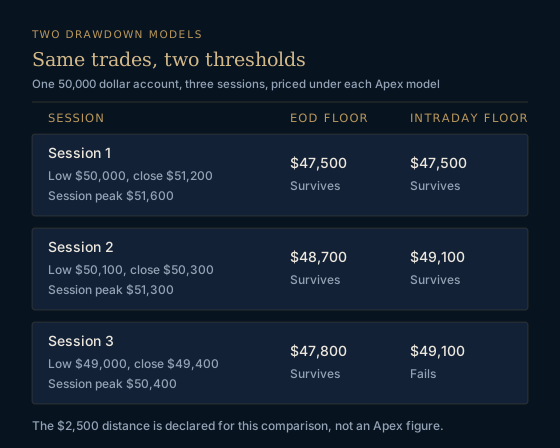
Worked table: the same trade sequence on a $50,000 account, priced under both models
Declared inputs for this check: a $50,000 starting balance, a declared threshold distance of $2,500 below the reference balance, and a first session gain of $1,200. Worked arithmetic: $50,000 + $1,200 = $51,200 end-of-day balance. The $2,500 distance is an illustrative figure declared here for the comparison, not an Apex published number: read your own account's stated drawdown limit and substitute it. The peak of $51,600 reached inside session one sets the intraday threshold at $51,600 minus $2,500, which is $49,100, and under Apex's own wording that floor never moves back down.
| Session | Lowest balance in session | Close | EOD Threshold enforced | Intraday threshold at that moment | EOD model | Intraday model |
|---|---|---|---|---|---|---|
| 1 (peak $51,600) | $50,000 | $51,200 | $47,500 | $47,500 | Survives | Survives |
| 2 (peak $51,300) | $50,100 | $50,300 | $48,700 | $49,100 | Survives | Survives |
| 3 (peak $50,400) | $49,000 | $49,400 | $47,800 | $49,100 | Survives | Fails |
Identical trades. Session three closes green at $49,400, still above the starting balance minus the declared distance. Under the EOD model the enforced floor that day is $47,800, derived from the previous close of $50,300, so the $49,000 dip is untouched territory. Under the intraday model the floor is $49,100, set two sessions earlier by a peak the trader never banked, and the $49,000 dip liquidates the account. The trader did nothing different. The product was different.
How Do the 50% Consistency Requirement and the Safety Net Work in Dollars?
Together they decide whether the balance on the screen can leave: the consistency requirement sets a minimum cycle profit measured against your single best day, and the Safety Net sets a permanent floor below which nothing is withdrawable. The drawdown rules decide whether the account survives. These two decide whether the money moves.
The formula in Apex's own words: highest profit day divided by 0.5
Apex publishes a 50% Consistency requirement stating that no single trading day may account for more than 50% of total accumulated profit at the time of a payout request. (Apex Trader Funding, retrieved 2026-08-28) It also publishes the calculation: highest profit day divided by 0.5 gives the minimum net profit required since the last payout request, or since account inception if no payout has been made. (Apex Trader Funding, retrieved 2026-08-28) If the general idea of a consistency rule is new, the mechanic is the same one most firms run under different percentages.
Worked backwards: what a payout request actually needs
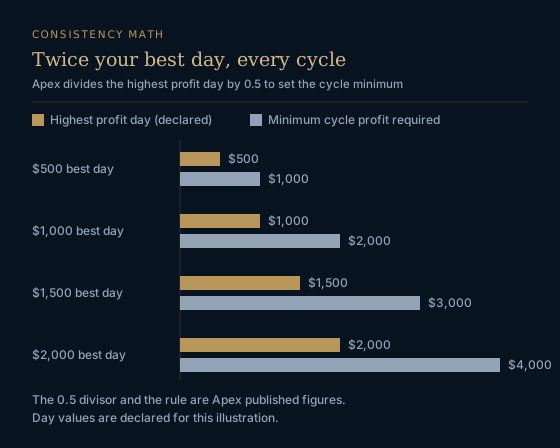
Apex states the formula but never solves it in the direction a trader cares about. Declared inputs for this check: a highest profit day of $1,000, Apex's published divisor of 0.5, and Apex's stated minimum of $250 profit on each qualifying day. Worked arithmetic: $1,000 + $1,000 = $2,000 minimum net profit required in the cycle. Dividing by 0.5 is doubling, so the rule reduces to one sentence Apex does not write: your cycle must earn at least twice your best day.
| Highest single profit day (declared) | Apex's published divisor | Minimum net cycle profit required (derived) | Best day as share of that total |
|---|---|---|---|
| $500 | 0.5 | $1,000 | 50% |
| $1,000 | 0.5 | $2,000 | 50% |
| $1,500 | 0.5 | $3,000 | 50% |
| $2,000 | 0.5 | $4,000 | 50% |
The day values are declared for the illustration; the divisor and the rule are Apex's. Read the third column as the trap: one exceptional session does not accelerate a payout, it raises the bar for every other session in the cycle.
The Safety Net: drawdown limit plus $100, held for the life of the account
Apex defines the Safety Net as the account's drawdown limit plus $100, says it must be maintained for the lifetime of the Performance Account, and says only profit above it is eligible to be requested as a payout. (Apex Trader Funding, retrieved 2026-08-28)
Two things follow. First, the balance you can withdraw is never the balance you see: subtract the drawdown limit, subtract another $100, and what remains is the eligible amount. Second, this is a permanent floor rather than a one-time qualification. This article does not print a dollar Safety Net per account size, because the per-size drawdown limits were not captured in the verified source pass on August 28, 2026, and an unverified number is worse than none. The arithmetic is one line: take the drawdown limit printed on your own account and add $100.
What Happens After You Pass an Apex Evaluation?
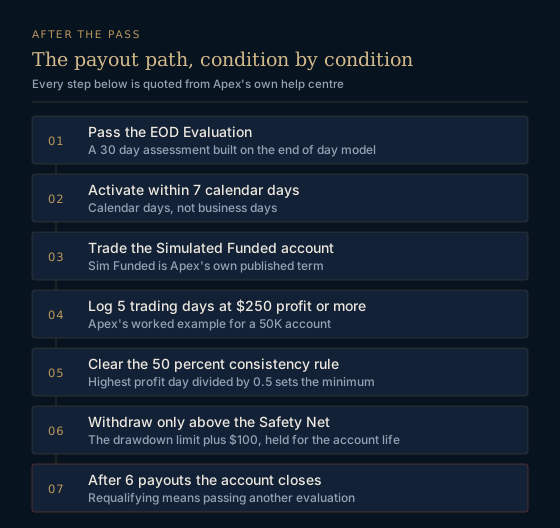
You get 7 calendar days to activate an account Apex itself calls Simulated Funded, then a payout path with a minimum number of qualifying days, a concentration limit, a withdrawable balance measured above the Safety Net, and a hard stop at six payouts. Each of those five conditions is quoted below. If you are working out what your own firm asks for before releasing money, the general first-payout checklist is the next thing to read.
7 calendar days to activate the EOD Performance Account
Apex states that after passing an EOD Evaluation the trader has 7 calendar days to activate the corresponding EOD Performance Account. (Apex Trader Funding, retrieved 2026-08-28) Calendar days, not business days, so a pass on a Friday spends a weekend of the window doing nothing.
Apex's own term for the account is Sim Funded
Apex's documentation describes the account awarded after passing as a Simulated Funded, or Sim Funded, account. (Apex Trader Funding, retrieved 2026-08-28) That is the firm's own term, published in its own help centre, and it is the honest one. If the distinction between a simulated account and a broker account matters to you, that question is worth reading on its own.
Minimum 5 trading days at $250 or more in profit before a payout request
Apex's payout documentation gives a worked example stating that a 50K Performance Account needs a minimum of 5 trading days with at least $250 profit on each of those days. (Apex Trader Funding, retrieved 2026-08-28) Combined with the consistency formula, the qualification is a shape, not just a total.
Six payouts, then the account closes and you requalify
Apex states that after 6 payouts the Performance Account is closed, and a new one requires qualifying through another evaluation. (Apex Trader Funding, retrieved 2026-08-28) This is the term most readers do not know they bought. Requalification is a cost the evaluation model carries and the instant-account model prices differently.
| Payout precondition | What Apex's documentation states |
|---|---|
| Activation window | 7 calendar days after passing to activate the Performance Account |
| Qualifying days | Minimum 5 trading days, each with at least $250 profit, on a 50K account |
| Withdrawable balance | Only profit above the Safety Net, defined as drawdown limit plus $100 |
| Concentration limit | No single day above 50% of total accumulated profit at request time |
| Account lifespan | Closed after 6 payouts, then requalification through another evaluation |
Prohibited Activity: Hedging the Same or Correlated Instrument
One failure mode has nothing to do with drawdown. Apex's prohibited activities page states that holding both long and short positions simultaneously on the same or correlated instrument is strictly prohibited. (Apex Trader Funding, retrieved 2026-08-28)
The word carrying the weight is correlated, because it extends the rule past the obvious case of one instrument held both ways. Apex's page does not enumerate which pairs it treats as correlated, so the boundary is not readable from the text quoted here. A boundary a trader cannot read in advance is its own category of risk. Ask the firm in writing before running any paired position.
What Apex Discloses About Simulated Results
Apex's own documentation calls the post-evaluation account Simulated Funded. That disclosure is not decoration.
This section makes no claim about Apex's registration status, because that is a register lookup rather than a documentation read. The National Futures Association states that the Commodity Exchange Act requires certain firms and individuals conducting business in the derivatives industry to register with the CFTC. (National Futures Association, retrieved 2026-08-28) Whether any specific firm falls inside that requirement, and whether it is actually registered, is checked in the public register in about two minutes. Our guide on checking that register walks the lookup, and running it yourself beats trusting anyone's summary, including this one.
For contrast, and stated as a rule rather than a promise: The Ordane rulebook is public, numbered and versioned, and no rule is ever applied retroactively to an open account. (Ordane Rulebook v1.0, notice above section 0 and section 6 Changelog, retrieved 2026-08-28)
FAQ: Apex Trader Funding Rules
What is the difference between Apex's EOD and Intraday thresholds?
The EOD Threshold is recalculated once per day at market close from the end-of-day balance and enforced through the next session. (Apex Trader Funding, retrieved 2026-08-28) The Intraday Trailing Threshold moves in real time with the account's Peak Balance and never moves downward. (Apex Trader Funding, retrieved 2026-08-28) In the worked table above, the same session three dip to $49,000 survives under one model and closes the account under the other.
What happens if you touch the EOD Threshold during a session?
Apex states that if the balance touches or falls below the EOD Threshold at any moment during the session, all open positions are automatically liquidated and the evaluation is immediately failed. (Apex Trader Funding, retrieved 2026-08-28) There is no intraday grace and no recovery inside the same session.
How many days do you have to activate a Performance Account after passing?
Seven calendar days from the pass. (Apex Trader Funding, retrieved 2026-08-28) Calendar days, not business days.
How does Apex's 50% consistency rule decide a payout?
Apex divides your highest profit day by 0.5 to get the minimum net profit required since your last payout request, or since account inception if there has been none. (Apex Trader Funding, retrieved 2026-08-28) A $1,000 best day therefore requires $2,000 of cycle profit before the request qualifies, and only profit above the Safety Net, defined as the drawdown limit plus $100, is eligible in the first place. (Apex Trader Funding, retrieved 2026-08-28)
How many payouts can you take before you have to requalify?
Six. Apex states that after 6 payouts the Performance Account is closed and another evaluation is required to obtain a new one. (Apex Trader Funding, retrieved 2026-08-28)
Running the Same Read on Ordane
The point of reading a rulebook line by line is knowing which clause closes an account, and which one delays the money, before you pay for either. Ordane's governing document is written to be read that way: the public, numbered and versioned Ordane Rulebook v1.0, with the six rules, the payout clauses and the guarantee clauses in one place. The five account sizes and their one-time fees are listed on the accounts page, and the reasoning behind the closed rule list is on why Ordane exists.
Sources
- EOD Evaluations - Apex Trader Funding apextraderfunding.com Retrieved 2026-08-28.
- Intraday Trailing Drawdown Evaluations - Apex Trader Funding apextraderfunding.com Retrieved 2026-08-28.
- EOD Performance Accounts (PA) - Apex Trader Funding apextraderfunding.com Retrieved 2026-08-28.
- EOD Payouts - Apex Trader Funding apextraderfunding.com Retrieved 2026-08-28.
- 50% Consistency Requirement - Apex Trader Funding apextraderfunding.com Retrieved 2026-08-28.
- Prohibited Activities - Apex Trader Funding apextraderfunding.com Retrieved 2026-08-28.
- Who Has to Register | NFA nfa.futures.org Retrieved 2026-08-28.