Home · The Ordane Journal · Before you pay · How to Verify a Prop Firm Company
How to Verify a Prop Firm Company
Ordane accounts operate on simulated capital. No live funds are traded and no deposits are accepted.
That sentence is the reason this article exists in the form it does: before you send money to any prop firm, you should be able to say who the legal entity behind the website is, where it is registered, and whether the regulatory claim on its homepage is something you can look up in a public database. This is one check among several worth running; see how to audit a prop firm before you pay for the full sequence.
Company verification is a quick task with a low ceiling. It tells you whether an entity exists on a government register. It does not tell you whether that entity will pay you. Most people conflate the two, and a registration that was in good standing on the day a firm took your fee is no obstacle to that firm going quiet later. Read are prop firms legit for the category-level evidence and what happens to the account and unpaid profit if a firm shuts down for the failure case.
This is the register-first identity check, plus the limit you should say out loud after you finish it.
What Does Company Verification Prove?
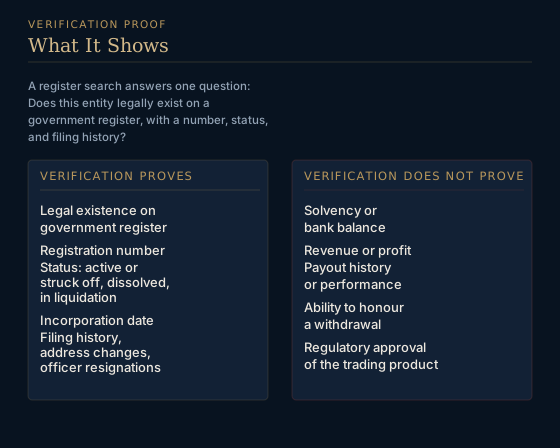
Company verification proves only that a named legal entity exists on a government register with a registration number, jurisdiction and status; it does not prove solvency, revenue or the ability to pay a withdrawal, the question that actually decides whether prop firms pay out when you request one.
A liftable definition
Company verification is the act of matching the name printed on the website, the checkout page and the contract against an official government company register, and recording the entity's registration number, jurisdiction, status and filing history with the URL and the date you looked.
That is the whole definition. Notice what it does not include: revenue, solvency, payout history, client funds, or any promise about the future.
Existence is not solvency or payout proof
The practical consequence: "we are a registered company" is not a rebuttal to "will you pay me?" They are separate questions with separate evidence. A registry search answers the first. Only a dated payout ledger, a published penalty clause, or third-party attestation touches the second, and a firm's withdrawal requirements tell you how far you have to get before that clause is even tested.
Treat company verification as a floor test. Failing it is disqualifying. Passing it proves almost nothing.
Which Legal Name Should You Search?
Search the name printed in the contract and on the invoice, not the brand name shown in marketing.
Website, invoice and contract must align
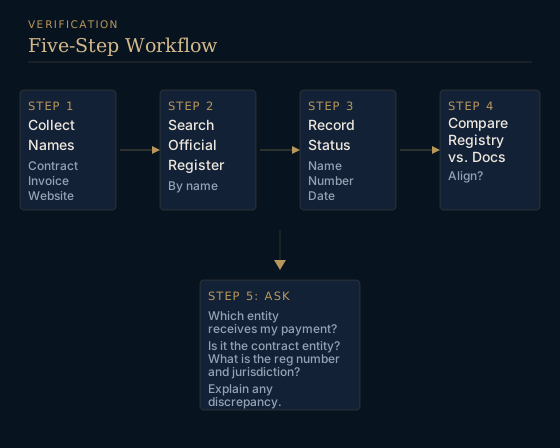
Before you open a register, collect the legal name from every place it should appear:
- The website footer, usually next to a company number or "operated by" line
- The Terms of Service or Terms and Conditions, in the parties clause
- The checkout page or invoice, which names the entity actually receiving the payment
- The purchase receipt or card statement descriptor after payment, if you already paid
The search key is the name in the contract and on the invoice, because those are the documents that would matter in a dispute. The footer is a starting hint, not the authority.
If a firm publishes no legal name at all, in any of those places, the verification is over before it starts. There is nothing to search, and you cannot construct a search key from a logo.
Record aliases without assuming identity
Keep a plain list:
| Where you found it | Exact name as printed | Company number, if shown | Date checked |
|---|---|---|---|
| Website footer | |||
| Terms of Service, parties clause | |||
| Checkout or invoice | |||
| Payment descriptor |
The point of the table is that mismatches become visible instead of getting smoothed over in your head. You are not building a case yet. You are collecting the search keys.
How Do You Search an Official Company Register?
Find the register for the jurisdiction named in the contract and record the exact registered name, number, jurisdiction, status and incorporation date with the source URL and the date checked.
Jurisdiction, number, status and filings
Once you find a record, capture five fields:
- Exact registered name. Character for character, including the suffix.
- Registration number. The stable identifier. Names change; numbers usually do not.
- Jurisdiction. Which register, which country or state.
- Status. Active, in good standing, struck off, dissolved, in liquidation, or the local equivalent.
- Incorporation date. How old the entity actually is, as opposed to how old the brand claims to be.
Read the status field literally. Companies House currently retains records of dissolved companies for 20 years (GOV.UK, Companies House is reviewing the retention period for dissolved company records, retrieved 2026-08-04). Finding a page is not the same as finding a live company.
Save the source URL and retrieval date
Registry data is volatile. Status changes, addresses change, officers resign. A screenshot from three months ago is a historical claim about the past, not a statement about today.
So record, in this form:
Set yourself a re-check interval. Before a large purchase, before a first withdrawal, and any time the firm announces a corporate change, look again.
Is a Regulatory Claim the Same as a Safety Guarantee?
No. A regulatory claim only proves that a named entity appears in a specific database; it says nothing about whether payouts are protected.
This is where most verification goes wrong. A firm makes a regulatory-sounding statement, the reader reads it as a safety guarantee, and nobody checks either half of it: whether the registration exists, and whether it covers the activity in question.
Do both halves separately.
Table 1: claim, database and interpretation
| Claimed status | Where it is checked | What a hit proves | What a hit does not prove |
|---|---|---|---|
| Registered with the CFTC or NFA | The CFTC directs the public to NFA BASIC to check registration and background information before trading (CFTC Check Registration, retrieved 2026-08-04) | The named entity appears in the registration and background database as described | That every product or service the firm sells falls inside that registration, or that payouts are protected |
| Incorporated in a named jurisdiction | The official company register for that jurisdiction (GOV.UK, Get information about a company, retrieved 2026-08-04) | The entity legally exists there, with a number, status and filing history | Solvency, payout capacity, or any regulatory supervision of the trading product |
| "Regulated" with no regulator named | Nowhere | Nothing | Nothing. An unnamed regulator is an unverifiable claim, not a weak one |
| Registration held by an affiliate, not the contracting entity | The relevant register or database, searched under the entity in your contract | That the affiliate is registered | That the entity taking your money is covered by it |
The last row is the one that catches people. The name in the marketing is not always the name in the parties clause, and the registration belongs to whichever entity actually holds it.
NFA BASIC and the CFTC scope caveat
The CFTC tells traders to check registration and backgrounds before trading (CFTC Check Registration, retrieved 2026-08-04). It points to NFA BASIC as the place to do it (CFTC Check Registration, retrieved 2026-08-04).
The realistic ceiling here: you can confirm or fail to confirm a stated registration, and you can identify a claim that names no regulator. You cannot, from a database, adjudicate whether a firm should be registered.
Which Mismatches Require an Explanation?
A mismatch between the register and the firm's own documents is not proof of fraud, but it is a question you are entitled to have answered before you pay.
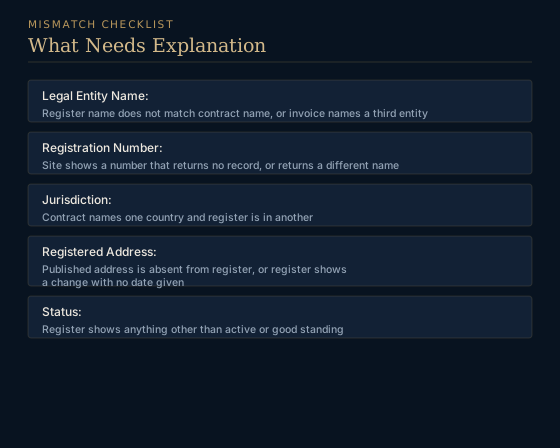
Verification produces one of three outcomes: everything aligns, something is missing, or two documents disagree. The third is the interesting one. Disagreement is not proof of fraud, and it is not nothing. It is a question you are entitled to have answered before you pay.
Table 2: website, contract, invoice and registry
Fill this in for the specific firm, then read the rightmost column.
| Field | Needs explanation if |
|---|---|
| Legal entity name | The register name does not match the contract name, or the invoice names a third entity |
| Company or registration number | The site shows a number that returns no record, or returns a different name |
| Jurisdiction | The contract names one country and the register is in another |
| Registered address | The published address is absent from the register, or the register shows a change with no date given |
| Status | The register shows anything other than active or good standing |
| Claimed regulator and licence | The regulator is unnamed, or the licence returns no result under the contracting entity |
| Officers or directors | The site names people who do not appear anywhere in the record, or the record names people the site never mentions |
| Payment recipient | The entity receiving the money is not the entity bound by the contract |
Any row you cannot complete is itself a data point. Write "not published" rather than leaving it blank, so you can see how much of the picture the firm has chosen to withhold.
Address and officer changes need dates
Companies genuinely relocate and directors genuinely resign. Neither is suspicious on its own. What matters is whether the change is dated and disclosed, or discovered by you afterwards.
A registered office that has moved three times in eighteen months, with each move landing at a different mass-service address, is a pattern worth asking about. A single move with a filing date, matching the site, is administrative housekeeping.
Concrete questions get answers or reveal an unwillingness to give them. "Are you a scam?" gets a denial from everyone, honest and otherwise.
What Can Be Said About Ordane Today?
Applying this article's own standard to Ordane means saying only what is confirmed, and naming what is not.
Ordane sells one product, the Ordane Instant Account: direct access, no evaluation phase and no challenge, on simulated capital. Ordane is operated by Ordane Markets Ltd (in formation). Ordane publishes at ordanemarkets.com.
What Else Should You Ask Before Paying?
The most common questions about company verification are answered below.
What does company verification prove? It proves that a named legal entity exists on a government register with a given registration number, jurisdiction and status. It does not prove solvency or the ability to pay a withdrawal.
Which legal name should you search? Search the name printed in the contract and on the invoice, the documents that would matter in a dispute, not the brand name shown in marketing.
How do you search an official company register? Find the register for the jurisdiction named in the contract, for example the Companies House service Find and update company information for United Kingdom entities (GOV.UK, retrieved 2026-08-04), and record the exact name, registration number, status and incorporation date with the URL and date checked.
Is a regulatory claim the same as a payout guarantee? No. The CFTC directs the public to NFA BASIC to check registration and background information before trading (CFTC Check Registration, retrieved 2026-08-04), but a database hit only confirms registration exists, not that payouts are protected.
What can be confirmed about Ordane's legal entity today? Ordane is operated by Ordane Markets Ltd (in formation) and publishes at ordanemarkets.com. The legal name, the incorporation status, the intended jurisdiction (Republic of Cyprus) and a commercial address are published. A full register-first check cannot be completed with what is public today, because the registration number and the registered office publish on incorporation, which has not happened yet.
This article is for information only and is not investment, financial, or tax advice.
Ordane accounts operate on simulated capital. No live funds are traded and no deposits are accepted. Payouts depend on simulated performance under Rulebook v1.0; no level of performance is typical or assured.