Home · The Ordane Journal · Before you pay · Prop Firms With No Consistency Rule: What It Costs
Prop Firms With No Consistency Rule: What It Costs
Ordane accounts operate on simulated capital. No live funds are traded and no deposits are accepted. (Ordane Rulebook v1.0, section 1, retrieved 2026-08-09)
Ordane sells one product, the Ordane Instant Account: direct access, no evaluation phase and no challenge, on simulated capital. (Ordane Rulebook v1.0, section 1, retrieved 2026-08-09)
A prop firm consistency rule caps the share of total profit that any single trading day can represent, checked at the moment of a payout request rather than during trading.
When a firm advertises "no consistency rule," the next question is where the constraint went. This article reads FTMO, Topstep, and FundedNext on their own rule pages: one plan drops the cap, another resets it after payout, and another sells removal as a checkout add-on.
What traders mean by a consistency rule here
The definitional owner is what a consistency rule is. In one line for this page: a consistency rule caps how much of total profit one day may represent, and firms usually check it at payout, not while you trade.
This article does not restate that definition at length. It audits what firms publish when they advertise the absence of that rule, where the same control reappears as day counts, payout resets, or checkout add-ons, and what that costs on a published price page.
Table 1: What Each Firm's Own Page Says, and at What Number
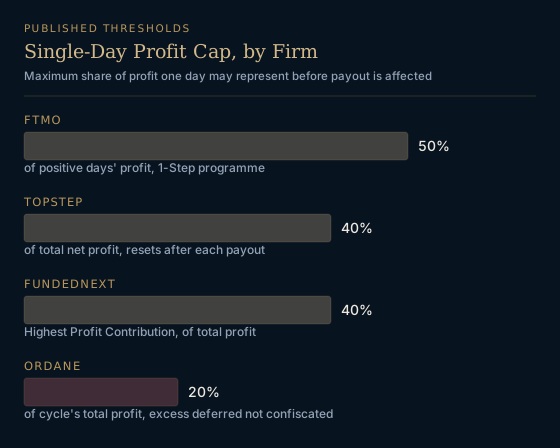
| Firm | Rule name on their page | Published threshold | Measured against | Consequence of breach |
|---|---|---|---|---|
| FTMO | Best Day rule | Best day does not exceed 50% of positive days' profit (FTMO, retrieved 2026-08-09) | Profit made on positive trading days, on the 1-Step programme and the FTMO Account (1-Step) (FTMO, retrieved 2026-08-09) | Not payout eligible until compliant |
| Topstep | Consistency percentage | 40% or below, not rounded (Topstep Help Center, retrieved 2026-08-09) | Total net profit in the current payout window (Topstep Help Center, retrieved 2026-08-09) | Withdrawal path blocked; resets to $0 after each payout (Topstep Help Center, retrieved 2026-08-09) |
| FundedNext | Highest Profit Contribution | 40% or below of total profit (FundedNext Help Center, retrieved 2026-08-09) | Highest single profit day divided by total profit, times 100 (FundedNext Help Center, retrieved 2026-08-09) | Withdrawal not eligible above 40% |
| Ordane | Clause R-4, 20 percent | No single day exceeds 20% of the cycle's total profit (Ordane Rulebook v1.0, clause R-4, retrieved 2026-08-09) | Cycle's total profit, checked at withdrawal request (Ordane Rulebook v1.0, clause R-4, retrieved 2026-08-09) | Excess deferred to next cycle, never confiscated (Ordane Rulebook v1.0, clause R-4, retrieved 2026-08-09) |
Every cell above traces to the firm's own documentation, retrieved on the date noted in each source. Nothing here comes from a comparison site's summary of a summary.
Does No Consistency Rule Mean No Rule at All?
Sometimes a firm advertises the absence of a consistency rule on one product line while running it on another, and the honest version of that firm's page will say so in plain language, not leave it to be inferred from silence.
One Firm, Two Plans, and the Sentence That Names Which One the Cap Binds
FTMO's Best Day rule is not universal across its own catalogue. The 50 percent cap on best-day profit applies to the FTMO Challenge: 1-Step and to the FTMO Account (1-Step) (FTMO, retrieved 2026-08-09). FTMO states this scope directly: "This rule applies to the FTMO Challenge: 1-Step as well as the FTMO Account (1-Step)" (FTMO, retrieved 2026-08-09). The 2-Step programme is listed separately, with four different objectives per phase covering profit target, maximum daily loss, maximum loss, and minimum trading days (FTMO, retrieved 2026-08-09). The Best Day rule is not one of those four. FTMO's own 2-Step listing is the mechanism behind a claim like "no consistency rule on the 2-Step": on that specific page, for that specific programme, the claim is accurate. The same page says nothing about the 1-Step programme two rows above it on the same site.
Why a scope sentence beats silence
A firm's silence about a rule on one page is not evidence the rule does not apply to you. Look for a positive scope sentence that names the programme. Absence alone is unconfirmed.
Where the Constraint Moves When the Rule Is Dropped
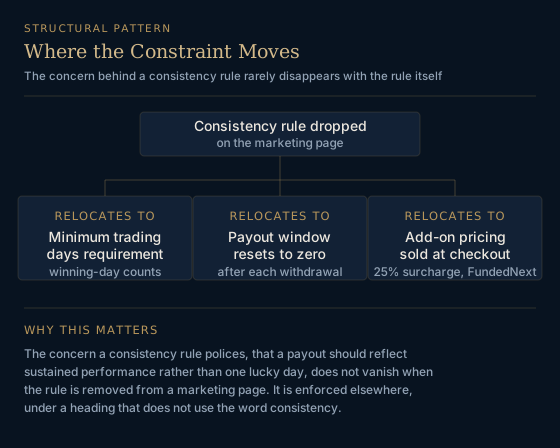
A firm rarely removes a consistency rule and simply lowers its own risk exposure to match. More often, the same concern (that a payout should reflect sustained performance rather than one lucky session) gets enforced through a different clause.
Minimum trading days and winning-day counts
Topstep's alternative to meeting the 40 percent consistency target is not "no requirement." It is a second path: five winning days of $150 or more in net profit and loss (Topstep Help Center, retrieved 2026-08-09). A firm that says "no consistency rule" while requiring a minimum number of winning days has relocated the constraint into a day-count requirement.
The payout window that resets when you request
Topstep's consistency calculation resets after a payout request and starts again from the next trading day, applying only to profit earned in the new window (Topstep Help Center, retrieved 2026-08-09). Satisfying the percentage once does not clear the account permanently. Requesting a payout also resets the runway to the next withdrawal.
Add-on pricing that reframes the rule as an upgrade
FundedNext prices the removal of trading-day requirements at checkout. Its No Minimum Trading Days add-on adds 25 percent to the account fee on Stellar 1-Step and Stellar 2-Step, and 20 percent on Stellar Lite (FundedNext Help Center, retrieved 2026-08-09). Compare the lighter set as base price versus base price plus add-on.
How Do You Check a Consistency Rule Before You Pay?
Four Checks, in the Order That Saves Money
First, search the firm's own site for "consistency," "best day," "highest profit contribution," and "profit contribution," not just "consistency rule," since the mechanism trades under several names. Second, once you find a rule, read the scope sentence: does it say which specific plan or programme it binds, the way FTMO names the 1-Step and FTMO Account (1-Step) explicitly (FTMO, retrieved 2026-08-09)? If there is no scope sentence, do not assume the absence applies to your plan; go check the other plan pages directly. Third, check whether the rule resets on any event, particularly a payout request, the way Topstep's consistency calculation zeroes out after every withdrawal (Topstep Help Center, retrieved 2026-08-09). A rule you satisfied once is not necessarily satisfied permanently. Fourth, if the firm sells a version of the account with the rule removed or loosened, price that version against the headline number rather than against itself, the way FundedNext's two add-ons each carry a fixed percentage surcharge over the base fee (FundedNext Help Center, retrieved 2026-08-09).
The screenshot to keep
Save a full-page PDF of the specific rule page on the day you pay, dated with the purchase day. That is the artifact if wording changes later.
What Ordane's Rulebook Says, Including Where It Is Stricter
A 20 percent rule, with excess deferred rather than confiscated
Ordane does not advertise the absence of a consistency rule. Clause R-4 sets the threshold at 20 percent: at withdrawal request, no single trading day may account for more than 20 percent of the cycle's total profit (Ordane Rulebook v1.0, clause R-4, retrieved 2026-08-09). That is tighter than FTMO's 50 percent Best Day cap (FTMO, retrieved 2026-08-09) and tighter than the 40 percent threshold published by Topstep (Topstep Help Center, retrieved 2026-08-09) and FundedNext (FundedNext Help Center, retrieved 2026-08-09).
If a day exceeds 20 percent, the excess from that day is deferred to the next cycle. It is never confiscated, and the remainder of the cycle pays out normally (Ordane Rulebook v1.0, clause R-4, retrieved 2026-08-09). FTMO withholds eligibility (FTMO, retrieved 2026-08-09), Topstep blocks the withdrawal path until compliant (Topstep Help Center, retrieved 2026-08-09), and FundedNext withholds eligibility above 40 percent (FundedNext Help Center, retrieved 2026-08-09).
A closed prohibited list
Clause R-6 names six prohibited practices; unlisted behavior is not a violation, and discretion is not a rule (Ordane Rulebook v1.0, clause R-6, retrieved 2026-08-09). Instant Account fees are one-time with no recurring fees, hidden tiers, or coupon games (Ordane Rulebook v1.0, section 1, retrieved 2026-08-09).
Table 2: The Same Account Priced With and Without the Rule
FundedNext publishes two add-ons as fixed percentages of the account's base fee: removing the minimum trading days requirement, and loosening the maximum loss limit to 10 percent.
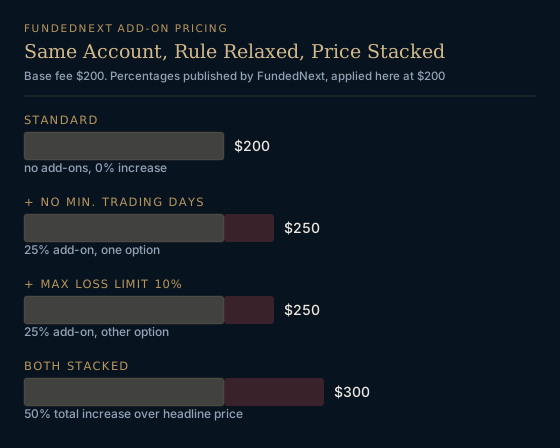
Declared inputs: base account fee of $300; No Minimum Trading Days add-on at 25 percent of base fee on Stellar 1-Step and Stellar 2-Step (FundedNext Help Center, retrieved 2026-08-09); Maximum Loss Limit 10 percent add-on at 25 percent of base fee (FundedNext Help Center, retrieved 2026-08-09).
$300 base + ($75 No Minimum Trading Days) + ($75 Maximum Loss Limit 10 percent) = $450 total, a 50 percent increase over the headline price when both constraints are relaxed.
| Configuration | Base fee | Add-on cost | Total paid | Increase over headline |
|---|---|---|---|---|
| Standard Stellar 1-Step/2-Step account | $300 | $0 | $300 | 0% |
| Add No Minimum Trading Days | $300 | $75 (25%) | $375 | 25% |
| Add Maximum Loss Limit 10 percent | $300 | $75 (25%) | $375 | 25% |
| Both add-ons stacked | $300 | $150 | $450 | 50% |
The percentages are published on FundedNext's own help page and scale linearly with whatever base fee you compare. A rule-relaxed configuration on this firm is not the headline price; it is the headline price plus a fixed surcharge you look up separately from the ad.
Declared inputs for Ordane's own R-4 arithmetic only: day profit 4000; window profit 10000; consistency cap 0.20.
| Input | Value | Arithmetic |
|---|---|---|
| Best day | 4000 | Declared |
| Window total | 10000 | Declared |
| Cap 20 percent | 2000 | 10000 x 0.20 = 2000 |
| Over-cap amount | 2000 | 4000 - 2000 = 2000 |
Assumptions: illustrative day and window totals for arithmetic only, not a forecast. Arithmetic: 10000 x 0.20 = 2000; 4000 - 2000 = 2000 of the best day sits above a 20 percent consistency cap.
Frequently Asked Questions
Can a firm add a consistency rule after I've already paid?
Only if its contract allows a unilateral rule change. Read the change-control clause for the exact product name before you pay. Today's marketing page is not a guarantee against a later policy update.
Does one big trading day forfeit all the profit from that day?
It depends on the firm's published consequence. Ordane defers the overage above R-4's 20 percent line to the next cycle rather than confiscating it (Ordane Rulebook v1.0, clause R-4, retrieved 2026-08-09). FTMO, Topstep and FundedNext publish eligibility holds rather than Ordane-style deferral on the pages cited in Table 1.
If I pay to remove a consistency rule, does that change my loss limits too?
Not automatically. FundedNext sells No Minimum Trading Days and Maximum Loss Limit 10 percent as separate add-ons, each at 25 percent of base fee on Stellar 1-Step and 2-Step (FundedNext Help Center, retrieved 2026-08-09). Paying for one line item does not rewrite the other.
Is a lower published consistency percentage always the stricter firm?
Not by itself. The percentage and what it is measured against are two different numbers. Ordane's 20 percent of cycle profit is a different bar from FTMO's 50 percent of positive-day profit, even though 20 is the smaller integer (Ordane Rulebook v1.0, clause R-4, retrieved 2026-08-09) (FTMO, retrieved 2026-08-09).
Where do I check whether a firm's stated rules apply to instant accounts specifically?
Open the rule page for the exact product name you are buying, not a general evaluation page. FTMO's Best Day rule names the 1-Step Challenge and FTMO Account (1-Step) explicitly (FTMO, retrieved 2026-08-09); silence on another plan is not evidence for that plan.
See also profit split, daily loss vs drawdown, breach outcomes, payout timing, instant vs evaluation.
An independent US regulator frames leveraged speculation as high risk (CFTC virtual currency risk advisory, retrieved 2026-08-16).
Sources
- Trading Objectives | FTMO.com ftmo.com Retrieved 2026-08-09.
- Consistency at Topstep | Topstep Help Center help.topstep.com Retrieved 2026-08-09.
- General FAQ | FundedNext Help Center help.fundednext.com Retrieved 2026-08-09.
- How does the Add-On feature work with the FundedNext new Challenge purchase? | FundedNext Help Center help.fundednext.com Retrieved 2026-08-09.
- Ordane Rulebook v1.0, clause R-4 ordanemarkets.com Retrieved 2026-08-09.