Home · The Ordane Journal · Before you pay · Can You Merge Prop Firm Accounts?
Can You Merge Prop Firm Accounts?
Ordane accounts operate on simulated capital. No live funds are traded and no deposits are accepted.
Ordane sells one product, the Ordane Instant Account: direct access, no evaluation phase and no challenge, on simulated capital.
Ordane sells one product, the Ordane Instant Account: direct access, no evaluation phase and no challenge, on simulated capital.
Merging two prop firm accounts sounds like addition: two balances become one, faster progress toward payout. It is not addition. It is a contract migration, and the firm's documentation, not intuition, decides which fields survive the conversion and which reset.
That distinction matters here because a merge, wherever it exists, changes the terms of a specific contract, not a pool of real money sitting in a wallet. Ordane sells one product, the Ordane Instant Account: direct access, no evaluation phase and no challenge, on simulated capital. Whether that product supports a merge at all is answered later in this article, plainly, with no guessing.
Can two prop firm accounts become one?
The short answer in 45 words
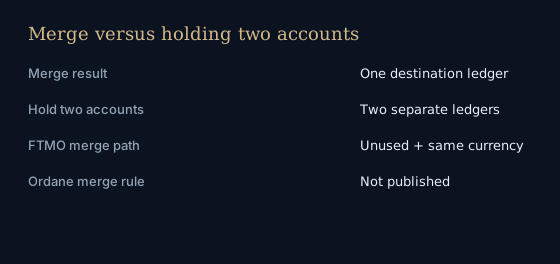
Some firms document a merge path with named preconditions: matching currency, matching product, no trade history on either account. FTMO is one of them. Other firms let a trader hold multiple accounts side by side without ever combining them, and the accounts stay legally and operationally separate the whole time.
No public keyword-volume data confirms how often this exact question is searched. That does not change the answer. It changes how you should read the rest of this article: as a way to test any firm's merge documentation against a fixed set of fields, not as evidence that merging is common, rare, or expected.
A merge is firm-specific and can be irreversible
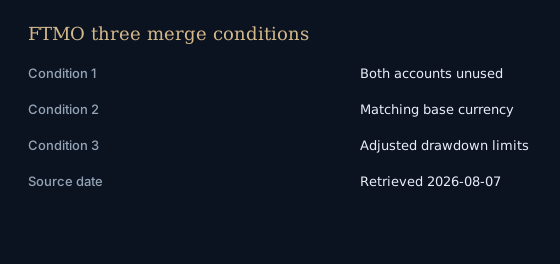
There is no universal merge mechanic in the prop firm industry. Each firm that offers a merge writes its own conditions, and those conditions are enforceable exactly as published, nothing more. FTMO states that a completed account merge is irreversible. Once two accounts become one under FTMO's process, there is no undo. That single fact should change how you approach any merge request: verify every field first, because there is no second attempt after the first one clears.
Is a merge the same as holding two accounts?
One resulting account versus two parallel ledgers
Holding two accounts means two separate ledgers exist under one login. Each keeps its own balance, its own limits and its own history. A merge means those two ledgers stop existing and one new ledger replaces them. This is the load-bearing distinction in the whole topic: a dashboard showing two account cards side by side is not evidence that a merge occurred, and it is not evidence that one is available.
The general question of how many accounts a firm allows you to hold at once is a separate question with its own answer, covered in how many prop firm accounts can you have. This article does not repeat that explanation. It picks up only where a merge, not mere multi-account eligibility, changes the structure of what you own.
Allocation, buying power and balance are different fields
"Allocation" is the account size assigned at setup. "Buying power" is what the platform lets you trade with, which can differ from allocation depending on leverage and product rules. "Balance" is what the account currently shows after trades. A merge that touches one of these does not automatically touch the others, and no source in this article documents a firm that treats the three as interchangeable during a merge. Treat each term as a separate line item when you read any firm's merge page, because a page that blurs the three is a page that has not told you what actually changes.
Table 1: what survives an account merge
The table below compares FTMO's documented merge path against Topstep's structure, where multiple accounts are held but no merge policy was found in the sources read on the retrieval date below. (Topstep Help Center, retrieved 2026-08-07).
| Field | FTMO (documented) | Topstep (as documented) |
|---|---|---|
| Merge path exists | Yes, three conditions apply: unused accounts, matching base currency, same product | Not documented in the source read on August 7, 2026 |
| Currency requirement | Same base currency required | Not documented in the source read on August 7, 2026 |
| Product requirement | Same product required | Not documented in the source read on August 7, 2026 |
| Unused-account condition | Accounts must be unused before merging | Not documented in the source read on August 7, 2026 |
| Resulting balance | Combined balance, with correspondingly adjusted drawdown limits | Each account's balance stays independent; Topstep permits mixed account sizes held simultaneously, with size and path locked per account |
| Payout cycle after merge | Not specified in the source read on August 7, 2026 | Each account follows its own payout policy independently, which is unaffected by any merge because none is documented |
| Reversibility | Irreversible once completed | Not applicable, since no merge is documented |
Absence of a merge policy in the Topstep sources read on August 7, 2026 is not evidence that Topstep prohibits merging. It means the two declared sources, Topstep's Express Account Parameters and Payout Policy pages, do not address the question one way or the other on the date checked.
How do you map account state before and after a merge?
The table below is a worked state map built only from the FTMO documentation already cited above. It shows what a merge changes and what it leaves alone, using the exact fields FTMO's own page defines.
| Field | Source account 1 | Source account 2 | Destination ledger (after merge) |
|---|---|---|---|
| Currency | Must match account 2 | Must match account 1 | Single currency, inherited from the matching pair |
| Product type | Must match account 2 | Must match account 1 | Single product, inherited from the matching pair |
| Trade history | Must be unused | Must be unused | No prior trade history carried in from either source |
| Balance | Balance A | Balance B | Combined balance of A and B |
| Drawdown limit | Set at account A's original size | Set at account B's original size | Adjusted to correspond to the combined balance |
| Reversibility | N/A before merge | N/A before merge | Irreversible once complete |
Declared inputs: this worked example assumes account A holds a balance and account B holds a balance, both denominated in the same currency and originating from the same product, since those are FTMO's stated preconditions. If A's balance is 150 and B's balance is 150, the resulting destination ledger balance is 150 + 150 = 300, combined as FTMO's documentation states. FTMO's source does not publish the exact formula used to recalculate the drawdown limit against that combined balance, only that the limit is adjusted correspondingly. This article does not compute a formula the source does not provide. If you are evaluating a real merge, ask the firm for the exact resulting drawdown number in writing before requesting it, because "adjusted correspondingly" is a direction, not a number.
Which six questions should you ask before requesting a merge?
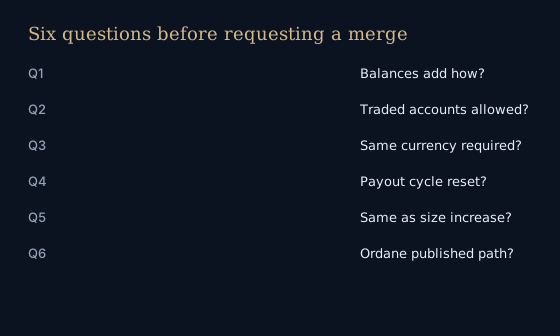
Before you request a merge with any firm, and before you pay for a second account with the intention of combining it later, get written answers to six questions. This checklist works regardless of which firm you use and regardless of how the merge mechanic is documented, because it names the fields that matter rather than assuming a specific formula.
- What is the exact resulting balance after the merge, stated as a number, not a description?
- What is the exact resulting drawdown or loss limit, stated as a number or a formula you can verify yourself?
- Does the merge reset the payout cycle date, or does the destination account inherit a cycle date from one of the source accounts?
- What account type and product does the destination ledger carry, and does that match what either source account was sold as?
- Do both source accounts need to be unused, and does either account's trade history disqualify the request?
- Is the merge reversible, and if not, what happens if the resulting account breaches a rule the source accounts would not have breached individually?
Send these six questions to support in writing before you request a merge or before you buy a second account expecting to combine it later. A firm that cannot answer all six in writing has not documented a merge mechanic you should rely on.
What does Ordane publish about merging accounts?
Ordane Instant Account comes in five sizes: $2,500, $10,000, $25,000, $50,000 and $100,000. Those five sizes are documented context for this article, not evidence of a merge policy either way.
The canonical store has no merge rule for Ordane accounts. There is no published clause stating that two Ordane Instant Accounts can be combined, and no published clause stating that they cannot. R-6's closed list of prohibited practices does not mention merging, and a practice absent from that list is not a violation under Ordane's own rulebook, but absence from a prohibition list is not the same thing as a documented merge mechanic. One states what you cannot do; the other would state what you can request and how. Ordane publishes neither a merge process nor a merge prohibition today.
This is not a reason to assume Ordane's approach resembles FTMO's three-condition path or Topstep's fully separate account structure. Both of those are specific, documented mechanics from specific firms. Ordane's own documentation, checked on the date in this article's source ledger, simply does not address the question yet. If you are evaluating an Ordane Instant Account with a merge in mind, the honest answer is to ask support directly and get the answer in writing, the same six-question test above applies here too, rather than infer one from adjacent rules that were written for a different purpose.
For the drawdown and daily loss values that would matter if a merge mechanic is ever published, the article what a payout does to your drawdown covers how limits behave under Ordane's existing rules, and this piece does not repeat that explanation.
Frequently Asked Questions
Do balances simply add together?
It depends on the firm. FTMO states the resulting account carries a combined balance with correspondingly adjusted drawdown limits, so the balance can sum while the risk limit is rewritten. No source here confirms every firm adds balances the same way.
Can traded accounts be merged?
No under FTMO's documented conditions. FTMO requires that both accounts be unused before a merge is permitted. An account with trade history does not qualify under that policy.
Must both accounts use the same currency?
Yes under FTMO's documented conditions. Matching base currency is one of three published preconditions for a merge. That is FTMO's rule, not a confirmed universal requirement.
Is merging the same as increasing account size?
No. Increasing size changes parameters on one account. Merging combines two ledgers into one destination, with FTMO documenting a combined balance and adjusted limits.
Can Ordane merge two Instant Accounts into one balance?
The canonical store has no merge rule for Ordane accounts. Treat absence as unpublished, not as permission. Ask support in writing before assuming a merge path exists.
An independent US regulator frames leveraged speculation as high risk (CFTC virtual currency risk advisory, retrieved 2026-08-16).
See also how many prop firm accounts can you have, how to choose account size, what a payout does to drawdown, daily loss vs max drawdown, breach outcomes.
Sources
- FTMO Account Merge FAQ ftmo.com Retrieved 2026-08-07.
- Topstep Express Account Parameters help.topstep.com Retrieved 2026-08-07.
- Topstep Payout Policy help.topstep.com Retrieved 2026-08-07.
- Ordane Rulebook v1.0, clause P-2 (sentence 1); ordanemarkets.com payout-funding statement (sentence 2) ordanemarkets.com Retrieved 2026-08-07.
- CFTC virtual currency risk advisory cftc.gov Retrieved 2026-08-16.