Home · The Ordane Journal · Payouts · Prop Firm Tax Calculator Inputs: Checklist
Prop Firm Tax Calculator Inputs: Checklist
A prop firm tax calculator input is a documented transaction fact, not a tax classification or rate conclusion. Whether a payout is taxable, and how much, depends on the trader's jurisdiction, registered status and what the contract calls the payment, so this article collects the four facts a tax professional needs before that question can be answered.
Ordane accounts operate on simulated capital. No live funds are traded and no deposits are accepted. (Ordane Rulebook v1.0, clause P-2, retrieved 2026-08-28)
Ordane sells one product, the Ordane Instant Account: direct access, no evaluation phase and no challenge, on simulated capital. (Ordane Rulebook v1.0, section 1, retrieved 2026-08-28)
Those statements describe the arrangement. They do not determine taxability, classification, withholding, deductibility or the rate that applies to a particular person.
What inputs does a prop firm tax calculator need?
A prop firm tax calculator needs the gross payout, payment date, original currency, conversion evidence, transaction fees, account purchase record, exact contract wording, payer and payee names, taxpayer jurisdiction, and every firm-issued payment or tax document. Start with the first-withdrawal evidence checklist when assembling the payment-side records.
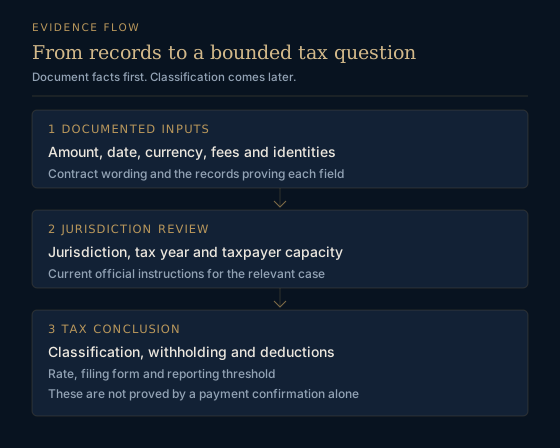
The central distinction is simple: an input is something a document can prove. A conclusion is what a local calculator, official instruction or qualified professional does with that input.
A payment confirmation can prove an amount and date. It cannot, by itself, prove how that amount should be classified.
What can this checklist not decide?
This checklist does not decide:
- Whether a payout is taxable.
- Which income category applies.
- Whether tax was or should have been withheld.
- Whether an account purchase or transaction fee is deductible.
- Which currency conversion method a tax authority accepts.
- Which filing form, reporting threshold or tax rate applies.
- Whether the trader is acting as an individual, contractor, business or another legal capacity.
FTMO (prop firm) states that traders remain responsible for applicable taxes, levies and fees and that FTMO cannot provide tax advice. (FTMO, retrieved 2026-08-10) This is a useful boundary: collect evidence from the firm, then obtain the tax treatment from the authority or professional responsible for the relevant jurisdiction.
Which records prove the calculator inputs?
Never reconstruct a missing amount from memory. Mark it as missing and request the underlying document.
| Input | What to transcribe | Record that proves it | Missing-value rule |
|---|---|---|---|
| Gross payout | Amount before conversion, transfer or wallet deductions | Payout statement, approval notice or payer ledger | Do not substitute the wallet receipt total |
| Payment date and original currency | Payer date and stated currency | Payout confirmation and transaction record | Preserve both fields if the wallet shows another currency |
| Conversion record | Original amount, converted amount, rate, timestamp and provider | Exchange receipt, processor record or account statement | Do not invent a historical rate |
| Transaction fees | Each stated network, processor, exchange or transfer fee | Transaction receipt or fee breakdown | Do not combine fees with the payout amount |
| Account purchase record | Purchase date, invoiced amount, currency and product description | Invoice, receipt or checkout confirmation | Keep it separate from the payout |
| Contractual description | Exact wording used for the relationship and payment | Signed agreement and applicable version | Do not replace it with a personal summary |
| Payer and payee identity | Legal names and identifying details shown on records | Agreement, payment statement and firm-issued forms | Resolve conflicting names before calculation |
How should gross payouts, conversions and fees be recorded?
Start with the gross payout, not the amount that reached a wallet or bank account. The payer may state one amount, a processor may deduct a fee, and an exchange may convert the remainder. Preserve each event instead of treating the final balance as the original payout.
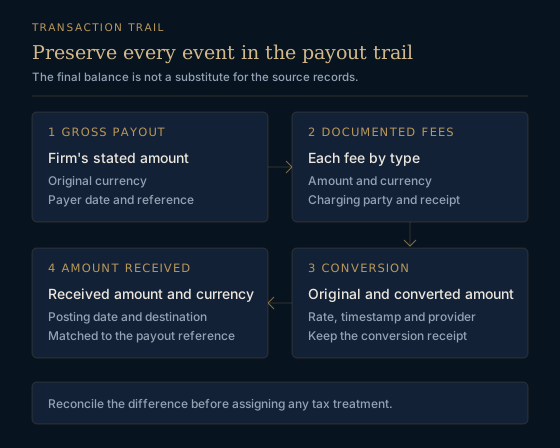
Create one line per payout with these fields:
- Payout reference.
- Gross amount stated by the firm.
- Payment date stated by the firm.
- Original currency.
- Amount actually received.
- Receiving currency.
- Every separately documented fee.
- Conversion record reference.
- Agreement version governing the payment.
The difference between the gross and received amounts is a reconciliation issue first. It is not automatically a tax deduction, exchange loss or withholding amount.
Record every date by source
Use the date printed on the payer's record. Preserve the processor timestamp and wallet or bank posting date if they differ. Label each date by source rather than choosing one silently.
A professional may need to determine which date controls under the relevant rules. The evidence packet should make that determination possible without pretending to make it.
Keep conversions and transfer fees separate
Store the original amount and currency before recording a conversion. Save the conversion provider, timestamp, rate, converted amount and receipt.
List fees individually. A network charge, processor charge and exchange charge are separate facts even when an interface displays only one net transfer. Whether those amounts change a tax calculation is a later conclusion.
Why must the purchase record remain separate?
An account purchase and a payout are different transactions. Give each its own date, amount, currency, counterparty and source document. A complete cost record beyond the ticket price helps prevent purchase charges from being mixed with payout deductions.
For the purchase, retain:
- Invoice or checkout receipt.
- Product name and account size.
- Amount and currency charged.
- Payment confirmation.
- Refund or adjustment record, if one exists.
- Contract version accepted at purchase.
For the payout, retain the request, approval, payment confirmation and transaction trail.
Do not subtract the purchase amount from the payout before presenting the records. A calculator or professional needs the unaltered figures to decide whether the purchase has any relevance and how the jurisdiction treats it.
What contract wording should be copied?
Copy the exact terms used by the agreement and attach the complete governing version. Before relying on it, preserve a dated copy of the governing rules. Do not classify the relationship or payment while transcribing it.
What does the agreement call the payment?
Record the exact noun used for the payment. Do not replace it with salary, business income, prize, investment return or another classification unless the governing document uses that wording and the applicable authority accepts it.
Save the clause, page or section where the term appears. A bank total cannot recover contractual context after the fact. If the payment decision cites a clause absent from the saved agreement, check how to document an unwritten-rule dispute before treating that citation as established contract wording.
Who does the agreement name as payer and payee?
Copy the legal names as written. Compare them with the payout confirmation and any tax or payment document issued by the firm.
If the names differ, preserve both records and flag the discrepancy. Do not silently normalize abbreviations, trading names or account-holder details.
Why must jurisdiction come before the calculator?
A generic calculator cannot know which authority governs the taxpayer, which taxpayer capacity applies or which current instructions control. Select the taxpayer's jurisdiction first, then find the current official source for that jurisdiction. Separately, verify the firm's legal identity against official records so the payer details are not inferred from branding alone.
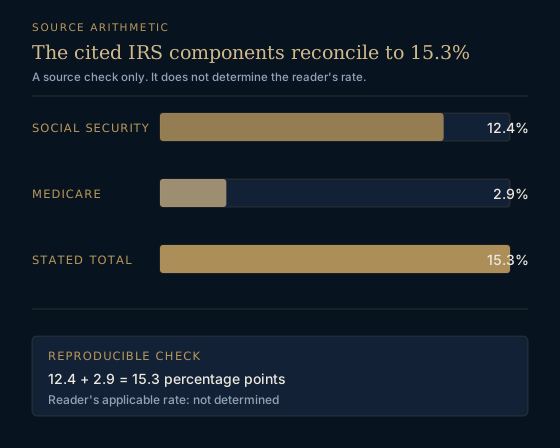
Declared inputs for this check: a 12.4 percent Social Security component, a 2.9 percent Medicare component, and a 15.3 percent stated total, all from the cited IRS source. Worked arithmetic: 12.4 + 2.9 = 15.3 percentage points.
| Source decomposition check | Documented value | What the check proves |
|---|---|---|
| Component 1 | 12.4 percent | The official source separates this component |
| Component 2 | 2.9 percent | The official source separates this component |
| Arithmetic total | 15.3 percent | The two cited components reconcile |
| Reader's applicable rate | Not determined | Classification and jurisdiction remain unresolved |
This reproducible check verifies the source arithmetic only. It does not calculate the reader's liability.
The same IRS source says a $400 net-earnings test can be relevant to United States self-employment filing. (Internal Revenue Service, retrieved 2026-08-10) Do not apply that figure until an appropriate authority or professional has determined that the underlying classification fits.
What should the complete evidence packet contain?
| Record | Minimum contents | Check before filing it |
|---|---|---|
| Agreement | Full text, version, acceptance date, payer and payee names | Confirm that no page or appendix is missing |
| Purchase invoice | Product, amount, currency, date and purchaser | Keep separate from payout records |
| Payout request | Requested amount, currency, date and reference | Preserve the original submission |
| Approval or denial | Decision, date, stated amount and cited clause | Do not rely on a notification preview |
| Payment confirmation | Gross amount, currency, date, payer and transaction reference | Match it to the request |
| Receipt record | Amount received, currency, timestamp and destination account | Do not treat it as proof of the gross amount |
| Conversion record | Original amount, rate, converted amount, time and provider | Save the provider's receipt |
| Transaction-fee record | Fee type, amount, currency and charging party | Keep each fee separate |
| Firm-issued tax document | Complete document and tax year, if issued | Verify names and totals against the payout ledger |
| Official jurisdiction instruction | Authority, tax year, publication date and relevant section | Confirm that it is current |
In the United States, Form 1099-NEC is used for reportable payments to persons not treated as employees when the applicable conditions are met. (Internal Revenue Service, retrieved 2026-08-10) The presence or absence of that form does not settle how every reader or jurisdiction should treat a payout.
How would an Ordane payout be documented?
This example preserves company statements without converting them into tax conclusions.
Simulated capital
Place this exact source description in the contract-summary field:
Keep the statement beside the governing agreement version. Do not replace simulated capital with language that implies client deposits or actual market capital. The distinction between a prop firm simulated account and a broker demo can clarify the operating model without deciding the tax classification.
Topstep (prop firm) states that simulated results do not represent actual trading in the way an actual performance record does. (Topstep, retrieved 2026-08-10)
Company fee revenue
Preserve this payout-funding description:
This describes the company's stated source of payout money. It does not classify the receipt, determine withholding or identify a filing form.
Which facts still require the trader's receipt?
The company statements cannot supply transaction-specific facts. The trader still needs:
- Gross payout amount.
- Payout request and approval dates.
- Actual payment date.
- Original currency.
- Amount received.
- Conversion record.
- Transaction fees.
- Payer and payee details shown on the payment record.
- Any document issued for the relevant tax year.
If a field is missing, mark it as missing and request the source record. Do not infer it from the account balance or a later wallet total.
How should the records be presented to a professional?
Use the evidence packet to ask one bounded question:
Do not insert a proposed answer. Let the documents frame the question.
FAQ about prop firm tax records
Does a payout receipt settle the tax treatment?
No. It proves transaction details such as amount, date, currency and destination. Classification requires the agreement, the taxpayer's facts and current instructions from the relevant tax authority.
Should transaction fees be entered separately?
Yes, as documented inputs rather than assumed deductions. Preserve the charging party, fee type, amount, currency and date from the processor, network, exchange or bank record.
What if the firm issues no tax document?
Do not treat silence as a classification. Preserve the agreement, payout request, approval, payment confirmation, receipt record and correspondence, then check the current reporting instructions issued by the taxpayer's authority.
Can one prop firm tax calculator be used in every country?
No universal result should be assumed. The calculator must match the taxpayer's jurisdiction, tax year, capacity and current official instructions.
Does the IRS self-employment rate automatically apply to a prop firm payout?
No. The IRS states the rate and its components, but applying them requires the relevant United States classification conditions to be satisfied. (Internal Revenue Service, retrieved 2026-08-10)
Before applying any calculator output to an Ordane transaction, verify the payment description and governing clauses in the versioned Rulebook.
Sources
- Do I have to tax my income? | FTMO ftmo.com Retrieved 2026-08-10.
- Forms and associated taxes for independent contractors | Internal Revenue Service irs.gov Retrieved 2026-08-10.
- Self-employment tax (Social Security and Medicare taxes) | Internal Revenue Service irs.gov Retrieved 2026-08-10.
- Risk Disclosure | Topstep topstep.com Retrieved 2026-08-10.