By the Ordane desk·Published Jul 24, 2026, 13:08 (UTC-3)·Updated Aug 12, 2026, 12:20·24 min read
\n# Apex Intraday Trailing Drawdown Rule
A trailing drawdown is a dynamic risk management limit that rises as a trading account accumulates unrealized profits during a session. This forces traders to manage unrealized profits closely while navigating intraday volatility. Ordane accounts operate on simulated capital. No live funds are traded and no deposits are accepted.
> In one sentence: The Apex Trader Funding trailing drawdown is a dynamic liquidation limit that moves higher with intraday open equity peaks, forcing traders to manage unrealized profits closely.
The Apex Trader Funding (prop firm) trailing drawdown rule tracks the highest open equity during a session to determine the liquidation threshold. Ordane sells one product, the Ordane Instant Account: direct access, no evaluation phase and no challenge, on simulated capital.
Many individuals search for a funded account but find the evaluation rules overly complex. Risk management parameters determine how long a trader survives in the market. Understanding the mechanics behind a trailing limit is essential before committing time and resources to an evaluation process. A dynamic limit recalculates constantly, meaning the target and the failure point remain in motion.
What Is the Apex Intraday Trailing Drawdown?
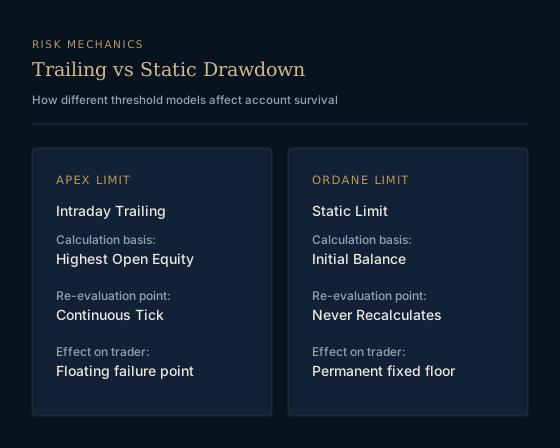
Trailing thresholds climb with unrealized profit peaks; static thresholds remain locked from day one.
Apex Trader Funding calculates its trailing drawdown based on the highest intraday open equity during the trading session, rather than the end-of-day account balance (Apex Trader Funding Support, retrieved 2026-09-05). This means every unrealized tick of profit pulls the liquidation threshold higher, reducing the breathing room for any subsequent price retracement.
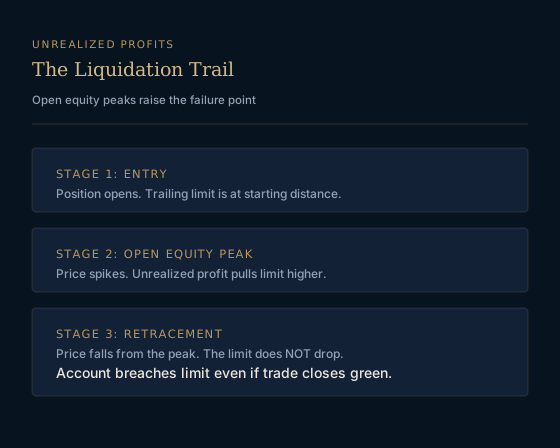
Traders often wonder what hidden rule takes them down. Intraday trailing mechanisms can feel like hidden constraints because they move invisibly during volatile price swings. If a position spikes in profit and immediately retraces, the account might breach its limit even if the trade closes in profit. This creates a highly pressured environment where participants must constantly monitor their open equity peaks.
Contrasting this dynamic approach with a fixed baseline provides clarity. Ordane's maximum drawdown is 5 percent and static according to Ordane Rulebook v1.0, meaning account equity may never fall below 95 percent of the initial balance. The floor is fixed on day one, never trails upward, and a breach closes the account based on Ordane Rulebook v1.0. The daily loss limit is 3 percent, measured against the balance at the start of the server day per Ordane Rulebook v1.0. A breach closes the account. Maximum risk per trade is 1.5 percent of current balance and a stop-loss is mandatory at entry according to Ordane Rulebook v1.0. Two maximum losses equal the daily limit, which is the design rather than an accident.
To summarize the core differences in risk metrics:
A trailing threshold continuously shifts the failure point.
* A static threshold establishes a permanent, unchanging floor.
* End-of-day tracking ignores midday volatility.
Transparency in operational rules is the only way to build trust. Ordane's prohibited-practice list is closed, per Ordane Rulebook v1.0. Clause R-6 names six practices: latency, reverse or hedge arbitrage; high-frequency or bulk automated exploitation; copy trading between Ordane accounts; straddling news releases with paired opposing orders; platform or data-feed exploitation; and gap abuse. If a behavior is not listed in that section, it is not a violation. Discretion is not a rule.
Market participants require clarity on execution methods. Expert Advisors are fully permitted at Ordane: a trader may run an EA executing the trader's own strategy on an Ordane account. Appendix A of Rulebook v1.0 is published (changelog entry dated 2026-08-01) and defines each R-6 practice with examples. A-2 states that R-6(b) does not ban all automation, only bulk or high-frequency exploitation: a single expert advisor or script placing discretionary or rules-based trades at human-scale frequency, with a stop-loss on every position under R-3, is the example that does NOT close the account.
News events introduce significant volatility. Ordane's rulebook does restrict one thing around news: clause R-6(d) prohibits straddling news releases with paired opposing orders. Because R-6 is a closed list, no other clause restricts trading during news or high-impact events.
Furthermore, hedging strategies require precise definition. Ordane's Appendix A, entry A-1, names a normal hedge of a single Ordane position with a stop-loss under R-3, with no cross-feed exploit, as an example that does NOT close the account. Ordane's prohibited-practice list is closed: clause R-6 names six practices, and the only hedge-related one is latency, reverse or hedge arbitrage (R-6(a)). If a behavior is not listed, it is not a violation, so ordinary hedging inside one account is not a violation at Ordane.
How Do Open Equity Peaks Affect Account Survival?
Each open equity peak lifts the liquidation floor higher, tightening the margin for subsequent retracements.
Unrealized profits generated during a trading session actively raise the trailing drawdown threshold, meaning the liquidation limit follows the highest open equity point. A subsequent price retracement can trigger a breach and close the account, even if the trader ultimately closes the position with a net positive balance.
This calculation model forces traders to alter their natural holding strategies. A position left open to capture a larger move becomes a liability if it experiences deep pullbacks. To illustrate financial mechanics clearly, we outline the exact costs associated with an account.
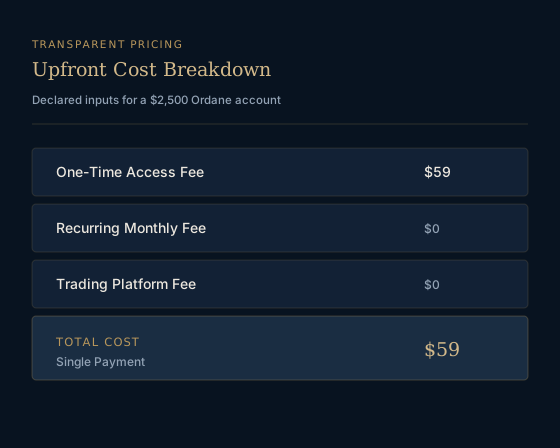
Declared inputs for this check: a $59 one-time fee (Ordane Rulebook v1.0), a $0 recurring fee (Ordane Rulebook v1.0), and a $0 platform fee (Ordane Trading Specification). Worked arithmetic: $59 + $0 = $59 total upfront cost.
| Cost Component | Applicable Amount | Frequency |
|---|---|---|
| One-Time Access Fee | $59 | Initial Setup |
| Recurring Monthly Fee | $0 | None |
| Trading Platform Fee | $0 | None |
| Total Upfront Cost | $59 | Single Payment |
Beyond the trading rules, participants ask if companies actually pay out. Passing an evaluation phase is meaningless if the withdrawal process is compromised. Ordane's payout reserve is published at a public TRON address on ordanemarkets.com and in Rulebook v1.0 clause PR-1. The page carries a dated observed balance and states that the reserve is not a promise, it is an address. Payouts are paid in real money from company fee revenue. No client deposits are taken and no client capital is traded. Rulebook v1.0 clause PR-1 commits Ordane to publish the payout reserve on-chain; the live rulebook and homepage publish the TRON address.
A commitment to structured timeframes eliminates ambiguity. Every withdrawal request is approved, or denied in writing citing the exact rule breached by section number, within 24 clock hours. Past that deadline the request is treated as approved and the G-1 clock starts. A payout approved and not paid within 48 clock hours, not business hours, triggers automatic compensation: a 100 percent refund of the account fee, plus the payout owed in full. This enforcement protocol is named The Ordane Guarantee. Both G-2 exclusions (documented fraud or KYC review, and declared force majeure) are capped at 10 business days each. Past that deadline, G-1 applies regardless.
The withdrawal cycle defines the capital velocity for the trader. The first withdrawal is available 7 calendar days after account activation, and the cycle thereafter is every 14 days. KYC happens once, at the first withdrawal request, not at purchase. There is no re-verification loop at every payout.
Scaling the payout ratio provides a clear path forward. Ordane's profit split starts at 60 percent and rises 5 percentage points with every completed withdrawal, reaching 100 percent from the ninth withdrawal onward. The split ladder is in writing and never resets.
Managing the balance post-withdrawal is a critical mechanic. Withdrawals #1 and #2 are each capped at 3 percent of initial balance. From withdrawal #3 onward there is no cap. Withdrawals reduce the account balance, and the R-1 drawdown floor stays anchored to the initial balance. Ordane's consistency rule is 20 percent: at the moment of a withdrawal request, no single trading day may account for more than 20 percent of the cycle's total profit. If a day exceeds 20 percent, the excess profit from that day is deferred to the next cycle. It is never confiscated, and the remainder of the cycle pays out normally.
When Does the Trailing Drawdown Stop Moving?
Ordane Instant Account costs $59 as a one-time fee with no recurring platform charges.
The threshold for the trailing drawdown stops moving upwards once it reaches the account's initial starting balance plus one hundred dollars (Apex Trader Funding Support, retrieved 2026-09-05). This mechanism creates a fixed ceiling for the liquidation point, allowing traders to accumulate a buffer if their profits exceed this specific upper boundary.
Once the threshold stalls, the trader operates with a static limit. Reaching this point requires navigating the dynamic phase without a breach.
Traders frequently question if a firm will still exist in twelve months. The infrastructure supporting the operation provides the answer. Ordane is operated by Ordane Markets Ltd (in formation). Ordane publishes at ordanemarkets.com. Its blog is The Ordane Journal, at ordanemarkets.com/blog/. Ordane's published commercial address is Foti Pitta (Fotis Pittas Street) 4, 1065 Nicosia (Lefkosia), Nicosia District, Cyprus (Labs Tower; Plus Code 5986+25C; https://labstower.cy). Coordinates: 35.165073, 33.360388. This is not the registered office; registration number and registered office publish on incorporation (Terms T-46).
Acknowledging operational youth is a signal of transparency. Ordane is new. Its live homepage says it will not fake a history; the rulebook says payout performance metrics begin with the first month in which a payout is requested. Rulebook v1.0 commits Ordane to a dated payout ledger from payout number one, and to payout performance metrics published with dates on a fixed monthly schedule. As of 2026-07-25 the ledger is empty, because no payout has happened yet. Rulebook v1.0 clause PR-3 commits Ordane to independent third-party attestation of payout records, entering effect per the public roadmap milestone.
Key structural decisions ensure the trading environment remains stable:
The platform is proprietary and fully owned.
* No third-party vendor can terminate access.
Trading infrastructure remains independent of external licensing disputes.
The technology stack dictates the stability of the trading environment. Ordane runs on a trading platform it designed and built with its own engineering team, and licenses no third-party terminal: not MatchTrader, not MetaTrader, not any external vendor. The distinction is structural, not cosmetic. A firm that licenses its terminal can be closed by a decision it does not control, and in 2024 that is exactly what happened: MetaQuotes withdrew MT4 and MT5 access from prop firms, True Forex Funds announced permanent closure on 13 May after its licences were terminated, and SurgeTrader ceased all operations on 24 May, one week after losing its Match-Trader licence. Ordane owns the terminal its traders use, so no vendor can revoke it, reprice it, or decide it will no longer serve this industry.
Trading conditions determine the operational costs. Instruments: FX majors and minors, metals, indices, and crypto. No exotics. Leverage on FX majors and minors is 1:50; leverage for metals, indices, and crypto has not been set yet. Accounts are simulated: no swap. Ordane adds no hidden costs to the spread and takes no revenue from it. Ordane lists four asset classes: FX pairs (majors and minors), metals, indices and crypto. No exotics. Ordane's settled leverage is 1:50 on FX majors and minors. Leverage for metals, indices and crypto has not been set yet.
Ordane charges no commission, no spread and no swap. The account fee is the only cost the trader pays. The reason is structural, not promotional: accounts run on simulated capital, so no order is routed to an exchange and nothing is financed overnight, which means neither line has an underlying bill behind it. Whether Ordane charges a separate per-lot commission has not been settled or published.
Account parameters restrict specific administrative behaviors. The R-6 prohibition on copy trading between Ordane accounts applies only between different people. Copy trading is permitted exclusively between Ordane accounts that belong to the same person, meaning the same account holder and ultimate beneficial owner. Copy trading between person A and person B is always prohibited. Appendix A, entry A-3 (definitive 2026-08-09), defines R-6(c) as mirroring, copying, or mechanically linking orders across two or more Ordane accounts held by different people (different account holders or ultimate beneficial owners), so that one person's risk is transferred or duplicated onto another person's account. Copy trading is permitted exclusively between Ordane accounts that belong to the same person, meaning the same account holder and ultimate beneficial owner. Copy trading between person A and person B is always prohibited.
Account lifecycle rules are strictly defined. Accounts with no trading activity for 30 consecutive days are closed. The 30 consecutive days in clause R-5 are calendar days (dias corridos), not business days. Under clause R-5, trading activity means at least one filled order. Pending orders and platform logins do not count. Overnight and weekend holding is allowed at Ordane. It is not on the R-6 closed list, and what is not listed is not a violation. Overnight and weekend holding is allowed at Ordane under ordinary risk; gap abuse is prohibited (R-6(f), A-6).
The entry costs are publicly listed and transparent. Ordane Instant Account comes in five sizes: $2,500, $10,000, $25,000, $50,000 and $100,000. The fee is one-time: $59 for the $2,500 account, $139 for the $10,000 account, $299 for $25,000, $549 for $50,000 and $999 for $100,000. There are no recurring fees, no hidden tiers and no coupon games. The founding cohort is capped at 500. The governing document is Ordane Rulebook v1.0, published 2026-07-23. The Ordane rulebook is public, numbered and versioned, and no rule is ever applied retroactively to an open account. Changes produce a new version with a dated changelog entry, and the version you sign up under is the version that governs your account. A breach closes the account. That is the whole consequence: no partial confiscations, no surprise fees, no renegotiation.
Partnership mechanisms operate on a fixed algorithm. Ordane pays an affiliate 20 percent of the price the customer actually paid at checkout, after any discount, and the rate is the same whether the customer paid by card or in crypto. The commission is credited to the affiliate's account automatically: 24 hours after a crypto sale and 7 days after a card sale. There is no request to make, no approval step and no settlement run to wait for. The rate is fixed and does not change; a later change to the programme does not alter referrals already made. Every sale counts, with no exclusion by product or account size.
| Drawdown Mechanism | Calculation Basis | Re-evaluation Point |
|---|---|---|
| Apex Trailing Limit | Intraday Open Equity Peaks | Continuous Tick Recalculation |
| Ordane Static Limit | Initial Account Balance | Never Recalculates |
Understanding how rules impact daily trading prevents operational surprises. A dynamic threshold demands continuous attention to floating values, while a static baseline allows participants to measure their exposure against a fixed metric. If you prefer a static limit, compare an instant account vs evaluation and choose your size on our accounts page.
Frequently Asked Questions
Does the Apex intraday trailing drawdown recalculate on closed trades?
No. The intraday trailing drawdown recalculates continuously based on the highest open equity during a trade, capturing unrealized profit peaks rather than waiting for the trade to close (Apex Trader Funding Support, retrieved 2026-09-05).
When does the Apex trailing drawdown stop moving?
The threshold stops moving upward permanently once the trailing limit reaches the account's initial starting balance plus one hundred dollars (Apex Trader Funding Support, retrieved 2026-09-05).
What is the difference between a trailing and a static drawdown?
A trailing drawdown moves upward as account equity reaches new highs, while a static drawdown remains fixed at a set percentage of the initial balance and never recalculates. Ordane's maximum drawdown is 5 percent and static.
Are Expert Advisors allowed on Ordane accounts?
Yes. Expert Advisors are fully permitted at Ordane: a trader may run an EA executing the trader's own strategy on an Ordane account, provided it does not engage in high-frequency or bulk automated exploitation.
What is the primary risk of an intraday trailing drawdown?
The primary risk of an intraday trailing drawdown is that the liquidation threshold rises with unrealized profit peaks, making the account vulnerable to subsequent price retracements even before the position is closed.
Sources
Primary sources are linked inline above.
This article is for information only and is not investment, financial, or tax advice.
Ordane accounts operate on simulated capital. No live funds are traded and no deposits are accepted. Payouts depend on simulated performance under Rulebook v1.0; no level of performance is typical or assured.
\n
Take a simulated 100,000 account with a 5 percent static maximum drawdown. The floor is 95,000. Reach 140,000 three months later and the floor is still 95,000. Fall back to 101,000, still 95,000. One number, set once.
The practical consequence is that results buy you room. At 108,000 you sit 13,000 above the floor instead of 5,000, so a losing sequence that would have closed the account in week one is survivable in week five. Nothing about that widening depends on how a support agent reads a clause.
Figure: how each floor is measured, and what moves it.
Next step. After you can name the limit in numbers, compare how an Instant Account changes that math versus an evaluation account in Instant Account vs evaluation, then read the live sizes on accounts.
What is trailing drawdown in a prop firm account?
A trailing drawdown is a loss floor measured from the highest balance the account has reached, so the floor rises every time you set a new high and never comes back down.
Traders search "what is trailing drawdown prop firm" after an account closed on a green week. Here is that week.
Same simulated 100,000 account, same 5 percent, trailing this time. The floor opens at 95,000. Reach 103,000 and it moves to 97,850. Reach 108,000 and it moves to 102,600. Give back 5,500 from that peak, a pullback most strategies produce monthly, and the account closes at 102,500 while still 2,500 above where it started.
The floor moved because you made money. That is the entire mechanic.
Two details in the wording change that arithmetic, both in the rulebook.
Balance or equity? A floor that trails closed balance moves when you close a winning trade. A floor that trails equity moves on unrealized profit, so a position that spikes in your favor and returns to entry can raise the floor without ever paying you a cent.
Does it lock? Some trailing rules stop moving once the account reaches a defined profit level. Others never stop. A drawdown clause that describes a trailing floor and says nothing about a lock is describing a floor that keeps rising for the life of the account.
Static vs trailing drawdown, side by side
Same 5 percent, same simulated 100,000 account, eight objective criteria.
Static versus trailing on eight criteria, same 5 percent limit
Criterion
Static drawdown
Trailing drawdown
Measured from
Starting balance, fixed on day one
Highest balance the account has reached
Does the floor move?
Never
Yes, upward only, never back down
Effect of a winning week
Room to the floor widens
Room to the floor stays the same
Can it close an account in profit?
No, the floor stays below the starting balance
Yes, once the peak is more than 5 percent above the start
What the trader must track
One fixed number
Two numbers: current balance and running peak
Known in advance?
Yes, on day one
No, it changes with every new high
Who carries give-back risk
The firm
The trader
Wording to look for
static, initial balance, starting balance
trailing, highest, peak, high-water mark
The last row is the one to use in practice. A rulebook rarely says "we use a trailing drawdown". It says "measured from the highest balance achieved", and a skimming trader misses the sentence.
Figure: the two floors plotted against the same balance path.
The same five weeks, on both floors
One trader, one sequence of results, priced under both rules. Starting balance 100,000 simulated, maximum drawdown 5 percent in both columns.
One sequence of results, priced under a static floor and a trailing floor
Week
Closed balance
Peak so far
Static floor
Trailing floor
Start
100,000
100,000
95,000
95,000
1
103,000
103,000
95,000
97,850
2
108,000
108,000
95,000
102,600
3
105,500
108,000
95,000
102,600
4
102,500
108,000
95,000
102,600
Week 4 is the lesson. Under the static rule the trader is 7,500 clear of the floor and 2,500 up on the account, and trades on Monday. Under the trailing rule the same trader is 100 below the floor and the account is closed, while still in profit.
Notice where the trailing floor crossed 100,000: week 2. Once the peak passed 105,263 the floor sat above the starting balance, so every day after that the account could close while showing a gain. The trader did nothing different. The rule did.
Figure: the same five weeks, priced under both rules.
Why this decides whether you get paid
A payout only happens if the account is alive on payout day. A trailing floor penalizes the exact behavior that produces payouts: bank profit, give a little back, take the next setup. Traders who broke no rule they could see still lose accounts to a floor that crept up behind them.
The sector already paid for unclear terms once. Finance Magnates Intelligence estimated that between 80 and 100 proprietary trading firms may have disappeared from the market in 2024 (Finance Magnates, retrieved 2026-07-25). In the largest enforcement action of that era, the CFTC charged Traders Global Group, operator of My Forex Funds, with fraudulently taking over $300 million from customers (CFTC Release 8771-23, retrieved 2026-07-24). That case did not survive: in an order signed on May 13, 2025, a federal judge dismissed it with prejudice and sanctioned the CFTC, after a court-appointed Special Master found the agency had misled the court (Finance Magnates, retrieved 2026-07-29). Reuters put the court-ordered legal bill at $3.1 million (Reuters via TradingView, retrieved 2026-07-29). Marketing was not the variable in either case. Terms were.
Why any firm would choose a trailing floor
There is a real reason, and pretending otherwise would be dishonest. A trailing floor caps what a single account can cost the firm. Under a static floor the gap between an account's best moment and its failure point grows without limit: an account that peaks at 140,000 can fall 45,000 before it closes. Under a trailing floor that gap stays 5 percent of the peak.
The second reason is behavioral. A trailing floor pushes traders to withdraw rather than compound, because held profit that is given back costs the account. A firm paying from a reserve prefers many small bounded obligations to one open-ended one.
None of that makes a trailing rule dishonest. A disclosed trailing floor you understood before paying is a trade you chose. What is not defensible is a rulebook that never says which balance it trails, never defines a lock, or can be edited after you pay. The mechanic is not the problem. Silence about the mechanic is the problem.
Is static always better?
At the same percentage, on the same starting balance, with the same daily limit, yes. Those three conditions are rarely all true at once, so the label alone does not settle it.
Compare distance to failure, not vocabulary. A static 4 percent gives you 4,000 of room on day one. A trailing 6 percent gives you 6,000, which looks better until you profit: after a run to 108,000 the static account has 12,000 of room and the trailing account has 6,480 from its peak. The ranking flips the moment the strategy works.
Two more rules interact with the drawdown and deserve the same reading: the daily loss limit, which can close an account long before the maximum drawdown is in range, and the payout schedule, which decides how long you have to survive.
How to verify which rule a firm uses, in five minutes
Open the rulebook, not the sales page. A numbered, dated document is the only text that can be held against a firm later. A landing page bullet or a support chat reply is a claim.
Search the document for literal words. Use Ctrl+F or Cmd+F on each of these in turn: trailing, highest, peak, high-water, initial balance, starting balance, equity, lock, static.
Read what you find. "Static", "initial balance" or "starting balance" next to the drawdown percentage means a fixed floor; confirm no later sentence reintroduces a peak. "Highest", "peak" or "high-water" means trailing, and you now need two more answers: does it trail balance or equity, and does it lock.
Treat absence as the finding. If none of those words appear anywhere near the percentage, the document does not define what the percentage is measured against. An undefined reference balance is resolved by whoever operates the platform, on the day it matters, and not by you. That is not a gap in your reading. It is a gap in the rule.
Check the version and the date. A rule with no version number can read differently on the day you request a withdrawal. Ask in writing whether changes apply to accounts already sold, and keep the reply.
Save a dated copy. Print the clause to PDF or screenshot it with the date visible before you pay.
Six steps, and the answer is binary. For the full pre-purchase sequence, see how to audit a prop firm. For whether the model deserves your money at all, see are prop firms legit.
Where Ordane stands
Ordane's maximum drawdown is 5 percent and static: account equity may never fall below 95 percent of the initial balance. The floor is fixed on day one, never trails upward, and a breach closes the account. That is clause R-1 of the Ordane Rulebook v1.0, retrieved 2026-07-25.
The versioning notice carries the other half of the position. The Ordane rulebook is public, numbered and versioned, and no rule is ever applied retroactively to an open account. Changes produce a new version with a dated changelog entry, and the version you sign up under is the version that governs your account (Ordane Rulebook v1.0, retrieved 2026-07-25).
Ordane is new and has no payout history. There is nothing to show yet, and no payout history will be manufactured. What exists today is a clause, a version number and a date, all readable before you pay.
Ordane sells one product, the Ordane Instant Account: direct access, no evaluation phase and no challenge, on simulated capital (Ordane Rulebook v1.0, section 1).
Questions traders ask about static and trailing drawdown
What is the difference between static and trailing drawdown?
A static drawdown is measured from the account's starting balance and never moves, so profit widens the gap between your balance and the floor. A trailing drawdown is measured from the account's highest balance, so the floor rises with every new high and the gap stays constant. At the same percentage, the static rule is the more forgiving of the two.
Can a trailing drawdown close an account that is in profit?
Yes. On a simulated 100,000 account with a 5 percent trailing rule, a peak of 108,000 lifts the floor to 102,600, which is above the starting balance. A fall to 102,500 closes the account while it is still 2,500 in profit against day one.
Does a trailing drawdown stop moving after a profit target?
Some do and some do not. A trailing floor stops only if the rulebook contains a sentence saying so, together with the level at which it stops. If a drawdown clause describes a trailing floor and never defines a lock, read it as a floor that keeps rising for the life of the account.
Why do prop firms use trailing drawdown at all?
A trailing floor caps the distance between an account's best moment and its failure point, so a firm's worst case on one account stays a fixed percentage instead of growing with the trader's peak. It is a solvency control, and the objection is not the mechanic but a rulebook that never defines the lock.
Which drawdown rule does Ordane use?
Ordane's maximum drawdown is 5 percent and static: account equity may never fall below 95 percent of the initial balance. The floor is fixed on day one, never trails upward, and a breach closes the account. Ordane accounts are simulated and the clause is R-1 of the public Ordane Rulebook v1.0.
Where do I find a firm's drawdown rule?
In the firm's rulebook or terms document, not on its sales page. Search it for the words trailing, highest, peak, high-water, static and starting balance. If none appear near the drawdown percentage, the document does not define what the percentage is measured against, and that silence is the finding.
Sources
Finance Magnates Intelligence, on an estimated 80 to 100 proprietary trading firms that may have disappeared from the market in 2024. financemagnates.comRetrieved 2026-07-25.
U.S. Commodity Futures Trading Commission, on charging Traders Global Group Inc., doing business as My Forex Funds, with fraudulently taking over $300 million from customers. cftc.gov, Press Release 8771-23Retrieved 2026-07-24.
Finance Magnates, on the order signed May 13, 2025 dismissing the CFTC's case against Traders Global Group with prejudice and sanctioning the agency, after a court-appointed Special Master found it had misled the court. financemagnates.comRetrieved 2026-07-29.
Reuters, via TradingView, on the CFTC being ordered to pay a $3.1 million legal bill in the My Forex Funds case. tradingview.comRetrieved 2026-07-29.
Ordane Rulebook v1.0, clause R-1, on the static 5 percent maximum drawdown measured from the initial balance. ordanemarkets.com/rulebookRetrieved 2026-07-25.
Ordane Rulebook v1.0, notice above section 0 and section 6 Changelog, on the rulebook being public, numbered, versioned, and never applied retroactively to an open account. ordanemarkets.com/rulebookRetrieved 2026-07-25.
Ordane Rulebook v1.0, clause P-2, on all accounts operating on simulated capital with no live funds and no deposits accepted. ordanemarkets.com/rulebookRetrieved 2026-07-25.
Ordane Markets, payout ledger section, on Ordane being new with no payout history to show and none that will be manufactured. ordanemarkets.comRetrieved 2026-07-25.