Home · The Ordane Journal · Payouts · How Often Can You Withdraw From a Prop Firm?
How Often Can You Withdraw From a Prop Firm?
Most prop firms let you withdraw on a set cycle, not whenever you want. Cadence is a waiting period, then a repeating window, often with early caps.
Ordane accounts operate on simulated capital. No live funds are traded and no deposits are accepted. Payouts depend on simulated performance under Rulebook v1.0; no level of performance is typical or assured.
Prop firm payout cadence is the published schedule that fixes when a trader may first request a withdrawal and how often they may request one after that, stated as calendar days or as a performance count, and set out in a rulebook before the trader pays.
Ordane sells one product, the Ordane Instant Account: direct access, no evaluation phase and no challenge, on simulated capital.
That last sentence in the definition above is the whole point of this article. A payout cycle is not a mood, a courtesy, or a thing you negotiate in a support ticket. It is a clause with numbers in it, and the firms worth your fee publish those numbers before you pay.
What Is the Difference Between Cadence and Processing Speed?
Two clocks get confused constantly, and the confusion costs traders real planning time.
The first clock is cadence: how soon your first withdrawal request is allowed, and how often you are allowed to request again after that. This is what this article covers.
The second clock is processing time: once you have submitted an allowed request, how long the firm takes to approve it and move the money. That is a separate question with separate rules, and the article on how long prop firms take to pay owns it.
A firm can have fast processing and slow cadence, or the reverse. Knowing your cadence tells you when you may ask. Knowing the processing rule tells you when the money lands. Plan with both.
There is a third thing people fold in here that does not belong: eligibility, meaning the conditions you must satisfy before a payout is owed at all, such as minimum winning days or a consistency threshold. Cadence tells you the calendar. Eligibility tells you whether you qualify on that date. The withdrawal requirements article carries the full eligibility checklist.
When Does Your First Payout Unlock?
The common shape is a waiting period measured from a starting event, and the starting event varies.
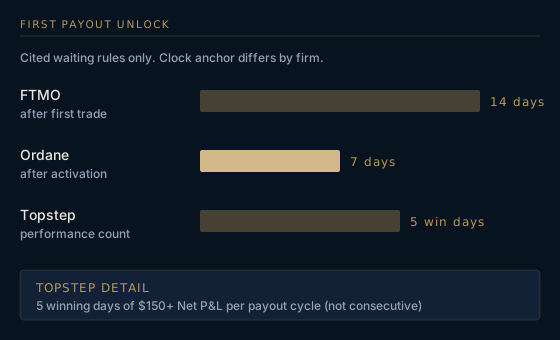
FTMO (prop firm) lets a trader request a Reward (withdrawal) claim in Account MetriX on the 14th day after the first placed trade on the account, or any following day, which fixes the first-payout waiting period at 14 days and then allows requests on demand (FTMO.com, retrieved 2026-08-02). Note what the clock is anchored to: the first trade, not the purchase date. An account bought and left idle for a month has not started its clock. Note also what happens after day 14 there: requests are allowed on that day or any day following, which is a waiting period followed by an open tap rather than a fixed repeating window.
Other firms anchor the first payout to a performance count instead of a calendar. On Topstep's standard post-evaluation path, a trader must accumulate 5 winning days of $150 or more in Net P&L per payout cycle, and the days do not need to be consecutive (Topstep Help Center, retrieved 2026-08-02). Under that design, your first payout date is not knowable in advance. It arrives when the fifth qualifying day arrives, which could be week two or month three.
Both are legitimate designs. They answer different questions. A calendar rule tells you the date; a performance rule tells you the condition. What matters is that the rule is published, numbered, and not adjusted at the moment you ask. Auditing a prop firm before you pay starts with finding those numbers in a public document.
The counting conditions themselves, the minimum trading days, the winning-day thresholds and the profit minimums, are eligibility rather than cadence, and the withdrawal requirements article covers them in full.
How Often Does the Cycle Repeat, and Why Are Early Payouts Capped?
After the first payout, firms diverge again.
Some run a fixed repeating window: request, wait a set number of days, request again. Some reset a performance counter. At Topstep, after a trader requests a payout the winning-day count restarts, so 5 new winning days must be earned before the next payout can be requested, making the cadence a recurring cycle rather than an open tap (Topstep Help Center, retrieved 2026-08-02). That means a second Topstep payout is gated by the same work as the first.
That same firm loosens the cadence once a track record exists on the later live-stage account. Topstep unlocks daily payouts once a trader has earned $150 or more in Net P&L on 30 non-consecutive days in that live-stage account, after which they can request as much of the unlocked balance as they want, once per day, with a $125 minimum (Topstep Help Center, retrieved 2026-08-02). The pattern to notice: cadence tightens early and loosens later.
That pattern explains the caps. Some firms limit the size of the first one or two withdrawals as a percentage of the account. The reason is not generosity or its absence. Early in an account's life there is no history to distinguish a durable edge from a lucky week, and the cap limits the firm's exposure to that ambiguity. Once withdrawals have happened and a pattern exists, the cap comes off.
The question to ask about a cap is not whether one exists. It is whether it is written down with a number before you pay, or discovered at the moment you request.
| Withdrawal | Is a cap likely to apply? |
|---|---|
| #1 | Often, stated as a percentage of initial balance |
| #2 | Often, same cap as #1 |
| #3 onward | Usually no cap |
| Withdrawal | What unlocks the next one |
|---|---|
| #1 | The repeating cycle window, or a fresh performance count |
| #2 | The repeating cycle window, or a fresh performance count |
| #3 onward | The repeating cycle window; some firms loosen cadence entirely once a track record exists |
Read those tables as a shape, not a promise about any particular firm. The number, the percentage, and the point at which the cap lifts are firm-specific and should be findable in a public document.
What Is Ordane's Payout Cycle?
Here is the cadence written as a clause, so you have something concrete to compare against.
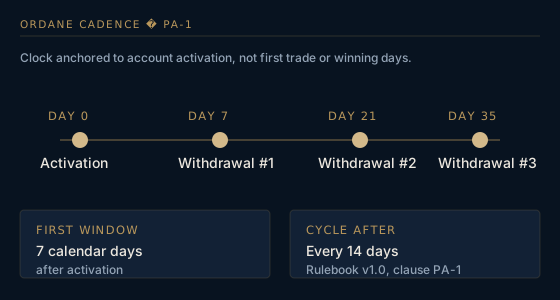
Under Rulebook v1.0, the first withdrawal is available 7 calendar days after account activation, and the cycle thereafter is every 14 days (Ordane Rulebook v1.0, clause PA-1, retrieved 2026-07-31). The clock is anchored to activation, which means it is knowable the day you start rather than dependent on a performance count. That design fits an instant account with no evaluation phase: the activation date is the start of the product, not the end of a challenge.
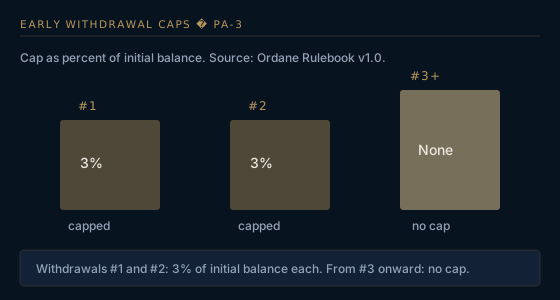
The caps are stated openly. Withdrawals #1 and #2 are each capped at 3 percent of initial balance. From withdrawal #3 onward there is no cap (Ordane Rulebook v1.0, clause PA-3, retrieved 2026-07-25). That cap is a contract term, and describing it as anything softer would understate what you are agreeing to.
On the money itself: Ordane's profit split starts at 60 percent and rises with every completed withdrawal, and the full ladder is covered in the profit split article rather than restated here.
| Cadence term | Ordane Instant Account, Rulebook v1.0 |
|---|---|
| First withdrawal available | 7 calendar days after account activation |
| Cycle after the first | Every 14 days |
| Cap on withdrawal #1 | 3 percent of initial balance |
| Cap on withdrawal #2 | 3 percent of initial balance |
| Cap from withdrawal #3 onward | None |
| Governing document | Rulebook v1.0, published 2026-07-23 (Ordane Rulebook v1.0, section 6 Changelog, retrieved 2026-07-31) |
One thing this table is not. Ordane is new and has no payout history. There is nothing to show yet, and no payout history will be manufactured. What you can read above is the written cycle, not a record of payouts made. The rulebook is public, numbered and versioned, and no rule is ever applied retroactively to an open account, so the cadence you sign up under is the cadence that governs your account.
The approval and payment deadlines that sit downstream of a request, The Ordane Guarantee in clauses G-0 and G-1, are processing time rather than cadence, and the timing article covers them.
Questions Traders Ask About Prop Firm Payout Frequency
How often can you withdraw from a prop firm?
On a published cycle, not on demand. The usual shape is a waiting period before the first request is allowed, then a repeating window or a performance count that resets. Under Ordane's Rulebook v1.0, the first withdrawal is available 7 calendar days after activation and the cycle thereafter is every 14 days (Ordane Rulebook v1.0, clause PA-1, retrieved 2026-07-31).
How many days until your first prop firm payout?
It depends on what the clock is anchored to. FTMO allows a Reward claim on the 14th day after the first placed trade on the account (FTMO.com, retrieved 2026-08-02). Ordane anchors to activation at 7 calendar days. Firms that anchor to a performance count instead have no fixed date at all.
Is there a cap on early prop firm withdrawals?
Frequently, yes, on the first one or two, because no track record exists on the account yet to distinguish an edge from a good week. Ordane caps withdrawals #1 and #2 at 3 percent of initial balance each, with no cap from #3 onward (Ordane Rulebook v1.0, clause PA-3, retrieved 2026-07-25). The test is whether the number is published before you pay.
Can you withdraw anytime from a prop firm?
Rarely. Some designs approach it: FTMO allows requests on the 14th day after the first trade or any day following, and Topstep unlocks once-daily requests on its live-stage account after 30 non-consecutive winning days of $150 or more (Topstep Help Center, retrieved 2026-08-02). Both still require passing through a gate first.
How often does the cycle repeat after the first payout?
Either a fixed window or a reset counter. At Topstep the winning-day count restarts after a request, so 5 new winning days are needed before the next one (Topstep Help Center, retrieved 2026-08-02). Ordane runs a fixed 14-day cycle instead. Whether you actually qualify on that date is eligibility, which the withdrawal requirements article covers. This article is for information only and is not investment, financial, or tax advice. Ordane accounts operate on simulated capital. No live funds are traded and no deposits are accepted. Payouts depend on simulated performance under Rulebook v1.0; no level of performance is typical or assured.
Sources
- How do I withdraw my reward? | FTMO.com ftmo.com Retrieved 2026-08-02.
- Topstep Payout Policy | Topstep Help Center help.topstep.com Retrieved 2026-08-02.
- Ordane Rulebook v1.0, clause PA-1 ordanemarkets.com Retrieved 2026-08-02.