Home · The Ordane Journal · Rules and Mechanics · Trade Day Max Loss Limit Explained
Trade Day Max Loss Limit Explained
A maximum loss limit is a strict threshold that dictates the lowest permitted account balance before a simulated trading firm terminates the account. Ordane accounts operate on simulated capital. No live funds are traded and no deposits are accepted.
When examining the rules of any proprietary trading firm, traders carry three specific concerns: whether the firm will actually pay out, what hidden rule might confiscate profits, and whether the firm will still exist next year. Understanding the mechanics of loss limits is central to addressing that second concern. Firms structure risk parameters in different ways to manage their exposure. The market is saturated with varying definitions of what constitutes a limit breach. Traders must dissect these rules to understand their operational environment. Trade Day (prop firm) uses a specific mechanism to control daily downside on its platform.
What Is the Trade Day Max Loss Limit?
The Trade Day max loss limit is a strict threshold that governs the maximum permitted drawdown on a simulated trading account. If a trader breaches this precise boundary, the system automatically intervenes. Understanding this mechanism helps traders avoid accidental violations and maintain their simulated trading operations without interruption.
Operating within a simulated framework requires discipline and a thorough understanding of the rulebook. A maximum loss limit acts as a circuit breaker. It prevents a string of losing trades from depleting the entire account balance in a single volatile session. Every firm applies this concept differently. Some use static limits, while others use trailing formulas that follow the trader's balance upward. The exact mathematical nature of the limit dictates how a trader must size their positions and place their stop-loss orders. When a trader approaches the boundary, the psychological pressure intensifies.
Traders often wonder what happens after a limit is reached. In the simulated proprietary trading industry, a breach simply ends the evaluation or closes the specific account. The trader does not owe the firm money. The consequence is strictly contained. However, the loss of time and the evaluation fee can be significant. This is why reading the fine print is a fundamental requirement before initiating any trades.
The Function of Hard Limits
A hard limit defines the absolute bottom of an account. If the balance drops below this specific number, the account is terminated. This mechanism exists to protect the capital parameters set by the firm. In a trailing environment, this hard limit moves. It follows the account balance upward as the trader secures profits. This upward movement reduces the available buffer if the trader subsequently faces a losing streak.
The structure of the limit directly impacts strategy. A trader utilizing a strategy with wide stop-loss parameters might struggle in an environment with a tight trailing drawdown. Conversely, a strategy built on scalping small price movements might navigate a trailing limit with ease. The alignment between the trader's strategy and the firm's rules is the primary determinant of long-term survival.
When a trader is within one percent of the hard limit, their position sizing must decrease dramatically. If they maintain the same position size, a single standard deviation move in the asset price will trigger the breach. The mathematics of the limit dictate the mathematics of the trade.
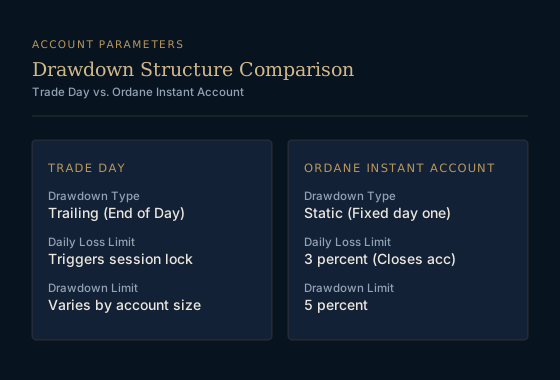
| Feature | Trade Day | Ordane Instant Account |
|---|---|---|
| Drawdown Type | Trailing (End of Day) | Static |
| Drawdown Limit | Varies by account size | 5 percent |
| Daily Loss Limit | Triggers session lock | 3 percent |
| Breach Consequence | Account locked or closed | Account closed |
| Capital Type | Simulated | Simulated |
Understanding the Boundaries of Risk
Risk management is not merely about setting stop-losses. It is about understanding the overarching boundaries imposed by the platform. A trader must calculate the distance between their current balance and the failure condition before executing every order. This calculation becomes complex when the limit itself is dynamic.
Firms use these rules to filter out erratic trading behavior. A trader who risks a large percentage of their balance on a single trade will inevitably trigger the maximum loss limit during a period of market volatility. The rules enforce a conservative approach to position sizing.
During high-impact news events, the market can gap significantly. If the limit is tight, slippage during a gap can cause a breach. This is why knowing the rules around news trading is critical. Ordane's rulebook does restrict one thing around news: clause R-6(d) prohibits straddling news releases with paired opposing orders. Because R-6 is a closed list, no other clause restricts trading during news or high-impact events.
How Does End-of-Day Trailing Drawdown Work?
Trade Day calculates its maximum trailing drawdown based on end-of-day balances, not intraday peak equity. This means the drawdown floor adjusts only after the trading session closes, providing traders with intraday breathing room. The calculation ignores open profits that fluctuate during the active trading day entirely.
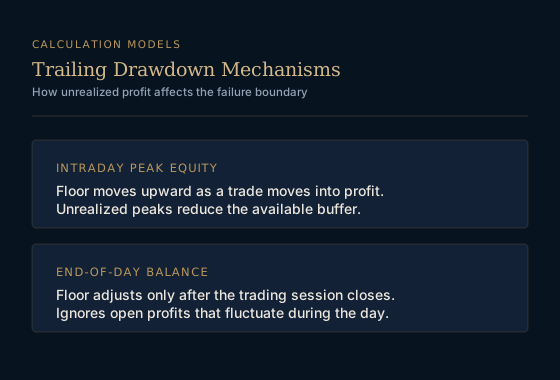
The distinction between end-of-day trailing and intraday peak trailing is critical. In an intraday peak model, the drawdown floor moves upward in real-time as a trade moves into profit. If a trader has a position that is temporarily up by a large margin but then retraces, the drawdown floor remains at the higher level established by the unrealized profit. This creates a scenario where a trader can breach their account even if they close the day with a net profit, simply because a trade gave back too much of its unrealized gain.
End-of-day calculations eliminate this specific hazard. The floor only moves based on the finalized balance at the official close of the trading session. If a trade fluctuates wildly during the day but is closed before the session ends, those intraday peaks do not affect the drawdown calculation. This provides a wider margin for error during active market hours.
Intraday Peak Equity Versus End-of-Day
The mechanics of the calculation dictate the trader's operational freedom. Intraday peak equity requires the trader to aggressively secure profits. If they leave a winning trade open and it reverses, they risk moving their failure boundary closer to their current balance without actually booking any gains. This often leads to premature profit-taking.
End-of-day models allow for longer holding periods within the session. The trader can let a position fluctuate without the fear of the drawdown floor creeping upward on every tick. The only number that matters for the adjustment of the limit is the balance recorded at the daily settlement time.
Consider a trader who starts a session with a flat balance. The market opens. The trader enters a long position. The asset appreciates rapidly, creating significant unrealized profit. Under an intraday peak system, the high-water mark is set at this very second. If the asset then retraces and the trader closes the position at a break-even point, they have effectively lost a massive portion of their buffer. The floor moved up, but their finalized balance did not. Under an end-of-day system, because the balance is unchanged at the close, the floor remains exactly where it was.
Quote: "The calculation method of a trailing drawdown fundamentally alters trade management. An end-of-day model offers flexibility, while an intraday model demands rigid profit realization to protect the buffer."
Managing Open Positions Under EOD Rules
Operating under an end-of-day rule requires a specific awareness of the session close. The trader must evaluate their open positions as the closing time approaches. Any profit held across the session boundary will permanently move the drawdown floor upward.
This creates a strategic decision point. Closing a trade before the session ends secures the profit and moves the floor, establishing a new baseline for the next day. Holding the trade open exposes the trader to overnight risk, but also locks in the new floor based on the closing value.
Overnight and weekend holding is allowed at Ordane. It is not on the R-6 closed list, and what is not listed is not a violation. When holding overnight in an end-of-day system, the trader must be acutely aware of the daily settlement price. The settlement price will lock in the new high-water mark if the account is in profit.
What Are Daily Loss Limits and Session Locks?
Trade Day enforces a daily loss limit; if triggered, the trading account is locked until the start of the next trading session. This soft breach mechanism prevents further losses on the same day without permanently closing the account, enforcing a mandatory pause on the trader's activity.
A session lock acts as a behavioral safeguard. In the proprietary trading industry, a significant number of account failures occur during periods of emotional trading. When a trader faces a sudden loss, the impulse to immediately execute another trade to recover the capital is strong. This often leads to further losses and an eventual hard breach of the maximum drawdown limit.
By locking the account, the platform enforces a cooling-off period. The trader is forced to step away from the terminal and wait for the next session. This pause allows the trader to reset their analytical perspective and approach the market with a clear strategy the following day. The account remains active; only the ability to execute new orders is suspended.
Soft Breaches Versus Hard Closures
The industry standard often applies a hard closure for any breach of a daily limit. In a hard closure scenario, hitting the daily loss threshold instantly terminates the account. The trader loses all progress and must purchase a new evaluation to continue operating.
A soft breach, such as a session lock, provides a completely different operational environment. The trader is penalized for exceeding the daily risk parameter, but the penalty is time, not account termination. The capital remains intact, minus the realized losses, and the trader can resume operations when the lock expires.
At Ordane, a breach closes the account. That is the whole consequence: no partial confiscations, no surprise fees, no renegotiation. The daily loss limit is 3 percent, measured against the balance at the start of the server day. A breach closes the account. Ordane sells one product, the Ordane Instant Account: direct access, no evaluation phase and no challenge, on simulated capital. Every withdrawal request is approved, or denied in writing citing the exact rule breached by section number, within 24 clock hours. Past that deadline the request is treated as approved and the G-1 clock starts. A payout approved and not paid within 48 clock hours, not business hours, triggers automatic compensation: a 100 percent refund of the account fee, plus the payout owed in full. This structure is governed by The Ordane Guarantee. Both G-2 exclusions (documented fraud or KYC review, and declared force majeure) are capped at 10 business days each. Past that deadline, G-1 applies regardless.
| Rule | Description |
|---|---|
| Trailing Drawdown | Trade Day calculates its maximum trailing drawdown based on end-of-day balances, not intraday peak equity. |
| Daily Loss | Trade Day enforces a daily loss limit; if triggered, the trading account is locked until the start of the next trading session. |
| Disclosure | The Commodity Futures Trading Commission (CFTC) mandates that simulated trading programs disclose that hypothetical results do not represent actual trading and have inherent limitations. |
The Impact of Forced Pauses
The forced pause forces the trader to confront their risk management protocol. If a daily limit is triggered, it indicates a failure in position sizing or a lack of adherence to stop-loss rules. The time away from the charts should be utilized to review the sequence of events that led to the lock.
When the next trading session begins, the daily loss limit is reset. The trader starts with a clean slate for the day, although the maximum trailing drawdown limit remains in effect. This daily reset allows the trader to compartmentalize their risk. A bad day does not mathematically ruin the next day, provided the maximum limit was not breached. The psychological benefit of a session lock removes the capability to make irrational decisions during a period of high emotional stress.
What Are the Evaluation Costs and Regulatory Limits?
The Commodity Futures Trading Commission (CFTC) mandates that simulated trading programs disclose that hypothetical results do not represent actual trading and have inherent limitations. All evaluation costs and rules exist within this simulated framework. Traders must account for these fundamental realities when assessing proprietary trading structures.
The proprietary trading industry is built on the evaluation model. Traders pay a fee to access a simulated environment. If they demonstrate the ability to generate simulated profits while adhering to strict risk management rules, they are granted access to a simulated account where performance is tied to a payout structure.
The cost of these evaluations can accumulate rapidly. A trader who repeatedly breaches the maximum loss limit will find themselves purchasing multiple evaluations. This cycle of failure and repurchase is a significant revenue driver for many firms in the industry. Understanding the rules is the only way to break this cycle and achieve consistent performance.
The Cost of Retries
Every failed evaluation represents a sunk cost. The firm collects the fee, and the trader is left with nothing but experience. The mathematical reality is that frequent breaches destroy the trader's capital before they ever reach a payout stage.
The evaluation model inherently relies on a high failure rate. The constant pressure of trailing limits and tight daily loss limits forces traders into errors. When the account breaches, the firm collects the fee. This cycle can repeat indefinitely if the trader does not adapt their strategy to the specific constraints of the rulebook.
This is why understanding the distinction between end-of-day trailing and intraday peak equity is vital. A rule structure that provides more operational breathing room reduces the probability of an accidental breach, thereby reducing the long-term cost of operating within the simulated environment.
Quote: "The true cost of proprietary trading is not the initial fee. It is the cumulative cost of repeated failures caused by a lack of understanding of the firm's specific risk parameters."
Institutional Transparency
The requirement for clear disclosures highlights the nature of the industry. The simulated environment is designed to replicate market conditions, but it is not the market itself. The rules imposed by the firm dictate the reality of the simulation.
Traders must demand transparency. If a rule is ambiguous, it will likely be interpreted in a way that benefits the firm. Detailed, versioned rulebooks provide the necessary clarity. A trader should never execute an order without knowing exactly how that order will affect their daily loss limit and their maximum trailing drawdown.
Declared inputs for this check: a 60 percent initial split (Ordane Rulebook v1.0), a 5 percent increment (Ordane Rulebook v1.0), and a 65 percent subsequent split (Ordane Rulebook v1.0). Worked arithmetic: 60 + 5 = 65.
| Base Split | Increment | Subsequent Split |
|---|---|---|
| 60 percent | 5 percent | 65 percent |
| 65 percent | 5 percent | 70 percent |
| 70 percent | 5 percent | 75 percent |
Ordane Instant Account comes in five sizes: $2,500, $10,000, $25,000, $50,000 and $100,000. The fee is one-time: $59 for the $2,500 account, $139 for the $10,000 account, $299 for $25,000, $549 for $50,000 and $999 for $100,000. There are no recurring fees, no hidden tiers and no coupon games. Ordane's profit split starts at 60 percent and rises 5 percentage points with every completed withdrawal, reaching 100 percent from the ninth withdrawal onward. The split ladder is in writing and never resets.
For traders seeking an environment without daily locks or trailing limits, Ordane's maximum drawdown is 5 percent and static: account equity may never fall below 95 percent of the initial balance. The floor is fixed on day one, never trails upward, and a breach closes the account. Ordane sells one product, the Ordane Instant Account: direct access, no evaluation phase and no challenge, on simulated capital. Review the versioned rulebook today.
Frequently Asked Questions
What is a max loss limit?
A max loss limit is a strict threshold that determines the lowest permitted account balance before a simulated trading account is terminated. Firms use this parameter to enforce risk management rules.
How does Trade Day calculate trailing drawdown?
Trade Day calculates its maximum trailing drawdown based on end-of-day balances, not intraday peak equity.
What happens if I hit the daily loss limit on Trade Day?
Trade Day enforces a daily loss limit; if triggered, the trading account is locked until the start of the next trading session.
Does Ordane use a trailing drawdown?
No. Ordane's maximum drawdown is 5 percent and static: account equity may never fall below 95 percent of the initial balance.
What are the consequences of a breach at Ordane?
A breach closes the account. That is the whole consequence: no partial confiscations, no surprise fees, no renegotiation.
Sources
- Trade Day Help Center, on how the trailing drawdown is calculated at the End of the Day and does not use intraday unrealized profits. support.tradeday.com Retrieved Sep 5, 2026.
- Trade Day Help Center, on the Daily Stop Limit and account lock mechanics when triggered. support.tradeday.com Retrieved Sep 5, 2026.
- U.S. Commodity Futures Trading Commission, on Rule 4.41 regarding hypothetical performance disclosure for simulated trading. cftc.gov Retrieved Sep 5, 2026.