Home · The Ordane Journal · Rules and mechanics · Why Does a Prop Firm Account Start at Zero?
Why Does a Prop Firm Account Start at Zero?
Ordane accounts operate on simulated capital. No live funds are traded and no deposits are accepted. Payouts depend on simulated performance under Rulebook v1.0; no level of performance is typical or assured.
Ordane sells one product, the Ordane Instant Account: direct access, no evaluation phase and no challenge, on simulated capital.
Zero-balance accounts, defined: a zero-balance prop trading account is one where the ledger balance field starts at $0 while buying power is still extended from the account's full nominal size, so the account can trade immediately even though the profit-and-loss counter has not moved yet.
The confusion around a "$0.00" dashboard reading on a $50,000-labeled account comes from treating one number as if it were the whole account, when a prop firm account actually runs on four separate fields that answer four separate questions.
How Can an Account Trade With a Zero Balance?
ESMA's product-intervention notice states that CFDs are complex instruments and come with a high risk of losing money rapidly due to leverage (ESMA, retrieved 2026-08-10). That leverage risk is the independent frame behind any prop CFD-style ticket.
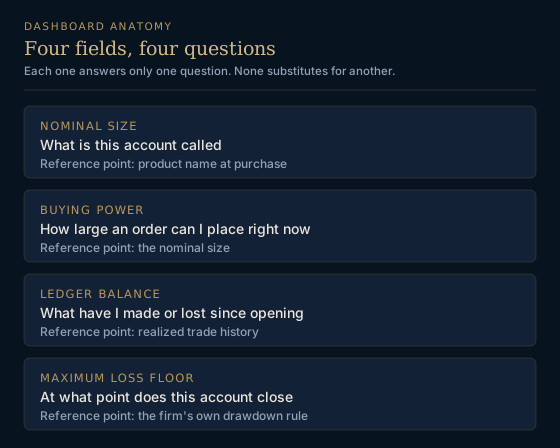
An account can trade with a zero balance because buying power and ledger balance are two different fields. Buying power sets how large an order the platform accepts. Ledger balance records accumulated profit or loss. A firm can set buying power from a nominal size while the balance line still opens at zero.
That single fact resolves half of the confusion traders feel when a dashboard shows "$0.00" next to a $50,000 account label: no cash sits behind either number. Both are simulation parameters, not deposited money, at any prop firm, not only Ordane. To understand more about the nature of these accounts, read about whether a prop firm account is a demo account.
Buying Power and Ledger Balance Can Start at Different Values
Those two statements are not a contradiction. They describe two fields that happen to carry different numbers on day one.
Topstep (prop firm) structures the same moment differently from FTMO. Topstep says its post-pass simulated account starts with a zero balance that grows from trading profit, while the account retains the full buying power associated with its selected size even though the displayed starting balance is zero. (Topstep Express Account Parameters, retrieved 2026-08-07)
FTMO (prop firm) says its post-pass account starts with the same fictitious balance size selected for the evaluation, and that an active post-pass account has no direct account-size upgrade option outside its separate scale-up process. (FTMO Account Size FAQ, retrieved 2026-08-07)
So a trader moving from Topstep language to FTMO language, or the reverse, is not translating a single concept. Each firm has picked its own starting value for the balance field, and the choice is a design decision, not a universal rule of prop trading.
Nominal Size or Buying Power
Nominal size is the label on the account, the number in the product name: $50,000, $100,000, whatever size was purchased or earned. It is a reference value. Buying power is the operational consequence of that reference value: it caps how large a position the platform will let the trader open at any given moment. A $50,000 nominal account might carry buying power calculated directly from that figure, but the two are not interchangeable terms for a spreadsheet. Nominal size names the account. Buying power limits the order.
Ledger Balance and Maximum Loss Floor
Ledger balance is the running total of realized profit and loss since the account started, whatever that starting value happened to be, zero or a full nominal figure. It moves after every closed trade. The maximum loss floor is a separate line entirely: it is the equity level below which the account closes, and it is calculated from the account's own starting rule, not from the current balance figure a trader might expect. A balance of zero does not mean a loss floor of zero. It means the floor is anchored somewhere else, defined by that firm's own rule, and a trader who assumes the floor tracks the balance number one-to-one is reading the wrong field. For a deeper open how different drawdown types impact this, see our article on static vs. trailing drawdown.
Four fields matter, and each answers one question only:
| Field | Question It Answers | Typical Reference Point |
|---|---|---|
| Nominal size | What is this account called | Product name at purchase |
| Buying power | How large an order can I place right now | Nominal size |
| Ledger balance | What have I made or lost since the account opened | Realized trade history |
| Maximum loss floor | At what point does this account close | The firm's own drawdown rule |
Order Accepted by Buying Power
Declared inputs: a $50,000 nominal account, a starting ledger balance of $0, and buying power extended against the $50000 nominal size. The trader places one order. The platform checks buying power, not the current ledger balance, before accepting the order. Buying power is sufficient because it is calculated from the $50,000 nominal figure, so the order fills. Nothing about the $0 starting balance blocks the trade. This is the entire mechanism that confuses new traders: the field that gates the order and the field that shows on the summary screen are not the same field.
Profit Changes Balance While the Floor Stays Visible
Declared inputs for this check only: starting ledger balance 0; gain 1200; second gain 600. Arithmetic: 1200 + 600 = 1800. Arithmetic: 1200 + 600 = 1800 under these declared inputs for a two-trade sequence check. Ledger balance now reads $1,200. Buying power, tied to the nominal $50,000 figure rather than to the balance, does not shrink because of this gain, and the maximum loss floor, wherever that firm's rule sets it, has not moved either, because the floor is a separate calculation from realized profit. For more on how these numbers interact, explore the difference between balance and equity.
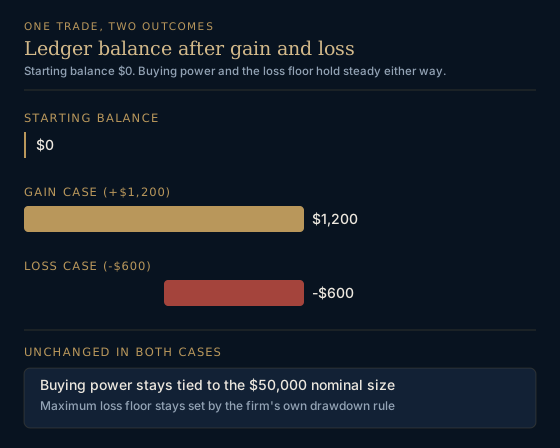
Now run the loss case. Declared inputs: starting ledger balance $0, loss $600. Arithmetic: 0 - 600 = -600 (same as $0 - $600 = -$600). A negative ledger balance is possible in a structure that starts the balance field at zero, because the balance field is simply tracking profit and loss, and profit and loss can run negative before it runs positive.
| Scenario | Starting Balance | Trade Result | Arithmetic | Resulting Balance |
|---|---|---|---|---|
| Gain case | $0 | +$1,200 | $0 + $1,200 | $1,200 |
| Loss case | $0 | -$600 | $0 - $600 | -$600 |
Whether a negative balance by itself triggers closure depends on where that firm has set its maximum loss floor relative to the account's other parameters, which is exactly why the floor has to be read as its own field rather than inferred from the balance sign. Understanding the daily loss limit is crucial here.
Find the Actual Liquidation Line
The number that closes the account is rarely the balance figure a trader glances at first. It is the maximum loss floor, and that floor is set relative to the account's starting parameters as defined in that firm's own rule, not relative to the live balance reading. Before trading a size, a trader should locate the specific rule or clause that defines the floor and confirm what value it is measured against. This is a key part of how to audit a prop firm before committing.
Confirm What a Payout Percentage Applies To
A payout split applies to profit, meaning the positive movement of the ledger balance field, not to the nominal account size and not to buying power. Confirm, in the firm's own documentation, whether the payout basis is calculated from the ledger balance's net gain since the account opened, and whether any withdrawal caps or cycle rules attach to that same figure. Our article on prop firm profit split explained covers this in detail.
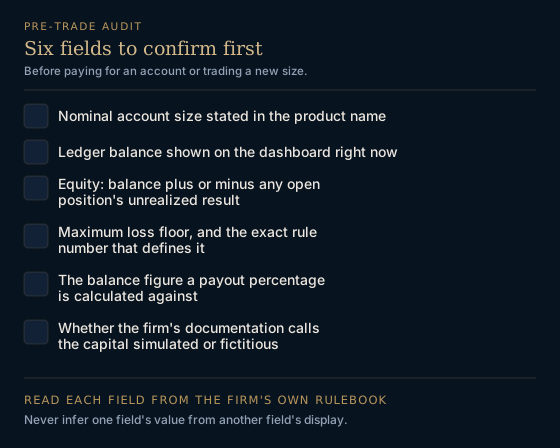
Six fields to capture and verify before paying for an account or accepting a new size:
- [ ] Nominal account size stated in the product name
- [ ] Ledger balance shown on the dashboard right now
- [ ] Equity, meaning balance plus or minus any open position's unrealized result
- [ ] Maximum loss floor, and the exact rule number that defines it
- [ ] The balance figure a payout percentage is calculated against
- [ ] Whether the firm's own documentation calls the capital simulated or fictitious
Why Does Leverage Make the Floor-Versus-Balance Distinction Matter More?
Simulated accounts often run on leveraged CFD or futures-style products, and the regulatory warnings attached to leverage explain why the distinction between a display number and a liquidation trigger is not cosmetic. ESMA's standard risk warning for CFDs states that CFDs are complex instruments and come with a high risk of losing money rapidly due to leverage. (ESMA CFD product intervention notice, retrieved 2026-08-10)
The CFTC's customer advisory on virtual currency trading states that speculating in virtual currency futures and options markets should be considered a high-risk transaction, like all futures products, because entering futures through leveraged accounts amplifies the underlying risk. (CFTC virtual currency advisory, retrieved 2026-08-10)
Leverage is exactly what lets a $50,000 nominal account extend meaningful buying power from a $0 ledger balance in the first place, and it is exactly what makes the maximum loss floor, not the balance display, the field that actually decides when the account closes.
Four Nominal Sizes Are Published
Ordane Instant Account comes in five sizes: $2,500, $10,000, $25,000, $50,000 and $100,000. (Ordane Rulebook v1.0, section 1, retrieved 2026-08-07) Those four figures are the nominal sizes published in Ordane's own rulebook.
Simulated Capital Is Not a Deposit
(Ordane Rulebook v1.0, clause P-2, retrieved 2026-08-07) Ordane's public rulebook does not publish whether the ledger balance display on its own dashboard opens at zero, at the nominal size, or at some other value, so this article does not claim parity with any competitor's balance convention. A trader on an Ordane account should read the maximum drawdown floor and the daily loss limit directly from Rulebook v1.0 rather than assume another firm's balance convention applies. The drawdown and payout-split mechanics that govern an Ordane account are covered in full at prop-firm-balance-vs-equity and static-vs-trailing-drawdown, and this article does not repeat that explanation here.
Is the Account Size Withdrawable?
No. Nominal account size is a reference figure that sets buying power. It is not a cash balance and is not itself withdrawable. What can potentially be withdrawn is profit recorded in the ledger balance field, subject to that firm's own payout rules.
Can Balance Be Negative?
Yes, in a structure where the ledger balance starts at zero and simply tracks profit and loss, a losing trade can push that figure below zero before the maximum loss floor, a separate calculation, triggers account closure.
Is Buying Power the Same as Equity?
No. Buying power is the cap on order size, typically tied to nominal account size. Equity is the ledger balance adjusted for any open position's current unrealized profit or loss. The two are calculated from different inputs and answer different questions.
Which Number Triggers Closure?
The maximum loss floor triggers closure, not the ledger balance by itself and not buying power. The floor is defined by each firm's own rule relative to the account's starting parameters, and that definition has to be read directly rather than assumed from the balance display.
Does Ordane Start at Zero?
Ordane's public rulebook publishes its four nominal account sizes and confirms the accounts run on simulated capital, but it does not publish whether the dashboard's ledger balance field opens at zero or at the nominal size. For the drawdown floor and payout mechanics that do govern an Ordane account, see prop-firm-balance-vs-equity, static-vs-trailing-drawdown and is-a-prop-firm-account-a-demo-account, which each own a distinct piece of that explanation and are not repeated in this article.
Sources
- Ordane Rulebook v1.0, section 1 ordanemarkets.com Retrieved 2026-08-07.
- Topstep Express Account Parameters help.topstep.com Retrieved 2026-08-07.
- FTMO Account Size FAQ ftmo.com Retrieved 2026-08-07.
- Notice of product intervention decisions on CFDs and binary options | ESMA esma.europa.eu Retrieved 2026-08-10.
- Customer Advisory: Understand the Risks of Virtual Currency Trading | CFTC cftc.gov Retrieved 2026-08-10.