Home · The Ordane Journal · Risk and exposure · Prop Firm Profit Target Explained: The Number You Must Hit to Pass
Prop Firm Profit Target Explained: The Number You Must Hit to Pass
By the Ordane desk
Every prop firm evaluation is built around one number: the profit target. Reach it and you pass. Miss it, or break a loss rule reaching for it, and the account closes. Ordane accounts operate on simulated capital. No live funds are traded and no deposits are accepted. (Ordane Rulebook v1.0, retrieved 2026-07-28) So before you judge a target by how big it looks, read the rest of this page. The target is not a finish line. It is one side of a ratio, and the other side is the drawdown.
A profit target is the minimum profit, set as a percentage of account size, that a trader must reach during an evaluation phase to pass, without breaching the daily loss limit or the maximum drawdown. It is a threshold the firm sets before you buy, not a goal set by ambition.
What a profit target actually is
Ordane sells one product, the Ordane Instant Account: direct access, no evaluation phase and no challenge. With no evaluation phase, there is no profit target to hit.
Why an evaluation has one at all
An evaluation is a filter. The firm is not looking for the largest gain. It is looking for proof that you can produce a gain while staying inside a fixed risk box. The target is the pass mark on that test. The loss limits are the box. Both are set by the firm before you buy, and both apply only while you are in the evaluation.
Profit target vs drawdown: the ratio is the real difficulty
Target against drawdown is what sets it
A 10 percent target sounds harder than a 6 percent target. On its own, that number tells you almost nothing. What sets the real difficulty is the room you have to reach it. A target is only as hard as the drawdown it sits against. The question is not "how much must I make," it is "how much can I lose while I make it."
Why a tight ratio forces leverage
When the target is a large share of your loss room, you have little margin for a losing streak. Small, patient positions may not reach the target inside the time or the risk you are given. So the temptation is to size up. Bigger positions reach the target faster, and they also hit the drawdown faster. That leverage, taken on to close the gap between a high target and a thin drawdown, is the mechanism that breaches most evaluations. Not the target alone. The ratio.
The math on a concrete account size
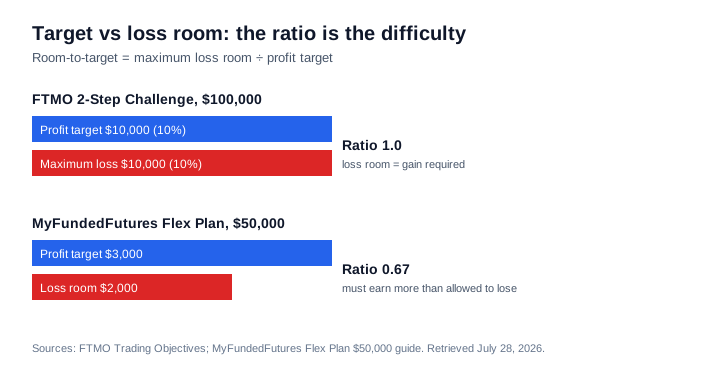
Take FTMO's 2-Step Challenge on a $100,000 account. Phase one asks for a 10 percent profit target, which is $10,000 (FTMO, Trading Objectives, retrieved 2026-07-29). The maximum loss on that challenge is 10 percent, static against the initial capital, which is also $10,000 (FTMO, Trading Objectives, retrieved 2026-07-29). So you must make $10,000 without your account ever falling $10,000 from its start. The target equals the entire loss room: a one-to-one ratio. Every dollar of progress toward passing spends a dollar of the room that keeps you alive.
Now compare MyFundedFutures on its Flex Plan $50,000 account. The profit target is $3,000 and the end-of-day trailing maximum loss limit is $2,000 (MyFundedFutures, Flex Plan $50,000 guide, retrieved 2026-07-29). Here the target is 1.5 times the loss room. You must make more than you are allowed to lose. Judge any evaluation this way, target against drawdown, and the sales-page number stops fooling you.
Room-to-target: the number the sales page never prints
The one ratio that tells you the real difficulty
Room-to-target is the number every sales page leaves out. Define it once and you can rank any evaluation in under a minute: room-to-target equals the maximum loss room divided by the profit target, both read off the same offer. A value at or above 1 means the loss room is roughly as large as the gain required, which is survivable at normal position size. A value well below 1 means you must earn more than you are allowed to lose, which is only reachable by sizing up, and that added size is the mechanism that breaches accounts. FTMO's 2-Step Challenge sits at 1.0: a 10 percent target against a 10 percent maximum loss (FTMO, Trading Objectives, retrieved 2026-07-29). MyFundedFutures' Flex Plan $50,000 sits at 0.67: a $2,000 loss room against a $3,000 target (MyFundedFutures, Flex Plan $50,000 guide, retrieved 2026-07-29). One caution when you compare ratios across firms: check what kind of floor the loss room is, static or trailing, because a trailing floor spends part of the room as your balance grows.
From ratio to trade count on a real account
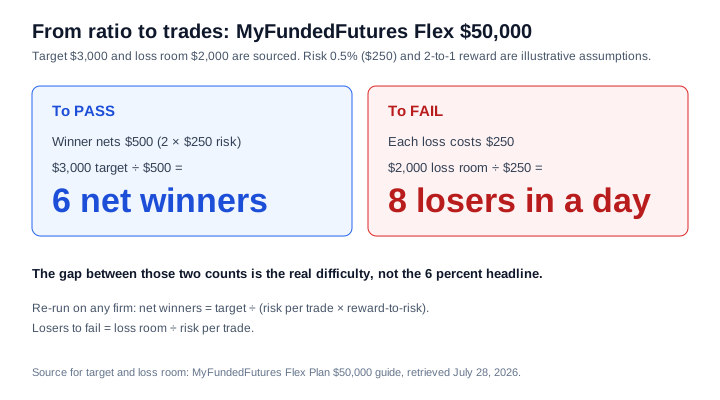
The ratio becomes concrete when you turn it into trades. Take the MyFundedFutures Flex Plan $50,000 account: a $3,000 target and a $2,000 end-of-day loss room (MyFundedFutures, Flex Plan $50,000 guide, retrieved 2026-07-29). The two inputs that follow, a 0.5 percent risk per trade and a 2-to-1 reward-to-risk, are illustrative assumptions chosen to make the arithmetic concrete. They are not a recommendation and not a claim about typical results. At 0.5 percent of $50,000 you risk $250 a trade, and at 2-to-1 a winner nets $500. So six net winners clear the $3,000 target ($3,000 divided by $500), while eight losing trades in a single day reach the $2,000 loss room ($2,000 divided by $250) and end the day. Print the two side by side: six net winners to pass, eight bad trades in one day to fail. The gap between those counts, not the headline percentage, is the actual difficulty of the evaluation. One scope note: the trade counts ignore the plan's other pass conditions. The same evaluation applies a 50 percent consistency rule and requires a minimum of 2 trading days (MyFundedFutures, Flex Plan $50,000 guide, retrieved 2026-07-29), so six winners packed into one outsized day would clear the dollar target and still not pass.
To re-run this on any firm in under a minute: room-to-target equals maximum loss room divided by profit target; net winners to pass equals target divided by (risk per trade times reward-to-risk); losers to fail equals loss room divided by risk per trade. Feed in the firm's two sourced numbers and your own two assumptions, and the difficulty stops being a feeling.
| Offer | Profit target | Max loss room | Room-to-target | Source |
|---|---|---|---|---|
| FTMO 2-Step Challenge | 10% (phase one) | 10%, static | 1.0 | FTMO Trading Objectives, retrieved 2026-07-29 |
| FTMO 1-Step Challenge | 10% | 10%, EOD trailing | 1.0 | FTMO Trading Objectives, retrieved 2026-07-29 |
| MyFundedFutures Flex $50,000 | $3,000 | $2,000, EOD trailing | 0.67 | MyFundedFutures Flex Plan $50,000 guide, retrieved 2026-07-29 |
One-step vs two-step profit targets, and what happens after you pass
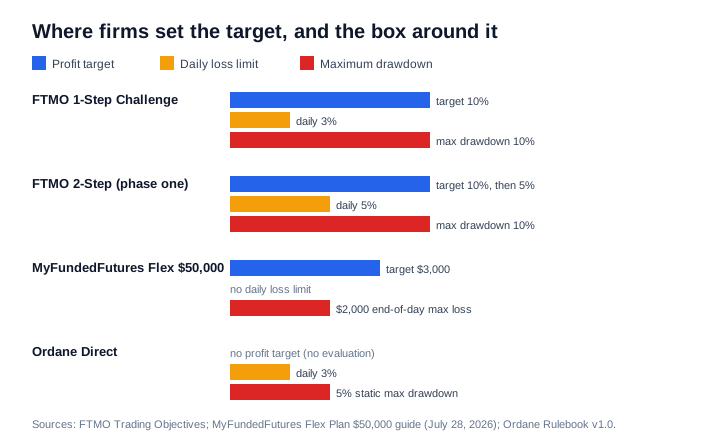
Evaluations come in two common shapes. A one-step model asks for a single target in one phase. FTMO's 1-Step Challenge sets that target at 10 percent, against a 3 percent daily loss limit and a 10 percent maximum loss that trails end-of-day, recalculated daily at 00:00 CE(S)T from the highest achieved balance (FTMO, Trading Objectives, retrieved 2026-07-29). A two-step model splits the work across two phases. FTMO's 2-Step Challenge asks 10 percent in phase one and 5 percent in Verification, against a 5 percent daily loss limit, a static 10 percent maximum loss measured from the initial capital, and a minimum of 4 trading days (FTMO, Trading Objectives, retrieved 2026-07-29).
Here is the fact traders miss. The profit target applies only during the evaluation. Once you clear the phases and reach the post-evaluation account, there is no fixed target to hit. That next account is still simulated, not a live brokerage account: FTMO states that all accounts it provides to clients are demo accounts with fictitious funds, trading in a simulated environment only, and MyFundedFutures names its next stage the Sim Funded Stage (FTMO, Trading Objectives; MyFundedFutures, Flex Plan $50,000 guide, both retrieved 2026-07-29). You trade and withdraw under that account's own rules, not under a threshold you must beat by a deadline. The reason firms drop the target is simple: it was a filter, and once you have passed the filter it has already done its job. The target is a gate you pass through once, not a rule you carry forever.
Whether you should buy an evaluation at all, instead of an instant account, is a separate purchase decision covered in our guide to instant account versus the evaluation prop firm. This page owns the target mechanic, not that choice.
Where named firms set the target
Each row below is quoted from the firm's own live documentation, so you can see the target-to-drawdown ratio, not just the target.
| Firm | Profit target | One-step or two-step | Daily loss limit | Max drawdown | Room-to-target (loss room ÷ target) |
|---|---|---|---|---|---|
| FTMO 2-Step Challenge | 10% phase one, 5% Verification | Two-step | 5% | 10%, static | 1.0 |
| FTMO 1-Step Challenge | 10% | One-step | 3% | 10%, EOD trailing | 1.0 |
| MyFundedFutures (Flex Plan, $50,000) | $3,000 | Single Evaluation Stage into a Sim Funded Stage | None | $2,000, EOD trailing | 0.67 |
Sourcing note. FTMO rows come from the FTMO Trading Objectives page (ftmo.com/en/trading-objectives), retrieved 2026-07-29. The MyFundedFutures row is scoped to the Flex Plan $50,000 account only and comes from that plan's guide in the MyFundedFutures Help Center (help.myfundedfutures.com), retrieved 2026-07-29. The MyFundedFutures figures are dollar values for the $50,000 size and do not describe the firm's other plans or sizes. The final column is computed by us, not quoted: room-to-target equals the maximum loss room divided by the profit target from the two sourced cells in that same row. FTMO rows use the 10 percent maximum loss against the 10 percent target, giving 1.0; the MyFundedFutures row uses the $2,000 end-of-day loss room against the $3,000 target, giving 0.67. The two FTMO floors are not the same kind despite the identical 10 percent: the 2-Step limit is static, measured from the initial capital, while the 1-Step limit trails end-of-day from the highest achieved balance, so its room shrinks as the balance grows; the mechanics of that difference are covered in our static versus trailing drawdown guide. The table also omits pass conditions that sit beside target and drawdown: FTMO's 2-Step Challenge requires a minimum of 4 trading days, and the MyFundedFutures Flex Plan $50,000 evaluation applies a 50 percent consistency rule and requires a minimum of 2 trading days. No pass or fail rate is stated here because none was found in these firms' own documentation. These rules change: this table is accurate as of 2026-07-29, and should be re-checked within 90 days.
Why Ordane has no profit target
The whole ratio problem above assumes there is an evaluation to pass. Ordane does not run one.
Ordane sells one product, the Ordane Instant Account: direct access, no evaluation phase and no challenge, on simulated capital.
Ordane sells one product, the Ordane Instant Account: direct access, no evaluation phase and no challenge. (Ordane Rulebook v1.0, retrieved 2026-07-28) With no evaluation phase, there is no profit target to hit. Ordane Instant Account comes in four sizes: $10,000, $25,000, $50,000 and $100,000. (Ordane Rulebook v1.0, retrieved 2026-07-29)
That does not mean there is no discipline. Read the drawdown beside it. Ordane's maximum drawdown is 5 percent and static: account equity may never fall below 95 percent of the initial balance. The floor is fixed on day one, never trails upward, and a breach closes the account. (Ordane Rulebook v1.0, clause R-1, retrieved 2026-07-28) The daily loss limit is 3 percent, measured against the balance at the start of the server day. A breach closes the account. (Ordane Rulebook v1.0, clause R-2, retrieved 2026-07-28) So the honest trade is visible: no target to chase, but the same fixed risk box from the first minute. The drawdown mechanics themselves are covered in our guide to static versus trailing drawdown.
The concession, stated plainly. Skipping the evaluation means you pay for direct access instead of proving yourself first through a cheaper challenge. That suits a trader who is confident in a process and does not want to spend weeks passing a test to reach the post-evaluation account. It does not suit a trader whose main goal is the lowest possible upfront cost, who may prefer a low-priced challenge and the risk of failing it. Ordane makes one of those trades, out loud. The governing document is Ordane Rulebook v1.0, published 2026-07-23.
Questions traders ask about the profit target
How much profit passes a prop firm evaluation?
It depends on the firm and the model. FTMO's 1-Step Challenge sets a 10 percent target, and its 2-Step Challenge asks 10 percent in phase one and 5 percent in Verification (FTMO, Trading Objectives, retrieved 2026-07-29). Always read the target next to the drawdown, because that ratio, not the target, sets how hard it truly is.
What is the difference between a one-step and a two-step target?
A one-step model asks for a single target in one phase, usually a larger one. A two-step model splits the work across two phases, often a bigger first target and a smaller second. FTMO's 2-Step Challenge, for example, asks 10 percent then 5 percent (FTMO, Trading Objectives, retrieved 2026-07-29). The total path differs, but both are gates you pass once before the post-evaluation account.
Does the profit target stay after you pass?
No. The profit target applies only during the evaluation. Once you clear it and reach the post-evaluation account, there is no fixed target you must beat by a deadline. FTMO, for example, states there is no profit target on the subsequent FTMO Account (FTMO, Trading Objectives, retrieved 2026-07-29). You trade and withdraw under that account's own rules instead. The target is a one-time gate, not a rule you carry into the account that follows.
Why do most traders fail the target?
Usually the ratio, not the number. When the target is a large share of the loss room, patient position sizes may not reach it in time, so traders size up. Bigger positions reach both the target and the drawdown faster. That added leverage, taken on to close the gap, is what breaches accounts.
How many winning trades does it take to hit a profit target?
It depends on your risk per trade and your reward-to-risk, not on the target alone. On the MyFundedFutures Flex Plan $50,000 account, the target is $3,000 (MyFundedFutures, Flex Plan $50,000 guide, retrieved 2026-07-29). Risking 0.5 percent, which is $250, at 2-to-1 makes a $500 net winner, so six net winners clear it, provided the plan's 50 percent consistency rule and 2-day minimum are also met. Those two inputs are illustrative, not a recommendation.
Is an 8 percent profit target realistic?
It depends entirely on the drawdown beside it, not the 8 percent on its own. An 8 percent target against a 4 percent maximum loss forces you to earn twice your loss room, which usually means sizing up; the same 8 percent against a 16 percent loss leaves room to reach it at normal size. Judge it by the room-to-target ratio, not the headline number.
Are there accounts with no profit target?
Yes. Ordane sells one product, the Ordane Instant Account: direct access, no evaluation phase and no challenge (Ordane Rulebook v1.0, retrieved 2026-07-28). With no evaluation, there is no profit target. The risk rules still apply from day one: a 5 percent static maximum drawdown (Ordane Rulebook v1.0, clause R-1, retrieved 2026-07-28) and a 3 percent daily loss limit (Ordane Rulebook v1.0, clause R-2, retrieved 2026-07-28).
Disclosures
Ordane accounts operate on simulated capital. No live funds are traded and no deposits are accepted. Payouts depend on simulated performance under Rulebook v1.0; no level of performance is typical or assured.
This article is for information only and is not investment, financial, or tax advice.
Sources
- Trading Objectives | FTMO.com ftmo.com Retrieved 2026-07-29.
- Flex Plan - $50,000 / A Comprehensive Guide | My Funded Futures Help Center help.myfundedfutures.com Retrieved 2026-07-29.
- Ordane Rulebook v1.0 ordanemarkets.com Retrieved 2026-07-29.
- Notice of product intervention decisions on CFDs and binary options | ESMA esma.europa.eu Retrieved 2026-08-10.
- Customer Advisory: Understand the Risks of Virtual Currency Trading | CFTC cftc.gov Retrieved 2026-08-10.