Home · The Ordane Journal · Risk and exposure · Martingale and Grid Rules at Prop Firms
Martingale and Grid Rules at Prop Firms

Ordane accounts operate on simulated capital. No live funds are traded and no deposits are accepted. Payouts depend on simulated performance under Rulebook v1.0; no level of performance is typical or assured.
Ordane sells one product, the Ordane Instant Account: direct access, no evaluation phase and no challenge, on simulated capital.
ESMA's product-intervention notice states that CFDs are complex instruments and come with a high risk of losing money rapidly due to leverage (ESMA, retrieved 2026-08-10). That instrument-risk frame is independent of any prop-firm marketing page.
A martingale strategy doubles position size after a loss to recover it in one trade. A grid strategy places a fixed ladder of buy and sell orders around a price, letting the market fill some and average the rest.
At Ordane, neither survives contact with the rulebook math: clause R-3 caps every trade at 1.5 percent risk with a mandatory stop-loss, and two maximum losses already equal the clause R-2 daily limit, so a third rung cannot exist in one day. (Ordane Rulebook v1.0, clauses R-2 and R-3, retrieved 2026-08-06)
Is Martingale Allowed on a Prop Firm Account?
For how equity counts open losses, see balance versus equity on a prop account.
The 40-word answer, quotable as written
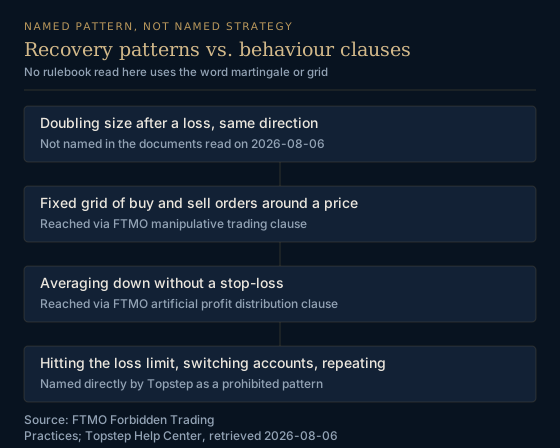
Neither FTMO nor Topstep names martingale or grid trading in its documents. Both ban behaviours a recovery ladder can produce: opposite positions opened for manipulation, profit spread across days without matching risk. The daily loss limit usually reaches the strategy before any rule is quoted.
Table 1: Recovery Patterns Against the Clauses That Reach Them
| Recovery pattern | Named in the documents read on 2026-08-06 | Clause that can reach it | Daily loss limit reaches it first | Published consequence |
|---|---|---|---|---|
| Doubling size after a loss, same instrument, same direction | Not named in the documents read on 2026-08-06 | None quoted reaches this pattern on its face | Yes, at firms with an equity-based intraday limit | Not specified for this pattern alone |
| Fixed grid of buy and sell orders around a price | Not named as "grid" | FTMO manipulative-trading clause, simultaneous opposite positions (FTMO, Forbidden Trading Practices, retrieved 2026-08-06) | Depends on grid spacing and account size | Not specified for this pattern alone |
| Averaging down without a stop-loss | Not named in the documents read on 2026-08-06 | FTMO artificial profit distribution clause, by pattern over time (FTMO, Forbidden Trading Practices, retrieved 2026-08-06) | Yes, unrealized loss counts against equity-based limits | Not specified for this pattern alone |
| Hedging a loser with an opposite position | Not named as "hedge" outside the manipulative-trading example | FTMO manipulative-trading clause (FTMO, Forbidden Trading Practices, retrieved 2026-08-06) | Only if the net position still carries loss against the limit | Not specified for this pattern alone |
| Hitting the loss limit, then switching to a second account and repeating | Named directly at Topstep | Topstep's named prohibited pattern (Topstep Help Center, Prohibited Conduct, retrieved 2026-08-06) | The pattern is defined by hitting the limit, so no, the limit is the trigger | Warning, deletion of the impacted trading day, account reset, permanent account closure, delay or denial of a payout request (Topstep Help Center, Prohibited Conduct, retrieved 2026-08-06) |
Cells reading "not named in the documents read on 2026-08-06" are a finding, not a gap to be filled with a plausible-sounding ban. No document in the ledger names martingale, grid trading, or averaging down as such.
Does the Loss Limit Get There Before the Rule Does?
For how a daily loss limit is calculated, see how a daily loss limit is calculated.
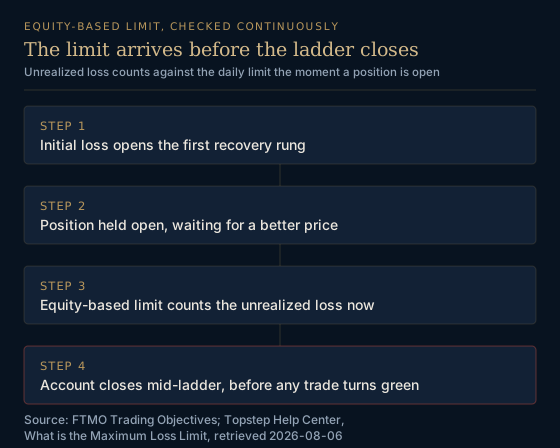
What intraday checking does to a recovery plan
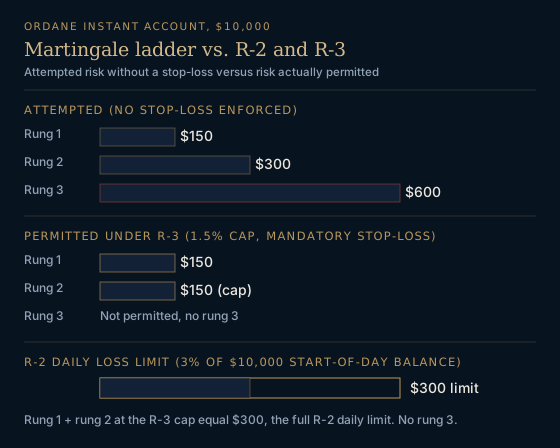
The following table works the arithmetic on an Ordane Instant $10,000 simulated account, where clause R-3 sets maximum risk per trade at 1.5 percent of current balance with a mandatory stop-loss at entry, and clause R-2 sets the daily loss limit at 3 percent of the balance at the start of the server day.
Table 2: The Ladder Against Ordane's R-2 and R-3 on a $10,000 Account
| Ladder rung | Attempted position risk if no stop-loss enforced | Cumulative open risk if all rungs stayed open | Actual permitted risk under R-3 (1.5% of $10,000) | Cumulative risk under R-3 |
|---|---|---|---|---|
| Rung 1, first entry after a loss | $150 | $150 | $150 | $150 |
| Rung 2, doubled after rung 1 loses | $300 | $450 | Not permitted; capped at $150 | $300 |
| Rung 3, doubled again after rung 2 loses | $600 | $1,050 | Not permitted; capped at $150 | $450, but account already closed |
| Ordane R-2 daily loss limit (3% of $10,000 start-of-day balance) | $300 |
Under Ordane's clause R-3, the ladder above is not merely discouraged, it is arithmetically impossible past the first rung, because every trade is capped at $150 of risk with a mandatory stop-loss attached at entry (Ordane Rulebook v1.0, clause R-3, retrieved 2026-08-06). Two maximum-risk losses in a single day already equal $300, which is exactly Ordane's daily loss limit of 3 percent measured against the start-of-day balance (Ordane Rulebook v1.0, clause R-2, retrieved 2026-08-06). A trader running rung 1 and rung 2 at the maximum permitted size has already used the entire daily allowance: 150 plus 150 equals 300. There is no rung 3. The design does not need a martingale ban written into it, because the per-trade cap and the daily limit are set to intersect at exactly the point a doubling ladder would try to cross.
Does Automation Change Anything?
For speed and technical caps, see scalping rules on prop accounts.
The Rule Design That Answers the Question in Advance
Ordane's prohibited-practice list is closed. Clause R-6 names six practices: latency, reverse or hedge arbitrage; high-frequency or bulk automated exploitation; copy trading between Ordane accounts; straddling news releases with paired opposing orders; platform or data-feed exploitation; and gap abuse. If a behavior is not listed in that section, it is not a violation. Discretion is not a rule. (Ordane Rulebook v1.0, retrieved 2026-08-10).
The daily loss limit is 3 percent, measured against the balance at the start of the server day. A breach closes the account. (Ordane Rulebook v1.0, retrieved 2026-08-10).
Maximum risk per trade is 1.5 percent of current balance and a stop-loss is mandatory at entry. Two maximum losses equal the daily limit, which is the design rather than an accident. (Ordane Rulebook v1.0, retrieved 2026-08-10).
Discretion and unwritten rules are covered in whether a firm can enforce a rule it never wrote.
Ordane's clause R-3 caps risk per trade at 1.5 percent of current balance with a mandatory stop-loss at entry, and clause R-2 sets the daily loss limit at 3 percent measured against the balance at the start of the server day (Ordane Rulebook v1.0, clause R-3, retrieved 2026-08-06) (Ordane Rulebook v1.0, clause R-2, retrieved 2026-08-06). Together, these two numbers do not administratively forbid a doubling ladder, they make one arithmetically impossible: two maximum-size losses already exhaust the daily limit, so a third rung cannot exist inside a single trading day regardless of what the trader intends to run. This is a deliberate exclusion, not an oversight, and it is worth stating plainly what it costs. A trader who wants to average down into a losing position without a stop-loss cannot do that here. The mandatory stop at entry under R-3 removes that option at the point of order placement, not after the fact.
Ordane's prohibited-practice list under clause R-6 is closed: if a behaviour is not listed in that section, it is not a violation (Ordane Rulebook v1.0, clause R-6, retrieved 2026-08-06). What that closed list contains, and how it differs from an open, discretionary catch-all like the ones quoted above from FTMO, is covered in full in can a prop firm enforce an unwritten rule, and is not restated here.
Frequently Asked Questions
For how static and trailing drawdown floors work, see static versus trailing drawdown.
Can a firm close an account for a strategy it never named in its rulebook?
Yes, at firms that carry an open catch-all clause. FTMO's list closes with language reaching any pattern it "reasonably considers might cause financial, reputational, or other harm" (FTMO, Forbidden Trading Practices, retrieved 2026-08-06), which by design covers strategies with no name attached to them anywhere in the document. At a firm with a closed list, such as Ordane's clause R-6, a behaviour not listed is not a violation (Ordane Rulebook v1.0, clause R-6, retrieved 2026-08-06).
Can a grid EA pass an evaluation?
FTMO permits algorithmic trading and EAs by name, subject to the same three conditions that apply to any strategy (FTMO, FAQ, retrieved 2026-08-06). Whether a specific grid configuration crosses into the simultaneous-opposite-positions clause depends on spacing and intent, which is not something either rulebook quantifies. No document in the ledger states a pass rate or approval outcome specific to grid EAs.
What happens to profits earned by a strategy later ruled prohibited?
Topstep publishes a consequence ladder for prohibited conduct: a warning, deletion of the impacted trading day, an account reset, permanent account closure, or delay or denial of a payout request (Topstep Help Center, Prohibited Conduct, retrieved 2026-08-06). That ladder is Topstep's own published sequence and is not stated here as a market-wide practice; no other firm in this ledger publishes an equivalent list.
How do you get a written answer from a firm before paying?
An independent US regulator frames leveraged speculation the same way: like all futures products, speculating in these markets should be considered a high-risk transaction (CFTC, retrieved 2026-08-10).
Worked recovery arithmetic
Declared inputs for this check only: first loss 150; doubled recovery stake 150; flat simulated account 10000; daily loss limit 3 percent.
| Step | Value | Arithmetic |
|---|---|---|
| First loss | 150 | Declared |
| Doubled stake | 150 | Declared |
| Combined | 300 | 150 + 150 = 300 |
| Daily limit dollars | 300 | 10000 x 0.03 = 300 |
Arithmetically: 150 + 150 = 300, which equals 10000 x 0.03 = 300 on these declared inputs.
Sources
- FTMO FAQ, which instruments and strategies are allowed ftmo.com Retrieved 2026-08-06.
- FTMO, Forbidden Trading Practices ftmo.com Retrieved 2026-08-06.
- Topstep Help Center, Prohibited Trading Strategies at Topstep help.topstep.com Retrieved 2026-08-06.
- Topstep Help Center, Prohibited Conduct help.topstep.com Retrieved 2026-08-06.
- Topstep Help Center, What is the Maximum Loss Limit help.topstep.com Retrieved 2026-08-06.
- FTMO, Trading Objectives ftmo.com Retrieved 2026-08-06.
- Ordane Rulebook v1.0, clause R-3 ordanemarkets.com Retrieved 2026-08-06.
- MIT 6.042 Lecture 26: The Gambler's Ruin courses.csail.mit.edu Retrieved 2026-08-10.
- Notice of product intervention decisions on CFDs and binary options | ESMA esma.europa.eu Retrieved 2026-08-10.
- Customer Advisory: Understand the Risks of Virtual Currency Trading | CFTC cftc.gov Retrieved 2026-08-10.