Home · The Ordane Journal · Pricing and Cost · How Trading Costs Reduce Prop Firm Drawdown
How Trading Costs Reduce Prop Firm Drawdown
A trade closes green on the chart and red in the account. That gap is not a platform bug. It is the commission, the spread, the swap, and the slippage arriving after the fill, in a place most traders never check until a rule fires.
Ordane accounts operate on simulated capital. No live funds are traded and no deposits are accepted. Clause P-2 of the Ordane Rulebook v1.0 requires that declaration. Ordane sells one product, the Ordane Instant Account: direct access, no evaluation phase and no challenge, on simulated capital (Ordane Rulebook v1.0, section 1, retrieved 2026-08-04). That matters here for one narrow reason: the cost you pay to open a position is a real charge against a simulated balance, and the loss limit measuring that balance does not care where the loss came from.
This article does one job. It moves trading costs off the pricing page and into the risk calculation, where a small charge decides whether equity touches a contract limit, the same static ceiling covered in the guide to static vs trailing drawdown.
Which Trading Costs Affect a Prop Firm Account?
Most cost confusion is a definitions problem. Traders lump four different mechanics into one word, "fees," then get surprised when only some of them show up where they expected. It is one of the checks worth running as part of any audit of a prop firm before you pay.
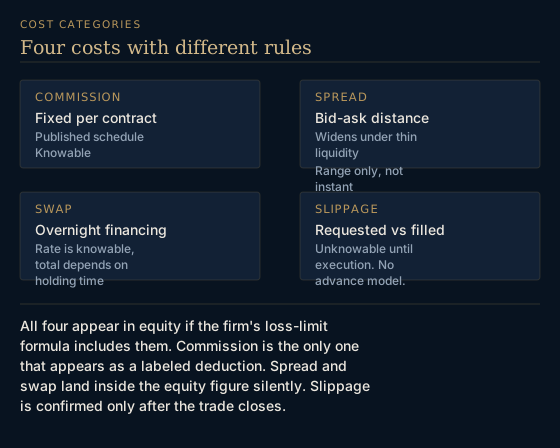
A liftable cost definition
Use this test. A trading cost is any charge that changes your account balance or equity as a direct consequence of opening, holding, or closing a position, and that is not the market moving against you.
That test has two useful edges. It excludes the account fee you paid to buy the account, which is a purchase, not a per-trade charge. And it includes charges that arrive while a position is still open, which is the category that catches people.
Commission, spread, swap and slippage are different
Commission is a stated charge per contract, per lot, or per side. It is a schedule you can read before you trade. On the futures side it arrives bundled with exchange and regulatory fees. Topstep's fee page separates three of them: commissions, an exchange fee, and an NFA regulatory fee (Topstep, retrieved 2026-08-04). A single per-contract number quoted anywhere else may already contain all three.
Topstep states that commissions and fees are deducted automatically from your balance with each filled trade, and that they show up in your net profit and loss (Topstep, retrieved 2026-08-04). Read the mechanism there, not just the number: deduction with the fill means the charge is not a monthly statement item you reconcile later. It lands on the balance as the trade fills.
Spread is the distance between bid and ask. It is not a line item on a schedule. You pay it by entering at one price and being able to exit only at a worse one, which means a position that has not moved at all still shows a small loss immediately after the fill. Spread widens under thin liquidity and around scheduled events, so the cost you modelled at noon is not the cost you pay at a release, the same window covered in the rules on trading news events.
Swap is the overnight financing charge on a held position. FTMO defines an FX swap as a cost, or an income, to traders for holding a position overnight (FTMO, retrieved 2026-08-04). The parenthetical in that definition is the part traders skip. Swap has a sign. Depending on the instrument and direction, holding can credit the account instead of debiting it. You still have to know which, because the one you assumed was a small debit can be a large one on a wide interest-rate differential.
Slippage is the difference between the price you requested and the price you received. It is not published anywhere in advance, because it is a property of the moment of execution rather than a property of the product. It is the only one of the four you cannot model from a document.
Those four behave differently in a rulebook. Commission is knowable and fixed. Spread is knowable in range but not in instant. Swap is knowable in rate but conditional on holding time. Slippage is not knowable at all. Any pre-trade check that treats them as one number is checking the wrong thing.
For the broader fee landscape beyond per-trade costs, including account fees, reset fees, and inactivity charges, see the coverage of hidden fees in prop firm pricing.
Where Do Costs Appear in Profit and Loss?
The practical question is not whether costs exist. It is which field on your dashboard they have already touched by the time you look at it.
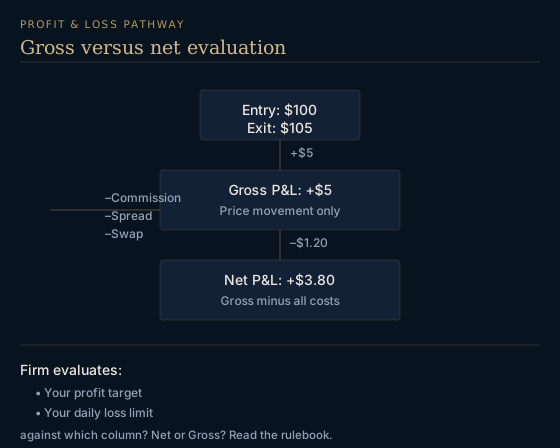
Gross result versus net result
Gross result is the price movement of your position: exit minus entry, times size. Net result is that number after every charge above.
Topstep states the distinction in exactly those terms: commissions and fees are deducted from your balance with each filled trade and show up in your net profit and loss (Topstep, retrieved 2026-08-04). "Net" is doing real work in that sentence. If a firm reports gross P&L in one place and net P&L in another, and your profit target is evaluated against one of them, you need to know which. It is also the number that decides whether a profit split payout lands where you expected.
The failure mode is not complicated. A trader watches a running total that excludes costs, reaches the target on that total, requests a payout, and finds the evaluated figure lower than the figure they were watching. Nothing was hidden. They were reading the wrong column.
Real-time equity can move before a trade closes
This is the mechanic that turns costs from an accounting detail into a risk parameter.
FTMO's maximum daily loss is measured on equity, and FTMO states that equity includes open positions, commissions, and swaps (FTMO, retrieved 2026-08-04). Read that as three separate inclusions. Open positions means the floating result of an unclosed trade counts. Commissions means the charge at fill counts. Swaps means the overnight financing counts.
The consequence: equity moves the instant you open a position, before the market has done anything. Commission lands, spread puts you fractionally underwater, and both are inside the number your daily limit watches. If the limit is measured against equity rather than closed balance, you started the day with slightly less headroom than the balance implied, and you spend a little more of it every time you enter.
FTMO is explicit that this matters near a limit. It says commission, swap and possible slippage must be considered near a loss limit (FTMO, retrieved 2026-08-04). That is a firm telling its own traders that the published loss threshold is not the threshold your P&L needs to respect, because costs sit between the two.
Can a Fee Cause a Rule Breach?
Yes, and the honest version of that answer is narrower and more useful than the alarmed version.
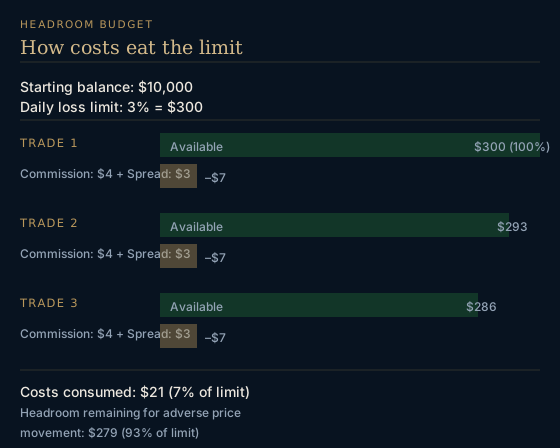
A fee does not cause a breach on its own. A fee reduces the distance between your current equity and the limit. What causes the breach is a market move into a gap that costs made smaller.
Costs consume loss-limit headroom
Think of headroom as a budget. If a daily limit sits three percent below the day's starting balance, that three percent is the entire budget for the day, and every charge is a withdrawal from it.
Two of those withdrawals happen without any adverse price movement. Commission is charged at fill. Spread puts the position underwater at the moment it opens. If you take several positions in a session, that is several small withdrawals from the same budget, none of which were losing trades.
Now add the third. A position held overnight pays swap, and that charge lands while the position is still open, which means it lands inside the equity figure being monitored. The charge is not spread evenly across the week either: FTMO states that a triple swap is charged overnight from Wednesday to Thursday, because most instruments need two days to settle a trade (FTMO, retrieved 2026-08-04). A trader holding through that rollover has less room the next morning than the balance on the statement suggested.
None of that is exotic. It is arithmetic, and FTMO puts a number on it. On 5 lots of EURUSD you pay $15 in turnover commission, so against a maximum daily loss of minus $500, a stop loss placed at exactly minus $500 does not respect the limit: the minus $15 commission still has to be accounted for (FTMO, retrieved 2026-08-04). The count that says "nowhere near the limit" is gross. The limit is net.
Overnight holding is where swap and headroom intersect most sharply, and firms differ on whether it is permitted at all. That is covered separately in the guide to overnight and weekend holding rules.
A target can be met gross and missed net
The same arithmetic runs the other direction, and it is the version that costs people payouts rather than accounts.
Suppose a profit target is a fixed percentage of the starting balance. A trader accumulates price movement equal to that percentage and stops, satisfied. But every one of those trades paid commission, crossed a spread, and possibly paid swap. The gross total cleared the bar. The net total, which is the one being evaluated, sits underneath it.
The trader is not wrong about their trading. They are wrong about which number was being measured. The fix is not more trading. The fix is reading the firm's own language for whether the target is evaluated on gross or net, and recording your own P&L the same way, one of the checks in the prop firm audit checklist.
That distinction, gross versus net evaluation, belongs on any due-diligence checklist alongside drawdown type and payout terms, along with a check on whether the account itself skips the evaluation phase.
How Do FTMO and Topstep Disclose Costs?
Two firms, two different disclosure surfaces. The value is not in the numbers, which change. It is in knowing where each firm chose to put the mechanism.
Table 1: named treatment and location
| Firm | What the firm states | Where it appears | Verified |
|---|---|---|---|
| Topstep | Commissions and fees are deducted automatically from your balance with each filled trade and show up in your net profit and loss (Topstep, retrieved 2026-08-04) | Help centre pricing article | 2026-08-04 |
| Topstep | The per-trade charge separates into commissions, an exchange fee, and an NFA regulatory fee (Topstep, retrieved 2026-08-04) | Help centre article on commissions and fees | 2026-08-04 |
| FTMO | Equity for the maximum daily loss calculation includes open positions, commissions and swaps (FTMO, retrieved 2026-08-04) | Academy lesson on maximum daily loss | 2026-08-04 |
| FTMO | An FX swap is a cost, or an income, for holding a position overnight, and a triple swap is charged overnight from Wednesday to Thursday (FTMO, retrieved 2026-08-04) | Blog article on swaps | 2026-08-04 |
| FTMO | Commission, swap and possible slippage must be taken into account when a stop loss is placed at the daily loss limit (FTMO, retrieved 2026-08-04) | Blog article on challenge mistakes | 2026-08-04 |
Read the pattern rather than the entries. Topstep documents costs as a settlement mechanic: they are deducted at fill. FTMO documents costs as a risk mechanic: they sit inside the equity figure that the daily loss rule watches, and traders are told to account for them near the threshold.
Both are correct. They are answering different questions, which is why checking one firm's framing does not tell you how another firm behaves, a gap this kind of comparison shares with the broader question of whether prop firms are legitimate in the first place.
Current schedules require fresh verification
Every figure in the table above carries a retrieval date of August 4, 2026, and a verification window that closes on November 2, 2026. That is not boilerplate caution.
Commission schedules change. Exchange and regulatory fees are set by venues and regulators, not by the prop firm, and they move on their own calendar. Swap size tracks the gap between the central-bank interest rates of the two currencies, and FTMO states the charge is applied at the end of the trading day, usually around midnight (FTMO, retrieved 2026-08-04). Spread models depend on the liquidity provider. Loss-limit formulas are rewritten when a firm revises its rulebook.
Five volatile inputs, five independent update cycles. A cost model built from a page you read six months ago is a model of a market that no longer exists. Re-read the source pages, and record the date you read them, so that when a number surprises you later, you know whether it changed or you misread it.
How Do You Run a Cost-Aware Pre-Trade Check?
The check is short. It has to be, or it will not survive contact with a live session.
Table 2: known and uncertain cost inputs
| Cost input | Knowable before the trade | What to record | Source to consult |
|---|---|---|---|
| Commission per side | Yes, from a published schedule | The exact per-contract or per-lot charge | Firm's fee page, dated |
| Exchange and regulatory fees | Yes, if broken out | Whether they are bundled into commission or listed separately | Firm's fee page, dated |
| Spread at entry | Range only, not instant | The observed spread at the moment of entry | Platform quote at fill |
| Swap, if holding overnight | Rate yes, total no | The rate and its sign, debit or credit (FTMO, retrieved 2026-08-04) | Instrument specification, dated |
| Slippage | No | Requested price versus filled price, after the fact | Fill confirmation |
| Which P&L the firm evaluates | Yes | Gross or net, in the firm's own words | Rulebook or help centre |
| Whether costs sit inside monitored equity | Yes | The exact formula language (FTMO, retrieved 2026-08-04) | Rulebook or academy page |
The two rows to fill first are the last two. Everything above them is arithmetic; those two tell you which arithmetic applies.
Notice that only one input, slippage, is genuinely unknowable in advance, and one, spread, is knowable as a range but not as a number. That is a manageable amount of uncertainty. The rest is reading, starting with the withdrawal requirements that first payout has to clear.
Record net P&L after the fill
Modelling costs before the trade is half the work. The half people skip is confirming, after the fill, what actually got charged.
Log four things per trade: requested price, filled price, total charge deducted, and resulting net result. Do it for a couple of weeks and you will have a personal cost baseline that no published schedule can give you, because it includes your instruments, your sizes, and your execution times.
That baseline is what lets you size a position against a loss limit honestly. FTMO's own guidance is to consider commission, swap and possible slippage when approaching a limit (FTMO, retrieved 2026-08-04). You cannot consider what you have never measured, and it is one more reason the question of whether prop firms actually pay starts with reading your own numbers correctly before it starts with reading theirs.
What Does Ordane Publish on Costs?
One confirmed distinction, and three things this article will not guess at.
No spread markup claim from the canonical store
Instruments: FX majors and minors, metals, indices, and crypto. No exotics. Leverage on FX majors and minors is 1:50; leverage for metals, indices, and crypto has not been set yet. (Confirmed by the owner, 2026-07-28) Ordane charges no spread, no commission and no swap: the account is simulated, so no order reaches an exchange and nothing is financed overnight, and neither line has a bill behind it. (Ordane, Trading Specification, retrieved 2026-09-01)
That is a statement about one of the four cost categories above. Pass-through means the spread you pay is the provider's spread. It is not a claim that spread is zero, and it does not remove spread from the equity calculation. It removes one specific thing: a margin added on top by the firm.
The Ordane rulebook is public, numbered and versioned, and no rule is ever applied retroactively to an open account. Changes produce a new version with a dated changelog entry, and the version you sign up under is the version that governs your account (Ordane Rulebook v1.0, notice above section 0, and section 6 Changelog, retrieved 2026-08-04). For a cost question, that matters in one way: a cost-relevant clause cannot be rewritten under an account already open.
Do not invent unsettled leverage or instrument details
The same record leaves leverage for metals, indices, and crypto unset. This article does not fill that in, and no reader should infer it from the FX figure.
It is equally clear about a second gap, and it is a cost gap. Whether a per-lot commission applies on top of the pass-through spread is not confirmed, so this article does not state that one does, and it does not state that one does not. Pass-through on spread is not an answer to the commission question.
The third is the plumbing. As of 2026-08-04 the payment and payout rails, including the minimum withdrawal amount, are not published on ordanemarkets.com, so this article makes no claim about how a charge or a payout moves. It also cites no Terms section on costs or refunds: every cost fact above comes from the rulebook and the canonical record.
Ordane is new. Its live homepage says it cannot show years of payout history; the rulebook says payout performance metrics begin with the first month in which a payout is requested. (ordanemarkets.com, reserve section, and Ordane Rulebook v1.0 clause PR-2, checked 2026-08-04) What can be verified today is the versioned rulebook and the on-chain payout reserve address, not a cost track record.
The distinction between static and trailing drawdown determines how much of that headroom you keep after a winning day, and it is covered in its own guide.
Questions traders ask about trading costs
Do commissions count toward daily loss?
At some firms, yes, and the firm will say so in its formula. FTMO states that equity for the maximum daily loss calculation includes open positions, commissions and swaps (FTMO, retrieved 2026-08-04). Where a limit is measured on equity defined that way, commission reduces headroom the moment it is charged. Check the formula language at your own firm rather than assuming, because the answer is a property of the rulebook, not of commissions in general.
Can swaps be positive?
Yes. FTMO defines an FX swap as a cost, or an income, for holding a position overnight (FTMO, retrieved 2026-08-04). Direction and instrument decide the sign. A positive swap is a credit while the position is held, and it also lands inside the monitored equity figure at firms that include swaps there. Do not plan around it: FTMO states the size of a swap is based on the interest rates of the central banks behind the two currencies, and the larger the difference in rates, the larger the swap (FTMO, retrieved 2026-08-04). A credit today is not a credit next month.
Is spread a separate charge?
Not as a line item. Commission is deducted as an identifiable amount, which is why Topstep can state that commissions and fees are deducted automatically from your balance with each filled trade and show up in your net profit and loss (Topstep, retrieved 2026-08-04). Spread is paid implicitly through the entry price: it shows up as the position being fractionally underwater at the moment it opens, not as a labelled deduction. Both consume headroom. Only one appears as a charge you can point to.
Which schedule should you save?
Save the firm's fee page, the loss-limit formula page, and the instrument specification page, each with the date you read it. All five cost inputs in this article are volatile: commission schedules, exchange and regulatory fees, swap rates, spread models, and loss-limit formulas each change on their own timetable. Dated copies let you distinguish "the rule changed" from "I remembered it wrong," which is the difference between a fixable process error and an argument you cannot win.
Sources
- Topstep, TopstepX Commissions and Fees, on commissions and fees being automatically deducted from each trade, and on the per-trade charge separating into Commissions, an Exchange Fee and an NFA Regulatory Fee. help.topstep.com Retrieved 2026-08-04.
- Topstep, Pricing and Payment Questions, on commissions and fees being deducted automatically from your balance with each filled trade and showing up in Net P&L. help.topstep.com Retrieved 2026-08-04.
- FTMO Academy, Maximum Daily Loss, on equity for the maximum daily loss calculation including open positions, commissions and swaps. academy.ftmo.com Retrieved 2026-08-04.
- FTMO, What Is a Swap and For Whom Is It Important, on an FX swap being a cost or an income for holding a position overnight, on the swap size tracking the interest rates of the two central banks, on the charge landing at the end of the trading day around midnight, and on the triple swap charged overnight from Wednesday to Thursday. ftmo.com Retrieved 2026-08-04.
- FTMO, Tips for Completing the FTMO Challenge, on taking commission, swap and possible slippage into account, and on the worked example where 5 lots of EURUSD cost $15 in turnover commission against a maximum daily loss of minus $500. ftmo.com Retrieved 2026-08-04.
- Ordane Rulebook v1.0, clause P-2, section 1, the notice above section 0, section 6 Changelog and clause PR-2, on simulated capital with no live funds and no deposits accepted, on the single Ordane Instant Account product, on the rulebook being public, numbered, versioned and never applied retroactively to an open account, and on payout performance metrics beginning with the first month in which a payout is requested. ordanemarkets.com/rulebook Retrieved 2026-08-04.
- Ordane Markets, reserve section, on Ordane being new and unable to show years of payout history. ordanemarkets.com Retrieved 2026-08-04.
- Ordane canonical record, confirmed by the owner, on instruments being FX majors and minors, metals, indices and crypto with no exotics, and on leverage of 1:50 for FX majors and minors with metals, indices and crypto not yet set. Confirmed 2026-07-28.
- Ordane, Trading Specification: no spread, no commission and no swap on any instrument. Retrieved 2026-09-01.