Home · The Ordane Journal · Pricing and cost · Pay After You Pass: Where the Real Fee Hides
Pay After You Pass: Where the Real Fee Hides
Pay-after-you-pass pricing separates the amount required to enter an evaluation from the amount required to continue after meeting its conditions. The first payment is therefore not necessarily the complete price. Two of the four published offers checked here disclose that second amount, from $78 to $598; the other two firms' silence on the number is itself part of the answer.
Ordane accounts operate on simulated capital. No live funds are traded and no deposits are accepted. (Ordane Rulebook v1.0, clause P-2, retrieved 2026-08-28)
Ordane sells one product, the Ordane Instant Account: direct access, no evaluation phase and no challenge, on simulated capital. (Ordane Rulebook v1.0, section 1, retrieved 2026-08-28)
This article examines a different model: evaluations sold with a small entry payment and a larger deferred fee. For the broader structural comparison, see how evaluations differ from instant accounts. The useful question is: What exact amount will I owe if I pass, and what happens if I do not pay it?
Italy's securities regulator, CONSOB, warned that some prop-firm schemes may combine increasingly difficult trading challenges with further payments required to retain access. (CONSOB, retrieved 2026-08-28) That warning does not describe every pay-later offer. It establishes why each payment stage should be identified before the first transaction.
What Does Pay After You Pass Actually Defer?
Pay after you pass generally separates an entry payment from a larger fee collected after the evaluation conditions are met. The first payment answers what must be paid today. It does not necessarily answer what continuing will cost.
AquaFunded states that a trader can select an account size and pay $5 to begin its Pass First Pay Later model. (AquaFunded, retrieved 2026-08-16)
Alpha Trader Firm states that its full programme fee is collected only after the trader passes. (Alpha Trader Firm, retrieved 2026-08-16)
Atlas Funded states that its entry fee is $1 and that the larger fee becomes due after passing. (Atlas Funded, retrieved 2026-08-28)
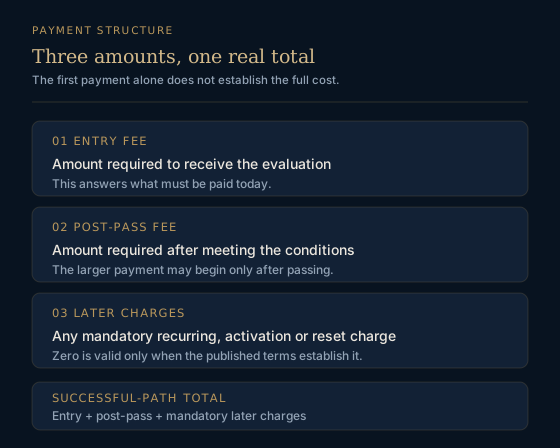
Which three amounts should you identify?
- Entry fee: the amount required to receive the evaluation.
- Post-pass fee: the amount required after meeting the evaluation conditions.
- Later charges: any mandatory recurring, activation, platform, reset or account-stage charge disclosed by the offer.
Separate those charges from money held as broker margin by checking the fee-versus-deposit distinction.
The third amount may be zero only when the published terms establish that result. Alpha Trader Firm describes its Pay Later fees as one-time charges with no recurring fees. (Alpha Trader Firm, retrieved 2026-08-16) That term applies to Alpha's offer, not automatically to every programme using similar language.
Cost after failure = entry fee + any stated failure charge
Cost after passing and continuing = entry fee + post-pass fee + mandatory later charges
| Offer | Entry amount established | Post-pass amount established | Recurrence established |
|---|---|---|---|
| AquaFunded | $5 | Not established by this source set | Not established by this source set |
| Alpha Trader Firm | $10 | Full programme fee, exact amount not established here | One-time, no recurring charges |
| Atlas Funded | $1 | $554 for the $100K size | Not established by this source set |
How Do the Failure and Pass Totals Differ?
The two outcomes must be calculated separately because the larger payment may be triggered only after passing. The condition used to mark an evaluation as passed can include a published performance threshold, but the invoice amount and payment deadline still need their own terms.
Alpha Trader Firm states that a trader who does not pass loses only the $10 entry fee, while the full programme fee is collected after passing. (Alpha Trader Firm, retrieved 2026-08-16)
| Outcome under Alpha's published description | Amount established by the source |
|---|---|
| Evaluation not passed | $10 entry fee |
| Evaluation passed and trader continues | $10 entry fee plus the full programme fee |
This structure places the larger financial decision after the evaluation has been completed. Calculate both paths before starting. If the post-pass amount is missing, the successful-path total remains unknown.
Goat Funded Trader publishes a fourth example with the amount broken out by account size. Its Pay Later Model FAQ states an initial cost of $5 to join, covering server and infrastructure expenses, with the full challenge fee due only after passing. (Goat Funded Trader, retrieved 2026-08-16) That published fee runs $78 for the 5k challenge, $118 for 10k, $168 for 15k, $238 for 25k, $368 for 50k, and $598 for the 100k challenge. (Goat Funded Trader, retrieved 2026-08-16) Alongside Atlas Funded's $554 on its $100K account, that gives two firms with a published number and a visible range, $78 to $598 at Goat, a single point at Atlas, while Alpha states the mechanism without a figure and AquaFunded states neither.
Is Deferred Pricing the Same as a Discount?
No. Deferral changes when an amount is paid. A discount changes how much is paid.
A valid comparison requires the same firm, account size, rules and account stage:
Deferred total = entry fee + post-pass fee + mandatory later charges
Difference = deferred total - comparable upfront price
A positive difference means the deferred path costs more. Zero means only the timing changed. A negative difference means the deferred path costs less, provided the products being compared are otherwise identical.
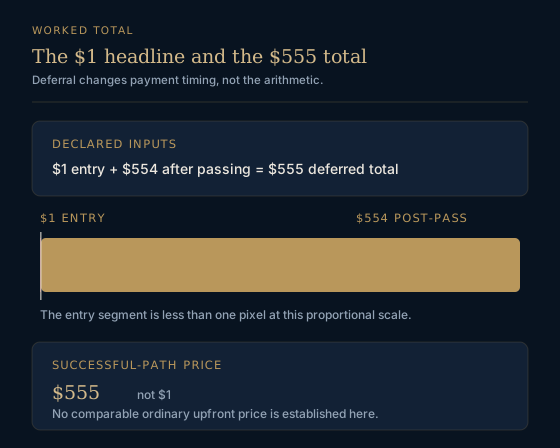
Atlas Funded's page lists $1 upfront and $554 after passing for its $100K size. (Atlas Funded, retrieved 2026-08-28)
Declared inputs for this check: $1 upfront, $554 after passing, and $555 deferred total. Worked arithmetic: 1 + 554 = 555.
The relevant deferred total is therefore $555, not $1. This source set does not provide a comparable ordinary upfront price for the same Atlas product, so it cannot establish whether $555 is a discount.
Which Terms Decide What You Signed?
Whichever document the firm publishes for the deferred stage, not the entry-checkout page, because the entry terms and the post-pass terms are not guaranteed to be the same document.
When does the fee become due?
“After passing” identifies a trigger but may not identify the complete deadline. Alpha Trader Firm says the full fee is collected after the trader passes. (Alpha Trader Firm, retrieved 2026-08-16) The offer should also state whether payment is due immediately, when an invoice is issued, before activation or within a specified period. If time is advertised as unlimited, verify whether the evaluation clock and billing run together.
How is the deferred fee collected?
The entry-payment method should not be assumed to govern the deferred payment. For comparison, FTMO states that its upfront evaluation can be paid by bank wire, debit or credit card, PayPal, Revolut Pay, cryptocurrencies or Skrill. (FTMO, retrieved 2026-08-16) That list applies to FTMO, not automatically to a deferred programme.
What happens if you pass and do not pay?
The offer should state whether the next account remains inactive, expires or carries another published consequence. Silence does not establish a penalty. It means the consequence remains unanswered.
Does anything recur?
A one-time deferred fee and a recurring charge are different commitments. Alpha Trader Firm expressly describes its Pay Later fees as one-time with no recurring charges. (Alpha Trader Firm, retrieved 2026-08-16) The same conclusion cannot be transferred to another programme without its own published term.
How Can You Get the Deferred Amount in Writing?
Use this objective checklist before entering payment details:
- Record the offer, account size, entry fee and retrieval date.
- Find the exact amount due after passing.
- Record every mandatory later charge disclosed by the offer.
- Identify the event and deadline that trigger payment.
- Check the consequence of passing without paying.
- Confirm whether any charge recurs after activation or reset.
- Compare the deferred total with the ordinary upfront price for the same product.
- Preserve a dated copy of the offer page and any written support response.
A complete written answer contains a number, currency, trigger and consequence. “You pay later” does not provide those four elements. Add that calculation to a broader pre-payment audit before choosing an offer.
Where Does a One-Time Fee Leave Nothing to Defer?
The opposite structure places the complete published charge at the beginning.
The fee is one-time: $59 for the $2,500 account, $139 for the $10,000 account, $299 for $25,000, $549 for $50,000 and $999 for $100,000. There are no recurring fees, no hidden tiers and no coupon games. (Ordane Rulebook v1.0, section 1, retrieved 2026-08-28)
For the Ordane Instant Account, that published ladder means there is no separate evaluation payment or post-pass activation fee. The comparison is structural: one model divides payments across entry and passing, while the other publishes one initial fee. It does not determine which rules or risk limits suit a particular trader.
What Do Traders Ask About Pay-Later Offers?
Is pay later the same as a free challenge?
No. AquaFunded states that entry costs $5, while Atlas Funded states that entry costs $1. (AquaFunded, retrieved 2026-08-16; Atlas Funded, retrieved 2026-08-28)
What does failure cost under Alpha Trader Firm's offer?
Alpha Trader Firm states that a trader who does not pass loses only the $10 entry fee. (Alpha Trader Firm, retrieved 2026-08-16)
Does every pay-later fee recur?
No universal conclusion is supported by this source set. Alpha Trader Firm describes its own fee as one-time with no recurring charges. (Alpha Trader Firm, retrieved 2026-08-16)
Is the $1 Atlas entry payment the total successful-path price?
No. Atlas Funded lists $554 after passing for its $100K size, producing a $555 deferred total when added to the $1 entry payment. (Atlas Funded, retrieved 2026-08-28)
Can one firm's payment methods be assumed for another firm?
No. FTMO's published payment-method list applies to FTMO. It does not establish how another firm's deferred fee is collected. (FTMO, retrieved 2026-08-16)
This article is for information only and is not investment, financial, or tax advice.
Ordane accounts operate on simulated capital. No live funds are traded and no deposits are accepted. Payouts depend on simulated performance under Rulebook v1.0; no level of performance is typical or assured. (Ordane Rulebook v1.0, clause P-2, retrieved 2026-08-28)
To compare the published one-time structure with deferred offers, review the Ordane Instant Account options.
Sources
- Comunicazione Consob a tutela dei risparmiatori, 8 luglio 2024 consob.it Retrieved 2026-08-28.
- Pass First Pay Later aquafunded.com Retrieved 2026-08-16.
- Alpha Trader Firm Pay Later Program 2026 — Start for $10, Pay After You Pass blogs.alphafunded.com Retrieved 2026-08-16.
- Pay After You Pass: 1$ Access Challenge atlasfunded.com Retrieved 2026-08-28.
- What payment methods are available? | FTMO.com ftmo.com Retrieved 2026-08-16.
- PAY LATER MODEL | Goat Funded Trader FAQ's help.goatfundedtrader.com Retrieved 2026-08-28.