Home · The Ordane Journal · Before you pay · Proprietary Trading Companies Explained
Proprietary Trading Companies Explained
Retail proprietary trading companies provide software environments where independent traders execute strategies to earn a profit split based on their statistical performance. Ordane accounts operate on simulated capital. No live funds are traded and no deposits are accepted. Understanding this model protects participants from unrealistic expectations.
What Is a Proprietary Trading Company?
Proprietary trading refers to a firm or bank trading for its own direct gain instead of earning commission dollars by trading on behalf of clients (CFTC Glossary, retrieved 2026-09-13). Retail proprietary trading companies operate differently. They provide access to simulated capital environments where traders keep a split of simulated profits.
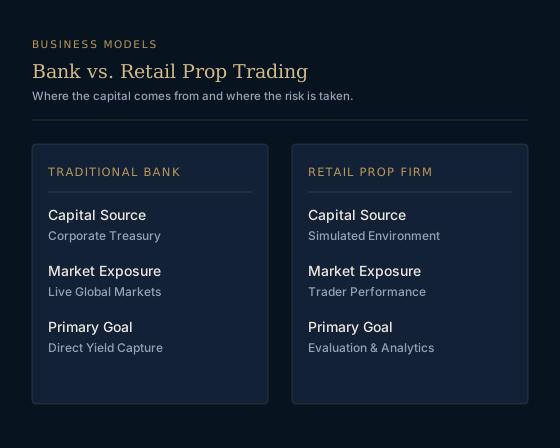
While the name is shared across both sectors, the execution and the risk models are entirely different. Traditional institutions risk their own corporate treasury in the live markets. Retail firms build evaluation frameworks to test trader discipline. They collect data rather than deploying capital directly into external exchanges.
How retail prop firms differ from banks
Traditional banks maintain trading desks executing large volume orders in global markets. Their goal is to capture yield on their corporate balance sheets. Retail proprietary trading companies do not operate this way. They do not hand over corporate treasury funds to members of the public. Instead, they provide a software environment that tracks performance based on live market data.
When a retail trader executes a position, that order remains within the simulated environment. The firm measures the performance against a strict set of risk parameters. If the trader demonstrates discipline and generates a positive simulated return, the firm issues a payout. The core difference lies in the exposure. Banks expose themselves to market risk, while retail firms expose themselves to the statistical performance of their user base.
The CFTC definition of prop trading
The regulatory framework provides a clear boundary. The traditional definition focuses on direct market exposure. Registered entities engage in proprietary operations when deploying their own capital to buy and sell financial instruments. The goal is capital appreciation or hedging internal risk against broader market movements.
Retail firms operate outside this specific definition because they do not deploy capital into live markets on behalf of the retail participant. The capital is simulated. The trader provides trading data, not an employment service managing a live book. This explains why retail firms are not regulated as broker-dealers or investment banks. They sell software evaluations and data analytics, not financial securities or investment contracts.
How Do Retail Prop Firms Actually Work?
To understand the retail model, you must examine the financial mechanics behind the evaluation phase. The system relies on strict rules and performance metrics to filter out unsustainable trading behavior.
Why you pay an evaluation fee
The entry point for almost every retail proprietary trading company is an upfront fee. This cost serves multiple purposes. First, it covers the technology, data feeds, and administrative overhead required to maintain the simulated environment. Second, the fee acts as a psychological barrier, ensuring participants follow risk parameters rather than executing reckless trades.
Firms use these fees to sustain their operations. The evaluation phase acts as a filter. Many participants fail because they lack the discipline to manage risk over a sustained period. The fees collected from failed evaluations form a significant portion of the revenue for many companies in this sector. Ordane sells one product, the Ordane Instant Account: direct access, no evaluation phase and no challenge, on simulated capital. By removing the evaluation phase, the model focuses entirely on immediate adherence to the risk rules.
Profit targets and hidden rules
During a standard evaluation, participants must achieve a specific return while adhering to drawdown limits. The normal risk FTMO (prop firm) Challenge requires a trader to reach a 10% profit target (FTMO Evaluation Objectives, retrieved 2026-09-13). Achieving this target without breaching the daily loss limit or the maximum drawdown requires strict risk management and a proven strategy.
However, many companies deploy hidden rules that complicate the process. These can include consistency rules that are not disclosed upfront, restrictions on holding trades overnight, or arbitrary limits on trading during news events. If a firm does not publish a closed list of rules, they reserve the right to deny a payout based on internal discretion. A closed list means that if a behavior is not explicitly banned in the rulebook, it is permitted.
Where the payout money comes from
The most common question from participants is the origin of the payout funds. Since the accounts are simulated, the profits generated by the trader are also simulated. When a trader requests a withdrawal, the company must pay that amount using real money from its own reserves.
For most retail firms, payout funding comes directly from the pool of evaluation fees paid by all users. Statistically, most traders fail their evaluations or breach the rules shortly after passing. The revenue from these failures funds the payouts for the minority who succeed. Firms unable to manage fee revenue against payout obligations will eventually fail, making verifiable payout reserves essential for informed participants.
Are Prop Firms Regulated?
The regulatory environment for retail proprietary trading companies is complex and evolving. Because these firms do not hold client deposits for investment purposes, they generally fall outside traditional financial regulatory frameworks.
The Volcker Rule restriction on banks
To understand the regulatory divide, it helps to look at traditional institutions. The Volcker Rule prohibits banking entities from engaging in short-term proprietary trading of securities, derivatives, commodity futures and options on these instruments for their own account (Volcker Rule, retrieved 2026-09-13). This rule was designed to prevent banks from taking excessive risks with their own capital.
Retail firms are not banks. They do not hold insured deposits, and they do not trade securities on behalf of clients. Therefore, the Volcker Rule does not apply to them. Their business model is classified as software and evaluation services. This classification allows them to operate globally without the extensive licensing required for traditional brokerages.
Why retail firms face regulatory scrutiny
Despite the software classification, regulatory scrutiny over the retail proprietary trading sector has increased globally following recent platform disruptions and market shifts (Retail Prop Trading Firms Face Regulatory Headwinds, retrieved 2026-09-13). Regulators are primarily concerned with consumer protection, misleading marketing, and the potential for fraud in the digital space.
Some firms have historically used terms that imply a live environment to describe their simulated operations. Regulators investigate companies that imply retail participants are trading live funds in regulated markets. The current regulatory pressure is forcing the industry to adopt clearer language. Firms that survive this transition explicitly declare their simulated nature and publish their rules in a transparent format.
How Much Does It Cost to Join?
The cost structure is built around the size of the simulated capital allocated to the trader. Larger simulated balances command higher initial fees, reflecting the increased potential payout liability.
Evaluation fees vs actual deposits
When you pay an evaluation fee, you are paying for a service, not making a financial deposit. A deposit implies that the money remains yours and is held in custody to margin live trades. An evaluation fee is a non-refundable purchase of an assessment program.
<blockquote id="quote"> "Retail proprietary trading firms offer simulated environments where payouts are tied to performance, requiring strict adherence to operational rules rather than trading live funds." - Ordane Research Desk </blockquote>
If you purchase a simulated evaluation for a specific fee, your maximum financial exposure is exactly that fee. You are not responsible for any simulated losses beyond that amount. You also do not own the simulated balance. It is a notional value used to calculate your permitted risk and potential payouts.
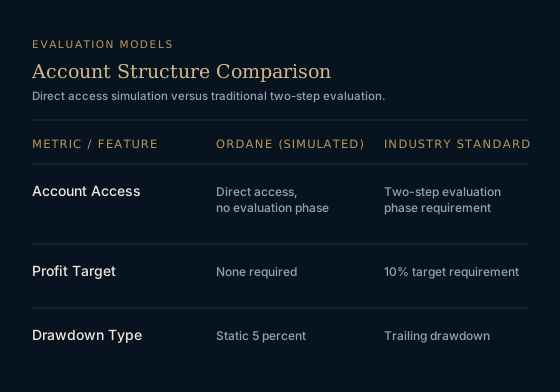
To illustrate the financial mechanics of accessing a simulated environment, review the following comparison between a direct access model and traditional evaluation requirements.
<table id="dataset-comparison"> <thead> <tr> <th>Metric/Feature</th> <th>Ordane (Simulated)</th> <th>Industry Standard</th> </tr> </thead> <tbody> <tr> <td>Account Access</td> <td>Direct access, no evaluation phase</td> <td>Two-step evaluation phase</td> </tr> <tr> <td>Profit Target</td> <td>None</td> <td>10% profit target requirement</td> </tr> <tr> <td>Drawdown Type</td> <td>Static 5 percent</td> <td>Trailing drawdown</td> </tr> </tbody> </table>
This structure dictates your path to a payout. Firms with trailing drawdowns force you to secure profits quickly. A static floor provides a fixed reference point, offering a clearer risk management landscape from day one.
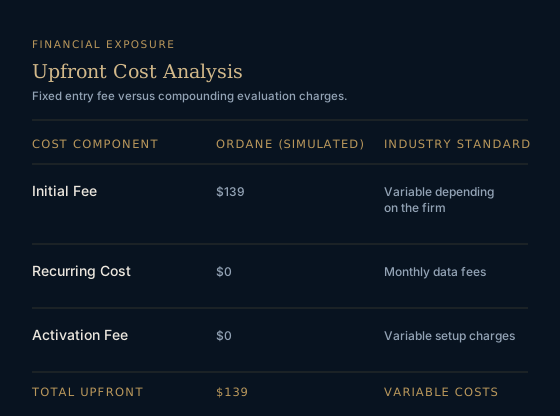
Declared inputs for this check: a $139 initial fee, a $0 recurring charge, and a $0 activation fee. Worked arithmetic: $139 + $0 = $139 total upfront cost.
<table id="dataset-dual9"> <thead> <tr> <th>Cost Component</th> <th>Ordane (Simulated)</th> <th>Industry Standard</th> </tr> </thead> <tbody> <tr> <td>Initial Fee</td> <td>$139</td> <td>Variable depending on firm</td> </tr> <tr> <td>Recurring Cost</td> <td>$0</td> <td>Monthly data fees common</td> </tr> <tr> <td>Activation Fee</td> <td>$0</td> <td>Variable setup charges</td> </tr> <tr> <td>Total Upfront Cost</td> <td>$139</td> <td>Variable and often compounding</td> </tr> </tbody> </table>
The arithmetic is straightforward when the rules are public and final. The industry standard often involves hidden costs that emerge only when you pass the evaluation, requiring you to pay an activation fee before receiving your credentials.
Frequently Asked Questions
Participants entering the simulated trading space share common concerns regarding legitimacy, legal requirements, and the mechanics of compensation. The answers rely entirely on the terms outlined in the specific contract you sign.
Are prop firms legit or a scam?
The legitimacy of a retail proprietary trading company depends entirely on its adherence to its own published rules. A legitimate firm publishes a versioned rulebook, pays its successful traders on time, and maintains a verifiable reserve. A firm acts deceptively when it retroactively changes rules to deny payouts or employs hidden consistency clauses.
Do I need a license to trade for a prop firm?
You do not need a financial license to participate in a retail proprietary trading evaluation. Because you are trading on simulated capital within a software environment, you are not acting as a broker or an investment advisor. You are an independent contractor interacting with a data feed, removing the requirement for professional regulatory licensing in most jurisdictions.
How do prop firms make money?
The primary revenue source for the retail sector is the collection of evaluation fees. Because trading requires intense discipline, the statistical majority of participants breach a risk parameter and fail the assessment. The firm retains the upfront fee to offset its operational costs and fund the payouts for successful users.
Can I lose more than my evaluation fee?
No, your financial liability is strictly limited to the upfront fee you paid to access the simulated environment. If you breach a drawdown limit and lose a significant portion of the simulated capital, the account is closed. The firm absorbs the simulated loss, and you are not required to repay the deficit.
What happens if a prop firm shuts down?
If a retail firm ceases operations, active accounts are terminated and pending payouts are typically lost. When a company shuts down, participants hold no status as creditors because they did not deposit funds into a custody account. They purchased a software service that is no longer available.
Sources
- CFTC Glossary cftc.gov Retrieved 2026-09-13T11:52:34-03:00.
- FTMO Evaluation Objectives ftmo.com Retrieved 2026-09-13T11:52:34-03:00.
- Volcker Rule sec.gov Retrieved 2026-09-13T11:52:34-03:00.
- Retail Prop Trading Firms Face Regulatory Headwinds financemagnates.com Retrieved 2026-09-13T11:52:34-03:00.