Home · The Ordane Journal · Before you pay · Apex Funded Accounts
Apex Funded Accounts
Apex Funded Accounts are simulated trading environments granted to users who successfully pass a structured evaluation phase. In this model, participants pay an upfront fee to access an evaluation account where they must reach specific profit targets while adhering to strict trailing drawdown limits before they become eligible to request payouts based on simulated performance.
Ordane accounts operate on simulated capital. No live funds are traded and no deposits are accepted. Ordane sells one product, the Ordane Instant Account: direct access, no evaluation phase and no challenge, on simulated capital.
What Are Apex Funded Accounts?
Apex Trader Funding (prop firm) provides evaluation accounts where traders attempt to reach a profit target without breaching rules to qualify for simulated capital. These evaluations test risk management and consistency. Traders who pass the evaluation phase and meet all trading requirements receive a simulated performance account with a specific profit split.
The proprietary trading industry operates primarily on simulated platforms. Traders pay a fee to access an evaluation environment. During this phase, they must demonstrate profitability while adhering to strict risk management parameters. If a trader achieves the target profit without violating the daily loss limit or the maximum drawdown rules, the firm grants them access to a performance account. This performance account also operates on simulated capital, but the trader becomes eligible to receive a portion of the simulated profits as a payout.
The model shifts the financial risk of trading live capital away from the trader. Instead of depositing thousands of dollars into a brokerage account, the trader pays a much smaller fee for the evaluation. However, the rules governing these evaluations are challenging. The trailing drawdowns and strict loss limits ensure that only a fraction of participants successfully complete the phase.
Traders evaluating this model must understand that they are purchasing an assessment of their trading skills. The fees paid for the evaluations compensate the firm for the platform access and the simulated environment.
What Are the Documented Evaluation Sizes and Costs?
The evaluation sizes and the associated costs at Apex depend on the initial balance chosen by the trader.
Apex Trader Funding offers evaluations from $25K to $300K accounts (Apex Trader Funding, retrieved 2026-09-29). Each account size carries a different subscription fee, profit target, and trailing drawdown limit. Traders select the size that aligns with their strategy. The upfront fee is a recurring monthly subscription that remains active until the trader passes the evaluation, fails, or cancels the service.
When a trader violates a rule, the account is suspended. To continue, the user must pay a reset fee to restore the balance. These reset fees constitute a significant portion of the total cost.
Once a trader passes, the monthly subscription ceases. However, the firm often requires an activation fee to transition the user to the payout eligible phase. Traders calculating the entry cost must sum the subscription, the probable reset fees, and the final activation fee.
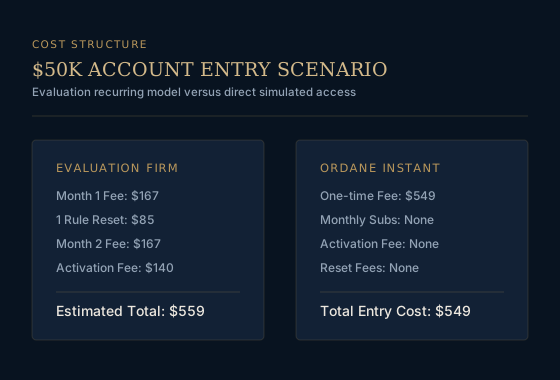
Table: Total Cost Scenario for a $50K Evaluation
| Phase | Description | Estimated Cost |
|---|---|---|
| Month 1 Subscription | Initial evaluation fee | $167 |
| Rule Breach Reset | One reset due to trailing drawdown | $85 |
| Month 2 Subscription | Continued evaluation fee | $167 |
| Activation Fee | One-time fee upon passing | $140 |
| Total Entry Cost | Estimated total before first payout | $559 |
Ordane operates on a different structure entirely. The fee is one-time: $59 for the $2,500 account, $139 for the $10,000 account, $299 for the $25,000 account, $549 for the $50,000 account, $999 for the $100,000 account. There are no recurring fees, no hidden tiers and no charge to withdraw.
How Do Rules and Drawdowns Work?
Traders must adhere to strict drawdown limits and trading rules to maintain their accounts.
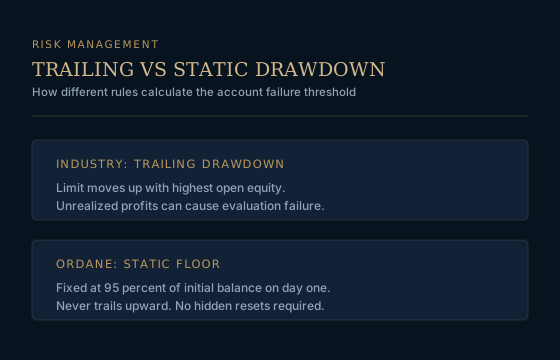
The most critical rule is the maximum drawdown. Many firms employ a trailing drawdown that tracks the highest open equity of the account. If a trader reaches a new high profit but the market reverses before they close the position, the drawdown limit moves up with that temporary high. This mechanism forces traders to secure profits quickly rather than letting trades run, altering how they execute their strategies.
Daily loss limits add another restriction. A daily limit calculates the maximum amount a trader can lose in a single server day. A breach results in immediate account failure.
Ordane's maximum drawdown is 5 percent and static: account equity may never fall below 95 percent of the initial balance. The floor is fixed on day one, never trails upward, and a breach closes the account. The Ordane daily loss limit is 3 percent, measured against the balance at the start of the server day. A breach closes the account.
Furthermore, Ordane's consistency rule is 20 percent: at the moment of a withdrawal request, no single trading day may account for more than 20 percent of the cycle's total profit. If a day exceeds 20 percent, the excess profit from that day is deferred to the next cycle. It is never confiscated, and the remainder of the cycle pays out normally.
How Do Payouts Work at Apex?
Payouts at Apex follow a specific structure based on the amount withdrawn and the account history.
Apex pays 100 percent of the first $25,000 per account, then 90 percent after (Apex Payout Parameters, retrieved 2026-09-29). Reaching the payout stage requires passing the evaluation, paying the activation fee, and trading profitably while adhering to the drawdown rules.
Firms enforce minimum trading day requirements before a trader can request a withdrawal. A trader cannot place one large successful trade and withdraw the funds the next day. They must demonstrate consistency over a set number of active days. Additionally, firms implement withdrawal caps for the first few cycles, limiting the maximum amount a trader can extract regardless of their simulated profit.
Delays in processing withdrawals create anxiety, as traders fear the firm might deny the request based on a hidden rule.
The Ordane Guarantee addresses this directly. Every withdrawal request is approved, or denied in writing citing the exact rule breached by section number, within 12 clock hours. Past that deadline the request is treated as approved and the G-1 clock starts. A payout approved and not paid within 24 clock hours, not business hours, triggers automatic compensation: a 100 percent refund of the account fee, plus the payout owed in full.
How Do Profit Splits Compare?
The profit split determines how much of the simulated profit the trader actually receives.
Prop firm traders typically keep 70 to 90 percent of profits, with top firms in 2026 offering 80 to 100 percent splits (2026 Guide to Prop Firms, retrieved 2026-09-29). The split is a core marketing metric. Firms advertise higher percentages, but the nominal split matters less than the rules governing the withdrawals. A firm offering a high split might impose consistency rules or trailing drawdowns that make reaching the payout improbable.
When comparing splits, traders must read the specific conditions attached to the percentages. These details determine the actual monetary value of the account.
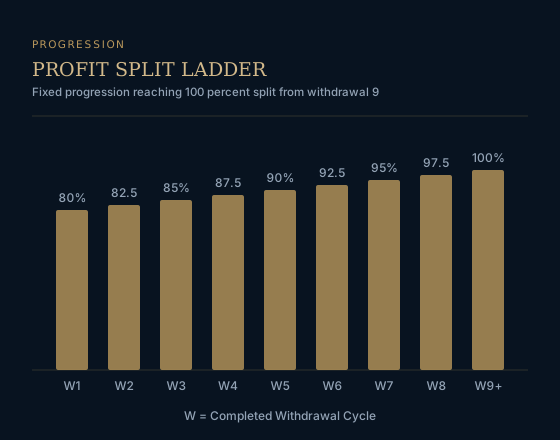
Ordane approaches the split with a fixed progression. Ordane's profit split starts at 80 percent and rises 2.5 percentage points with every completed withdrawal, reaching 100 percent from the ninth withdrawal onward. The split ladder is in writing and never resets. The first withdrawal is available 7 calendar days after account activation. Each later withdrawal is available 14 calendar days after the preceding withdrawal is completed, not on a fixed recurring cycle. A pending, declined or unknown request does not start the next 14-day period.
What to Verify Before Paying
Traders must verify the company registration, the payout reserve, and the exact rulebook version before purchasing an evaluation.
The CFTC strongly urges the public to verify a company's registration with the Commission (CFTC Customer Advisory, retrieved 2026-09-29). Regulatory registration is the first layer of verification.
Beyond regulatory checks, traders should demand proof of funds. The industry relies heavily on marketing claims, but rarely provides the blockchain addresses to back those claims. A firm that cannot prove it has the capital to pay successful traders is structurally unsafe. The payout reserve address is disclosed on-chain for any purchase bound to this version of the Ordane Rulebook.
Finally, traders must verify the rules they are agreeing to. The Ordane rulebook is public, numbered and versioned, and no rule is ever applied retroactively to an open account. Changes produce a new version with a dated changelog entry, and the version you sign up under is the version that governs your account.
Table: Apex and Industry Market Comparison
| Metric / Feature | Ordane (Simulated) | Industry Standard |
|---|---|---|
| Account Access | Instant Direct Access | Evaluation Challenge |
| Maximum Drawdown | Static 5 percent | Trailing high-water mark |
| Payout Window | 24 clock hours guaranteed | 3 to 14 business days |
| Reserve Proof | Public on-chain address | Hidden internal accounts |
FAQ: Apex Funded Accounts
These frequently asked questions clarify the mechanics, the costs, and the rules of the evaluation programs.
What happens if I hit the trailing drawdown limit?
If the account equity touches or falls below the trailing drawdown limit, the firm considers the evaluation failed. The account is suspended, and the trader can no longer execute positions. To resume trading, the participant must pay a reset fee, which restores the account to its original starting balance.
Do evaluation firms provide actual capital for trading?
No, proprietary evaluation firms do not provide actual capital for trading. Users operate on simulated capital during both the evaluation phase and the performance phase. The payouts traders receive are derived from the firm's fee revenue, not from actual market profits generated by the simulated trades.
How does the profit split scale over time?
The scaling of the profit split depends on the specific firm. Some firms offer a fixed percentage permanently. Others offer a higher percentage initially before dropping to a standard rate. Traders should read the terms to understand exactly how much of their simulated profit they are entitled to withdraw.
Why do firms require consistency rules?
Consistency rules exist to prevent traders from passing an evaluation with a single lucky trade. Firms want to see a demonstrated ability to manage risk over multiple days. If one day accounts for a massive percentage of the total profit, it suggests gambling rather than a repeatable strategy.
Can the rules change after I purchase an account?
Many firms retain the right to alter their terms of service or trading rules at their discretion. Traders must look for firms that offer versioned rulebooks, where the rules active at the time of purchase govern the account permanently.
Sources
- CFTC Customer Advisory cftc.gov Retrieved 2026-09-29.