Home · The Ordane Journal · Before you pay · Topstep Prop Firm Review: Rules & Payouts
Topstep Prop Firm Review: Rules & Payouts
Topstep (prop firm) evaluates futures traders in a simulated environment before offering hypothetical profit splits. The process requires traders to pay an upfront fee, reach specific profit targets, and follow strict risk management rules in a simulated environment before becoming eligible to request a payout.
Ordane accounts operate on simulated capital. No live funds are traded and no deposits are accepted. (Ordane Rulebook v1.0, clause P-2, retrieved 2026-09-29)
This structural reality applies across the industry. When evaluating any proprietary trading firm, understanding the difference between simulated performance and live execution is the first step toward verifying their claims. Traders must look past the marketing and examine the actual rulebook.
What is Topstep and How Does It Work?
Topstep operates as a futures trading evaluation service where users pay a recurring fee to prove their skills.
The proprietary trading industry offers various models for market access. Topstep focuses exclusively on the futures market. Traders do not deposit live funds to trade. Instead, they pay a monthly subscription fee to enter an evaluation environment. The goal is to reach a predefined profit target without hitting the maximum drawdown limit or violating any daily loss rules.
The Single-Step Trading Combine
The Topstep Trading Combine is the firm's evaluation program (Topstep, retrieved 2026-09-29). Many competitors require two separate phases of evaluation before granting access to a funded account. Topstep streamlined this process into one phase. A single step reduces the time required to complete the test, but the rules governing the single step remain strict. The trader must demonstrate consistent profitability and rigid risk management. The evaluation measures performance in a simulated environment using real market data. The monthly fee continues until the trader either passes the evaluation or cancels the subscription. If a trader breaches a rule, the account fails. The trader can pay a reset fee to try again, which generates significant revenue for the firm.
Express Funded Accounts Are Simulated
Passing the evaluation does not grant access to live capital. An Express Funded Account is a Simulated Account (Topstep Terms of Use, retrieved 2026-09-29). The trader continues to operate in a simulated environment. The firm tracks the simulated performance and pays out real money based on the virtual profits generated by the trader. This mechanism is standard across the proprietary trading industry. The firm manages its own risk by copying select trades to a live master account at its discretion. The trader has no connection to the live master account and executes orders strictly within the simulation. This structure protects the firm from market losses while allowing them to evaluate trader performance over time.
How Does The Trading Combine Evaluation Process Work?
The evaluation process measures risk management discipline against a defined profit target and a maximum drawdown limit.
The mechanics of the Trading Combine require detailed attention. Traders select an account size, which determines the profit target, the daily loss limit, and the maximum trailing drawdown. The account sizes generally range from fifty thousand dollars to one hundred and fifty thousand dollars in simulated buying power.
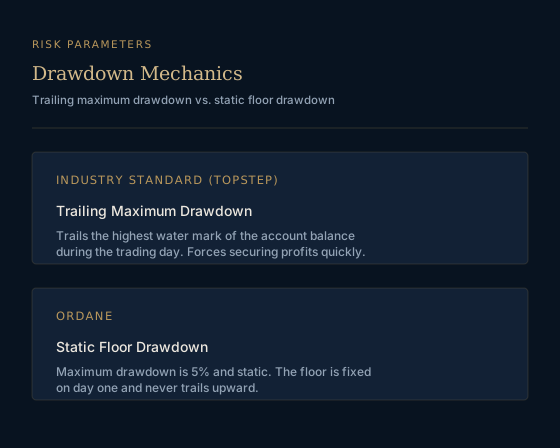
The maximum trailing drawdown trails the highest water mark of the account balance during the trading day. If the simulated equity drops below this trailing limit, the account fails. The trailing mechanism forces traders to secure profits quickly and penalizes those who let winning trades turn into losing trades. Managing a trailing drawdown requires a completely different strategy than managing a static drawdown floor.
Ordane approaches this differently. Ordane's maximum drawdown is 5 percent and static: account equity may never fall below 95 percent of the initial balance. The floor is fixed on day one, never trails upward, and a breach closes the account. A static floor provides absolute clarity on the risk limit. The trader knows exactly where the account fails, regardless of intraday fluctuations.
Topstep also enforces a daily loss limit. If the simulated equity falls below the daily limit, the platform automatically liquidates open positions and locks the account for the remainder of the trading day. This rule prevents a single bad day from destroying the entire account. The daily loss limit resets at the start of the next trading session.
Are There Hidden Traps in Topstep Rules?
The rules at Topstep are public, but traders often fail by misunderstanding the consistency requirements and the daily loss limits.
Traders often look for hidden traps in proprietary trading firm rulebooks. The reality is that the rules are usually public, but the statistical probability of passing remains low due to human psychology and strict risk parameters.
The 5 Winning Days Rule
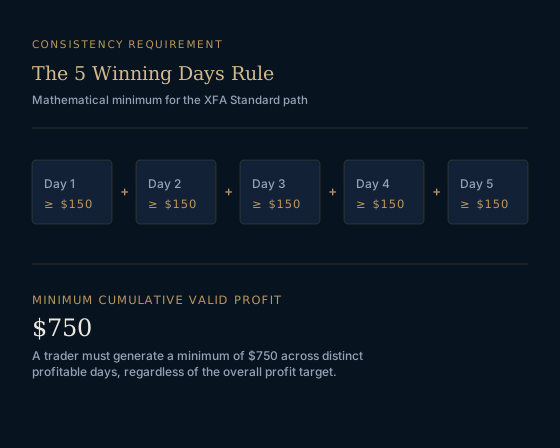
The XFA Standard path requires five winning days of at least $150 each (Topstep Program Overview, retrieved 2026-09-29). This rule forces consistency. A trader cannot pass the evaluation by getting lucky on a single large news trade. The profit must be distributed across at least five separate trading sessions. A winning day only counts if the net simulated profit exceeds one hundred and fifty dollars. Days with smaller profits do not contribute to the five day requirement.
Because of this requirement, a trader must generate a minimum of seven hundred and fifty dollars across distinct profitable days, regardless of the overall profit target. This mathematical minimum forces a distribution of returns.
| Minimum Winning Days | Daily Threshold | Minimum Cumulative Valid Profit |
|---|---|---|
| 5 Days | $150 | $750 |
This mechanism protects the firm from variance. A trader who passes a single step evaluation in one day might just be lucky. A trader who meets the consistency rule demonstrates a repeatable strategy. However, the rule also keeps the trader in the evaluation longer, increasing the probability of hitting a drawdown limit or paying another monthly subscription fee.
Ordane's consistency rule is 20 percent: at the moment of a withdrawal request, no single trading day may account for more than 20 percent of the cycle's total profit. If a day exceeds 20 percent, the excess profit from that day is deferred to the next cycle. It is never confiscated, and the remainder of the cycle pays out normally. This ensures that the trader relies on a system rather than a single outlier event, without imposing a rigid daily dollar minimum.
What Are the Platform and Market Data Requirements?
Futures trading requires direct access to exchange data, and the evaluation accounts rely on accurate price feeds to simulate execution. Topstep uses live CME exchange data feeds for its futures evaluations (Topstep, retrieved 2026-09-29). Traders must connect through the platforms the firm supports and, after passing, typically become responsible for exchange data fees directly. The exchanges classify proprietary trading firm users as professional traders, which triggers higher data costs than retail classifications, so factor these monthly expenses into your operational overhead before projecting profitability.
Will You Actually Get Paid by Topstep?
Payouts depend on generating simulated profits while navigating the withdrawal rules and maintaining the account in good standing.
The ultimate goal of entering an evaluation is to receive a payout. Traders want to know if the firm will honor the withdrawal request.
However, requesting a payout often triggers a rule regarding the maximum trailing drawdown. In many programs, taking a payout reduces the account balance, which brings the equity closer to the trailing drawdown limit. Traders must read the fine print carefully to understand how a withdrawal affects their remaining risk buffer.
Ordane sells one product, the Ordane Instant Account: direct access, no evaluation phase and no challenge, on simulated capital. (Ordane Rulebook v1.0, section 1, retrieved 2026-09-29) The payout mechanism relies on absolute transparency. The Ordane Guarantee enforces the payment timeline. Every withdrawal request is approved, or denied in writing citing the exact rule breached by section number, within 12 clock hours. Past that deadline the request is treated as approved and the G-1 clock starts. A payout approved and not paid within 24 clock hours, not business hours, triggers automatic compensation: a 100 percent refund of the account fee, plus the payout owed in full. G-2 excludes documented fraud or KYC review and declared force majeure, each for at most 10 business days. Beyond those deadlines, G-1 applies regardless.
CFTC Caution on Simulated Trading
Regulatory context is vital. The CFTC requires that the presentation of hypothetical trading results be accompanied by the appropriate caution (CFTC Trading System Advisory, retrieved 2026-09-29). This applies directly to the proprietary trading industry. The results generated in an Express Funded Account are hypothetical. The trades are not executed on a live exchange. Simulated environments cannot replicate the exact liquidity and slippage of live markets. Traders must acknowledge that simulated performance does not guarantee future results in live trading.
What Are the Topstep Pricing and Costs?
The cost structure includes the initial evaluation fee, monthly recurring charges during the test, and potential activation fees.
Evaluating the true cost of a proprietary trading firm requires looking beyond the headline price. Topstep charges a monthly subscription fee for the Trading Combine. If a trader takes three months to pass the evaluation, they pay the subscription fee three times.
If a trader breaches a rule during the evaluation, they can pay a reset fee to restore the account balance and start over. Reset fees are a primary revenue driver for firms that rely on a subscription model. The psychological pressure to reset immediately after a failure can lead to significant accumulated costs.
Once the trader passes the Trading Combine, the monthly subscription fee stops. However, the trader must pay a one time activation fee to open the Express Funded Account. Additionally, the trader assumes responsibility for the monthly CME data fees.
Ordane eliminates the recurring model. The fee is one-time: $59 for the $2,500 account, $139 for the $10,000 account, $299 for the $25,000 account, $549 for the $50,000 account, $999 for the $100,000 account. There are no recurring fees, no hidden tiers and no charge to withdraw. The trader pays once, takes the account, and trades.
Market Comparison: Features and Standards
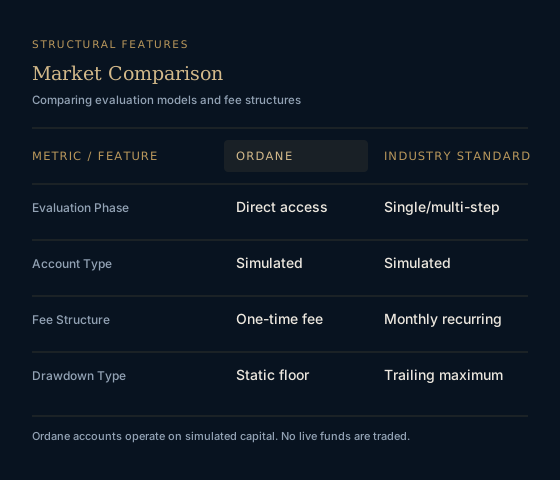
Comparing structural features clarifies what a trader actually receives when purchasing an evaluation.
| Metric/Feature | Ordane (Simulated) | Industry Standard |
|---|---|---|
| Evaluation Phase | Direct access | Single or multi-step evaluation |
| Product Model | Ordane Instant Account | Express Funded Account |
| Account Type | Simulated | Simulated |
| Fee Structure | One-time fee | Monthly recurring subscription |
| Drawdown Type | Static floor drawdown | Trailing maximum drawdown |
Topstep Rules Verification Checklist
The rulebook dictates the parameters of the evaluation.
| Rule Area | Topstep Requirement | Verification Source |
|---|---|---|
| Evaluation Type | Trading Combine evaluation program | Topstep |
| Account Capital | An Express Funded Account is a Simulated Account | Topstep Terms of Use |
| Consistency Rule | The XFA Standard path requires five winning days of at least $150 each | Topstep Program Overview |
| Data Feed | Accurate exchange price feeds for simulated execution | Topstep |
| Regulatory Notice | The CFTC requires that the presentation of hypothetical trading results be accompanied by the appropriate caution | CFTC Trading System Advisory |
Frequently Asked Questions
Traders frequently ask about legitimacy, overnight holding rules, and the nature of the simulated capital used in the accounts.
Do proprietary trading firms use real capital?
The vast majority do not. An Express Funded Account is a Simulated Account (Topstep Terms of Use, retrieved 2026-09-29). The firm pays the trader from its own corporate revenue based on the simulated performance.
Why do firms require a minimum number of winning days?
Firms implement rules like the five winning days requirement to filter out luck. The XFA Standard path requires five winning days of at least $150 each (Topstep Program Overview, retrieved 2026-09-29). This ensures the trader has a repeatable strategy rather than relying on a single volatile market event.
Can traders hold positions overnight?
Topstep generally requires traders to close all positions before the end of the daily electronic trading session. Holding futures contracts overnight carries significant gap risk, which simulated risk management systems aim to avoid. Ordane's approach is different. Overnight and weekend holding is allowed at Ordane. It is not on the R-6 closed list, and what is not listed is not a violation.
Are the results published by prop firms real?
The profits paid to traders are real money, but the trading environment is simulated. The CFTC requires that the presentation of hypothetical trading results be accompanied by the appropriate caution (CFTC Trading System Advisory, retrieved 2026-09-29). Traders must understand the distinction between receiving a real payout and trading a live market.
Sources
- Topstep Terms of Use topstep.com Retrieved 2026-09-29.
- CFTC Trading System Advisory cftc.gov Retrieved 2026-09-29.
- Topstep Program Overview help.topstep.com Retrieved 2026-09-29.