Home · The Ordane Journal · Before you pay · What Does Proprietary Trading Mean?
What Does Proprietary Trading Mean?

Proprietary trading occurs when a financial institution deploys its own capital to capture market opportunities, assuming all associated risks and retaining all generated profits. This structure contrasts with executing client orders for commissions. Ordane accounts operate on simulated capital. No live funds are traded and no deposits are accepted.
The financial industry utilizes specific terminology to categorize market participants based on the origin of their capital and the structure of their market exposure. Retail traders frequently encounter the term proprietary trading when researching firms that offer access to trading infrastructure and simulated environments. Understanding the precise definition requires separating traditional banking operations from the modern retail evaluation model. The distinction clarifies exactly what market environment a trader operates within and what capital is actually at stake during the execution of a strategy. This operational structure removes the ambiguity often found in the retail sector by defining the exact nature of the capital environment from the first interaction. Traders require clear, objective definitions to evaluate the mechanisms behind the firms they choose to interact with. By examining the historical context of institutional trading desks and contrasting it with the current retail landscape, market participants can navigate the industry with a focus on verifiable mechanics rather than marketing terminology. The evolution of the term reveals a fundamental shift in how risk is managed and how profits are generated in the modern financial ecosystem.
What Does Proprietary Mean in Finance?
Proprietary trading occurs when a financial firm trades its own capital for direct market gain instead of executing orders on behalf of clients (SEC, retrieved 2026-09-12). In the traditional financial system, this structure means the institution retains all generated profits and absorbs all incurred losses, operating entirely independent of external customer deposits.
The definition relies entirely on the source of the capital and the ultimate beneficiary of the market action. Proprietary trading refers to trading by a firm for its own account rather than on behalf of customers (CME Group, retrieved 2026-09-12). When a financial institution deploys its internal balance sheet to capture market opportunities, it acts as a principal in the transaction. The firm takes on the full market exposure, accepting the statistical probability of both drawdowns and returns. This model contrasts directly with agency trading, where a brokerage executes orders for a client and earns a fixed commission regardless of the market outcome. The proprietary model aligns the risk and the reward entirely within the corporate entity, requiring sophisticated risk management frameworks to protect the firm's core capital reserves from severe market volatility.
The Traditional Institutional Definition
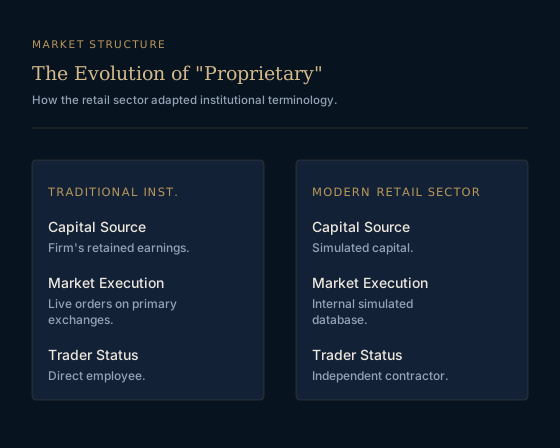
Historically, proprietary trading desks existed exclusively within large investment banks and specialized, heavily capitalized trading firms. These specialized desks utilized the massive capital reserves of the parent institution to speculate on directional price movements, complex arbitrage opportunities, and intricate derivative strategies across global markets. The traders operating on these desks were direct employees of the bank. They received a standard base salary and earned performance bonuses based strictly on the net profits they generated for the firm over a specific fiscal period. The capital deployed was strictly institutional, sourced from the firm's retained earnings or dedicated trading capital pools. The technological infrastructure, the direct data feeds from primary exchanges, and the comprehensive risk management systems were built, maintained, and monitored by the bank's internal engineering and compliance departments.
The risk parameters governing these institutional desks were tightly controlled by the firm's central risk management department. Traders operated within strict daily loss limits and maximum drawdown thresholds calculated against the firm's total capital allocation. If a trader breached these predefined limits, the automated risk systems immediately locked the trading terminal, and the open positions were aggressively liquidated by the risk desk. The firm absorbed the financial loss, and the trader faced internal disciplinary action, reduction of capital allocation, or immediate termination. The fundamental mechanic defining this era was that the firm put its own corporate capital at risk in the live market. The trader brought analytical expertise and execution skill, while the firm provided the financial backing and the necessary technological infrastructure to interface directly with primary exchanges. This model dominated the financial landscape for decades, establishing the baseline definition of the term before regulatory changes fundamentally altered the structure of institutional banking and capital deployment.
How the Retail Industry Changed the Meaning
The retail sector eventually adopted the proprietary trading terminology and applied it to a completely different business model, creating significant semantic overlap. Modern retail firms offer independent traders the opportunity to prove their skills through structured evaluation programs. These programs charge an upfront fee for access to a simulated trading environment. The terminology shifted away from describing the source of the capital deployed in the live market to describing the structure of the profit split arrangement offered upon successful completion of the evaluation phase.
Retail firms frequently advertise access to capital, but the underlying mechanics operate differently from the traditional institutional model. The retail participant is an independent contractor, not an employee of a bank. The trader pays a non-refundable fee to enter an evaluation phase governed by specific parameters. The rules of these evaluations often involve complex profit targets, minimum trading days, and restrictive drawdown calculations that trail the highest high of the account balance, significantly increasing the statistical difficulty. The vast majority of retail participants fail these evaluations. The fees collected from failed evaluations form the primary revenue stream for many of these firms. This model relies on high turnover and the constant acquisition of new participants attempting to pass the criteria. The term proprietary trading in the retail space now describes this specific evaluation and fee structure rather than the direct deployment of institutional balance sheets in the live market. The focus shifted from institutional capital allocation to the gamification of market simulation.
Are You Trading Real Proprietary Capital?
The transition from institutional bank desks to retail evaluation programs created significant confusion regarding the actual nature of the capital being traded. Traders frequently assume they are executing orders in the live market with the firm's actual corporate money. This assumption ignores the fundamental risk management reality of the modern retail model. Understanding the actual capital environment is critical for evaluating the legitimacy, the operational stability, and the payout mechanics of a firm. Transparency regarding the execution environment separates firms operating with sustainable mechanics from those relying on obscured failure rates.
Simulated Funds vs. Live Execution
Retail firms do not provide unverified traders with direct access to live institutional capital. The risk of distributing real funds to thousands of independent retail traders is mathematically unsustainable and practically impossible from a risk management perspective. Instead, the industry relies entirely on simulated trading environments. The trader executes orders on a platform that mirrors live market pricing and simulates slippage and execution latency, but the orders do not reach a liquidity provider, a prime broker, or a centralized exchange. The capital displayed on the screen is virtual. The profits and losses exist only within the firm's internal database metrics.
This structure represents standard practice across the retail sector, although firms frequently obscure this reality with vague marketing terminology designed to imply live market execution. Transparency about the simulated nature of the environment remains rare. Ordane sells one product, the Ordane Instant Account: direct access, no evaluation phase and no challenge, on simulated capital. By stating the precise nature of the capital upfront, the trader understands the exact mechanics of the contractual relationship. The firm does not act as a broker executing trades on an exchange. The firm evaluates simulated performance metrics and issues payouts based solely on that simulated data, provided the trader adheres strictly to the established rulebook. This clarity allows traders to focus on execution within the defined parameters rather than questioning the routing of their orders.
The Business Model Behind Evaluation Fees
The standard retail model utilizes evaluation fees as the primary engine to generate corporate revenue. Firms construct complex challenges featuring multiple phases, tight time limits, and strict risk parameters. The statistical probability of navigating these challenges successfully and reaching a payout stage is extremely low. The firm collects the upfront fee, and when the trader inevitably violates a rule due to the restrictive parameters, the firm retains the entire fee. This cycle repeats continuously, creating a business model heavily dependent on trader failure rather than successful, long-term simulated trading.
When a trader does achieve a payout, the firm compensates the trader from the collective pool of collected evaluation fees. The firm does not pay the trader from profits generated in the live market because the trades were never executed in the live market in the first place. This structural reality creates an inherent conflict of interest between the firm and the successful trader. The firm benefits financially when the trader fails the evaluation or breaches a rule prior to a withdrawal request. This dynamic explains the proliferation of hidden rules, subjective violation interpretations, and retroactive policy changes across the industry. Firms deploy these tactics to deny payouts and protect their internal fee revenue pool. The model prioritizes rapid fee collection over long-term trader retention, necessitating a constant influx of new participants to sustain operations.
How Do Traders Evaluate Firm Reliability?
The retail model's reliance on evaluation fees and hidden rules generates severe and justified skepticism among experienced traders. Market participants have documented denied payouts, sudden rule changes applied retroactively, and abrupt firm closures. Traders require verifiable proof of a firm's operational integrity and financial capacity before committing their time and upfront costs to a simulated environment. The primary concerns revolve around the absolute certainty of payment, the stability of the trading rules, and the verifiable financial longevity of the corporate entity.
The Reliability of Payouts
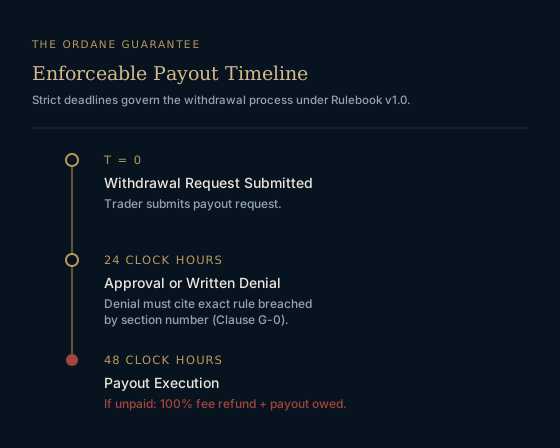
The immediate and most pressing fear is successfully completing the required simulated performance and facing a denied withdrawal request. Firms frequently utilize subjective interpretations of trading behavior, such as classifying standard execution as prohibited exploitation, to cancel accumulated profits. Traders need a strict contractual guarantee that overrides discretionary decisions and establishes a rigid timeline for processing. Every withdrawal request at Ordane is approved, or denied in writing citing the exact rule breached by section number, within 24 clock hours. Past that deadline the request is treated as approved and the G-1 clock starts.
This mechanism completely removes the firm's ability to delay or ignore a request pending a prolonged internal review. The process is bound by a strict, enforceable time limit. A payout approved and not paid within 48 clock hours, not business hours, triggers automatic compensation: a 100 percent refund of the account fee, plus the payout owed in full. This specific mechanism is The Ordane Guarantee. It imposes a severe financial penalty directly on the firm for failing to meet its payout obligations within the stated timeframe. The guarantee forces the firm to operate efficiently, maintain liquid reserves, and eliminates the ambiguity surrounding withdrawal processing times that plagues the broader industry.
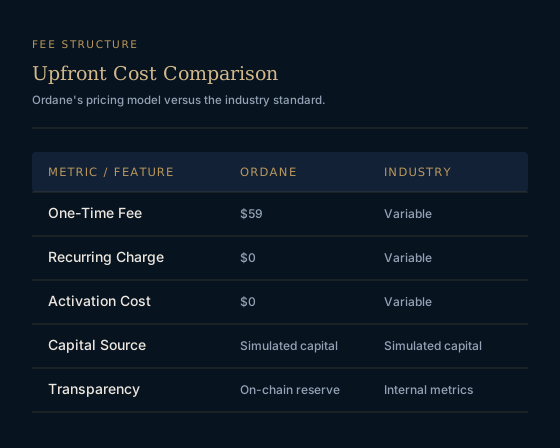
To illustrate the financial mechanics of starting an account without hidden costs or recurring subscription traps, consider the upfront pricing structure required to access the simulated environment.
Declared inputs for this check: a $59 one-time fee, a $0 recurring monthly charge, and a $0 activation cost. Worked arithmetic: $59 + $0 = $59 total upfront cost.
<div id="table"></div>
| Metric/Feature | Ordane (Simulated) | Industry Standard |
|---|---|---|
| One-Time Fee | $59 | Variable |
| Recurring Monthly Charge | $0 | Variable |
| Activation Cost | $0 | Variable |
| Capital Source | Simulated capital | Simulated capital |
| Regulatory Oversight | Unregulated software service | Unregulated software service |
| Market Execution | Internal simulated database | Internal simulated database |
| Transparency | On-chain verifiable reserve | Unverifiable internal metrics |
Regulatory Rules and Trading Restrictions
The second major concern involves the implementation of hidden rules that trigger unexpected account closures during the withdrawal review phase. Firms frequently implement vague clauses regarding specific trading styles or market conditions, allowing them broad discretion to retroactively classify profitable trades as violations. Traders require a static, closed list of rules where everything not explicitly banned is entirely permitted. Ordane's prohibited-practice list is closed. Clause R-6 names six practices: latency, reverse or hedge arbitrage; high-frequency or bulk automated exploitation; copy trading between Ordane accounts; straddling news releases with paired opposing orders; platform or data-feed exploitation; and gap abuse. If a behavior is not listed in that section, it is not a violation. Discretion is not a rule.
The governing rulebook must also protect the trader from retroactive changes designed to invalidate past performance. A firm cannot alter the agreement parameters after the fee is paid and the simulated trading begins. The Ordane rulebook is public, numbered and versioned, and no rule is ever applied retroactively to an open account. Changes produce a new version with a dated changelog entry, and the version you sign up under is the version that governs your account. This structural transparency provides legal certainty. The trader operates under a fixed, unchanging contract that cannot be modified unilaterally to deny a legitimate payout based on simulated results.
Corporate Longevity and Reserves
The final critical concern is the verifiable financial stability of the firm itself. The retail space has witnessed numerous firms cease operations abruptly, taking trader fees and unpaid simulated profits offline without warning. Traders require concrete proof that the firm currently holds the capital required to meet its obligations, rather than relying on future fee collection. Promises of financial strength or internal screenshots are insufficient. Ordane's payout reserve is published at a public TRON address on ordanemarkets.com and in Rulebook v1.0 clause PR-1.
This on-chain reserve provides real-time, independent verification of the firm's liquidity. Any trader can audit the address directly on the blockchain at any time to confirm the funds exist and remain stationary. The reserve demonstrates clearly that the firm separates operational capital required to run the business from the payout capital designated for traders. It proves the capacity to pay before the trader executes a single simulated order on the platform. This level of transparency replaces empty marketing claims with cryptographic proof, directly addressing the fundamental fear of corporate insolvency and operational collapse.
How Does Regulation View Proprietary Firms?
The regulatory environment surrounding proprietary trading remains complex and is strictly enforced by federal agencies. Financial regulators rigorously separate institutions that handle client deposits from entities that trade their own capital for speculative return. This separation aims to protect the broader financial system from the systemic risks associated with excessive leverage and speculative trading by commercial banks. The rules governing these entities dictate exactly how they can operate, what markets they can access, and what capital they can deploy.
The Volcker Rule Restriction on Banks
Following the severe market disruptions of the global financial crisis, international regulators implemented massive legislative reforms to restrict the speculative trading activities of commercial banking institutions. The most significant of these reforms targeted proprietary trading desks directly. The Volcker Rule restricts banking entities from engaging in proprietary trading (CFTC, retrieved 2026-09-12). This foundational regulation forces banks to make a structural choice between serving as a traditional depository institution protected by government insurance or operating exclusively as a speculative trading firm without access to retail deposits.
The logic behind this strict restriction relies on protecting the consumer. Banks hold the deposits of ordinary citizens and businesses. If a bank utilizes those guaranteed deposits to engage in high-risk proprietary trading and suffers catastrophic losses in the market, the government and ultimately the taxpayers bear the heavy cost of the subsequent bailout. By completely prohibiting this specific activity, regulators aim to insulate the core banking system from extreme market volatility and speculative failure. The regulation fundamentally altered the structure of Wall Street, forcing major banks to close their internal proprietary desks and spin them off into independent, unregulated entities operating solely with private capital.
Why Retail Firms Operate Differently
Retail evaluation firms do not fall under the Volcker Rule or similar stringent banking regulations primarily because they do not accept client deposits for investment purposes. The upfront fee paid by a retail trader is classified as a payment for a digital service, specifically the evaluation process and access to the simulated trading infrastructure provided by the firm. The firm never acts as a custodian of the trader's funds for live market execution, nor does it invest the fee in financial instruments on the trader's behalf.
Because retail firms operate entirely within a simulated environment, they do not execute trades on regulated, centralized exchanges. They provide a sophisticated software service. This critical distinction keeps them outside the direct purview of financial regulators who oversee traditional brokers, exchanges, and clearinghouses. However, this distinct lack of regulatory oversight places the burden of due diligence entirely on the individual trader. Without a federal regulator enforcing capital requirements, auditing execution practices, or mandating fair business conduct, the trader must rely solely on the firm's published contracts and verifiable proof of liquidity. The absolute absence of regulatory protection makes transparent, versioned rulebooks and public on-chain reserves the only reliable indicators of a firm's operational integrity. To trade within a transparent structure that eliminates the evaluation phase, explore the Ordane Instant Account.
<div id="quote"></div>
Frequently Asked Questions
What does proprietary trading mean in traditional finance?
Proprietary trading occurs when a financial firm trades its own capital for direct market gain instead of executing orders on behalf of clients (SEC, retrieved 2026-09-12). The firm retains all profits and absorbs all losses.
How do retail evaluation firms differ from institutional desks?
Retail firms evaluate traders using a simulated environment, charging an upfront fee for access. They do not deploy live capital on centralized exchanges or accept client deposits for investment.
Are retail evaluation firms regulated like banks?
No. Because they provide a simulated software service and do not take customer deposits for investment, they do not fall under strict banking regulations like the Volcker Rule (CFTC, retrieved 2026-09-12).
What capital is at risk in a retail evaluation account?
Ordane accounts operate on simulated capital. No live funds are traded and no deposits are accepted. The trader only risks the upfront evaluation fee paid to access the software.
How can a trader verify a firm's ability to pay?
Traders should demand cryptographic proof of liquidity rather than marketing promises. Ordane's payout reserve is published at a public TRON address on ordanemarkets.com, allowing independent verification on the blockchain.
Sources
- SEC Adopts Rules to Implement Volcker Rule sec.gov Retrieved 2026-09-12T04:19:21-03:00.
- CME Group Glossary cmegroup.com Retrieved 2026-09-12T04:19:21-03:00.
- Volcker Rule - CFTC cftc.gov Retrieved 2026-09-12T04:19:21-03:00.