Home · The Ordane Journal · Pricing and cost · Do Prop Firms Require a Deposit?
Do Prop Firms Require a Deposit?
Do prop firms require a deposit? In simulated-account models, the charge is a fee
In the simulated-account model covered here, a prop firm charges an access or evaluation fee instead of taking a broker deposit. The fee is a purchase price, not a margin balance you fund. The written agreement controls whether any other liability or recurring charge exists, so verify it before paying.
Ordane accounts operate on simulated capital. No live funds are traded and no deposits are accepted. Ordane sells one product, the Ordane Instant Account: direct access, no evaluation phase and no challenge, on simulated capital.
That distinction is the starting point. A broker deposit becomes capital in your trading account. A fee for a simulated account buys access to a service and does not become your tradable balance. This article shows how to confirm the difference in writing before you pay anyone. Before you get there, it is worth knowing how to check whether a prop firm is legitimate in the first place, since the deposit question is only one piece of that wider check.
What's the difference between a fee for access and a deposit at risk?
In the model covered here, a deposit is money added to a broker account and available as the trader's balance. An access or evaluation fee is different: it pays for a service or account access and does not become tradable capital. The contract still controls refunds, renewals and loss liability.
EarnForex states that when you trade with a prop firm you are risking the fee you pay to attempt the challenge or open the account, while the firm risks the capital it has provided you to trade (EarnForex, retrieved 2026-07-31).
If you are choosing between an evaluation and a direct-access product, the difference between an instant account and an evaluation challenge shapes how that fee is structured before you ever reach checkout.
What you actually pay, and what it is not
The confusion is worth killing with a table, because the two things sit in different categories entirely. One is your capital. The other is a product you bought.
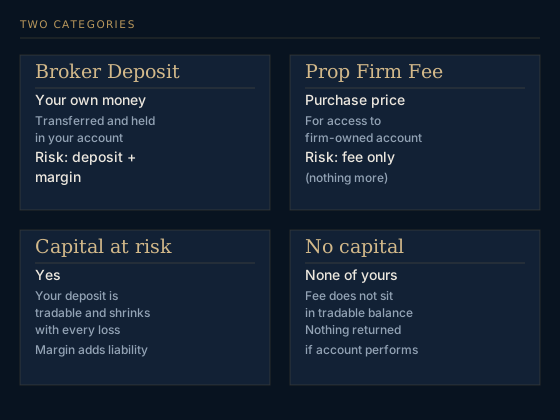
| Item | What it is | Tradable capital of yours? | Most you can lose |
|---|---|---|---|
| Broker deposit | Your own money transferred to the broker and held in your trading account | Yes | Depends on the broker agreement and applicable account protections |
| Simulated-account fee | A purchase price for access to a simulated account or evaluation | No | The fee, only if the agreement excludes other liability and recurring charges |
Two consequences follow from that table.
First, in a simulated-account model, the account size is not a number you funded. Alpha Capital Group, itself a prop firm and therefore an interested party, states that a trader's direct financial exposure is typically the evaluation fee plus any optional resets, not the full nominal account size, noting that a $100,000 simulated account does not mean the trader deposited $100,000 (Alpha Capital Group, retrieved 2026-07-31). The headline figure describes the account's parameters, not your bank transfer.
Second, the simulated balance is not your margin. A loss-limit breach can close the account, but its exact consequence comes from the written rules. Confirm that the agreement creates no debt or loss liability beyond the stated fee. The mechanics of what closes the account, and how a static floor differs from a trailing one, are covered in static versus trailing drawdown.
Why can simulated-account firms charge a fee instead of taking a deposit?
Because the customer is buying access to a simulated trading environment, not adding client capital to a trading balance. This describes the named examples below, not every proprietary trading arrangement.
Alpha Capital Group's blog, itself a prop firm and an interested party, states that traders are not depositing margin like retail broker clients, and that the only upfront risk is the evaluation fee (Alpha Capital Group, retrieved 2026-07-31).
Spotware, a platform vendor rather than a firm selling accounts, describes the underlying mechanism: instead of committing live funds immediately, firms place traders on simulated, or demo, accounts that mirror real market conditions (Spotware, retrieved 2026-07-31).
FTMO, in its own account FAQ, states that all accounts it provides to clients are demo accounts with fictitious funds and any trading is in a simulated environment only (FTMO, retrieved 2026-07-31).
The structural reason no deposit is taken in these examples is contained in those statements. The account balance is simulated, so the access fee does not fund that balance.
How do you confirm this before you pay?
Run four checks before checkout, each answerable in a few minutes, and each with a specific thing you are looking for.
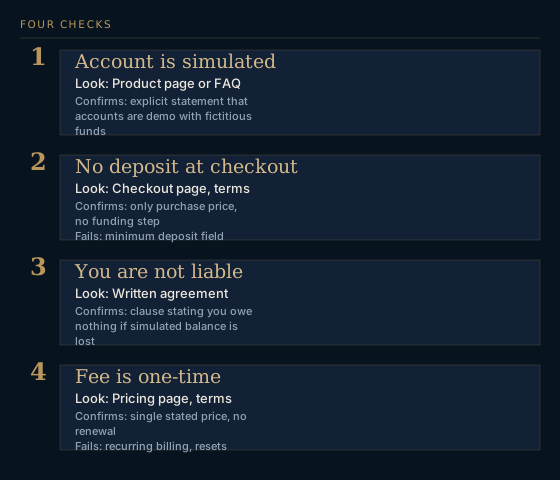
| Check | Where to look | What confirms it | What fails it |
|---|---|---|---|
| The account is simulated | Product page or account FAQ | An explicit statement that accounts are simulated or demo with fictitious funds (FTMO, retrieved 2026-07-31) | Silence, or language implying your capital is deployed |
| No deposit or margin is taken | Checkout page and account terms | Only a purchase price at checkout, with no funding step | A "minimum deposit" field, or a margin requirement |
| You are not liable for losses | The written agreement | A clause stating you owe nothing if the simulated balance is lost | Any clause making you responsible for the firm's funds |
| The price model is clear | Pricing page and terms | Every one-time, recurring, reset, data and platform charge is disclosed | Any charge that appears only after purchase |
The third row is the one people skip. A firm that cannot show you that sentence in writing has not answered the deposit question, whatever its homepage says. This is exactly the kind of clause that a broader firm audit is built to catch before you pay.
The fourth row is where the deposit question ends and a different question begins. Once you know nothing is deposited, the remaining money question is what the ticket price does not cover: the costs beyond the ticket, such as resets, data or platform charges, which the article on prop firm hidden fees deals with directly. Your total exposure, of which the fee is the main piece, is covered in the article on whether you can lose money with a prop firm.
Ordane's structure, stated plainly
Ordane accounts operate on simulated capital. No live funds are traded and no deposits are accepted. Clause P-2 of the Ordane Rulebook v1.0 requires the simulated-capital declaration; the no-deposits statement also appears in the live rulebook disclosure and homepage (retrieved 2026-08-04).
Payouts are paid in real money from company fee revenue. No client deposits are taken and no client capital is traded. Rulebook v1.0 clause PR-1 commits Ordane to publish the payout reserve on-chain; the live rulebook and homepage publish the TRON address.
Ordane's payout reserve is published at a public TRON address on ordanemarkets.com and in Rulebook v1.0 clause PR-1. As of 2026-08-04, the page reports a dated observed balance and warns that the wallet does not prove future solvency, total liabilities or future payouts. There is no pooled trader capital funding anyone's withdrawal, because no client deposits are accepted. Once a withdrawal is approved, how long a prop firm actually takes to pay is a separate clock worth checking before you sign up.
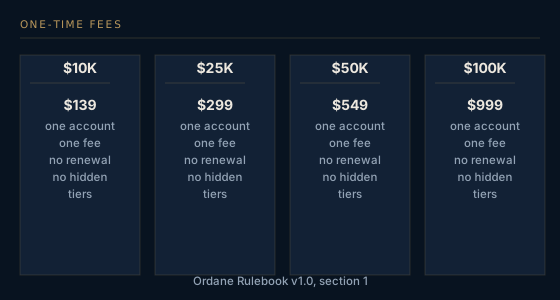
The fee is one-time. Ordane Instant Account comes in four sizes, $10,000, $25,000, $50,000 and $100,000, and the fee ranges from $139 to $999 depending on size (Ordane Rulebook v1.0, section 1, retrieved 2026-07-31). There are no recurring fees, no hidden tiers and no coupon games. The full price ladder is set out in section 1 of the rulebook rather than restated here.
The Ordane rulebook is public, numbered and versioned, and no rule is ever applied retroactively to an open account (Ordane Rulebook v1.0, notice above section 0 and section 6 Changelog, retrieved 2026-07-31). Changes produce a new version with a dated changelog entry, and the version you sign up under is the version that governs your account. That matters for the deposit question specifically: the clause saying no deposits are accepted cannot be rewritten under you after purchase.
The honest concession. Ordane is new. Its live homepage says it cannot show years of payout history; the rulebook says payout performance metrics begin with the first month in which a payout is requested. This article does not claim a payout track record. What you can verify today is the structure in writing: simulated capital, no deposits, a one-time fee, versioned rules and the public reserve address.
Questions traders ask about prop firm deposits
Do prop firms require a deposit?
Not in the simulated-account model covered here. You pay an access or evaluation fee instead of transferring capital into a tradable balance. Alpha Capital Group's own blog, an interested party, states that traders are not depositing margin like retail broker clients (Alpha Capital Group, retrieved 2026-07-31). The written agreement still controls your liability.
Is the prop firm fee a deposit?
No. A deposit becomes your balance and shrinks as you lose. A fee is a purchase price that buys entry and does not sit in the account. Nothing of the fee is tradable, and none of it is returned to you as balance if the account performs well.
Can you lose more than the fee?
Only treat your loss as limited to the fee when the written agreement says so. EarnForex states that losses are usually limited to the challenge or account fee and advises checking the agreement for exceptions (EarnForex, retrieved 2026-08-04). Liability is contractual, not automatic.
Do prop firms take margin like a broker?
Simulated-account firms do not use the account balance as your margin. Spotware describes the model directly: instead of committing live funds immediately, firms place traders on simulated, or demo, accounts that mirror real market conditions (Spotware, retrieved 2026-07-31). Check the agreement to confirm that no separate deposit or liability applies.
Does a $100,000 account mean I put up $100,000?
No. Alpha Capital Group, an interested party, notes that a $100,000 simulated account does not mean the trader deposited $100,000, and that direct exposure is typically the fee plus any optional resets rather than the nominal size (Alpha Capital Group, retrieved 2026-07-31). The account size describes the simulated parameters, nothing more.
Sources
- What Are Simulated Funds? | Alpha Capital. alphacapitalgroup.uk Retrieved 2026-07-31.
- How Much Does a Prop Firm Evaluation Cost in 2026? | Alpha Capital. alphacapitalgroup.uk Retrieved 2026-07-31.
- Do Prop Firms Use Real Money? | Spotware. spotware.com Retrieved 2026-07-31.
- FTMO Account FAQ | FTMO.com. ftmo.com Retrieved 2026-07-31.
- Will I Owe Money to a Prop Firm if I Lose Their Funds? | EarnForex. earnforex.com Retrieved 2026-07-31.