Home · The Ordane Journal · Rules and mechanics · Prop Firms Without a Consistency Rule
Prop Firms Without a Consistency Rule
A consistency rule in proprietary trading firms generally requires a trader's profits to fall within a specific percentage range of their total profits, preventing single lucky trades from passing an evaluation. (Finance Magnates, retrieved 2026-09-13)
Ordane accounts operate on simulated capital. No live funds are traded and no deposits are accepted. (Ordane Rulebook v1.0, clause P-2, retrieved 2026-09-13)
The proprietary trading industry often advertises large simulated account sizes, but the fine print dictates whether you actually reach a payout. Many evaluation programs include mechanisms designed to fail traders who rely on high volatility. One of the most common mechanisms is the consistency rule. To understand the full anatomy of what can block a payout, what is the consistency rule at a prop firm is the reference that maps every variation in the industry.
What Is a Prop Firm Consistency Rule?
Consistency rules dictate that no single trading day can account for more than a predetermined percentage of a trader's total profit, often set at 30 percent or 50 percent. (Finance Magnates, retrieved 2026-09-13) The mathematical reality is that a successful trade becomes a compliance violation.
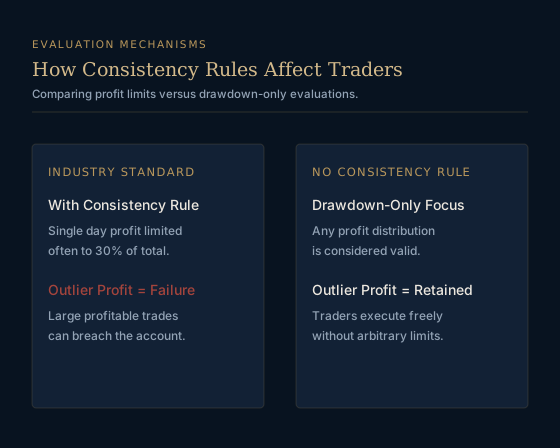
This mechanism directly attacks the first fear of any participant: passing an evaluation and never getting paid. You follow the drawdown limits, avoid news embargoes, and still lose your account because you made too much money on a single position. Traders often discover this clause only at withdrawal time. Before paying, use the prop firm audit checklist to locate the consistency clause in any rulebook before it surprises you at withdrawal.
To protect yourself, read the terms carefully. If you seek a prop firm without a consistency rule, you must find companies that rely on fixed drawdown limits rather than arbitrary constraints.
How Does the Consistency Rule Block Your Payout?
If a firm enforces a consistency rule, letting a winner run becomes a liability. The evaluation process demands that your performance is evenly distributed. If the market trends aggressively on Friday, capturing that move might push you over the firm's daily threshold.
The problem lies in elasticity at withdrawal time. An elastic clause gives the firm a reason to deny your request. You want a closed list of rules: if a behavior is not listed, it is not a violation. Whether a prop firm can enforce a rule that is not written down is a separate question; can a prop firm enforce an unwritten rule covers the legal and contractual mechanics behind discretionary clauses.
Understanding what happens when you breach a prop firm account is equally important: firms differ on whether excess profit is confiscated, deferred, or treated as an outright breach.
Prop Firms Without a Consistency Rule
A prop firm without a consistency rule evaluates risk strictly through drawdown limits. If you do not breach the daily loss limit and the maximum static drawdown, your profits are valid, regardless of how they are distributed.
The absence of this rule aligns evaluation criteria with objective risk parameters. Traders can execute naturally, capturing outsized moves when the market presents them. Review how prop firm daily loss limits are calculated so you understand which drawdown metric controls your headroom at each firm.
FTMO Standard Evaluation Rules
FTMO (prop firm) does not apply a consistency rule to its standard evaluation process; traders can pass the profit target even if a large portion comes from a single trading day. (FTMO FAQ, retrieved 2026-09-13) They state clearly that they do not apply any hidden rules or consistency rules, and as long as your trading is legitimate and complies with their terms, you can trade freely. (FTMO FAQ, retrieved 2026-09-13)
By removing the consistency clause, FTMO shifts evaluation entirely to drawdown metrics. However, you still have to pass an evaluation phase, trading in a simulated environment before requesting a payout.
Evaluation Fees vs. Instant Funding Cost
An evaluation firm might charge a lower entry fee, but you must pass challenges before requesting a withdrawal. A firm without an evaluation phase charges a higher initial fee, but the path to a payout is direct. The instant account vs evaluation comparison details how the two models differ on cost, risk, and rule structure.
Ordane sells one product, the Ordane Instant Account: direct access, no evaluation phase and no challenge, on simulated capital. (Ordane Rulebook v1.0, section 1, retrieved 2026-09-13) You do not spend weeks trying to hit a profit target while managing a consistency rule. You trade, you manage your risk against a static drawdown, and you request a withdrawal when eligible.
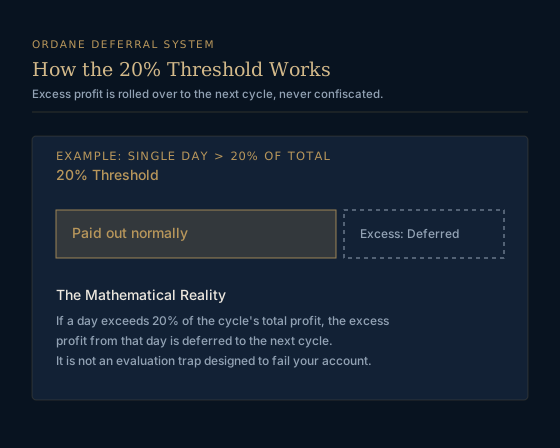
Ordane's consistency rule is 20 percent: at the moment of a withdrawal request, no single trading day may account for more than 20 percent of the cycle's total profit. If a day exceeds 20 percent, the excess profit from that day is deferred to the next cycle. It is never confiscated, and the remainder of the cycle pays out normally. (Ordane Rulebook v1.0, clause R-4, retrieved 2026-09-13) This mechanism ensures that a trader receives their payout, while the outlier profit is simply rolled over to the next period. It is not an evaluation trap designed to fail your account; it is a mechanical payout schedule.
To understand how withdrawals interact with your remaining loss buffer, what a payout does to your drawdown explains the mechanics of the static floor after each withdrawal cycle.
| Metric | Value |
|---|---|
| Industry standard consistency limit | 30 percent |
| Ordane deferral threshold | 20 percent |
| Metric/Feature | Ordane (Simulated) | Industry Standard |
|---|---|---|
| Consistency Rule Impact | Excess deferred, never confiscated | Account failure or payout denied |
| Maximum Drawdown | 5 percent static floor | Trailing drawdown from high water mark |
| Evaluation Phase | Direct access, no evaluation | One or two step challenge required |
| Profit Split Start | 60 percent | Varies, often requires scaling |
| Account Capital | Simulated capital only | Simulated capital only |
The Ordane Guarantee provides certainty regarding payouts. Every withdrawal request is approved, or denied in writing citing the exact rule breached by section number, within 24 clock hours. (Ordane Rulebook v1.0, clause G-0, retrieved 2026-09-13) Past that deadline the request is treated as approved and the G-1 clock starts. A payout approved and not paid within 48 clock hours, not business hours, triggers automatic compensation: a 100 percent refund of the account fee, plus the payout owed in full. (Ordane Rulebook v1.0, clause G-1, retrieved 2026-09-13) The Ordane rulebook is public, numbered and versioned, and no rule is ever applied retroactively to an open account. (Ordane Rulebook v1.0, clause 6 Changelog, retrieved 2026-09-13)
For the complete picture on how long approval and transfer actually take, how long prop firms take to pay breaks down the two separate clocks behind every payout. Once you are ready to request, the prop firm withdrawal requirements checklist covers every condition you need to meet before submitting.
FAQ: Prop Firms and Consistency Rules
The industry is filled with companies offering different variations of the consistency rule. Understanding these variations helps you choose the right environment for your trading style, especially if you rely on capturing large, infrequent market moves.
What is the best prop firm without consistency rule?
FTMO does not apply a consistency rule to its standard evaluation process; traders can pass the profit target even if a large portion comes from a single trading day. (FTMO FAQ, retrieved 2026-09-13) If you want to skip evaluations entirely, Ordane offers instant access on simulated capital with a deferral system: if a day exceeds 20 percent, the excess profit from that day is deferred to the next cycle. It is never confiscated, and the remainder of the cycle pays out normally. (Ordane Rulebook v1.0, clause R-4, retrieved 2026-09-13)
Is there a prop firm instant funding no consistency rule?
Yes. Instead of an evaluation trap, Ordane uses a deferral system. If a day exceeds 20 percent, the excess profit from that day is deferred to the next cycle. It is never confiscated, and the remainder of the cycle pays out normally. (Ordane Rulebook v1.0, clause R-4, retrieved 2026-09-13) This provides direct access without the risk of an arbitrary failure.
Can I pass with a prop firm no consistency rule in one day?
If a firm does not enforce minimum trading days, you can pass quickly. FTMO does not apply any hidden rules or consistency rules. (FTMO FAQ, retrieved 2026-09-13) However, doing so requires taking significant risk, which often leads to a failure in subsequent stages of the evaluation.
Do all prop firms have a consistency rule?
No. Consistency rules dictate that no single trading day can account for more than a predetermined percentage of a trader's total profit, often set at 30 percent or 50 percent. (Finance Magnates, retrieved 2026-09-13) Firms without this rule evaluate traders solely through drawdown metrics.
What happens if I breach the consistency rule?
During an evaluation, a breach might mean trading additional days to smooth your profit curve. At the payout stage at other firms, a breach might result in a denied payout or a complete account termination. At Ordane, if a day exceeds 20 percent, the excess profit from that day is deferred to the next cycle. It is never confiscated, and the remainder of the cycle pays out normally. (Ordane Rulebook v1.0, clause R-4, retrieved 2026-09-13) The Ordane rulebook is public, numbered and versioned, and no rule is ever applied retroactively to an open account. (Ordane Rulebook v1.0, clause 6 Changelog, retrieved 2026-09-13)
Sources
- What Are Consistency Rules in Prop Trading and Why Do They Matter? financemagnates.com Retrieved 2026-09-13T18:14:23-03:00.
- Are there any restrictions on my trading style? | FTMO ftmo.com Retrieved 2026-09-13T18:14:23-03:00.