Home · The Ordane Journal · Rules and mechanics · Prop Firm Trading Strategy: Test Every Rule
Prop Firm Trading Strategy: Test Every Rule
A prop firm trading strategy is a mathematical risk framework designed specifically to survive strict simulated capital constraints. Compatibility requires synchronizing trade frequency, capital exposure, and profit goals with the precise rulebook governing the simulated environment. The system must satisfy every operational limit simultaneously to avoid an immediate account termination.
Ordane accounts operate on simulated capital. No live funds are traded and no deposits are accepted.
The Commodity Futures Trading Commission advisory states that two out of three retail forex customers lose money. (CFTC, retrieved 2026-08-26). This severe base rate is the baseline any risk strategy has to beat just to break even. Building a complete plan requires mapping every rule before executing the first order.
Testing a strategy against historical price data is an incomplete process. A backtest that measures aggregate profit while ignoring temporary equity retracements and trading costs provides a false sense of security. Strategy validation requires translating contract clauses into a mathematical stress test.
What Makes a Trading Strategy Prop Firm Compatible?
Compatibility means a trading strategy satisfies every applicable risk and time rule simultaneously. A system fails compatibility if reaching the required profit forces the trader to breach a daily loss limit. It also fails if it violates a consistency ceiling during the execution sequence.
Synchronization Across Contract Constraints
A strategy built to pass FTMO (prop firm) Challenge phase has to clear a 10% profit target measured against the Initial Simulated Capital before Verification even starts. (FTMO.com, retrieved 2026-08-26). However, reaching that mark violates other constraints if the pacing is incorrect.
Traders often increase their position sizing to accelerate the return curve. This mathematical shortcut increases the maximum drawdown exposure on each individual setup. When a firm measures the drawdown limit against open equity rather than closed balance, the strategy can easily breach the limit.
<span id="quote"></span>
Prop firm compatibility demands strict synchronization. The maximum adverse excursion of the worst historical losing streak must fit inside the daily loss limit. The strategy must also generate sufficient trade volume to meet activity minimums without diluting the overall expectancy.
Scope Boundary of the Trading Plan
This guide tests a complete plan rather than explaining individual calculations. We compile the constraints into a unified stress test. If a system requires heavy modification just to fit within daily limits, it is not compatible.
Ordane sells one product, the Ordane Instant Account: direct access, no evaluation phase and no challenge, on simulated capital. When a product has no evaluation phase, the rules apply permanently from the first order. We use these constraints to build the testing framework.
How Do You Build a Constraint Sheet From the Actual Rulebook?
A robust plan begins with exact data extraction. You must list the precise limits governing your specific account size. This extraction process forms the foundation of the mathematical stress test.
Document the Core Constraints
You must gather the target, the required timeframe, the consistency ceiling, the daily loss limit, and the maximum drawdown. Documenting the absolute value of each constraint prevents estimation errors during volatile market sessions.
A strategy trading Topstep (prop firm) $50K Trading Combine has $2,000 of total room before the trailing Max Loss Limit closes the account, versus $4,500 of room on the $150K size. (Topstep, retrieved 2026-08-26). These figures dictate the maximum position sizing.
The constraint sheet must reflect the current version of the rulebook. Firms update their terms constantly, and a strategy built on outdated limits will fail. The trader must read the official documentation, isolate the numerical thresholds, and transfer them to the worksheet.
Separate the Evaluation Rules From Post-Pass Rules
Firms with multi-step processes apply different standards at different times. You must separate evaluation rules from post-pass rules before calculating anything. A strategy optimized purely for an evaluation challenge might fail completely when transitioned to a funded stage.
Topstep (prop firm) XFA Standard payout path requires a strategy to produce 5 separate winning days with at least $150 profit on each before a withdrawal is allowed. (Topstep Help Center, retrieved 2026-08-26).
This separation ensures the trader understands the long-term requirements. Documenting both sets of rules allows the trader to decide whether to adjust the system upon passing. Alternatively, they can design a single conservative system that satisfies both phases simultaneously.
Classify Each Rule as a Hard Breach or Progress Requirement
You must classify each rule properly to know how to react. A hard breach terminates the account instantly. Delayed eligibility pauses withdrawals. Progress requirements govern the completion of evaluation phases.
Classifying the rules dictates the required response when a limit is approached. A trader can afford to delay a payout, but a hard breach is fatal.
- A 10% profit target is a progress requirement.
- A fixed $2,000 daily loss limit is a hard breach.
- A requirement for 5 winning days is a delayed eligibility constraint.
How Do You Run the Strategy Through the Binding-Constraint Test?
The binding constraint is the specific rule that forces your plan to stop first. To find it, you must simulate the worst-case scenario. The test reveals whether the system breaks under pressure before realizing its theoretical profit.
Test the Planned Loss Sequence
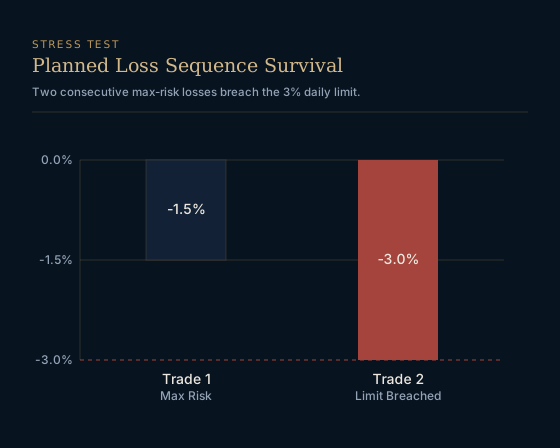
Test the planned loss sequence against the daily and total loss ceilings. If your system averages consecutive losing trades during flat markets, multiply that sequence by your risk per trade. If the total exceeds the daily limit, the constraint binds and the plan fails.
The daily limit is often the most restrictive parameter for day traders. A high-frequency system taking multiple small losses can breach the ceiling rapidly. The trader must calculate the maximum historical drawdown duration and compare it against the firm's specific rules.
Test Expected Profit Concentration
Test the expected profit concentration against the consistency limit. Trend-following systems often generate the bulk of their returns in a handful of sessions. If a system generates massive single-day returns, it will breach concentration limits.
Consistency limits force traders to distribute their gains across multiple days. The trader must measure the standard deviation of daily returns in the backtest. They must then adjust the position sizing on high-probability setups to remain compliant.
Test Trade Frequency Against Deadlines
Test your trade frequency against minimum-day and deadline requirements. Swing traders holding positions for extended periods face activity limits. The strategy frequency must align with the operational calendar defined by the contract.
FTMO (prop firm) Minimum Trading Days rule forces a strategy to trade on at least 4 separate days before the evaluation can be completed, which rules out clearing the target in one session. (FTMO.com, retrieved 2026-08-26).
Use a Decision Tree for Adjustments
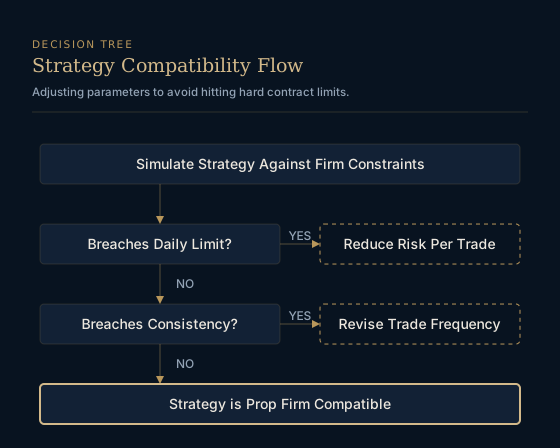
You face a simple decision tree: pass, revise position size, revise frequency, or reject the plan entirely. If the simulated drawdowns hit a hard limit, you must reduce risk. If the system cannot trade often enough, you must adjust frequency.
The decision tree removes emotion from the preparation phase. Attempting to force a high-volatility strategy into a tight drawdown constraint guarantees failure. Accepting a rejection early preserves capital and directs the trader toward a compatible method.
What Does a Stress Test Look Like Against Fixed Limits?
We map a theoretical plan against a fixed ruleset to demonstrate the stress test. We use the Ordane structure because it applies immediately without phases. This provides a clean model for testing the interaction of multiple hard limits.
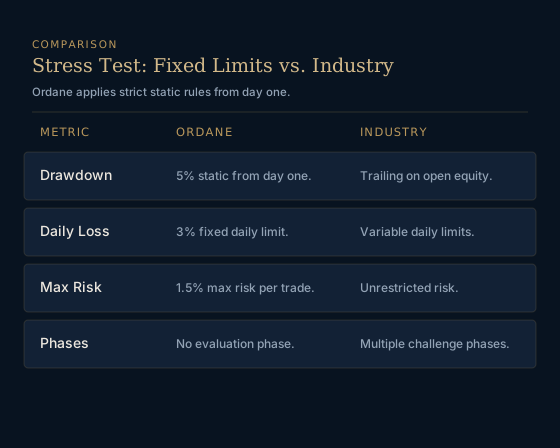
<table id="table"> <thead> <tr> <th>Metric/Feature</th> <th>Ordane (Simulated)</th> <th>Industry Standard</th> </tr> </thead> <tbody> <tr> <td>Drawdown Basis</td> <td>5% static floor from day one.</td> <td>Trailing drawdown based on open equity.</td> </tr> <tr> <td>Daily Loss Limit</td> <td>3% fixed daily limit.</td> <td>Variable daily limits across firm phases.</td> </tr> <tr> <td>Risk Per Trade</td> <td>1.5% maximum risk per trade.</td> <td>Often unrestricted, allowing excessive risk.</td> </tr> <tr> <td>Account Phases</td> <td>Direct access, no evaluation phase.</td> <td>Multiple challenge and verification phases.</td> </tr> </tbody> </table>
Translate Clauses Into Concrete Dollar Limits
Ordane published rules cap risk at 1.5% per trade, 3% in a single day, and 5% static drawdown overall, three thresholds a compliant strategy must respect at the same time. (Ordane Markets, retrieved 2026-08-26). Using the maximum size, the calculations are definitive.
Identify which limit binds first under consecutive full-risk losses. If a trader takes consecutive losses at the maximum risk allowance, the daily limit is breached on the second trade. The daily limit binds the strategy before the overall drawdown floor is ever threatened.
Reduce Planned Risk for Survival
The strategy stress test reveals that deploying maximum risk per trade leaves zero room for variance. A single premature entry followed by a second attempt consumes the entire daily allowance. You must reduce planned risk until the loss sequence fits all thresholds simultaneously.
By halving the exposure, the strategy detaches from the daily limit and transfers the stress to the overall drawdown floor. The trader recalculates the required win rate at the lower position size to ensure the system remains profitable.
Does the Trading Plan Still Work After the Evaluation Phase?
For firms that use evaluation phases, passing the challenge is only the initial step. The conditions often change dramatically once the trader receives access to the subsequent phase. A strategy validated for the challenge might break completely under the final contract.
Re-Run the Clauses That Change
Re-run only the clauses that change after passing. The alternate Topstep (prop firm) XFA Consistency path only requires a strategy to trade at least 3 days with at least 1 trade per day, a lower bar for traders who trade less often. (Topstep Help Center, retrieved 2026-08-26).
The trader must identify every variable that shifts. Some firms tighten the daily loss limit, while others introduce strict consistency rules that did not apply during the evaluation. Re-running the constraint worksheet highlights exactly where the strategy must adapt.
Confirm Readiness With a Final Checklist
Stop and open the dedicated post-pass guide when a new condition appears. Withdrawals change the mathematical baseline. The stress test confirms whether the system can operate within the withdrawal windows.
A final checklist confirms readiness: same sizing, same frequency, same instruments, and the same prohibited-practice boundary. If a behavior is not listed in the rulebook, it is not a violation. The trader must ensure the strategy respects the exact constraints of the current phase.
To ensure your strategy respects real boundaries, compare an instant account vs evaluation model and review the Ordane Instant Account rules before you start.
<span id="faq"></span>
FAQ: Testing a Prop Firm Trading Plan
Which rule should determine the risk per trade?
The daily loss limit dictates the risk per trade for a strategy. The CFTC advisory states that two out of three retail forex customers lose money, illustrating why risk management is critical. A trader must divide the firm's daily limit by their maximum consecutive losses to survive. (CFTC, retrieved 2026-08-26).
Can a profitable strategy still fail a prop firm evaluation?
A profitable strategy can fail an evaluation if it breaches a strict parameter like Topstep (prop firm) $2,000 max loss limit on a $50K Trading Combine. A system relying on deep temporary retracements before moving into profit will hit a trailing limit and trigger an account closure. (Topstep, retrieved 2026-08-26).
How do you find the binding constraint in a rulebook?
A trader finds the binding constraint by testing historical performance against specific constraints like FTMO (prop firm) 10% profit target measured against Initial Simulated Capital. The rule that triggers a breach first during a losing sequence is the binding constraint that dictates the entire system configuration. (FTMO.com, retrieved 2026-08-26).
Should minimum trading days change the position size?
Minimum trading days should change the pacing rather than the sizing. For instance, Topstep (prop firm) XFA Consistency path requires trading at least 3 days with 1 trade per day. Manipulating position sizing mid-cycle to log days introduces compliance risks and can violate consistency rules. (Topstep Help Center, retrieved 2026-08-26).
Do you need to test the strategy again after passing?
A trader must test the strategy again if the prop firm alters the rules between phases. However, Ordane applies a static 5% drawdown and 1.5% maximum risk per trade directly from day one. When a product has no evaluation phase, the rules apply permanently. (Ordane Markets, retrieved 2026-08-26).
Sources
- Trading Objectives | FTMO.com ftmo.com Retrieved 2026-08-26.
- Topstep Express Funded Account Rules | Topstep topstep.com Retrieved 2026-08-26.
- Express Funded Account™ Parameters | Topstep Help Center help.topstep.com Retrieved 2026-08-26.
- Customer Advisory: Eight Things You Should Know Before Trading Forex | CFTC cftc.gov Retrieved 2026-08-26.
- Ordane Markets pricing page ordanemarkets.com Retrieved 2026-08-26.