Home · The Ordane Journal · Rules and mechanics · Prop Firm EA and Copy Trading Rules: What Bans You
Prop Firm EA and Copy Trading Rules: What Bans You
Ordane accounts operate on simulated capital. No live funds are traded and no deposits are accepted. Payouts depend on simulated performance under Rulebook v1.0; no level of performance is typical or assured.
Ordane sells one product, the Ordane Instant Account: direct access, no evaluation phase and no challenge, on simulated capital. (Ordane Rulebook v1.0, clause P-2, retrieved 2026-08-09)
An Expert Advisor, also called an EA, is a piece of software that automates a trading strategy the trader who runs it owns and built.
Most prop firms allow that, but forbid copy trading, which mirrors trades from another person's account or an external signal onto yours. (Ordane Rulebook, retrieved 2026-08-09)
That sentence matters here because every rule below is a rule about simulated exposure, not live funds, and firms police automation to protect the integrity of that simulation, not because a bot is inherently dangerous.
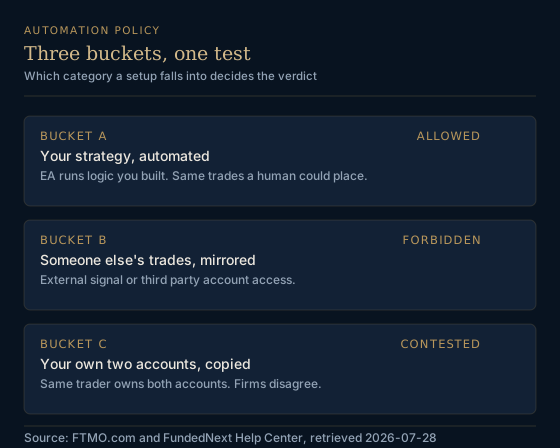
Copying between a trader's own accounts is the genuine grey zone, and it differs by firm. Learn your bucket before you read a single rulebook clause.
What Are the Three Automation Buckets, and Which One Bans You?
ESMA's product-intervention notice states that CFDs are complex instruments and come with a high risk of losing money rapidly due to leverage (ESMA, retrieved 2026-08-10). That leverage risk is the independent frame behind any prop CFD-style ticket.
The short answer, quotable as written
An Expert Advisor running a strategy you built and own is normally allowed, because it is your trading, only faster. Copy trading from someone else's account or a shared signal group is normally forbidden. Copying between two accounts you personally own sits in between, and policy varies by firm.
A strategy a human could execute is just faster typing
Automating logic you already own does not change what the firm is exposed to. The account takes the same trades, at the same risk, that a manual trader following the identical rules would take. Speed and consistency of execution do not turn a strategy into a different risk profile, which is why FTMO's condition for EA use is not "no automation" but that the trading stays legitimate and replicable under real market conditions on a broker account (FTMO.com, retrieved 2026-07-28).
The fingerprints: timestamps, lot ratios, fill sequences
Firms do not read your source code. They run statistical checks across accounts that share a liquidity feed, looking for entry timestamps that match to the millisecond, lot sizes that scale proportionally between accounts, fill sequences that line up trade for trade, and order bursts that arrive in sub-second clusters. None of these require inspecting your EA's logic. They only require comparing account activity against other accounts on the same server.
Detection happens at withdrawal, not at entry
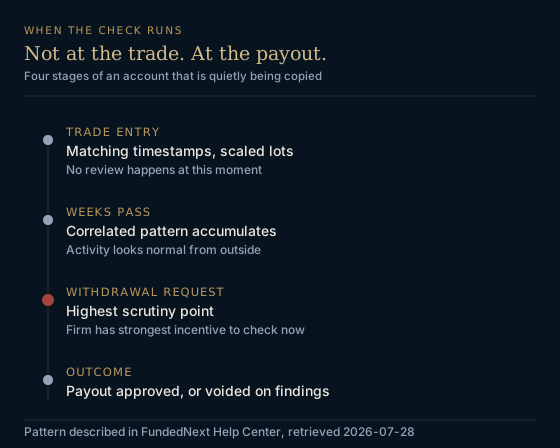
The trade itself rarely triggers a review. The account can run for weeks producing normal-looking activity, and the correlation check tends to happen at the point a payout is requested, when a firm has the strongest incentive to look closely at how the profit was generated. "Nobody will notice" is a false premise built on watching the wrong moment. The moment that matters is the one before money leaves the firm, not the one where the trade was placed.
Where Named Firms Draw the Automation Line
| Firm | Own-strategy EA allowed | External-signal or third-party copy trading forbidden | Copying between your own accounts allowed | Conditions |
|---|---|---|---|---|
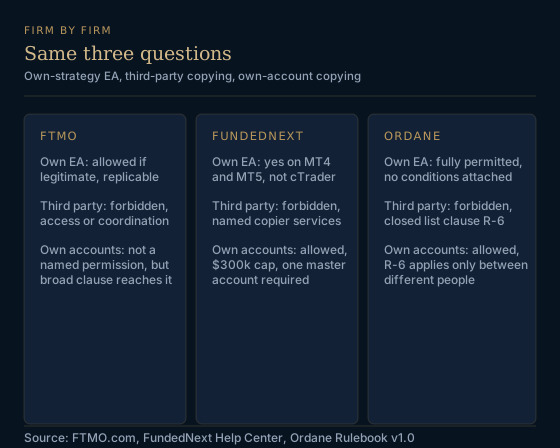
| FTMO | Yes, if legitimate and replicable under real market conditions on a broker account (FTMO.com, retrieved 2026-07-28) | Yes, third-party account access and coordinated simulated trades are forbidden (FTMO.com, retrieved 2026-07-28) | Not found in FTMO's own documentation as a distinct permission; the connected-accounts clause reads broad enough to reach it (FTMO.com, retrieved 2026-07-28) | EA logic causing server hyperactivity may require adjustment; platform limits of 200 orders at a time and 2,000 max positions per day apply (FTMO.com, retrieved 2026-07-28) |
| FundedNext | Yes, on MetaTrader 4 and MetaTrader 5 (FundedNext Help Center, retrieved 2026-07-28); no, on cTrader (FundedNext Help Center, retrieved 2026-07-28) | Yes, copying between different individuals and named external copier services are forbidden (FundedNext Help Center, retrieved 2026-07-28) | Yes, between accounts owned by the same individual, one Master account, combined capital capped at $300,000 (FundedNext Help Center, retrieved 2026-07-28) | EAs or bots built specifically to pass a challenge are strictly prohibited; each must use a distinct strategy (FundedNext Help Center, retrieved 2026-07-28) |
| E8 Markets (prop firm) | Not found in E8 Markets' own documentation | Not found in E8 Markets' own documentation | Not found in E8 Markets' own documentation | Not found in E8 Markets' own documentation |
| Ordane | Yes, EAs are fully permitted, executing the trader's own strategy | Forbidden between different people, closed list clause R-6 | Yes, exclusively between accounts belonging to the same person (same account holder / ultimate beneficial owner) | See the Ordane section below for the exact clause language |
The Seven Clause Words That Carry the Automation Rule
Search a firm's rulebook or terms page for these exact terms before you assume a policy from an FAQ answer:
| Clause word | What it usually restricts | Bucket it hits |
|---|---|---|
| Copy trading | Mirroring trades between accounts, same owner or different owners | B always; C depends on the firm |
| Mirror trading | Near-synonym for copy trading, sometimes carved out with its own conditions | B, sometimes C |
| Third-party signals | Trades originating from someone else's decision or a paid signal feed | B |
| Account management | Anyone other than the account holder controlling the account | B, including managers trading client accounts identically |
| High-frequency | Execution speed and order volume rather than automation itself | Any bucket whose EA trades at high frequency |
| Latency | Exploiting a delay between a price feed and the platform's execution price | Distinct practice, listed in the same section |
| Tick scalping | Extremely short-hold strategies exploiting feed noise | Distinct practice; bots are the practical way to execute it |
The restriction is frequently written into the prohibited-practices section of a rulebook rather than the FAQ, and a general FAQ answer does not override a specific rulebook clause. If the two disagree, the rulebook governs.
What Does Ordane Allow, in One Closed Answer? (Ordane Rulebook, retrieved 2026-08-09)
Running this article's own three-bucket test against Ordane produces a definite answer on every bucket, which no other firm in the comparison table can currently give in writing.
Bucket A, your strategy, automated: permitted. Expert Advisors are fully permitted at Ordane: a trader may run an EA executing the trader's own strategy on an Ordane account. (Ordane Rulebook v1.0, Appendix A, entry A-2, retrieved 2026-08-09)
Bucket C, your own two accounts, copied: permitted. The R-6 prohibition on copy trading between Ordane accounts applies only between different people. Copy trading is permitted exclusively between Ordane accounts that belong to the same person, meaning the same account holder and ultimate beneficial owner. Copy trading between person A and person B is always prohibited. (Ordane Rulebook v1.0, Appendix A, entry A-3, clarified 2026-08-09, retrieved 2026-08-09)
Bucket B, someone else's trades, mirrored: forbidden. Ordane's prohibited-practice list is closed. Clause R-6 names six practices: latency, reverse or hedge arbitrage; high-frequency or bulk automated exploitation; copy trading between Ordane accounts; straddling news releases with paired opposing orders; platform or data-feed exploitation; and gap abuse. If a behavior is not listed in that section, it is not a violation. Discretion is not a rule. (Ordane Rulebook v1.0, clause R-6, retrieved 2026-08-09)
The published proof sits in Appendix A, part of Rulebook v1.0 since August 1, 2026 (Ordane Rulebook v1.0, clause R-6 and section 6 Changelog, retrieved 2026-08-09). Its A-2 entry states in writing that R-6(b) does not ban all automation, only bulk or high-frequency exploitation, and gives the example that does not close an account: a single expert advisor or script placing discretionary or rules-based trades at human-scale frequency, with a stop-loss on every position under R-3 (Ordane Rulebook v1.0, Appendix A, retrieved 2026-08-09). That is the bucket-A permission in public, citable language, not a support-ticket answer.
The structural point holds regardless of what the appendix eventually adds: a closed list with a declared scope is falsifiable. You can check whether your behavior appears on it. An open-ended discretion clause, the kind that lets a firm call anything a violation after the fact, is not falsifiable, because there is nothing written down to check against.
How to Check a Firm's Automation Rule Before You Pay
A banned automated setup does not usually get flagged when you place the trade. It gets flagged at the withdrawal review, which is after the account fee is already spent. Run this check before you pay, not after.
An independent US regulator frames leveraged speculation the same way: like all futures products, speculating in these markets should be considered a high-risk transaction (CFTC, retrieved 2026-08-10).
For related published reading, see overnight and weekend holding rules.
What does this rule change on a simulated account?
It changes what the specification allows on simulated capital, not a live brokerage balance (Ordane Rulebook, retrieved 2026-08-10).
Where is the cost of the permission written?
In a separate clause from the permission itself: leverage, flatten clock, commission, or weekend close language on the firm's own page.
How do you reproduce the arithmetic in this article?
Use the declared inputs in the worked check and recompute the same multiplication or division; the numbers are listed in the table.
Does Ordane treat unlisted behaviour as a violation?
No. Ordane's prohibited-practice list is closed; what is not listed is not a violation (Ordane Rulebook, retrieved 2026-08-10).
Sources
- Which instruments can I trade and what strategies am I allowed to use? | FTMO.com ftmo.com Retrieved 2026-07-28.
- Forbidden Trading Practices | FTMO.com ftmo.com Retrieved 2026-07-28.
- Is EA allowed in FundedNext? | FundedNext Help Center help.fundednext.com Retrieved 2026-07-28.
- What Is The Copy Trading Rule at FundedNext? | FundedNext Help Center help.fundednext.com Retrieved 2026-07-28.
- Customer Advisory: Understand the Risks of Virtual Currency Trading | CFTC cftc.gov Retrieved 2026-08-10.
- Notice of product intervention decisions on CFDs and binary options | ESMA esma.europa.eu Retrieved 2026-08-10.