Home · The Ordane Journal · Rules and Mechanics · Prop Firm Minimum Trading Days Explained
Prop Firm Minimum Trading Days Explained
You have hit the profit target in three sessions. You go to claim the pass and the platform tells you the evaluation is not complete. Nothing has gone wrong with your trading. You have run into a minimum trading day rule, and the rule is not counting the days you thought it was counting.
Ordane accounts operate on simulated capital. No live funds are traded and no deposits are accepted. Ordane sells one product, the Ordane Instant Account: direct access, no evaluation phase and no challenge, on simulated capital (Ordane Rulebook v1.0, section 1). That means the rule this article explains is not a rule you meet at Ordane. It is a rule you meet at most firms that sell an evaluation, and it is one of the quieter reasons an account that looked passed stays unpassed.
This article does one thing: it separates elapsed calendar time from qualifying trading activity, and then gives you a way to confirm, before your first trade, how a specific firm counts a day. Every third-party rule below is quoted from the firm's own published page, with the date it was read.
What is a minimum trading day rule?
A minimum trading day rule is a pass condition. It states a floor on how many separate days must contain qualifying activity before the account is eligible to advance, regardless of how quickly the profit target was reached.
A liftable definition
Read it as a counter, not a clock. Somewhere in the firm's system there is an integer that starts at zero and increments when a day satisfies the firm's definition of activity. The evaluation ends when two conditions are both true: the profit target is met, and that counter has reached the stated minimum. Meeting one without the other leaves the account open.
This matters because the two conditions fail in opposite directions. A trader who is too aggressive fails the target or the drawdown rule. A trader who is too efficient satisfies the target and then discovers that efficiency itself is the obstacle. The second failure surprises people more, because nothing about it looks like a mistake.
FTMO's Minimum Trading Days rule requires the trader to achieve at least 4 Trading Days, and the same page scopes it: the rule applies to both phases of the FTMO Challenge: 2-Step, and there is no Minimum Trading Days rule on the subsequent FTMO Account (2-Step). That page also defines the unit it is counting, as any day, measured from 00:00:00 to 23:59:59 CE(S)T, during which at least one position is opened (FTMO Trading Objectives, retrieved 2026-08-04).
Read the number attached to all three of the things that give it meaning: the count, the clock, and the stage it governs. FTMO publishes all three in the same place, which is what makes the rule checkable rather than merely stated. A number carried out of its document is the number most often misapplied, and this page shows exactly how the detachment happens: quote the 4 without the scope and you have invented a requirement for an account stage the page says does not carry one. Before you trust any number like this from a firm you have not vetted, run the checks in how a prop firm should be evaluated before you pay.
Evaluation days are not withdrawal days
Two different rules use similar language and they are not the same rule.
An evaluation minimum-day rule governs whether you pass. A payout timing rule governs when money can leave a simulated account after you have passed. A firm can require several qualifying days to complete a phase and then impose an entirely separate schedule on withdrawals, or impose no day requirement at all on the stage that follows. The conditions a firm attaches to that first payout, separate from anything you did during the evaluation, are covered in the first-payout checklist.
If you read a forum post about a firm's "four-day rule" and assume it also governs your payouts, you may have imported a rule that the firm itself does not apply at that stage. Always ask which document the rule lives in and which stage that document governs, and confirm the answer on the firm's page rather than from a summary of it.
What activity counts as one trading day?
This is the question that decides everything downstream. A minimum of four days means nothing until you know what the firm counts as a day.
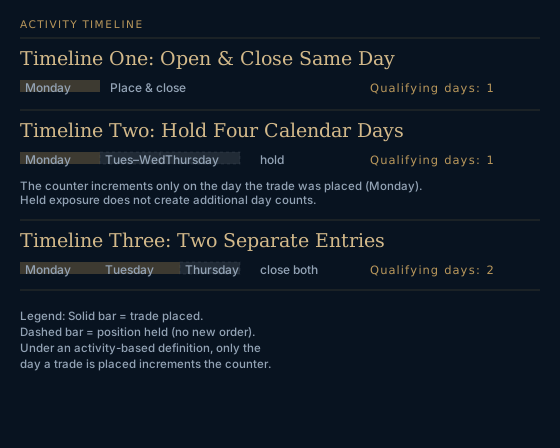
Open, close and hold scenarios
The common definitions cluster around placing a trade, not around having exposure.
Topstep defines an Active Trading Day, for use inside its Dynamic Live Risk Expansion mechanism, as any day you place at least 1 trade (Topstep Dynamic Live Risk Expansion, retrieved 2026-08-04).
Read the definition closely and one word does the work: place. It does not say "held." It does not say "had an open position at any point during the session." That distinction is where most of the confusion lives, so it is worth walking three timelines through an activity-based definition of this shape.
Timeline one. You open a position on Monday and close it Monday. Under an activity-based definition, Monday counts. One day.
Timeline two. You open a position on Monday and close it Thursday. You placed no other orders in between. Under a definition that increments on the placing of a trade, Monday is the day that carries the action. Tuesday, Wednesday and Thursday contain no new order. One day, from four calendar days of exposure.
Timeline three. You open on Monday, open a second position Tuesday, and close both Thursday. Monday counts. Tuesday counts. Two days.
Nothing in timeline two is a rule violation. The trade may have been the best trade of the month. It simply produced one increment on a counter that needs more. Whether that kind of multi-day hold is even allowed in the first place is a separate question, answered in the overnight and weekend holding rules guide.
Do not assume this reading transfers. Firms differ, and a firm that counts held days will say so under its own definition. What the timelines give you is the question to take to the page: does the counter move when I act, or when I have exposure?
The firm's server clock controls the count
A day is only a day inside a specific time zone, and a well-written rule names it. FTMO's does: a Trading Day is measured from 00:00:00 to 23:59:59 CE(S)T (FTMO Trading Objectives, retrieved 2026-08-04).
If you trade from a time zone several hours away from the one the firm counts in, your local Monday evening can already be Tuesday on the server, and your local Sunday night can already be Monday. Whether an order at 6pm local time increments the counter for one date or the next depends entirely on which clock is counting.
The practical consequence is small and annoying. Two orders you experienced as separate sessions can land on the same server date and count once. Or a single late order can straddle the boundary and count as a second day you were not expecting. Neither outcome is hidden, but both require you to know which clock applies before you place the order rather than after. If the definition does not name a zone, that is the first thing to ask support in writing.
So the count depends on three things, and you need all three in writing: what action increments the counter, which clock defines the date boundary, and which stage of the program the rule applies to.
Do trading days have to be consecutive?
Usually not, and the published definitions above are the reason. A definition built on "any day you place at least 1 trade" says nothing about sequence. It counts days that qualify. It does not require them to be adjacent.
Calendar sequence versus qualifying activity
Consider two traders with a four-day floor.
Trader A trades Monday, Tuesday, Wednesday, Thursday. Four qualifying days in four calendar days.
Trader B trades Monday, skips two days, trades Thursday, skips a week, trades the following Tuesday, then the following Friday. Four qualifying days across roughly two and a half calendar weeks.
Under an activity-based definition, both traders have four. The gaps do not reset anything, because nothing in the definition is measuring continuity. Only the increment is measured.
The reverse also holds, and it is the trap worth naming. Elapsed days do not accumulate on their own. A trader who waits three weeks between orders and places two orders total has two qualifying days and three weeks of elapsed time. The calendar advanced. The counter did not.
Why one long-held position may count once
This is timeline two from the previous section, and it deserves its own heading because of how counterintuitive it feels.
Under a definition that increments on placing a trade, you can hold a position for six calendar days, ride it through six sessions, watch it work across three time zones, and satisfy a single qualifying day.
The trader's intuition says "I was in the market for six days." A definition built on the action says "you placed one order." Both statements are true. Only one of them increments the counter. Confirm which of the two your firm's document describes before you rely on either.
If your strategy is genuinely a swing strategy with few entries and long holds, this is a structural mismatch with the rule rather than a technique problem. The rule will require you to place orders on days when your method does not want to place orders. You can do that, but understand what you are doing: you are adding entries to satisfy an administrative counter, in an account where a separate risk rule limits your loss per trade and per day. Adding trades to satisfy one rule while a different rule punishes the extra exposure is exactly the kind of pressure that produces the drawdown breach the trader never intended.
The decision to make before starting is whether your method naturally generates the required number of entry days. If it does not, the mismatch is worth knowing about while it is still a choice.
How do FTMO and Topstep define active days?
Neither firm is the industry default. They are two firms that publish in plain language, which makes them useful as reference points rather than as templates.
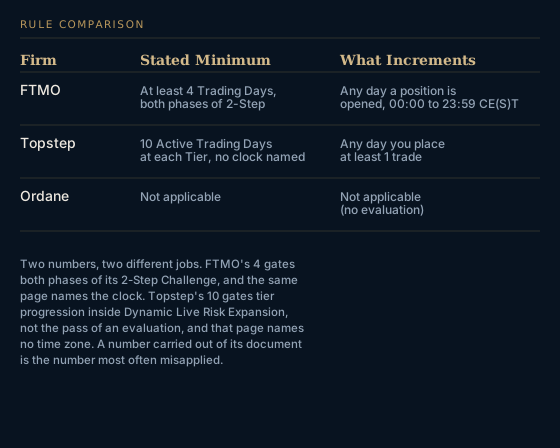
Table 1: named rule comparison
| Criterion | FTMO | Topstep | Ordane |
|---|---|---|---|
| Rule name as published | Minimum Trading Days rule | Active Trading Day | No evaluation phase exists |
| Stated minimum | At least 4 Trading Days, in both phases of the FTMO Challenge: 2-Step (FTMO Trading Objectives, retrieved 2026-08-04) | Spend 10 Active Trading Days at each Tier to unlock the next level (Topstep Dynamic Live Risk Expansion, retrieved 2026-08-04) | Not applicable |
| What increments the count | Any day during which at least one position is opened (FTMO Trading Objectives, retrieved 2026-08-04) | Any day you place at least 1 trade (Topstep Dynamic Live Risk Expansion, retrieved 2026-08-04) | Not applicable |
| Clock named | 00:00:00 to 23:59:59 CE(S)T (FTMO Trading Objectives, retrieved 2026-08-04) | Not stated in the cited document | Not applicable |
| Applies to | Both phases of the FTMO Challenge: 2-Step, and the page states there is no Minimum Trading Days rule on the subsequent FTMO Account (2-Step) (FTMO Trading Objectives, retrieved 2026-08-04) | The document defines the term for Dynamic Live Risk Expansion (Topstep Dynamic Live Risk Expansion, retrieved 2026-08-04) | Ordane sells one product, the Ordane Instant Account: direct access, no evaluation phase and no challenge, on simulated capital |
One cell still says "not stated," and that is the reading the page supports rather than a gap in the research. The Topstep page read on 4 August 2026 does state a count, "Spend 10 Active Trading Days at each Tier to unlock the next level," but that count gates tier progression inside a risk-expansion mechanism rather than the pass of an evaluation. The same page does not name a time zone. The FTMO row is the opposite case: one page carries the count, the increment trigger and the clock together, which is what a rule looks like when it is written to be checked. Two numbers, 4 and 10, doing two different jobs at two different firms, is the whole argument against carrying either one around as "the minimum."
Where each rule applies
The stage a rule governs is part of the rule. Topstep's definition, as read, exists to support a risk-expansion mechanism rather than to gate a pass (Topstep Dynamic Live Risk Expansion, retrieved 2026-08-04).
Two firms, two documents, two different jobs for a similar-sounding term. This is why "the four-day rule" as a piece of general knowledge is close to useless. The number is attached to a firm, a phase and a document, and it stops being true the moment you detach it from those three things. The same detachment problem shows up around news windows, covered in the news trading buffer guide, where a rule quoted out of context gets applied to the wrong session type entirely.
What should you verify before the first trade?
The checklist below is short because there are only a handful of things that can go wrong, and all of them are answerable from the firm's own published text before you place an order.
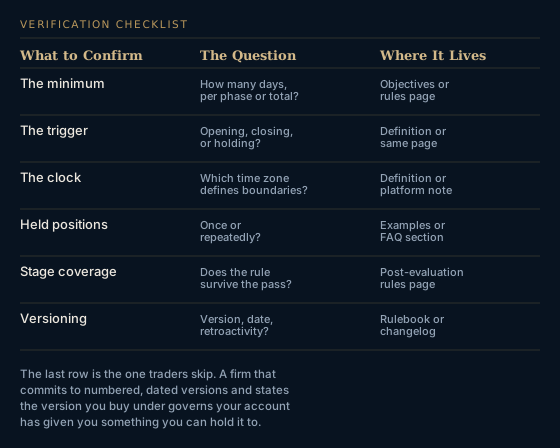
Table 2: clause, clock, activity and evidence
| What to confirm | The question in one line | What good evidence looks like | Where it usually lives |
|---|---|---|---|
| The minimum itself | How many qualifying days, and is that per phase or total? | A stated integer with the scope named, as in "at least 4 Trading Days" applied to both phases of the FTMO Challenge: 2-Step (FTMO Trading Objectives, retrieved 2026-08-04) | The objectives or rules page for the specific program |
| The increment trigger | What action makes a day count: opening, closing, or holding? | A definition naming the action, as in "any day you place at least 1 trade" (Topstep Dynamic Live Risk Expansion, retrieved 2026-08-04) | The same page, usually directly beneath the minimum |
| The clock | Which time zone defines the date boundary? | A named time zone written into the definition itself | The definition, or a platform or server-time note |
| Held positions | Does a multi-day hold count once or repeatedly? | A worked example showing which dates a held position counted on | An examples block or FAQ under the rule |
| Stage coverage | Does the rule survive the pass, or stop at it? | An explicit statement of scope for the stage that follows the evaluation | The rules page for the post-evaluation stage |
| Versioning | Which version of this text governs my account, and can it change under me? | A version number, a publication date and a changelog | A rulebook, terms document, or a dated changelog page |
The last row is the one traders skip and then regret. A minimum-day rule you read in March is only a fact about March unless the document carries a version and a promise about retroactivity. Without both, you have read a snapshot of a page that can be edited, and you will have no way to demonstrate what the page said on the day you bought. The broader question of whether a firm can be trusted to hold that line at all is the subject of the checks to run on any firm before you pay.
Save the version that governs the account
Do the boring thing. Before the first order, save the rules page as a PDF or a full-page capture, with the date visible. Note the version number if one exists. If none exists, note that too, because the absence is itself information about how the firm intends to handle changes.
Then read one specific thing: does the firm commit to not applying rule changes retroactively to accounts already open? A firm that publishes numbered, dated versions and states that the version you bought under governs your account has answered the question. A firm whose rules page carries no version and no date has left itself room, and the room is not in your favour.
For what a versioned commitment looks like in practice: the Ordane rulebook is public, numbered and versioned, and no rule is ever applied retroactively to an open account. Changes produce a new version with a dated changelog entry, and the version you sign up under is the version that governs your account (Ordane Rulebook v1.0, section 6 Changelog). The governing document is Ordane Rulebook v1.0, published 2026-07-23 (Ordane Rulebook v1.0, section 6 Changelog). Whether or not you buy from Ordane, that is the shape of the commitment to look for in someone else's document: a number, a date, and a statement about retroactivity.
What does Ordane disclose?
Short section, because there is not much to disclose on this particular topic.
Ordane Instant Account has no evaluation phase
Ordane sells one product, the Ordane Instant Account: direct access, no evaluation phase and no challenge, on simulated capital (Ordane Rulebook v1.0, section 1). There is no phase to pass, so there is no minimum trading day rule to satisfy in order to advance. The counter this entire article describes does not exist in the product.
What does exist is an inactivity rule pointing the other way. Accounts with no trading activity for 30 consecutive days are closed (Ordane Rulebook v1.0, clause R-5). That is not a floor on qualifying days before a pass. It is a ceiling on silence.
Two adjacent rules are worth naming so you do not confuse them with an evaluation requirement. The first withdrawal is available 7 calendar days after account activation, and the cycle thereafter is every 14 days (Ordane Rulebook v1.0, clause PA-1). That is a payout schedule, not an activity count, and it is the same distinction drawn earlier: evaluation days and withdrawal days are different rules governing different things.
The prohibited-practice list is also worth reading once for the same reason. Ordane's prohibited-practice list is closed. Clause R-6 names six practices: latency, reverse or hedge arbitrage; high-frequency or bulk automated exploitation; copy trading between Ordane accounts; straddling news releases with paired opposing orders; platform or data-feed exploitation; and gap abuse. If a behavior is not listed in that section, it is not a violation. Discretion is not a rule (Ordane Rulebook v1.0, clause R-6). A minimum-day requirement is not on that list and is not a rule anywhere else in the document.
Link to the canonical product and rulebook owners
This article covers one rule and stops. The full comparison between buying direct access and buying an evaluation, including what each structure costs you in time and in fees, belongs to the instant account versus evaluation guide in this cluster, and the profit target mechanics belong to the evaluation profit target guide. If you are still choosing a size, the account size guide covers that separately. Reading this page alone will tell you how days are counted; it will not tell you which product structure fits your method.
Questions traders ask about minimum trading days
Can one trade satisfy several days?
Under an activity-based definition of the kind quoted here, no. A single entry produces a single increment no matter how long the position stays open. If a firm counts differently, it will say so in an example under its definition, and if it publishes no example, treat the action-based reading as the working assumption and ask support in writing.
What if the target is reached early?
Then you keep trading until the day counter is satisfied, because both conditions have to be true. This is the situation that catches efficient traders. The uncomfortable part is that continuing to trade after the target is met exposes profit you have already earned to the same daily loss and drawdown limits that governed the account from day one. There is no rule that freezes your gains while the counter catches up. Plan the extra days as deliberately small, low-exposure entries rather than as ordinary trading sessions, and know before you start how many of those you are likely to need.
Does a payout day count?
There is no reason to assume it does, and no cited document here says it does. A payout is an administrative event, not a trade. Under an increment trigger that requires placing a trade (Topstep Dynamic Live Risk Expansion, retrieved 2026-08-04), requesting or receiving money is not the qualifying action. Payout timing is governed by a separate schedule, and the two rules should be read from two separate places in the document.
Can the rule change mid-account?
That depends entirely on the firm, and it is the single most important thing to establish before you buy. If the rules page has no version number and no publication date, the firm has not told you which text governs your account, and it has not told you what happens if the text changes while your account is open. Save the page with the date visible, look for an explicit statement about retroactivity, and treat the absence of one as a live risk rather than an oversight. A firm that commits in writing to numbered, dated versions and to never applying a change retroactively to an open account has given you something you can hold it to. A firm that has not has given you a page that can be edited.
Sources
- FTMO Trading Objectives, on the Minimum Trading Days rule requiring at least 4 Trading Days, applied to both phases of the FTMO Challenge: 2-Step, with no such rule on the subsequent FTMO Account (2-Step). ftmo.com Retrieved 2026-08-04.
- FTMO Trading Objectives, on a Trading Day being any day, measured from 00:00:00 to 23:59:59 CE(S)T, during which at least one position is opened. ftmo.com Retrieved 2026-08-04.
- Topstep Dynamic Live Risk Expansion, on an Active Trading Day being any day you place at least 1 trade. help.topstep.com Retrieved 2026-08-04.
- Topstep Dynamic Live Risk Expansion, on spending 10 Active Trading Days at each Tier to unlock the next level, a count that gates tier progression inside that risk mechanism rather than the pass of an evaluation. help.topstep.com Retrieved 2026-08-04.
- Topstep Dynamic Live Risk Expansion, on the page naming no time zone or server clock for its Active Trading Day count. help.topstep.com Retrieved 2026-08-04.
- Ordane Rulebook v1.0, section 1, on Ordane selling one product, the Ordane Instant Account, with direct access, no evaluation phase and no challenge, on simulated capital. ordanemarkets.com/rulebook Retrieved 2026-08-04.
- Ordane Rulebook v1.0, clause R-5, on accounts with no trading activity for 30 consecutive days being closed. ordanemarkets.com/rulebook Retrieved 2026-08-04.
- Ordane Rulebook v1.0, clause PA-1, on the first withdrawal being available 7 calendar days after account activation and the cycle thereafter being every 14 days. ordanemarkets.com/rulebook Retrieved 2026-08-04.
- Ordane Rulebook v1.0, clause R-6, on the prohibited-practice list being closed at six named practices, so a behavior not listed is not a violation. ordanemarkets.com/rulebook Retrieved 2026-08-04.
- Ordane Rulebook v1.0, section 6 Changelog, on the rulebook being public, numbered and versioned, never applied retroactively to an open account, and published 2026-07-23. ordanemarkets.com/rulebook Retrieved 2026-08-04.