Home · The Ordane Journal · Rules and Mechanics · Prop Firm Inactivity Rules: How Many Days You Have
Prop Firm Inactivity Rules: How Many Days You Have
Every prop firm caps how long an account can sit without a trade, and the number that closes your account is not always the number the firm advertises.
Ordane accounts operate on simulated capital. No live funds are traded and no deposits are accepted. Payouts depend on simulated performance under Rulebook v1.0; no level of performance is typical or assured.
In one sentence: A prop firm inactivity rule closes an account after a set number of days without a qualifying trade, and Ordane's own version, clause R-5, sets that window at 30 consecutive calendar days.
What Is a Prop Firm Inactivity Rule?
ESMA's product-intervention notice states that CFDs are complex instruments and come with a high risk of losing money rapidly due to leverage. That ESMA leverage frame sits outside any single firm's inactivity clause.
An inactivity rule closes a prop firm account when no qualifying trade is placed within a defined number of days, whether the account is still in evaluation or already active on the firm's post-evaluation product. The clause fires on absence, not on a loss: an account can be sitting well inside its drawdown limit and still get closed for having gone quiet too long.
Why Firms Close Idle Accounts
The rule is operational, not punitive. An open account, in evaluation or after it, occupies a platform seat, a data-feed license and a risk-monitoring slot the firm pays for continuously, whether or not the trader is placing orders. An account left open indefinitely with no activity is pure overhead with no upside for the firm, so the clause exists to reclaim that capacity. It is the same logic that closes a dormant bank account after a period of no transactions, applied to a trading account instead.
The Three Questions That Turn a Clause Into a Date
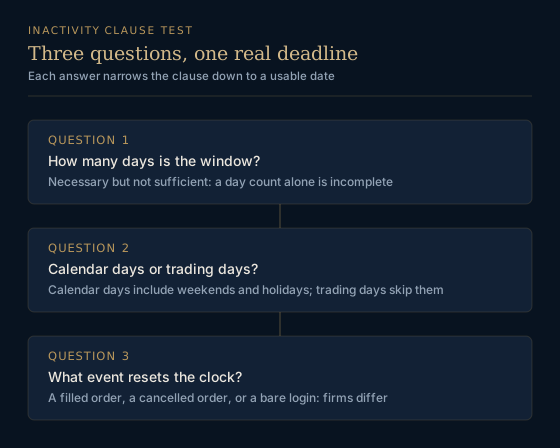
Three variables decide the real deadline: the window length, the counting basis and the reset event. A clause that answers all three turns into a date you can put on a calendar. Reading an inactivity clause and knowing your actual deadline are two different skills. Most traders read the headline number and stop there. That is not enough to know the date on which your account is at risk.
First Variable: The Window Length
This is the number the firm publishes most visibly. It is necessary but not sufficient. A day count told with nothing else is an incomplete instruction, because the same number measured two different ways lands on two different dates.
Second Variable: The Counting Basis
This is the variable that moves the deadline the most and gets stated the least. Calendar days include weekends and market holidays inside the count. Trading days skip them.
Third Variable: The Reset Event
If a rulebook does not state its counting basis or its reset event in writing, that silence is itself a finding, not a detail to skip past. Open a support ticket in writing and get the answer on record before you rely on your own reading of an ambiguous clause.
| Variable | The question to extract from the clause | The two common answers | Where it bites |
|---|---|---|---|
| Window length | How many days without activity close the account? | 30 days is the common number; some firms publish none | The advertised number is not always the operative one |
| Counting basis | Are those calendar days or trading days? | Calendar days count weekends; trading days skip them | Same 30-day clause, deadlines weeks apart |
| Reset event | What counts as activity that restarts the clock? | One filled order, or a profit-conditioned trading day | A login or pending order may not reset anything |
What Happens to Your Profit When an Inactive Account Closes?
Two separate questions collapse into one in most traders' minds, and they should not. The first question is whether the account itself is terminated. The second is whether profit already accrued in that account is forfeited or still payable.
Apex Trader Funding states plainly that once an account is closed for inactivity, it cannot be reinstated. That answers the first question for Apex: the account is gone, permanently, and a new one has to be purchased to continue. Apex's own documentation does not extend that same finality to accrued profit as a blanket rule inside the inactivity policy itself; the reinstatement is what is explicitly ruled out. Whether profit is still payable on a final request depends on the firm's separate payout eligibility rules, which is a different clause than the inactivity clause that ends the account.
The practical instruction: before you assume either outcome, check whether your firm's inactivity clause sits under its termination rules or under its payout eligibility rules, because that placement is what actually decides whether accrued profit follows the account into closure or survives it on a final withdrawal request.
Where Named Firms Set the Inactivity Window
| Firm | Window length | Counting basis as worded | Reset event as worded | Consequence for accrued profit |
|---|---|---|---|---|
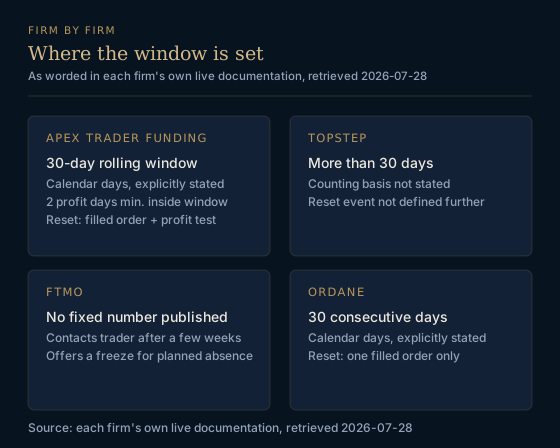
| Apex Trader Funding | 30-day rolling window, with a 2-profitable-day minimum inside it | Calendar days, explicitly stated | At least 2 trading days with $50+ net profit inside the rolling window | Not stated in Apex Trader Funding's own documentation as part of the inactivity policy itself |
| Topstep | More than 30 days of no trading activity | Not stated in Topstep's own documentation | Trading activity, undefined further | Not stated in Topstep's own documentation |
| FTMO | No fixed number of days published | Not stated in FTMO's own documentation | Not applicable; FTMO contacts the trader after a few weeks and offers an account freeze for planned absence | Not stated in FTMO's own documentation |
| The5ers | Not covered in this review | Not stated in The5ers' own documentation | Not stated in The5ers' own documentation | Not stated in The5ers' own documentation |
| Ordane | 30 consecutive days | Calendar days, explicitly stated | At least one filled order; pending orders and platform logins do not count | Not stated in Ordane Rulebook v1.0; the clause states the closure, not the treatment of accrued profit |
Where a competitor's stated window is more generous than Ordane's thirty days, that comparison sits in the same row above rather than buried elsewhere: Topstep's "more than 30 days" reads as marginally looser than Ordane's flat thirty, though Topstep does not state whether that window counts in calendar or trading days, which makes the two numbers hard to compare on equal footing. The sister rule, a minimum number of trading days before a payout, is the opposite mechanism, a floor rather than a ceiling, and has its own guide.
How Does Ordane's Inactivity Rule Work?
Accounts with no trading activity for 30 consecutive days are closed. That is clause R-5 of Ordane Rulebook v1.0, published 2026-07-23, and it answers all three questions this article opened with, in writing, with no ambiguity left for the trader to guess at.
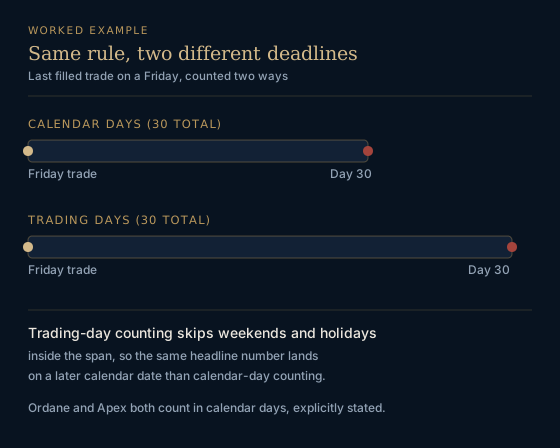
The window is thirty days. The counting basis is calendar days, not trading days: weekends and market holidays inside that thirty-day span count toward the total, the same way Apex counts its own window. The reset event is a filled order: at least one order that actually executes restarts the clock. A pending order that never fills does not reset it, and neither does logging into the platform without placing a trade. Compare that to the table above, where Topstep's window states no counting basis and no reset event, and FTMO publishes no fixed window at all. Ordane's clause R-5 is the one row in that comparison that leaves nothing for the trader to infer.
That specificity sits beside clause R-6, Ordane's closed list of prohibited practices: latency, reverse or hedge arbitrage; high-frequency or bulk automated exploitation; copy trading between Ordane accounts; straddling news releases with paired opposing orders; platform or data-feed exploitation; and gap abuse. If a behavior is not listed in that section, it is not a violation. Discretion is not a rule. The same discipline that makes R-6 a closed list of prohibited practices rather than a catch-all is what makes R-5 a dated clock rather than a vague warning.
The consequence, if any rule is breached, is stated once and applies the same way every time: a breach closes the account. To trade again you purchase a new account under the rulebook version current at that time.
Keeping an Account Active Without Trading Badly
Keeping an account active takes three habits, never a trade placed only to beat the deadline: a calendar date, a reminder set days before it, and knowing which event resets your firm's clock. In detail:
The caution matters as much as the habit. Keeping an account alive is never a reason to take a setup you would otherwise skip. A trade placed only to beat an inactivity deadline is a trade taken for the wrong reason, and it puts the daily loss limit at risk faster than inactivity ever would. The inactivity clock is a scheduling problem to solve with a calendar reminder, not a trading decision to solve with a trade.
Worked inactivity-window arithmetic
Declared inputs for this check only: inactivity window 30 calendar days; last qualifying activity day 0; today day 18.
| Input | Value | Arithmetic |
|---|---|---|
| Window | 30 | Declared |
| Elapsed | 18 | Declared |
| Remaining | 12 | 30 - 18 = 12 |
Arithmetically: 30 - 18 = 12 calendar days remain under these declared inputs.
For related published reading, see overnight and weekend holding rules.
Questions traders ask about prop firm inactivity rules
Does a pending order reset the inactivity clock?
Only if that firm's rule counts a pending order as qualifying activity. Many clocks require a fill or a closed trade. Read the inactivity clause before you leave a ticket resting for weeks. (Ordane Rulebook v1.0, clause R-5, retrieved 2026-08-13)
Does a platform login count as activity?
Usually no. Login without a qualifying trade or other listed action does not reset a calendar inactivity window. Confirm the firm's wording; Ordane R-5 uses calendar days. (Ordane Rulebook v1.0, clause R-5, retrieved 2026-08-13)
Are inactivity days calendar days or trading days?
Ordane R-5 counts calendar days. Other firms may use trading days. The difference changes weekend math. Check the unit before you pause. (Ordane Rulebook v1.0, clause R-5, retrieved 2026-08-13)
Is accrued profit payable after an inactivity closure?
Only if that firm's documents say so. Closure for inactivity can end the simulated account without a payout path. Do not assume accrued profit survives. (Ordane Rulebook v1.0, clause R-5, retrieved 2026-08-13)
What does Ordane clause R-5 state?
R-5 sets a 30 calendar-day inactivity window on the Ordane Instant Account. Miss the window and the account can close under that clause. Read the live rulebook for the exact text. (Ordane Rulebook v1.0, clause R-5, retrieved 2026-08-13)
Sources
- Ordane Rulebook v1.0, clause P-2 and ordanemarkets.com payout-funding statement Retrieved 2026-07-28.
- ordanemarkets.com, FAQ Retrieved 2026-07-28.
- Customer Advisory: Understand the Risks of Virtual Currency Trading. U.S. Commodity Futures Trading Commission Retrieved 2026-08-10.
- Express simulated account Parameters. Topstep Help Center Retrieved 2026-07-28.
- Inactivity Policy on Performance Accounts (PA). Apex Trader Funding Retrieved 2026-07-28.
- Notice of product intervention decisions on CFDs and binary options. ESMA Retrieved 2026-08-10.
- Trade without any time limit and take as long as you want to pass. FTMO Retrieved 2026-07-28.