Home · The Ordane Journal · Before you pay · Maven Prop Firm: Payouts, Rules and Real Costs
Maven Prop Firm: Payouts, Rules and Real Costs
Maven Trading is a prop firm selling simulated-capital challenges to full and part-time forex traders, with a 10-business-day payout frequency, an 80% profit split on Standard and Instant accounts, and a $14 Standard 2k 1-Step entry alongside a current 10% ETERNAL coupon (Maven Trading, retrieved October 2026). This teardown checks payouts, rules and longevity before the price tag.
Ordane accounts operate on simulated capital. No live funds are traded and no deposits are accepted. Payouts depend on simulated performance under Rulebook v1.5; no level of performance is typical or assured.
Ordane sells one product, the Ordane Instant Account: direct access, no evaluation phase and no challenge, on simulated capital (Ordane Rulebook v1.5, section 1, retrieved October 2026).
What is Maven Trading?
Maven Trading is a prop firm offering a premium funded trader program for full and part-time forex traders, providing only simulated trading (Maven Trading, retrieved October 2026). What you buy is a challenge on simulated capital: you pay a fee, trade a demo-style account, and if you pass, you receive a post-evaluation account where simulated profits are paid out under the published split.
If the phrase "simulated capital" surprises you, it is worth understanding exactly what you are buying before comparing prices. A funded-style prop account is not broker money in your name: read is a prop firm account a demo account for a full breakdown, and see instant account vs evaluation prop firm for how Maven-style evaluation programs differ from instant-funding offers. Maven runs both 1-Step and 2-Step evaluation structures; the difference is explained in prop firm 1-step vs 2-step evaluation, and it matters here because the loss limits differ between the two. The product line spans Standard and Instant accounts plus a smaller Mini tier, and the split you earn depends on which of those tiers you buy, so the account type deserves as much attention as the challenge size.
When does Maven pay you, and how much of the profit do you keep?
Maven's published payout frequency on its standard funded accounts is 10 business days, and you keep 80% of your simulated profits on Standard and Instant accounts, or 70% on the smaller Mini accounts (Maven Trading, retrieved October 2026). This question should come before any price comparison, because a cheap challenge at a firm that pays slowly is a worse deal than an expensive one at a firm that pays on schedule.
Two things matter about the frequency. First, the unit is business days, not calendar days: 10 business days spans roughly two calendar weeks once weekends are counted. Second, the published frequency applies to standard accounts; if you are on a different account type, do not assume the same cadence applies.
For how an 80% split is calculated in practice, what counts as profit and how scaling interacts, see prop firm profit split explained. For what a 10-business-day frequency commits a firm to, and how timelines compare across the industry, how long do prop firms take to pay covers the realistic expectations and the warning signs.
One honest caveat: these are the published terms, and published terms are what you can evaluate before paying. Treat any firm's marketing claims about fast payouts as a starting hypothesis, not a guarantee. What you can do with them is compare like with like: the frequency unit, the split by account tier, and the refund conditions. Those three numbers, all published by Maven on its own site, say more about the deal you are actually buying than any countdown timer on the pricing page.
Which Maven rule can zero your withdrawal?
The daily loss limit is the rule to watch, and Maven's numbers differ by challenge type: on the Standard 1-Step the maximum loss is 5% and the daily loss limit is 3%, while on the Standard 2-Step those limits are 8% max loss and 4% daily loss (Maven Trading, retrieved October 2026). Breach either limit and the challenge fails.

The percentages themselves are published; what the fine print decides is how they are measured. Two structural questions determine how much room those percentages actually give you:
- What balance is the daily loss measured against? Whether the 3% or 4% is measured against your starting balance, your equity high, or the balance at the previous day's close changes how much room you actually have. This is covered in prop firm daily loss limit explained.
- Is the max loss static or trailing? A static 5% or 8% limit keeps a fixed distance from your starting balance; a trailing limit tightens as you profit. Check which one Maven enforces on the challenge page before you trade, because the two behave very differently after a winning streak.
The refund trap hidden in the pricing fine print
There is also a qualification in the pricing fine print that readers routinely miss: the challenge fee is refundable, but only on the third withdrawal (Maven Trading, retrieved October 2026). Not the first, not the second: the third. Practically, this means you must survive the loss rules, pass, and complete three successful payout cycles before your entry fee comes back. If you were counting on the refund to make the challenge "free", recalculate: it is free only for traders who are consistently profitable across at least three payout cycles. Arithmetic makes the bar concrete: with payouts every 10 business days, three completed cycles take roughly six calendar weeks of profitable, rule-compliant trading before the entry fee comes back. That is a much higher bar than the marketing framing suggests, and it is exactly the kind of condition that separates a serious evaluation from an impulse purchase.
Is Maven still going to exist when you request your payout?
No public source can guarantee a firm's future, and this teardown claims no such thing. What you can do before paying is run your own due diligence using the how to audit a prop firm checklist, and to make the downside concrete, what happens if a prop firm shuts down walks through what happens to your paid fee and your unpaid profit when a firm closes. Budget your challenge fee as money you can afford to lose entirely, because that is the honest worst case.
What does a Maven challenge actually cost?
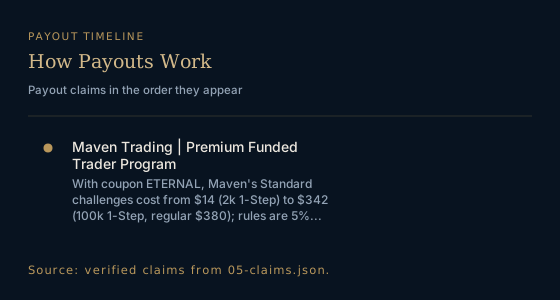
The Standard 2k 1-Step is displayed at $14 (Maven Trading, retrieved October 2026). On the coupon side, there are two codes in play. At fetch time, the banner coupon ETERNAL gave 10% off challenges, shown as "Trade Gold Eternal. 10% off with code". A second coupon, OMO, gave 40% off Omo challenges (Maven Trading, retrieved October 2026). Treat coupon pricing as volatile by nature: codes rotate, offers change, and the number that matters is the one on the checkout page the day you pay.

Verified facts at a glance
The table below lists each verified fact from the research ledger alongside its source. Nothing here is new information.
| Verified fact | Source |
|---|---|
| Maven Trading is a prop firm offering a premium funded trader program for full and part-time forex traders, providing only simulated trading. | Maven Trading |
| At fetch time, Maven's banner coupon ETERNAL gave 10% off challenges, shown as "Trade Gold Eternal. 10% off with code". | Maven Trading |
| A second Maven coupon, OMO, gives 40% off Omo challenges. | Maven Trading |
| The Maven Standard 2k 1-Step is displayed at $14; at fetch time the ETERNAL coupon gave 10% off challenges. | Maven Trading |
| Maven's payout frequency on standard funded accounts is 10 business days, with an 80% profit split on Standard and Instant accounts and 70% on Mini. | Maven Trading |
| Standard rules are 5% max loss and 3% daily loss on the 1-Step, 8% and 4% on the 2-Step, with the fee refundable on the third withdrawal. | Maven Trading |
Key terms side by side
| Term | 1-Step | 2-Step |
|---|---|---|
| Max loss limit | 5% | 8% |
| Daily loss limit | 3% | 4% |
| Profit split | 80% on Standard and Instant accounts | 80% on Standard and Instant accounts |
| Payout frequency | Every 10 business days | Every 10 business days |
| Fee refund | Only on the third withdrawal | Only on the third withdrawal |
| Entry price (2k Standard) | $14, displayed | $18, displayed |
Frequently Asked Questions
Direct answers about Maven Trading.
How long does Maven take to pay?
Maven's published payout frequency on standard funded accounts is 10 business days, roughly two calendar weeks once weekends are counted. The cadence applies to standard accounts; other account types may differ. Source: Maven Trading.
What profit split does Maven offer?
Maven pays an 80% profit split on Standard and Instant accounts, and 70% on Mini accounts. Confirm the tier you are buying, since the split differs by account type. Source: Maven Trading.
How much is a Maven challenge?
The Maven Standard 2k 1-Step is displayed at $14, and at fetch time the ETERNAL coupon gave 10% off challenges; other sizes and challenge types carry their own displayed prices. Source: Maven Trading.
What are Maven's loss rules?
Maven's Standard 1-Step carries a 5% maximum loss and a 3% daily loss limit; the Standard 2-Step carries 8% and 4%. Breaching either one fails the challenge. Source: Maven Trading.
Is the Maven challenge fee refundable?
Yes, but only on the third withdrawal, not the first or second. Treat the Maven refund as a bonus for sustained profitability, not a money-back guarantee. Source: Maven Trading.
Sources
- Maven Trading | Premium Funded Trader Program maventrading.com Retrieved 2026-10-08.
- Best Prop Trading Firms 2026 | Prop Firm Match propfirmmatch.com Retrieved 2026-10-08.