Home · The Ordane Journal · Before you pay · Goat Funded Trader Review: Rules, Cost & Payouts
Goat Funded Trader Review: Rules, Cost & Payouts
What Is Goat Funded Trader?
Goat Funded Trader (prop firm) is an evaluation firm selling access to simulated trading accounts. Traders pay a non-refundable fee to attempt profit targets under strict drawdown limits. Those who pass the evaluation phase receive a funded-stage account, earning a percentage of the simulated profits they generate.
Ordane accounts operate on simulated capital. No live funds are traded and no deposits are accepted. Payouts depend on simulated performance under Rulebook v1.4; no level of performance is typical or assured.
How Do Withdrawals Work?
Goat Funded Trader sets a $100 minimum withdrawal for funded-account rewards (All about Rewards and Profit Splits | Goat Funded Trader FAQ's, retrieved 2026-09-27).
A trader whose available reward is below this threshold cannot yet submit a qualifying withdrawal.
Bi-Weekly Payout Cycle
After passing the 1-Step evaluation, the standard payout cycle is bi-weekly, every 14 days (1 STEP MODEL | Goat Funded Trader FAQ's, retrieved 2026-09-27).
Goat Funded Trader, first payout (KYC): "the 2 business day window starts once your verification is complete." Delay exceptions: "pending or incomplete KYC, or by our team needing additional information from you." (How payouts work: eligibility, request, processing and arrival | Goat Funded Trader FAQ's, retrieved 2026-10-04 UTC). Weekends and holidays may increase the elapsed calendar time. These outline the firm's published payout conditions; however, this review explicitly has not verified Goat Funded Trader's historical payment record.
What Are the Drawdown Rules You Must Not Break?
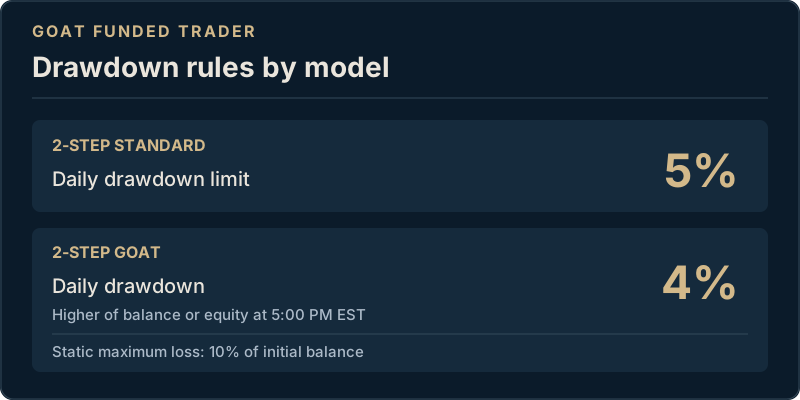
The 2-Step Standard model applies a 5% daily drawdown in both evaluation phases and the funded stage (2-Step Standard | Goat Funded Trader FAQ's, retrieved 2026-09-27).
The 5% Daily Drawdown Limit
A 5% limit means a string of consecutive losses or a single outsized move against a leveraged position can terminate the evaluation.
The 4% Daily Drawdown Baseline in the 2-Step GOAT Model
For the 2-Step GOAT model, the firm applies a 4% daily drawdown and determines the baseline at 5:00 PM EST using whichever is higher, account balance or account equity (2 Step GOAT Model | Goat Funded Trader FAQ's, retrieved 2026-09-27). Floating profits held at the reset can therefore affect the next daily baseline. This rule means traders who hold winning positions over the daily reset time may inadvertently tighten their own drawdown limit for the following trading day, as the baseline is raised to reflect the unrealized gains.
Static Maximum Loss in the 2-Step GOAT Model
The 2-Step GOAT maximum-loss floor is static and calculated as the initial account size minus 10% (2 Step GOAT Model | Goat Funded Trader FAQ's, retrieved 2026-09-27). To illustrate this rule, consider a $100,000 account under the 2-Step GOAT evaluation. The static floor is calculated as $100,000 minus 10%, anchoring the absolute minimum equity at $90,000. If the trader makes $5,000 in simulated profit, the account balance becomes $105,000, but the maximum loss floor remains at $90,000, effectively increasing the available drawdown room to $15,000. This static calculation differs from trailing drawdown models, where the floor moves upward as profits are generated.
What Are the Profit Targets and Payout Conditions?
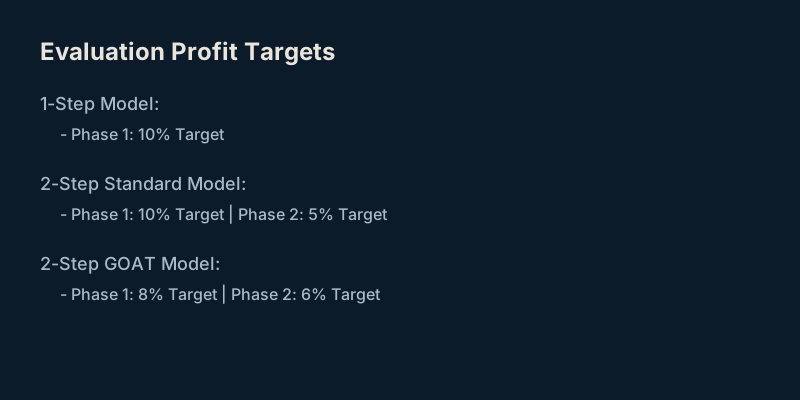
The Goat Funded Trader 1-Step evaluation requires a 10% profit target (1 STEP MODEL | Goat Funded Trader FAQ's, retrieved 2026-09-27).
Evaluation Profit Targets
The Goat Funded Trader 2-Step Standard evaluation requires a 10% target in Step 1 and a 5% target in Step 2 (2-Step Standard | Goat Funded Trader FAQ's, retrieved 2026-09-27).
The Goat Funded Trader 2-Step GOAT evaluation uses an 8% target in Phase 1 and a 6% target in Phase 2 (Goat Funded Trader vs FTMO Review, retrieved 2026-09-27).
What Are the Minimum Trading Days?
The Goat Funded Trader 1-Step evaluation requires three minimum trading days (1 STEP MODEL | Goat Funded Trader FAQ's, retrieved 2026-09-27).
A valid trading day is when the profit made on that day is at least 0.5% of the initial account balance. (1 STEP MODEL, retrieved 2026-10-04).
The Goat Funded Trader 2-Step Standard evaluation requires three minimum trading days in each evaluation phase (2-Step Standard | Goat Funded Trader FAQ's, retrieved 2026-09-27).
For 2-Step GOAT accounts purchased from July 25, 2026, the funded-stage requirement is four trading days per payout rather than three (What are the Minimum trading days? | Goat Funded Trader FAQ's, retrieved 2026-09-27). This means traders must log active trading days during the funded stage before they are eligible to request their accrued rewards.
Will the Firm Remain Operating Over the Coming Year?
This review examines published evaluation rules and withdrawal policies; it provides no evidence regarding Goat Funded Trader's solvency, cash reserves, or financial health. There is no independently verified payout ledger or proof of long-term sustainability. Traders should understand that this review does not constitute a guarantee of the firm's future continuity or its ability to honor payouts over the coming year.
Goat Funded Trader Evaluation Prices
An official Goat Funded Trader article lists evaluation pricing from $41 for a $5,000 1-Step account and from $17 for a $5,000 2-Step account, with starting allocations up to $200,000 (How Is Margin Interest Calculated? All You Need to Know, retrieved 2026-09-27). A separate official Goat Funded Trader page lists the 1-Step evaluation at $44 for a $5,000 account, extending to $200,000 (11 Best Instant Funding Prop Firms 2026, retrieved 2026-09-27). Because the two published entry prices conflict, buyers should confirm the exact charge at checkout before paying for an evaluation.
How Do the Evaluation Models Compare?
The Goat Funded Trader 1-Step evaluation requires a 10% profit target (1 STEP MODEL | Goat Funded Trader FAQ's, retrieved 2026-09-27). The Goat Funded Trader 2-Step Standard evaluation requires a 10% target in Step 1 and a 5% target in Step 2 (2-Step Standard | Goat Funded Trader FAQ's, retrieved 2026-09-27). The Goat Funded Trader 2-Step GOAT evaluation uses an 8% target in Phase 1 and a 6% target in Phase 2 (Goat Funded Trader vs FTMO Review, retrieved 2026-09-27).
| Evaluation Model | Phase 1 Target | Phase 2 Target | Source Document |
|---|---|---|---|
| 1-Step | 10% | None | ([1 STEP MODEL |
| 2-Step Standard | 10% | 5% | ([2-Step Standard |
| 2-Step GOAT | 8% | 6% | (Goat Funded Trader vs FTMO Review, retrieved 2026-09-27) |
Account Configuration Scenarios
The following table outlines how different models apply minimum trading day constraints across the evaluation lifecycle.
| Evaluation Route | Phase 1 Minimum | Phase 2 Minimum | Funded Stage Minimum |
|---|---|---|---|
| 1-Step Model | 3 valid days | Not applicable | 4 valid days per payout for accounts purchased on or after July 27, 2026; 3 for earlier purchases |
| 2-Step Standard | 3 valid days | 3 valid days | 4 valid days per payout for accounts purchased on or after July 25, 2026; 3 for earlier purchases |
| 2-Step GOAT (Post July 2026) | 3 days | 3 days | 4 days per payout |
The 80% Profit Split and 3% Processing Fee
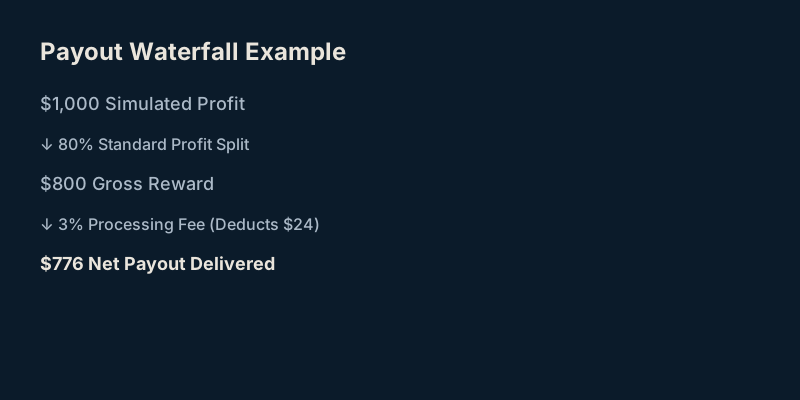
Goat Funded Trader states that traders on its 1-Step and 2-Step evaluation models receive an 80% profit split, with an optional 100% profit-split add-on available at checkout (All about Rewards and Profit Splits | Goat Funded Trader FAQ's, retrieved 2026-09-27). If a trader earns a simulated profit of $1,000, the standard 80% split allocates $800 to the trader as a reward. The firm also charges a 3% processing fee on rewards, calculated on the final reward amount after applying the applicable profit split and any deductions (How payouts work: eligibility, request, processing and arrival | Goat Funded Trader FAQ's, retrieved 2026-10-04 UTC). A $1,000 simulated profit becomes an $800 reward; the 3% fee removes $24, leaving a $776 net payout.
Is the Evaluation Fee Refundable?
Goat Funded Trader's refund policy says evaluation fees are non-refundable and transactions are final (What is the Refund Policy? | Goat Funded Trader FAQ's, retrieved 2026-09-27). Traders must treat the evaluation fee as a sunk cost. There is no mechanism to recover the fee if the evaluation is failed or if the trader simply decides to abandon the challenge.
An evaluation prop firm provides a paid testing environment where a trader attempts to reach a simulated profit target without a prop firm account breach. Operating similarly to a prop firm demo account, participants pay an upfront, non-refundable fee, alongside potential prop firm hidden fees, for the opportunity to prove their risk management skills on a chosen prop firm account size of simulated capital before qualifying for a funded stage. For traders seeking an alternative structure without an evaluation phase, Ordane sells one product, the Ordane Instant Account: direct access, no evaluation phase and no challenge, on simulated capital.
Simulated Capital and CFTC Warnings
The CFTC warns that assumptions used in hypothetical trading have not faced actual market conditions and may overstate or understate system performance (Fraud Advisory: Commodity Trading Systems Sold on the Internet | CFTC, retrieved 2026-09-27). Simulated results may therefore differ from results produced under actual market conditions. A strategy that performs well in a simulated environment may fail when exposed to real slippage, liquidity constraints, and execution delays. This warning applies exclusively to hypothetical trading, not to the solvency or continuity of the firm.
Frequently Asked Questions
Does Goat Funded Trader offer a 1-step evaluation?
Yes. The Goat Funded Trader 1-Step evaluation requires a 10% profit target (1 STEP MODEL | Goat Funded Trader FAQ's, retrieved 2026-09-27). It also requires three minimum trading days (1 STEP MODEL | Goat Funded Trader FAQ's, retrieved 2026-09-27).
What is the daily drawdown limit?
Goat Funded Trader (prop firm) is an evaluation firm selling access to simulated trading accounts. The 2-Step Standard model applies a 5% daily drawdown in both evaluation phases and the funded stage (2-Step Standard | Goat Funded Trader FAQ's, retrieved 2026-09-27). For the 2-Step GOAT model, the firm applies a 4% daily drawdown and determines the baseline at 5:00 PM EST using whichever is higher, account balance or account equity (2 Step GOAT Model | Goat Funded Trader FAQ's, retrieved 2026-09-27).
How often can you request a payout?
After passing the 1-Step evaluation, the standard payout cycle is bi-weekly, every 14 days (1 STEP MODEL | Goat Funded Trader FAQ's, retrieved 2026-09-27). Goat Funded Trader, first payout (KYC): "the 2 business day window starts once your verification is complete." Delay exceptions: "pending or incomplete KYC, or by our team needing additional information from you." (How payouts work: eligibility, request, processing and arrival | Goat Funded Trader FAQ's, retrieved 2026-10-04 UTC).
Are the evaluation fees refundable?
No. Goat Funded Trader's refund policy says evaluation fees are non-refundable and transactions are final (What is the Refund Policy? | Goat Funded Trader FAQ's, retrieved 2026-09-27).
Sources
- How Is Margin Interest Calculated? All You Need to Know goatfundedtrader.com Retrieved 2026-09-27.
- 11 Best Instant Funding Prop Firms 2026 goatfundedtrader.com Retrieved 2026-09-27.
- 1 STEP MODEL | Goat Funded Trader FAQ's help.goatfundedtrader.com Retrieved 2026-09-27.
- 2-Step Standard | Goat Funded Trader FAQ's help.goatfundedtrader.com Retrieved 2026-09-27.
- Goat Funded Trader vs FTMO Review goatfundedtrader.com Retrieved 2026-09-27.
- 2 Step GOAT Model | Goat Funded Trader FAQ's help.goatfundedtrader.com Retrieved 2026-09-27.
- All about Rewards and Profit Splits | Goat Funded Trader FAQ's help.goatfundedtrader.com Retrieved 2026-09-27.
- What are the Minimum trading days? | Goat Funded Trader FAQ's help.goatfundedtrader.com Retrieved 2026-09-27.
- How payouts work: eligibility, request, processing and arrival | Goat Funded Trader FAQ's help.goatfundedtrader.com Retrieved 2026-10-04.
- What is the Refund Policy? | Goat Funded Trader FAQ's help.goatfundedtrader.com Retrieved 2026-09-27.
- What is a Goat Funded Trader simulated funded account? | Goat Funded Trader FAQ's help.goatfundedtrader.com Retrieved 2026-09-27.
- Fraud Advisory: Commodity Trading Systems Sold on the Internet | CFTC cftc.gov Retrieved 2026-09-27.