Home · The Ordane Journal · Rules and mechanics · Do Prop Firms Allow Hedging?
Do Prop Firms Allow Hedging?
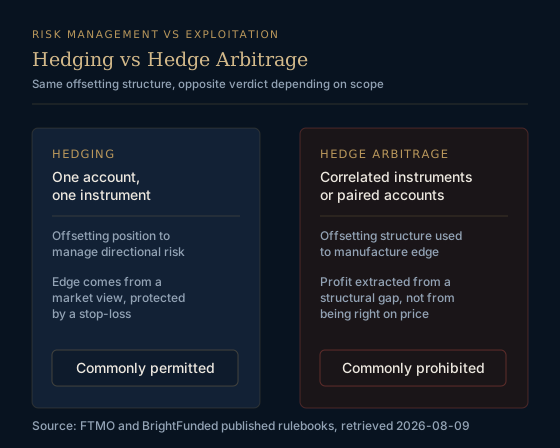
Hedging at a prop firm means holding offsetting positions to manage directional risk. Simple hedging inside a single account is often allowed. Hedge arbitrage, using that offsetting structure across correlated instruments or paired accounts to manufacture an edge that does not depend on guessing the market's direction, is the practice firms actually name and ban. Whether your hedge is a problem turns entirely on which of these two things you are doing, not on the word "hedging" itself.
Ordane accounts operate on simulated capital. No live funds are traded and no deposits are accepted. (Ordane Rulebook v1.0, clause P-2, retrieved 2026-08-09)
What Is the Difference Between Hedging and Hedge Arbitrage?
Hedging at a prop firm means holding offsetting positions to manage directional risk. Hedge arbitrage means using that offsetting structure, across correlated markets or across accounts, to manufacture a profit that does not depend on a market view. One is risk management. The other is exploitation.
The confusion is not accidental. In prop firm rules the word hedging can mean four different things: same-account hedging, cross-account hedging, copy-trading hedges, or cross-firm hedging, and firms treat each differently (Alex Firdaus, retrieved 2026-08-09). That is why "the firm allows multiple accounts" does not mean "the firm allows opposite trades across those accounts." Each of the four sits at a different point on the spectrum from ordinary risk management to a named violation, and no single answer covers all four.
| Meaning of "hedging" | FTMO | BrightFunded | Ordane |
|---|---|---|---|
| Same account, one instrument | Explicit exception inside the manipulation ban | Explicitly permitted | The written example of what does NOT close the account (Appendix A, A-1) |
| Cross-account, same firm | Forbidden ("connected accounts") | Soft breach on first detection, hard breach after | Closed list does not name it; only the arbitrage form is banned (R-6(a)) |
| Cross-firm | Forbidden ("accounts held with other providers") | Strictly prohibited | Closed list does not name it |
| Hedge used to game a payout rule | Listed violation (Best Day Rule workaround) | Not addressed in the cited rule | Not named; R-4's only consequence is deferral of excess profit, never confiscation |
This second table reorganizes only what the cited sources state directly; it adds no new claim.
What Do Prop Firms Actually Prohibit, and Why?
Firms ban hedge arbitrage because it manufactures an edge from the trading environment rather than from a market view, the same family of behavior as latency exploitation or reverse arbitrage: profit extracted from a structural gap, not from being right about price direction.
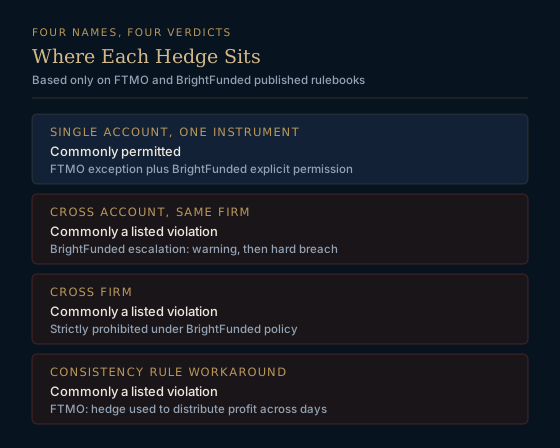
Two published rulebooks show the pattern clearly. FTMO (prop firm) forbids entering into opposite positions for manipulative purposes, alone or in concert with others, including between connected accounts or accounts held with other providers, but explicitly excepts entering into such positions on a single simulated account (FTMO, retrieved 2026-08-09). FTMO separately forbids using hedging or holding opposing positions on the same or highly correlated instruments as a way to artificially distribute profit across days and circumvent its Best Day consistency rule (FTMO, retrieved 2026-08-09). In other words, the exact same trade can be fine in isolation and a violation in context, depending on what it is being used to accomplish.
BrightFunded (prop firm) draws the line at the account boundary. It permits hedging the same financial instrument within the same trading account (BrightFunded, retrieved 2026-08-09), but prohibits hedging the same instrument across different accounts, with a published escalation policy: the soft breach is a one-time warning per user, and any subsequent hedge violation results in a hard breach (BrightFunded, retrieved 2026-08-09). BrightFunded also states that hedging between different prop firms is strictly prohibited (BrightFunded, retrieved 2026-08-09).
| Practice | Where It Typically Sits | Why |
|---|---|---|
| Single-account hedge on one instrument | Commonly permitted (FTMO exception, BrightFunded explicit permission) | Directional risk, not manufactured edge; no cross-account exploit |
| Cross-account hedge, same firm, paired accounts | Commonly a listed violation (BrightFunded escalation policy) | Risk offloaded between accounts rather than carried |
| Cross-firm hedge | Commonly a listed violation (BrightFunded) | Same structural exploit spread across providers to evade single-account detection |
| Hedge used to distribute profit across days (a consistency-rule workaround) | Commonly a listed violation (FTMO) | Manufactures a compliant profit pattern rather than reflecting real market risk taken |
This table draws only on what the cited published sources state directly. Where a firm's rulebook does not spell out an operational boundary, this article does not guess one on its behalf.
Why Is a Closed Rule List the Real Protection?
The concept that matters more than any single hedging clause is whether the rulebook you are trading under uses a closed list or an open, discretionary one.
A closed, named list means a hedge that does not match a listed practice is not a violation. You can read the six or seven named practices, place your own trade against them, and know where you stand before you ever request a payout. An open clause works the opposite way: because nothing is named, any hedge, however conservative, can be recast as abuse after the fact, at the exact moment a payout is due. The clause that traders should worry about is not the one that names hedge arbitrage. It is the one that names nothing and reserves the right to decide later, which is the same trap covered in how a prop firm can enforce a rule it never wrote down.
What Does Ordane Say About Hedging?
Ordane sells one product, the Ordane Instant Account: direct access, no evaluation phase and no challenge, on simulated capital. (Ordane Rulebook v1.0, section 1, retrieved 2026-08-09)
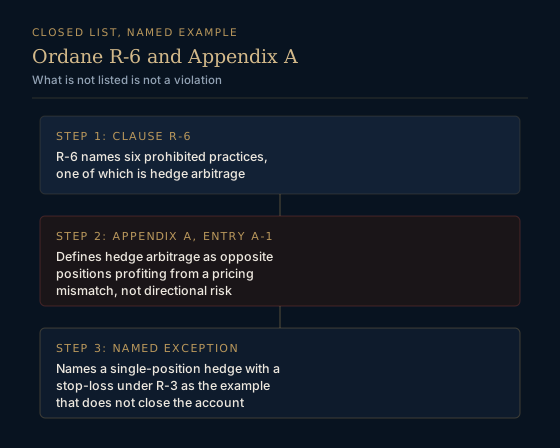
Ordane's clause R-6 is a closed list: it names six prohibited practices, and the only hedging-related one is latency, reverse or hedge arbitrage. If a behavior is not listed in that section, it is not a violation. Discretion is not a rule (Ordane Rulebook v1.0, clause R-6, retrieved 2026-08-09). That means ordinary hedging inside a single Ordane account, opening an offsetting position on the same instrument to manage risk, is not a violation under R-6, because it does not match the named practice.
Ordane's Appendix A, published August 1, 2026, gives that closed-list clause a worked example instead of leaving it to inference. Entry A-1 defines the prohibited hedge arbitrage as holding opposite positions whose edge comes from a pricing mismatch rather than directional risk, and names as an example that does not close the account a normal hedge of a single Ordane position with a stop-loss under R-3, with no cross-feed exploit (Ordane Rulebook v1.0, Appendix A, entry A-1, retrieved 2026-08-09). That is the operational answer most rulebooks leave you to guess at: a stop-loss-protected, single-account hedge is on record, in writing, as the example of what is allowed.
What Appendix A does not yet spell out is a specific numeric or structural threshold for where a legitimate hedge across correlated instruments, rather than across accounts, would cross into arbitrage. The clause names the practice and gives one worked example on each side of the line; it does not enumerate every correlated-market configuration. This article states that gap rather than inferring an answer the rulebook does not give.
Questions Traders Ask About Hedging at a Prop Firm
Do prop firms allow hedging?
Often, yes, inside a single account on a single instrument. FTMO and BrightFunded both permit that specific case (BrightFunded, retrieved 2026-08-09) (FTMO, retrieved 2026-08-09). What is commonly prohibited is hedging that crosses accounts, crosses firms, or is used to manipulate a rule like a consistency check.
Can you hold opposite positions on a prop firm account?
Within one account, on one instrument, this is the specific case FTMO exempts from its manipulation rule and BrightFunded explicitly permits (BrightFunded, retrieved 2026-08-09) (FTMO, retrieved 2026-08-09). At Ordane, Appendix A names exactly this configuration, a single position hedged with a stop-loss under R-3, as an example that does not close the account (Ordane Rulebook v1.0, Appendix A, entry A-1, retrieved 2026-08-09).
Is hedging across two prop firm accounts allowed?
Under BrightFunded's published policy, no: the soft breach is a one-time warning per user, and any subsequent hedge violation results in a hard breach (BrightFunded, retrieved 2026-08-09). This is the category most firms treat as the violation, distinct from same-account hedging. For more on managing multiple accounts, see how many prop firm accounts can you have.
Does hedging void a prop firm payout?
It depends entirely on which category the hedge falls into. A same-account hedge on one instrument commonly does not. A cross-firm or manipulation-motivated hedge commonly does, under published policies at firms like FTMO and BrightFunded (FTMO, retrieved 2026-08-09) (BrightFunded, retrieved 2026-08-09). There is no single answer that covers every configuration, which is the reason to check the specific closed list rather than the word "hedging" alone.
What counts as hedge arbitrage at a prop firm?
Hedge arbitrage is using an offsetting structure, across correlated instruments or across accounts, to extract a profit that comes from a structural mismatch rather than from directional market risk. Ordane's Appendix A defines it in exactly those terms and contrasts it against the single-account, stop-loss-protected hedge that remains allowed (Ordane Rulebook v1.0, Appendix A, entry A-1, retrieved 2026-08-09).
Hedging is not one rule, it is four different behaviors wearing the same name, and the firms that protect you are the ones that name the prohibited one and give you a worked example of the one that is not. Before opening a hedge on any account, check whether the rulebook you signed uses a closed list or an open one, the same check worth running on the rest of the rulebook when you audit a prop firm before paying.
Sources
- Forbidden Trading Practices | FTMO ftmo.com Retrieved 2026-08-09.
- How does the Hedging Rule work? | BrightFunded Help Center help.brightfunded.com Retrieved 2026-08-09.
- Prop Firm Hedging Rules: What Is Allowed in 2026 | Alex Firdaus alexfirdaus.com Retrieved 2026-08-09.
- Ordane Rulebook v1.0, Appendix A, entry A-1 ordanemarkets.com Retrieved 2026-08-09.