Home · The Ordane Journal · Rules and mechanics · Topstep Funded Accounts: Rules and Payouts
Topstep Funded Accounts: Rules and Payouts
Topstep (prop firm) requires traders to pass a simulated evaluation phase to access potential performance payouts. In contrast, Ordane accounts operate on simulated capital. No live funds are traded and no deposits are accepted. Traders evaluating these platforms need absolute clarity on rules, costs, and payout mechanics before committing.
This document examines the Topstep model, detailing its specific evaluation framework, payout structures, and the regulatory reality governing trader performance metrics. Ordane sells one product, the Ordane Instant Account: direct access, no evaluation phase and no challenge, on simulated capital.
What Are Topstep Funded Accounts?
Topstep offers a single-step evaluation process called the Trading Combine to access funded accounts (Topstep, retrieved 2026-09-12). Traders who successfully reach the profit target and follow all risk parameters qualify for simulated trading capital. This model allows individuals to demonstrate strategy consistency before they are evaluated for potential performance payouts.
Proprietary Trading Definition
The proprietary trading industry operates differently from traditional retail brokerages. In a standard retail environment, the individual deposits their personal capital, assumes all the market risk, and retains all the profits after execution costs. In the proprietary model, the firm assesses the trader through a rigorous evaluation process. The CFTC defines proprietary trading as trading done by a firm for its own account and risk, rather than for customers (CFTC, retrieved 2026-09-12). This distinction is critical for understanding the business model. The firm is not acting as a custodian for client investments. Instead, the trader acts as an independent contractor generating data in a simulated environment. The firm then uses its own capital to manage its corporate risk profile, paying the successful contractors a percentage of the simulated profits they generate. This structure democratizes access to professional trading tools without requiring the trader to risk large sums of personal capital on the live market.
Regulatory Standing
The regulatory standing of proprietary trading firms relies entirely on the nature of the capital being traded. Because traders do not deposit funds for investment and only pay a subscription or access fee, the model operates outside the traditional scope of retail brokerage regulations. The firm does not execute orders on behalf of retail clients in the live market. All trader activity occurs on simulated platforms that mimic live market data precisely. This ensures that the execution, slippage, and spread reflect real market conditions without exposing the firm to regulatory classifications designed for custodians of client assets. Transparency regarding the simulated nature of the environment is mandatory. Firms that obscure this fact or imply they are traditional brokers face intense regulatory scrutiny. Traders must always read the terms of service to understand their legal relationship with the firm, which is structured as a service agreement rather than a financial investment contract.
Do Topstep Traders Actually Get Paid?
Proprietary trading firms are evaluated by their ability to process payouts to successful traders rapidly and transparently. Understanding the exact mechanics of these payouts is the most critical step before committing to any evaluation process.
The First $10,000 Payout Rule
Payout structures dictate the true value of any proprietary trading account. Topstep traders receive 100% of their first $10,000 in profit payouts (Topstep, retrieved 2026-09-12). This specific policy serves as a major incentive for traders to maintain strict discipline during the initial stages of their operational status. The mechanics of this payout require the trader to request a withdrawal through the firm's approved payment rails, which typically involve bank wires or cryptocurrency transfers. By allowing the trader to keep the entirety of the first ten thousand dollars, the firm builds trust and encourages long-term retention. However, traders must carefully read the withdrawal rules. Some firms impose minimum trading days or specific consistency rules before processing a payout. Understanding the exact requirements for a withdrawal is just as important as understanding the technical trading rules themselves. A firm's payout speed and reliability are the ultimate proof of its operational integrity.
Profit Splits After Scaling
Once the initial payout threshold is crossed, the profit split adjusts to a standard industry rate, typically giving the firm a percentage of the ongoing profits. This alignment of interests ensures that the firm benefits from the trader's long-term consistency. Traders must compare how different firms handle scaling splits over time. Some firms require traders to hit specific profit targets to unlock higher splits, while others increase the split automatically based on the number of successful withdrawals processed. Ordane's profit split starts at 60 percent and rises 5 percentage points with every completed withdrawal, reaching 100 percent from the ninth withdrawal onward. The split ladder is in writing and never resets. The predictability of a written split ladder removes ambiguity and allows the trader to plan their financial projections accurately. Furthermore, the source of these funds must be transparent. Ordane's payout reserve is published at a public TRON address on ordanemarkets.com and in Rulebook v1.0 clause PR-1. The page carries a dated observed balance and states that the reserve is not a promise, it is an address.
Are There Hidden Rules in the Trading Combine?
Traders often worry about clauses that might invalidate their progress unexpectedly. A clear understanding of the rulebook is essential to avoid violating terms during or after the evaluation phase.
The 1-Step Evaluation Process
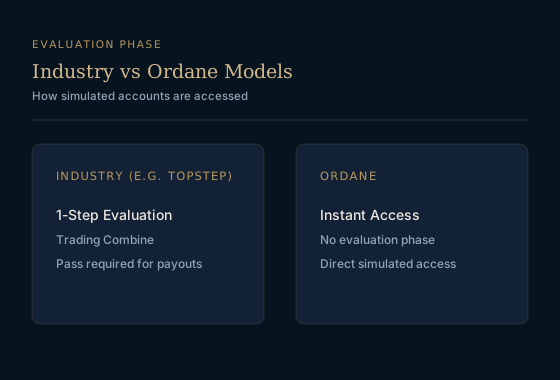
The evaluation phase is the primary barrier to entry in the proprietary trading industry. Many firms use a two-step evaluation, requiring the trader to pass an initial challenge and then a secondary verification phase. This dual requirement prolongs the time before a trader can qualify for payouts. In contrast, Topstep utilizes a streamlined approach for its users. A single-step evaluation reduces the time required to demonstrate proficiency, but it often comes with strict risk management parameters to offset the firm's increased risk exposure. Traders must carefully manage their position sizing and leverage to avoid breaching the rules during this highly concentrated evaluation period. The psychological pressure of a single-step test requires a robust trading plan and strict emotional discipline. The lack of a second phase means the initial phase serves as the sole filter for risk management proficiency.
Drawdown and Consistency Rules
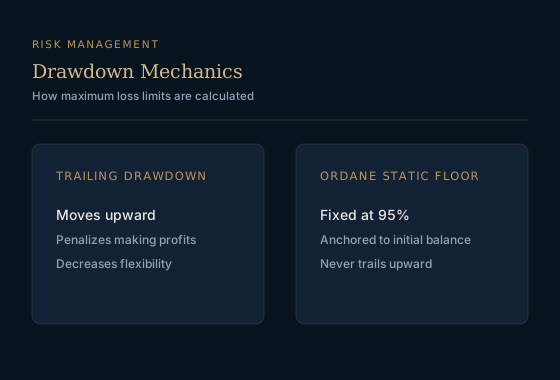
Risk management rules are the core of any proprietary trading firm's operations. The two most critical rules are the daily loss limit and the maximum drawdown. The daily loss limit dictates how much a trader can lose in a single trading day before the account is terminated. The maximum drawdown dictates the total permissible loss on the account overall. Drawdowns can be static, meaning they are fixed to the initial balance, or trailing, meaning they move up as the account balance reaches new highs. A trailing drawdown penalizes a trader for making profits and then giving some back, forcing them to trade smaller sizes as their balance grows. A static drawdown provides a fixed floor, offering much greater flexibility. The Ordane daily loss limit is 3 percent, measured against the balance at the start of the server day. A breach closes the account. Ordane's maximum drawdown is 5 percent and static: account equity may never fall below 95 percent of the initial balance. The floor is fixed on day one, never trails upward, and a breach closes the account.
Consistency rules also play a major role in preventing traders from relying on highly leveraged, lucky trades to pass evaluations. Ordane's consistency rule is 20 percent: at the moment of a withdrawal request, no single trading day may account for more than 20 percent of the cycle's total profit. If a day exceeds 20 percent, the excess profit from that day is deferred to the next cycle. It is never confiscated, and the remainder of the cycle pays out normally.
How Much Does the 50K Account Cost?
The cost of acquiring a proprietary trading account varies significantly depending on the business model. The Topstep 50K Trading Combine account costs $49 per month (Topstep, retrieved 2026-09-12). This subscription model means the trader will continue to pay the fee every month until they either pass the evaluation, cancel the subscription manually, or breach the rules and require a reset.
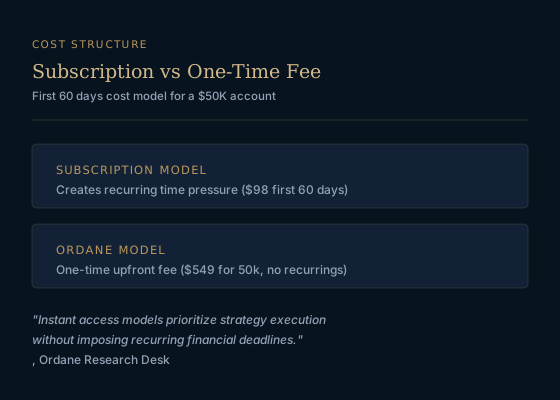
Subscription models inherently create time pressure, as the trader feels compelled to pass the evaluation before the next billing cycle triggers. This pressure can negatively impact trading psychology, leading to rushed entries, poor risk management, and ultimately, a failed evaluation. Modeling the true cost requires looking past the first month.
Declared inputs for this check: a $49 monthly subscription fee (Topstep, retrieved 2026-09-12), a $49 renewal fee for the second month, and a $0 activation fee. Worked arithmetic: $49 + $49 = $98 total upfront cost.
| Cost Component | Amount | Frequency |
|---|---|---|
| Base Subscription Fee | $49 | Monthly |
| Month Two Renewal | $49 | Monthly |
| Activation Fee | $0 | One-time |
| Total Upfront Cost | $98 | First 60 Days |
Alternatively, instant access models charge a single, upfront fee with no recurring billing. The fee is one-time: $59 for the $2,500 account, $139 for the $10,000 account, $299 for the $25,000 account, $549 for the $50,000 account, and $999 for the $100,000 account. There are no recurring fees, no hidden tiers and no coupon games. A single payment allows the trader to take weeks or months to reach their operational goals without incurring additional costs.
Furthermore, the operational costs of the trading environment itself must be considered carefully. Ordane charges no commission, no spread and no swap. The account fee is the only cost the trader pays. The reason is structural, not promotional: accounts run on simulated capital, so no order is routed to an exchange and nothing is financed overnight, which means neither line has an underlying bill behind it.
<div id="quote"></div>
<div id="table"></div>
| Metric/Feature | Ordane (Simulated) | Industry Standard |
|---|---|---|
| Evaluation Phase | Instant Access | 1-Step or 2-Step Evaluation |
| Cost Structure | One-time fee | Monthly Subscription |
| Drawdown Type | 5% Static Floor | Trailing or End-of-Day |
| Overnight Holding | Permitted | Often Restricted |
| First Payout | 7 Calendar Days | 30 Days or More |
Frequently Asked Questions
Do you lose your own money?
When participating in a proprietary trading evaluation, the trader's financial risk is strictly limited to the upfront fee paid to access the platform. Because the trading occurs in a simulated environment, market losses do not translate to personal financial debt. In traditional retail trading, a margin call can leave a trader owing the broker money. In the proprietary model, a breached account is simply closed. A breach closes the account. That is the whole consequence: no partial confiscations, no surprise fees, no renegotiation.
Is it a demo account?
The environment relies on simulated capital, meaning the orders are not routed to a live liquidity provider. However, the data feed mimics live market conditions precisely, ensuring the execution and slippage reflect real-world trading dynamics. This allows the firm to evaluate the trader's strategy without risking corporate capital on unproven talent. The difference between a free practice account and a paid simulated evaluation is the psychological pressure of the rules and the potential for performance payouts.
Can you hold overnight?
The ability to hold positions overnight or over the weekend depends entirely on the firm's specific risk parameters. Some firms prohibit overnight holding to avoid catastrophic gap risk during market opens. Other firms permit it, trusting the trader to manage the exposure. Overnight and weekend holding is allowed at Ordane. It is not on the R-6 closed list, and what is not listed is not a violation.
How often can you withdraw?
Withdrawal schedules dictate how quickly a trader can access their simulated profits. Some firms require thirty days of trading before processing the first payout. Others offer much faster cycles to reward consistent execution. The first withdrawal is available 7 calendar days after account activation, and the cycle thereafter is every 14 days.
Does the firm manipulate execution?
Reputable proprietary trading firms use certified data feeds and advanced technology to ensure execution matches the broader market perfectly. When a firm owns its infrastructure, it controls the execution quality directly. The high natural failure rate of trading evaluations provides enough revenue to cover operational costs, meaning legitimate firms have no incentive to manipulate individual trader execution. Transparency in rules, coupled with public payout ledgers, remains the standard for verifying a firm's operational integrity.
Sources
- What is the Trading Combine? help.topstep.com Retrieved 2026-09-12.
- CFTC Glossary cftc.gov Retrieved 2026-09-12.
- How do Payouts work? help.topstep.com Retrieved 2026-09-12.
- Topstep Pricing topstep.com Retrieved 2026-09-12.