Home · The Ordane Journal · Rules And Mechanics · Trading Multiple Prop Firms: The Real Rules
Trading Multiple Prop Firms: The Real Rules
Running accounts at more than one prop firm is usually allowed by market practice, but each firm's rulebook still governs that account alone, and Ordane only allows copy links between accounts of the same person.
Ordane accounts operate on simulated capital. No live funds are traded and no deposits are accepted. Payouts depend on simulated performance under Rulebook v1.0; no level of performance is typical or assured. Ordane sells one product, the Ordane Instant Account: direct access, no evaluation phase and no challenge, on simulated capital. Can you trade with multiple prop firms at once? Separate firm contracts can coexist. The clause that stops a stack is usually identical or coordinated orders, a shared capital cap, or a household rule inside one of those contracts. Ordane Instant Accounts follow the Ordane Rulebook closed list only. The CFTC warns that forex and leveraged trading involve substantial risk of loss. (CFTC, retrieved 2026-08-15) The R-6 prohibition on copy trading between Ordane accounts applies only between different people. Copy trading is permitted exclusively between Ordane accounts that belong to the same person.
Is Trading With More Than One Prop Firm Allowed?
ESMA's product-intervention notice states that CFDs are complex instruments and come with a high risk of losing money rapidly due to leverage (ESMA, retrieved 2026-08-10). That leverage risk is the independent frame behind any prop CFD-style ticket. Three questions hide inside one heading. "Can I trade with multiple prop firms" is really three questions, and they get different answers. A trader who has only asked "is it allowed" has answered the first question and ignored the other two. All three apply the moment a second account exists.
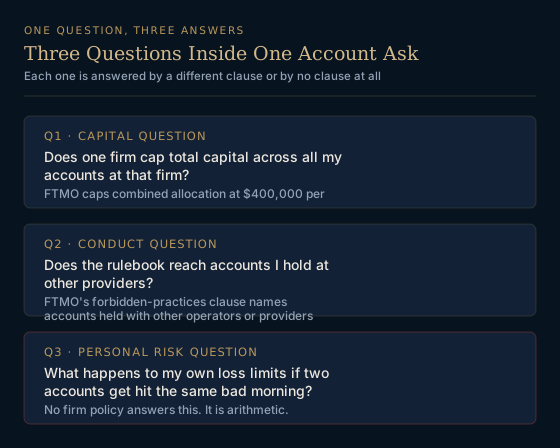
Table 1: Three Ways to Hold Two Accounts and the Clause That Governs Each
| Setup | Same orders on both accounts? | Clause type that applies | What the named firm's own text says |
|---|---|---|---|
| Two accounts, same firm, one trading strategy run on each independently | No | Capital allocation cap | FTMO caps total capital allocation across all accounts a trader holds with FTMO at $400,000 per trader or strategy before scaling; no limit is placed on account count itself (FTMO.com, retrieved 2026-08-11) |
| Two accounts, same firm, identical strategy mirrored across both | Yes | Suspension right on identical strategies over the cap | FTMO reserves the right to suspend accounts when identically traded strategies are detected across multiple FTMO accounts and the combined fictitious capital exceeds the maximum capital allocation limit (FTMO.com, retrieved 2026-08-11) |
| One account at Firm A, one account at Firm B, coordinated entries and exits | Yes | Conduct clause naming accounts at other operators | FTMO's forbidden trading practices cover trades performed in concert with other persons, explicitly including accounts held with other operators or providers, when used for manipulative purposes such as simultaneously entering opposite positions (FTMO.com, retrieved 2026-08-11) |
Read the second and third rows again. Neither one is triggered by holding two accounts. Both are triggered by making the two accounts trade the same thing, at the same time, once size crosses a stated threshold.
The Cap That Counts Your Accounts Together
A single-firm capital cap can count every account you hold at that firm toward one hard limit, regardless of how many logins you opened. That is a single-firm cap. It counts accounts at that firm, added together. It says nothing about a second firm's accounts by itself. What connects the two firms is the separate conduct clause covered below, not this cap.
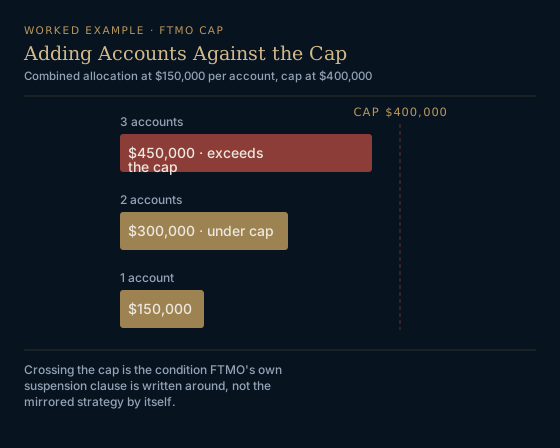
Worked example: adding your own allocation against the cap
Declared inputs: a trader already holds one FTMO account sized at $150,000 in allocated capital, and is deciding whether to add a second FTMO account sized at $150,000 to run a related strategy.
| Step | Calculation | Result |
|---|---|---|
| Existing allocation | One account at $150,000 | $150,000 |
| Add second account | $150,000 (existing) + $150,000 (new) | $300,000 combined |
| Compare to published cap | $300,000 vs. FTMO's stated $400,000 per trader or strategy | Under the cap |
| Add a third $150,000 account | $300,000 + $150,000 | $450,000, exceeds $400,000 |
The Clause That Reaches Accounts at Other Providers
A cross-account clause can suspend an Ordane Instant Account when mirrored orders run across providers, even when each provider sold a separate account.
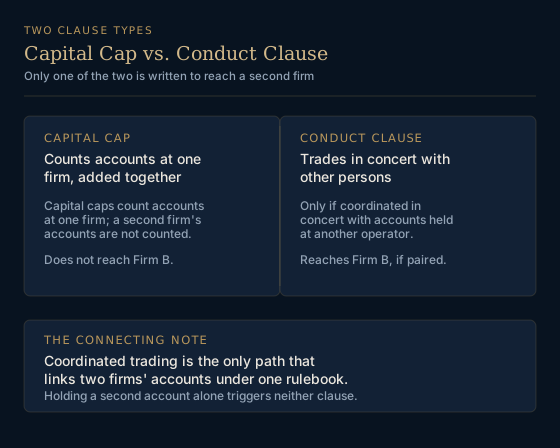
Identical Strategies Across Accounts: What the Cap and the Clause Do Together
The two rules above are not separate hazards. They are one hazard viewed from two rulebook clauses, and understanding how they interact is the actual mechanism a trader needs. That is why "same trader, same strategy, capital under the cap" is a materially different case from "same trader, same strategy, capital over the cap." A trader running one strategy across two $100,000 accounts at the same firm, totaling $200,000, sits under the $400,000 threshold FTMO states applies before scaling (FTMO.com, retrieved 2026-08-11); the identical-strategy language in the firm's own suspension clause is written to activate specifically when that combined figure exceeds the limit, not merely when a strategy is mirrored (FTMO.com, retrieved 2026-08-11). Cross into "in concert with other persons" territory, and the frame changes again. The identical-strategy language governs multiple accounts at FTMO. The forbidden-practices clause on coordination in concert with other persons is worded to reach accounts held with other operators or providers when used for a manipulative purpose (FTMO.com, retrieved 2026-08-11). A trader mirroring one strategy at Firm A and Firm B has left the capital-cap conversation and entered the coordinated-conduct conversation, and it is the second clause, not the first, that names accounts outside the firm's own platform. Firms that find a breach describe consequences in general terms rather than a fixed penalty schedule. FTMO's own language states that a breach of its rules may lead to removal of simulated trades from the trader's history, restricted platform access, disqualification from the Evaluation Process, forfeiture of potential rewards, or termination of all agreements, and does not commit to which of those applies in a given case (FTMO.com, retrieved 2026-08-11).
What Doubles When You Double the Accounts
Two loss limits, two fees, one bad morning
Every rule discussed so far concerns whether the firm restricts your conduct. This section concerns arithmetic that has nothing to do with any firm's discretion: what happens to your own numbers when two accounts sit open at once. Topstep (prop firm) defines the Maximum Loss Limit as the lowest point account balance may reach, and liquidates the account immediately if the balance touches it at any point in the trading day, including on unrealized profit and loss (Topstep Help Center, retrieved 2026-08-11). That limit applies per account. It does not shrink or combine because a trader holds a second account elsewhere. Nothing in the source material states that a firm nets, offsets, or combines these limits across accounts. The exposure is additive because the limits are defined per account, not per trader.
Slippage between accounts is not free
Two accounts running one strategy will not fill at identical prices on identical timestamps. Order routing, execution queues, and platform latency differ account to account even within the same firm, before a second firm's separate platform is added to the mix. A strategy that looks identical on paper produces two different fill sequences in practice, which is part of why firms describe detection in terms of "identically traded strategies" rather than requiring bit-for-bit identical fills (FTMO.com, retrieved 2026-08-11). That gap between intended-identical and actually-identical does not exempt a trader from the clause. It just means the mirroring is visible as a pattern, not as a perfect duplicate.
Six Steps Before You Buy an Account at a Second Firm
1. Pull the first firm's own account-count and capital-allocation policy, verbatim, and note the dollar figure and the date you read it. 2. Add the allocated capital of every account you already hold at that firm. Compare the sum to the published cap before adding a new account. 3. Pull the first firm's forbidden-practices or conduct clause, verbatim, and check specifically whether it names accounts held with other operators or providers. 4. Decide, in writing to yourself, whether the strategy on the new account will be identical to, related to, or independent of the strategy on the existing account. 5. Pull the second firm's own daily loss limit or equivalent, by account size, and add it to the first firm's limit to know your true combined daily exposure. 6. Keep a dated screenshot or saved copy of every clause you relied on. Rulebooks change; a decision made against today's wording needs today's wording on file.
Where a Single Firm's Own Copy-Trading Clause Stops
Ordane's own prohibited-practice list is closed: clause R-6 names six practices, and copy trading between Ordane accounts is one of them (Ordane Rulebook v1.0, clause R-6, retrieved 2026-08-11). Appendix A defines that clause specifically: it covers mirroring, copying, or mechanically linking orders across two or more Ordane accounts held by different people, meaning different account holders or ultimate beneficial owners, so that one person's risk is transferred onto another person's account (Ordane Rulebook v1.0, Appendix A, entry A-3, retrieved 2026-08-11). Copy trading is permitted between Ordane accounts that belong to the same person, and copy trading between person A and person B is always prohibited (Ordane Rulebook v1.0, Appendix A, entry A-3, retrieved 2026-08-11). This is a general illustration of how a closed-list clause reads inside one firm's own rulebook. This clause governs Ordane accounts. It does not create, extend, or imply any rule reaching a second firm's accounts, and nothing in it should be read as a statement about any other provider's policy.
Why do multi-firm stacks fail audits?
Stacks fail when one firm treats parallel accounts as prohibited hedging, copy trading, or risk aggregation. The Ordane Rulebook closed list owns Ordane Instant Accounts only.
How should you read the rulebook at each firm before stacking?
Read each closed prohibited list, copy-trading clause, household clause, and payout clock as separate contracts. Do not assume silence equals permission.
Declared inputs: worked check
Declared inputs: firm A daily loss rate 0.03 on size 100000; firm B daily loss rate 0.04 on size 100000; personal cash buffer 5000. Assumptions for this check only: separate firm equity meters; losses hit personal cash only through fees and time, not through shared simulated equity. Worked arithmetic: 100000 × 0.03 = 3000 100000 × 0.04 = 4000 3000 + 4000 = 7000 7000 − 5000 = 2000
| Meter | Rate | Size | Daily loss dollars |
|---|---|---|---|
| Firm A | 0.03 | 100000 | 3000 |
| Firm B | 0.04 | 100000 | 4000 |
| Combined meter dollars | 7000 | ||
| Cash buffer shortfall | 2000 |
The 2000 shortfall is personal planning math. It is not a shared firm equity meter. Appendix A, entry A-3 (definitive 2026-08-09), defines R-6(c) as mirroring, copying, or mechanically linking orders across two or more Ordane accounts held by different people (different account holders or ultimate beneficial owners), so that one person's risk is transferred or duplicated onto another person's account. Copy trading is permitted exclusively between Ordane accounts that belong to the same person, meaning the same account holder and ultimate beneficial owner. Copy trading between person A and person B is always prohibited. (Ordane Rulebook)
Questions
Can I run the same strategy at two firms?
Each firm's own rulebook answers this for its own accounts, and the answers differ by firm. FTMO's identical-strategy suspension right applies within FTMO's own multiple accounts once combined fictitious capital exceeds its published cap; its separate forbidden-practices clause on conduct in concert with other persons is what extends to accounts held with other operators, and only for the manipulative purposes it names. Read the specific firm's own wording for the specific pair of accounts in question.
Do firms share data with each other?
Nothing in the sourced material for this article states that prop firms exchange trading data with each other. FTMO's forbidden-practices clause is written broadly enough to reach conduct involving accounts at other operators without requiring that the two firms share information.
Does a breach at one firm affect the other?
The sourced material does not describe cross-firm consequences. FTMO's own stated consequences for a breach are described as applying to that trader's relationship with FTMO, and Topstep's account-stacking prohibition is likewise written in terms of a trader's own accounts at Topstep.
Does holding multiple accounts change my daily loss exposure?
Yes, by addition, not by firm policy. Topstep's Maximum Loss Limit liquidates an account immediately once balance touches that floor, and that limit is defined per account, with nothing stating that limits combine or net across accounts. A trader holding two accounts carries two separate loss floors that can both be hit on the same bad day.
Can I copy my own trades between my own Ordane accounts?
Yes. Ordane's Appendix A permits copy trading exclusively between Ordane accounts that belong to the same person, meaning the same account holder and ultimate beneficial owner. Copy trading between two different people is always prohibited under clause R-6. See also prop firm overnight and weekend holding, what you can trade on a prop firm account, static vs trailing drawdown, prop firm profit split explained, and how prop firms make money. Primary sources are linked inline above. This article is for information only and is not investment, financial, or tax advice.
Sources
Primary sources are linked inline above.
This article is for information only and is not investment, financial, or tax advice.