Home · The Ordane Journal · Payouts · Can You Leave Profit in a Prop Firm Account?
Can You Leave Profit in a Prop Firm Account?
Ordane accounts operate on simulated capital. No live funds are traded and no deposits are accepted. Payouts depend on simulated performance under Rulebook v1.0; no level of performance is typical or assured.
Ordane sells one product, the Ordane Instant Account: direct access, no evaluation phase and no challenge, on simulated capital.
A retained trading balance is money left on a prop firm account instead of withdrawn, produced by one of three separate mechanisms: an optional rollover feature, a payout cap, or arithmetic residue after a partial withdrawal (Ordane Rulebook v1.0, clause P-2, retrieved 2026-08-07).
Can Profit Stay in the Account?
ESMA's product-intervention notice states that CFDs are complex instruments and come with a high risk of losing money rapidly due to leverage (ESMA, retrieved 2026-08-10). That leverage risk is the independent frame behind any prop CFD-style ticket.

The short answer in 45 words
Profit can remain in a prop firm account under three separate conditions: the firm offers an optional rollover feature and the trader chooses it, a payout cap forces part of the profit to stay regardless of choice, or a partial withdrawal simply leaves arithmetic balance behind. These are not the same mechanism and they do not produce the same result.
Optional retained reward
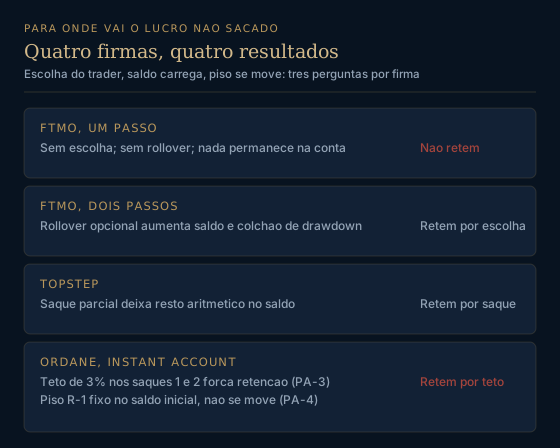
A rollover is a firm feature that lets a trader decline a full payout and instead leave the reward, or a portion of it, on the account to increase the balance and, in most published designs, the loss room measured from that higher balance. FTMO (prop firm) documents this feature on its two-step product: the FAQ states that its two-step product allows a trader to keep a reward on the account as rollover to build balance and drawdown buffer. (FTMO Withdrawal FAQ, retrieved 2026-08-07) The decision consequence is direct: choosing rollover means no cash that cycle, in exchange for more room to trade.
Table 1: Where Unwithdrawn Profit Goes
| Firm and product | Can the trader choose? | Minimum retained amount | Does balance carry? | Does the loss floor move? | Resetting event |
|---|---|---|---|---|---|
| FTMO, one-step | No | Not applicable | Not applicable | Not applicable | FTMO's one-step FAQ states rewards do not remain on the account to grow the balance; the source does not describe a resetting event because there is nothing to retain. (FTMO Withdrawal FAQ, retrieved 2026-08-07) |
| FTMO, two-step | Yes, rollover is optional | Not documented in the source read on 2026-08-07 | Yes, the FAQ states rollover builds balance and drawdown buffer. (FTMO Withdrawal FAQ, retrieved 2026-08-07) | Not documented in the source read on 2026-08-07 | Not documented in the source read on 2026-08-07 |
| Topstep | Effectively yes, by requesting less than the full eligible amount | Not documented in the source read on 2026-08-07 | Yes, worked examples show the remaining balance stays on the account after a partial payout. (Topstep Payout Policy, retrieved 2026-08-07) | Not documented in the source read on 2026-08-07 | Topstep requires positive net profit since the prior payout for later requests, with a stated first-request exception, which changes what counts as retained profit for the next cycle. (Topstep Payout Policy, retrieved 2026-08-07) |
| Ordane, Instant Account | Not documented, Ordane does not publish a rollover feature | Not applicable, no rollover policy is published | Yes, by arithmetic: withdrawals reduce the account balance. (Ordane Rulebook v1.0, clause PA-4, retrieved 2026-08-07) | No, the R-1 floor stays anchored to the initial balance regardless of balance changes. (Ordane Rulebook v1.0, clause PA-4, retrieved 2026-08-07) | Not documented in the source read on 2026-08-07 |
Start from eligible profit, not headline profit
Declared inputs: a trader has $10,000 of profit eligible for payout on an account with a $50,000 initial balance and a profit split of 80 percent for that withdrawal cycle. Before any cap or rollover choice, the eligible cash amount is:
$10,000 x 80% = $8,000
That $8,000, not the $10,000 headline profit figure, is the number every downstream choice operates on. The remaining 20 percent, $2,000, belongs to the firm under the split and was never available to withdraw or retain in the first place.
Apply the floor after the withdrawal
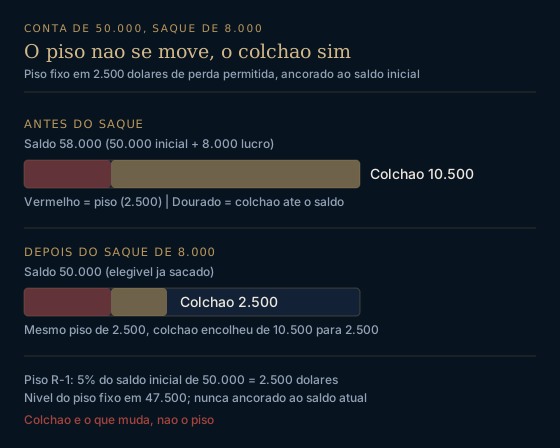
Declared inputs: the same $50,000 initial balance account, a static 5 percent drawdown floor measured from the initial balance, and a decision to withdraw the full $8,000 eligible cash in one request, leaving no rollover.
Step 1, the drawdown floor in dollars:
$50,000 x 5% = $2,500 of allowed loss from the initial balance
Step 2, the account balance immediately after the withdrawal, assuming the balance before the request was $58,000 ($50,000 initial plus $8,000 unwithdrawn profit):
$58,000 - $8,000 = $50,000 remaining balance
Find the rollover and cap clauses
Before assuming either outcome, locate three written facts for the specific firm and account type in question: whether a rollover feature exists at all, whether it is mandatory or optional, and whether any cap forces partial retention independent of choice. A firm that offers rollover on one product tier and not another, as FTMO does between its one-step and two-step products, (FTMO Withdrawal FAQ, retrieved 2026-08-07) means the answer is not a single company-wide policy. It is a per-product policy, and the product name has to be checked, not assumed from a general FAQ page.
Calculate post-request headroom
Once the eligible cash figure and the split are known, the calculation in the section above applies directly: subtract the requested withdrawal from the pre-request balance to get the post-request balance, then measure that post-request balance against the fixed floor level, not against the pre-request balance. A trader who skips this step and compares the withdrawal only to the headline profit figure will consistently overestimate how much loss room remains.
Copyable checklist, six fields to fill in before paying for an account or before a withdrawal decision:
- Product tier and whether it publishes a rollover feature at all.
- If rollover exists, is it optional or mandatory, and what is the minimum retained amount.
- Is there a payout cap on this withdrawal number in the cycle, and what is the cap's numeric value.
- What is the pre-request balance, in dollars, right now.
- What is the fixed drawdown floor, in dollars, calculated from the initial balance.
- What is the post-request balance minus the floor level: that number, not the headline profit, is the real cushion left to trade with.
How Does Ordane Handle Retained Profit?
(Ordane Rulebook, retrieved 2026-08-07) Ordane does not publish a rollover feature. There is no clause in the Ordane Rulebook that lets a trader opt into keeping profit on the account to grow the balance the way FTMO's two-step rollover does; (FTMO Withdrawal FAQ, retrieved 2026-08-07) the only mechanisms Ordane publishes are cap and arithmetic residue, not choice.
Withdrawals #1 and #2 are each capped at 3 percent of initial balance. From withdrawal #3 onward there is no cap.
Searchers asking "prop firm profit rollover explained", "keep profit in prop firm account for buffer", "does unwithdrawn prop firm profit expire", "prop firm rollover vs payout" are testing whether unwithdrawn profit stays as buffer or expires.
A minimum withdrawal is the smallest credit the firm will send in one request. If retained profit sits below that floor, the balance can stay on the simulated account until the next request clears the floor , which is why the mechanism belongs in the same table as static floors and shrinking cushions.
Three retention mechanisms that decide whether profit can wait
| Mechanism | What it does | What the trader must verify |
|---|---|---|
| Minimum withdrawal | Blocks request until closed profit clears a floor | Published minimum on the payout rail page |
| Withdrawal cap ladder | Caps early withdrawals as a percent of initial balance | Cap on withdrawal #1/#2 versus later uncapped payouts |
| Late-payout clock | Starts after approval, not after request | Clock hours versus business hours on the guarantee page |
For related published reading, see overnight and weekend holding rules, trading costs against drawdown, news trading restrictions, how to save prop firm rules before paying.
Is rollover the same as skipping a payout?
No. Rollover is a named product feature that a firm documents in advance, such as FTMO's two-step rollover that explicitly builds balance and drawdown buffer. (FTMO Withdrawal FAQ, retrieved 2026-08-07) Simply requesting a smaller withdrawal than the eligible amount, as in Topstep's partial-payout examples, (Topstep Payout Policy, retrieved 2026-08-07) leaves a retained balance too, but it is arithmetic residue, not a named feature, and the firm's documentation may not describe any buffer benefit attached to it.
Does retained profit increase loss room?
It depends on whether the drawdown floor is static or trailing. Where the floor is fixed to the initial balance, as Ordane's R-1 floor is, (Ordane Rulebook v1.0, clause PA-4, retrieved 2026-08-07) a higher balance from retained profit widens the dollar cushion above that floor without moving the floor itself. Where a firm's floor trails the current balance upward, retained profit could raise the floor along with it, which is a materially different outcome and has to be checked in that firm's own drawdown documentation rather than assumed.
Can a firm force profit to remain?
Yes, through a payout cap. Ordane's first two withdrawals are each capped at 3 percent of initial balance, with no cap from the third withdrawal onward. (Ordane Rulebook v1.0, clause PA-3, retrieved 2026-08-07) Any eligible profit above that cap on an early cycle stays on the account regardless of the trader's preference, which is a forced outcome, not a chosen rollover.
Does a payout issue a new account?
Not documented in the sources read for this article on 2026-08-07. Neither the FTMO nor the Topstep sources cited here describe a payout triggering a new account, and the Ordane Rulebook clauses used here, PA-3 and PA-4, (Ordane Rulebook v1.0, clauses PA-3 and PA-4, retrieved 2026-08-07) describe balance reduction on the same account, not account replacement. A trader on any firm should confirm this directly against that firm's current payout documentation rather than assume either outcome.
Where is the full post-payout drawdown calculation?
The complete formula, covering how the fixed floor interacts with daily loss limits and the consistency rule across a full withdrawal cycle, is covered in what a payout does to your drawdown. This article's boundary stops at the balance and cap mechanics shown above; it does not repeat the daily-loss or consistency-rule interaction, which belongs to that companion article. For withdrawal cadence, see how often can you withdraw from a prop firm, and for whether trading is allowed while a request is pending, see can you trade while a payout is pending.
Sources
- Ordane Rulebook v1.0, clause P-2 (sentence 1); ordanemarkets.com payout-funding statement (sentence 2) ordanemarkets.com Retrieved 2026-08-07.
- FTMO Withdrawal FAQ ftmo.com Retrieved 2026-08-07.
- Topstep Payout Policy help.topstep.com Retrieved 2026-08-07.
- Notice of product intervention decisions on CFDs and binary options | ESMA esma.europa.eu Retrieved 2026-08-10.
- Customer Advisory: Understand the Risks of Virtual Currency Trading | CFTC cftc.gov Retrieved 2026-08-10.