Home · The Ordane Journal · Payouts · Prop Firm Payout Methods: The Last Mile
Prop Firm Payout Methods: The Last Mile
Ordane accounts operate on simulated capital. No live funds are traded and no deposits are accepted. Payouts depend on simulated performance under Rulebook v1.0; no level of performance is typical or assured.
Ordane sells one product, the Ordane Instant Account: direct access, no evaluation phase and no challenge, on simulated capital.
Every payout promise a prop firm makes ends at a payment rail, and the rail has rules that no marketing page mentions.
ESMA states that CFDs are complex instruments and come with a high risk of losing money rapidly due to leverage (ESMA, retrieved 2026-08-10).
How Do Prop Firms Actually Pay You?
A prop firm pays an approved reward by bank wire, card network, e-wallet or crypto, chosen from a short published list. Each rail carries its own fee, its own minimum, and its own clearing time, and none of them starts moving until the request is approved.
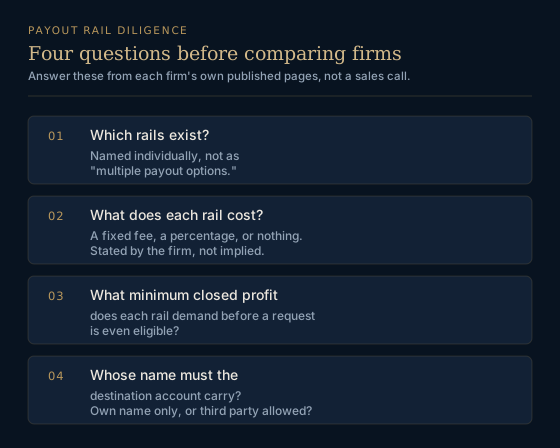
That sentence is the whole mechanism. The marketing page shows a split percentage. It does not show which rail applies to your payout size, what the firm charges to move it, what floor your closed profit has to clear first, or whose name has to sit on the receiving account. Those four questions describe every rail any firm will ever publish, and they survive a firm changing its table entirely, which the two tables below will not.
The Four Questions That Describe Any Rail
Before comparing any two firms, answer these for each one, from their own published pages, not from a sales call:
- Which rails exist, named individually, not as "multiple payout options"?
- What does each rail cost, in a fixed fee, a percentage, or nothing?
- What minimum closed profit does each rail demand before a request is even eligible?
- Whose name is the destination account required to carry?
Everything below answers those four questions for two firms that publish rail-level detail: FTMO (a proprietary trading firm) and Topstep (a proprietary trading firm).
Which payout rails do FTMO and Topstep publish, cell by cell?
FTMO and Topstep each publish named rails with fee, minimum and clearing time on their own help pages. This is two firms with published payout tables, not a market survey. Apply the same four questions to your own firm's pages before assuming either table below describes it.
| Rail | Firm | Fee charged by firm | Minimum closed profit | Published clearing time | Retrieved |
|---|---|---|---|---|---|
| Bank wire | FTMO | Not published as a separate fee (FTMO FAQ, retrieved 2026-08-06) | $20 (FTMO FAQ, retrieved 2026-08-06) | 1 to 2 business days after invoice approval (FTMO FAQ, retrieved 2026-08-06) | August 6, 2026 |
| Visa Direct / Mastercard Send | FTMO | Not published as a separate fee (FTMO FAQ, retrieved 2026-08-06) | Up to $20,000, capped by amount (FTMO FAQ, retrieved 2026-08-06) | Not published | August 6, 2026 |
| Skrill | FTMO | Not published as a separate fee (FTMO FAQ, retrieved 2026-08-06) | Up to $3,000, capped by amount (FTMO FAQ, retrieved 2026-08-06) | Not published | August 6, 2026 |
| Cryptocurrency | FTMO | Not published as a separate fee (FTMO FAQ, retrieved 2026-08-06) | $50 (FTMO FAQ, retrieved 2026-08-06) | Not published | August 6, 2026 |
| ACH | Topstep | $30 flat (Topstep Help Center, retrieved 2026-08-06) | $125 (Topstep Help Center, retrieved 2026-08-06) | 1 to 3 business days (Topstep Help Center, retrieved 2026-08-06) | August 6, 2026 |
| Wire/SWIFT | Topstep | $30 flat (Topstep Help Center, retrieved 2026-08-06) | $125 (Topstep Help Center, retrieved 2026-08-06) | 5 to 10 business days (Topstep Help Center, retrieved 2026-08-06) | August 6, 2026 |
The asymmetry is the payload, and it is visible in the table without any argument added: FTMO caps two rails by amount and sets a minimum as low as $20, while Topstep sets a single $125 floor across every rail it publishes, six times FTMO's smallest minimum (Topstep Help Center, retrieved 2026-08-06).
Why Does the Minimum Matter More Than the Fee?
A comparison page usually stops at "who charges less." That question is the wrong one. Topstep's own published fee, $30 flat, is not large in isolation (Topstep Help Center, retrieved 2026-08-06). FTMO charges no separate commission at all (FTMO FAQ, retrieved 2026-08-06). On fee alone, FTMO wins every time, but fee is not what decides how long the money sits with someone else before it reaches you. The minimum does.
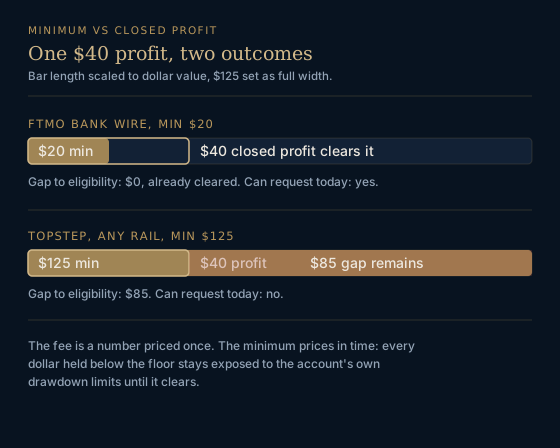
What a $125 Floor Does to a Small Account
Declared inputs: a trader's closed profit sits at $40, one firm's published minimum is $125 (Topstep), the other's published minimum for the same rail type is $20 (FTMO, bank wire).
The trader with $40 in closed profit cannot request a payout from the $125-minimum firm at all. 125 - 40 = 85 ($125 minus $40 equals $85) still owed before a request becomes eligible. That $85 has to accumulate inside the account first, and every dollar of it sits exposed to the account's own loss limits until it clears the floor. Against a $20 minimum, the same $40 already clears the requirement by $20 and the request can go in today.
| Scenario | Published minimum | Trader's closed profit | Gap to eligibility | Can request today? |
|---|---|---|---|---|
| FTMO bank wire (FTMO FAQ, retrieved 2026-08-06) | $20 | $40 | $0 (already cleared) | Yes |
| Topstep, any rail (Topstep Help Center, retrieved 2026-08-06) | $125 | $40 | $85 | No |
Why a Firm Charging Zero Commission Can Still Be the Slower Way to Get Paid
FTMO's zero house commission looks like the cheaper firm on the fee line alone (FTMO FAQ, retrieved 2026-08-06). But "cheaper fee" and "faster paid" are different questions, and the minimum answers the second one, not the first. A trader held below a $125 floor is not paying $125, they are waiting an unknown number of trading days to accumulate profit that stays inside the account, subject to the account's daily and maximum drawdown limits, the entire time it sits there. A trader cleared to request at $20 is not carrying that exposure. The fee is a number you can price in one sitting. The minimum is a number that prices in time, and time is where a small account gets hurt.
When Does the Payout Clock Actually Start?
Request, Approval, Invoice, Send: Four Events, Not One
A payout involves four distinct events: the trader submits the request, the firm approves or denies it, an invoice is generated and approved, and the money is sent. Reading a firm's published clearing time against the wrong one of these four events is the single most common misread in prop firm payouts.
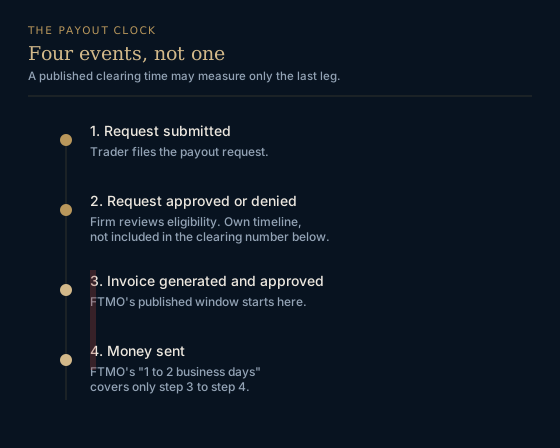
FTMO's own published number does not measure from the request. It measures from invoice approval: "the Reward is typically sent within 1-2 business days after the invoice is approved" (FTMO FAQ, retrieved 2026-08-06). Everything before invoice approval, the review of the request itself, is a separate step with its own timeline that this number does not include.
This article does not re-explain the full two-clock mechanics behind approval and payment deadlines. That belongs to the article on how long prop firms take to pay, which owns that explanation and is the correct next stop for anyone comparing deadline clauses across firms.
What Business Days Do to a Weekend Request
Every clearing time published in Table 1 that carries a unit is stated in business days, not calendar days: FTMO's 1 to 2 days after invoice approval (FTMO FAQ, retrieved 2026-08-06), Topstep's 1 to 3 days on ACH and 5 to 10 days on wire (Topstep Help Center, retrieved 2026-08-06). A request approved on a Friday afternoon does not lose two days to the weekend, it loses two days that were never counted as clearing time in the first place. A trader who submits on Thursday and reads "1 to 3 business days" as "by Sunday" will be wrong, and no firm's published wording corrects that assumption for you.
Whose Name Has to Be on the Destination Account?
Why Third-Party Payment Is Refused, and by Whom
Topstep states its rule plainly: "Payouts can only be sent to a bank account in your own name" (Topstep Help Center, retrieved 2026-08-06). That is the published rule, quoted exactly, and it means a payout cannot be routed to a spouse's account, a business partner's account, or a company account that does not carry the trader's own name as account holder.
The documentation retrieved for FTMO in this ledger does not address the destination account name at all. That is not evidence FTMO allows third-party payment, it is an absence, and the correct move for a reader is to ask FTMO support directly before assuming either answer.
The structural reason behind a same-name requirement is not stated by name in either firm's published page retrieved here, so this article does not claim to know it. What can be said without inventing anything: payment processors and banks routinely screen for transfers where the sender's records and the receiving account name do not match, and a firm that pays a name different from the one on file creates a compliance question for itself, independent of what the trader intended.
What to Fix Before the First Request, Not After
The account name on file with a firm's KYC process and the account name on the bank, card or e-wallet destination need to match before a payout request is submitted, not after it is denied. A mismatch discovered after approval does not just delay one payout, it can restart the entire approval clock on a corrected request. Confirming this ahead of time costs nothing and removes the most avoidable payout failure there is.
What Ordane Commits to on the Last Mile
Ordane's specific payment processor, payment method, currency, network and minimum withdrawal amount are not published for public citation at this time. What is published, in writing, in Rulebook v1.0, is the part of the last mile that governs how much of a payout a trader can move on the first two requests.
Clause PA-3 sets the cap directly: withdrawals #1 and #2 are each capped at 3 percent of initial balance, and from withdrawal #3 onward there is no cap (Ordane Rulebook v1.0, clause PA-3, retrieved 2026-08-06). That is the number a reader comparing minimums against caps actually needs, because it answers a different question than a rail minimum does: not "how much do I need before I can ask," but "how much am I allowed to take out the first two times I ask."
On the deadline side, clause G-1 ties a firm-side timing failure to an automatic outcome rather than an apology: a payout approved and not paid within 48 clock hours, not business hours, triggers a 100 percent refund of the account fee plus the payout owed in full (Ordane Rulebook v1.0, clause G-1, retrieved 2026-08-06). The full mechanics behind that deadline, including the approval clock that precedes it under clause G-0, belong to the article on how long prop firms take to pay.
For payout-adjacent reading, see how long prop firms take to pay, prop firm withdrawal requirements, can a prop firm take back your payout, where does prop firm payout money come from, trading costs against drawdown.
An independent US regulator frames leveraged speculation similarly: like all futures products, speculating in these markets should be considered a high-risk transaction (CFTC, retrieved 2026-08-10).
Worked fee check
Declared inputs for this check only: payout amount $2000; Topstep ACH flat fee $30 (published; no percent fee on that rail).
| Input | Value | Arithmetic |
|---|---|---|
| Payout | 2000 | Declared |
| Flat rail fee | 30 | Topstep ACH (Topstep Help Center, retrieved 2026-08-06) |
| Net | 1970 | 2000 - 30 = 1970 |
Arithmetically: 1970 + 30 = 2000 under these declared inputs (net plus the published Topstep ACH fee returns the payout). The same check does not invent a percent fee FTMO and Topstep do not publish on these rails.
Questions traders ask before requesting a payout
What is the difference between a payout rail and a profit split?
The rail is how money moves after approval; the profit split is how much of closed profit you may request. Fees attach to the rail, not to the split slogan.
How do minimum withdrawal amounts block a request?
If closed profit sits below the published minimum, the request is not eligible. Under declared inputs of $40 profit against a $125 minimum, 125 - 40 = 85 still has to accumulate first.
Do payout fees change the net you receive?
Yes. Under the declared Topstep ACH inputs above, 2000 - 30 = 1970 net on a $2000 payout.
How fast is Ordane's late-payout compensation clock?
A payout approved and not paid within 48 clock hours triggers the G-1 compensation rule on the Ordane Rulebook (Ordane Rulebook, retrieved 2026-08-10).
Are the first Ordane withdrawals capped?
Withdrawals #1 and #2 are each capped at 3 percent of initial balance; from withdrawal #3 onward there is no cap (Ordane Rulebook, retrieved 2026-08-10).
Sources
- FTMO FAQ, on the published withdrawal rails, their minimums, the absence of a separate house commission, and the reward being sent within 1 to 2 business days after invoice approval. ftmo.com/en/faq/how-do-i-withdraw-my-profits Retrieved 2026-08-06.
- Topstep Help Center, Topstep Payout Policy, on the $30 flat fee, the $125 minimum across rails, the ACH and wire clearing windows, and payouts being sent only to a bank account in the trader's own name. help.topstep.com, Topstep Payout Policy Retrieved 2026-08-06.
- European Securities and Markets Authority, notice of product intervention decisions on CFDs and binary options, on CFDs being complex instruments carrying a high risk of losing money rapidly due to leverage. esma.europa.eu Retrieved 2026-08-10.
- U.S. Commodity Futures Trading Commission, customer advisory, on speculating in these markets being considered a high-risk transaction like all futures products. cftc.gov Retrieved 2026-08-10.
- Ordane Rulebook v1.0, clause PA-3 on the 3 percent cap covering withdrawals #1 and #2 with no cap from withdrawal #3 onward, and clause G-1 on the 48 clock hour payment deadline and its automatic compensation. ordanemarkets.com/rulebook Retrieved 2026-08-06.