Home · The Ordane Journal · Payouts · Prop Firm Earnings: The Ceiling in the Clauses
Prop Firm Earnings: The Ceiling in the Clauses

Ordane accounts operate on simulated capital. No live funds are traded and no deposits are accepted. Payouts depend on simulated performance under Rulebook v1.0; no level of performance is typical or assured.
Ordane sells one product, the Ordane Instant Account: direct access, no evaluation phase and no challenge, on simulated capital.
The CFTC warns that forex and leveraged trading involve substantial risk of loss. (CFTC, retrieved 2026-08-15)
A prop firm payout ceiling is the maximum a single account can pay out in one withdrawal cycle, calculated from account size, profit split, payout cap and consistency rule, four published contract terms, not a forecast of what any trader will earn.
How Much Do Prop Firm Traders Make?
ESMA's product-intervention notice states that CFDs are complex instruments and come with a high risk of losing money rapidly due to leverage (ESMA, retrieved 2026-08-10). That leverage risk is the independent frame behind any prop CFD-style ticket.
The 45-word answer
No prop firm publishes an audited average payout per trader, and none is required to. What is public is the account size, the profit split, the payout cap and the consistency rule, four terms that together set a maximum for one cycle, not an average across traders.
Why an average would not help even if it existed
An average earnings figure across thousands of accounts would mix traders who never withdrew, traders who breached on day one, and the rare trader who scaled for a year. It would tell you nothing about what your account, at your size, under your rules, can pay. A ceiling does. It is the number that cannot be exceeded regardless of skill, and it comes straight from the contract you sign, not from a marketing page's selection of its best outcomes.
This article stacks all four terms, account size, split, payout cap, and consistency rule, into one per-cycle ceiling, then multiplies that ceiling by cadence to get a period figure. Two narrower questions are answered elsewhere: what a single withdrawal request nets you when the cap and the split both apply to that one request, and how the split percentage itself rises over time. Both are linked at the end of this piece.
Searches such as how much do prop firm traders make per month, how much can you make prop firm trading, how much money do prop firm traders make, prop firm trader salary, do prop traders make money and highest paying prop trading firms all ask for an observed outcome. The public contracts support a ceiling calculation, not an audited average or salary. This article keeps those two categories separate.
What Do the Rules Say About Presenting Simulated Results as Earnings?
CFTC Regulation 4.41(b) requires hypothetical or simulated performance to carry a warning that it has inherent limitations and, unlike an actual performance record, does not represent actual trading (CFTC final rule, retrieved 2026-08-10). That distinction applies directly here: a screenshot of simulated profit is evidence of one simulated result, not evidence of typical income. Topstep's own risk disclosure likewise identifies hypothetical or simulated results as carrying inherent limitations (Topstep, retrieved 2026-08-10). A contractual ceiling can be reproduced from published clauses; an earnings claim requires outcome data the clauses do not contain.
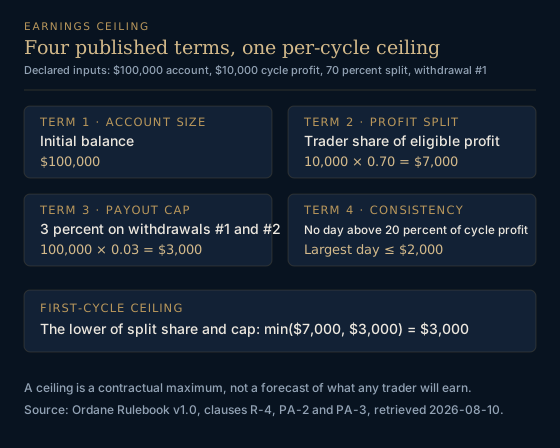
Table 1: Which Four Terms Set the Cycle Ceiling?
Declared inputs for the worked example: $100,000 account, $10,000 cycle profit, 70 percent split, withdrawal #1, and no day above 20 percent of cycle profit.
| Term | Published rule used | Worked value |
|---|---|---|
| Account size | Initial balance | $100,000 |
| Profit split | Trader share of eligible profit | 10,000 × 0.70 = $7,000 |
| Payout cap | 3 percent on withdrawals #1 and #2 | 100,000 × 0.03 = $3,000 |
| Consistency | No day above 20 percent of cycle profit | Largest day must be $2,000 or less |
The first-cycle ceiling is the lower of the split share and the applicable cap: min($7,000, $3,000) = $3,000. From withdrawal #3 onward, the cap no longer applies, so the same declared profit and split produce a $7,000 ceiling if the consistency test defers nothing (Ordane Rulebook v1.0, clauses R-4, PA-2 and PA-3, retrieved 2026-08-10).
Why Does the Consistency Rule Move Money Between Cycles Instead of Confiscating It?
A consistency rule is a concentration limit, not a penalty. At Ordane, no single trading day may account for more than 20 percent of a cycle's total profit at the moment a withdrawal is requested. If a day exceeds that share, the excess is deferred to the next cycle. It is never confiscated, and the rest of the cycle's profit pays out normally. (Ordane Rulebook v1.0, clause R-4, retrieved 2026-08-10)
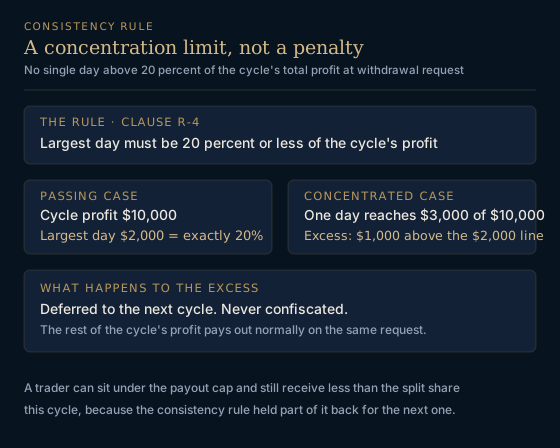
This is where the per-cycle ceiling in Table 1 meets a second, independent constraint. The split-and-cap arithmetic sets the maximum the contract allows to leave the account in one request. The consistency rule sets which portion of that cycle's profit is even eligible to be counted toward that request right now. A trader can be under the payout cap and still short of the full split share, because the consistency rule held part of the cycle's profit back for the next one.
How Does Withdrawal Cadence Change the Period Ceiling?
A per-cycle ceiling only becomes a period figure once you know how often a cycle closes.
How often a cycle closes
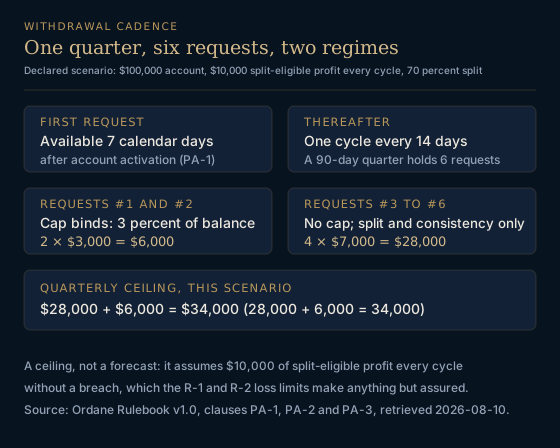
At Ordane, the first withdrawal is available 7 calendar days after account activation, and the cycle thereafter is every 14 days. (Ordane Rulebook v1.0, clause PA-1, retrieved 2026-08-10) That means in a 90-day quarter, a trader who requests every eligible cycle gets roughly one withdrawal in the first week and five more at 14-day intervals, six requests total.
What the first cycles cap
The withdrawal cap applies only to withdrawals #1 and #2. (Ordane Rulebook v1.0, clause PA-3, retrieved 2026-08-10) For the $100,000 account example above, that means the first two of those six quarterly requests are each capped at $3,000 regardless of profit generated, while the remaining four are bound only by the split and the consistency rule. A per-cycle ceiling of $7,000 (at the 70 percent split step) applied across four uncapped cycles in a quarter gives a theoretical quarterly ceiling of $28,000 (7,000 × 4 = 28,000) from those four cycles alone, before adding the two capped cycles at $3,000 each ($6,000 combined). The full quarterly ceiling in this specific worked scenario is $34,000 (28,000 + 6,000 = 34,000), a ceiling, not a forecast, and one that assumes the trader generates $10,000 in split-eligible profit every single cycle without a breach, which the loss limits in R-1 and R-2 make anything but assured.
What Do FTMO and Topstep Publish, and What Do They Not?
Re-fetched live for this article at the date of writing.
| Firm | Published split | Published account ceiling | Payout cap disclosed? |
|---|---|---|---|
| FTMO (prop firm) | 90 percent share of simulated profits on the scaling plan, valid for the 2-Step product only (FTMO.com, retrieved 2026-08-10) | $2,000,000 across all of a trader's accounts on the scaling path (FTMO.com, retrieved 2026-08-10) | Not verified in this research pass; check the firm's payout terms directly |
| Topstep (prop firm) | Not verified in this research pass for this article; the firm's risk disclosure covers simulated-results language only (Topstep, retrieved 2026-08-10) | Not verified in this research pass | Not verified in this research pass |
| Ordane | Starts at 60 percent, rises 5 points per completed withdrawal, reaches 100 percent from the ninth withdrawal onward (Ordane Rulebook v1.0, clause PA-2, retrieved 2026-08-10) | Five sizes: $2,500, $10,000, $25,000, $50,000, $100,000 (Ordane Rulebook v1.0, retrieved 2026-08-10) | Yes: 3 percent of initial balance on withdrawals #1 and #2, no cap from #3 onward (Ordane Rulebook v1.0, clause PA-3, retrieved 2026-08-10) |
Where this table says "not verified in this research pass," that is a marker, not an assumption of zero disclosure. It means this article's own live check did not locate a published figure, and no number should be inferred in its place.
How Do You Calculate Your Own Payout Ceiling in Six Steps?
This is the general method the worked example above follows in sequence.
- Start at the account's daily loss limit and maximum drawdown. These bound how much can be lost before the account closes, which indirectly bounds sustainable profit-taking behavior, but they do not cap profit directly.
- Apply the profit split published for your account tier to any profit figure to get your raw share.
- Apply the payout cap, if one exists for your withdrawal number, and take whichever of the split share or the cap is smaller.
- Apply the consistency rule to check whether any single day's concentration exceeds the allowed share of the cycle's profit; if it does, subtract the deferred portion from this cycle's eligible total.
- Apply the cadence, the number of withdrawal cycles in your period, to multiply the resulting per-cycle ceiling into a period figure.
- State the result as a range with the date you calculated it and the account size it applies to, never as a single number without both.
A number produced this way is a contractual ceiling under stated rules on a stated date. It is not a prediction of what any trader will earn, and it says nothing about the probability of reaching that ceiling.
What Does the Arithmetic Look Like at Ordane?
Five account sizes
Ordane Instant Account comes in five sizes: $2,500, $10,000, $25,000, $50,000 and $100,000. (Ordane Rulebook v1.0, retrieved 2026-08-15) The fee is one-time: $59 for the $2,500 account, $139 for the $10,000 account, $299 for $25,000, $549 for $50,000 and $999 for $100,000, with no recurring fees, no hidden tiers and no coupon games. (Ordane Rulebook v1.0, retrieved 2026-08-15)
Run the same six-step ceiling procedure on the $25,000 size, the one not shown in Table 1's generic grid.
Declared inputs: $25,000 account, third withdrawal request (cap no longer applies), 70 percent split (second step on the ladder), $2,500 in cycle profit, no single day over 20 percent of that profit.
| Step | Rule applied | Calculation | Result |
|---|---|---|---|
| 1 | R-1 static floor and R-2 daily loss limit | 25,000 × 0.95 floor; 25,000 × 0.03 daily cap | Account cannot fall below $23,750 equity or lose more than $750 in a server day without closing |
| 2 | PA-2 profit split (70 percent step) | 2,500 × 0.70 | $1,750 raw share |
| 3 | PA-3 payout cap | Withdrawal #3, no cap applies | Cap does not bind |
| 4 | R-4 consistency rule | No single day exceeded 20 percent of $2,500 | Nothing deferred |
| 5 | Cadence | Single cycle | No multiplier yet |
| 6 | Ceiling on this date | $1,750 raw share, no deferral, no cap | $1,750 |
Step 1: R-1 and R-2 bound the account at a 5 percent static floor and a 3 percent daily loss limit, so the account cannot fall below $23,750 equity or lose more than $750 in a server day without closing. (Ordane Rulebook v1.0, clause R-1, retrieved 2026-08-15) (Ordane Rulebook v1.0, clause R-2, retrieved 2026-08-15) Step 2: at a 70 percent split, $2,500 in profit yields a raw share of $1,750 (2,500 × 0.70 = 1,750). (Ordane Rulebook v1.0, clause PA-2, retrieved 2026-08-10) Step 3: withdrawal #3 carries no cap, so the cap does not bind here. (Ordane Rulebook v1.0, clause PA-3, retrieved 2026-08-10) Step 4: no single day exceeded 20 percent of the $2,500 cycle profit in this scenario, so the consistency rule defers nothing. (Ordane Rulebook v1.0, clause R-4, retrieved 2026-08-10) Step 5: this is a single cycle, so no cadence multiplier applies yet. Step 6: the ceiling for this cycle, on this account, at this split, on this date, is $1,750.
A split that rises with each completed withdrawal
Ordane's profit split starts at 60 percent and rises 5 percentage points with every completed withdrawal, reaching 100 percent from the ninth withdrawal onward. (Ordane Rulebook v1.0, clause PA-2, retrieved 2026-08-10) That means the same profit figure produces a different per-cycle ceiling at withdrawal #1 than it does at withdrawal #9, and the six-step procedure above has to be re-run at each step of the ladder rather than assumed constant across a trader's history with the account.
For the two narrower questions promised above, see withdrawal requirements and request limits and how the profit split changes. Related context: trading costs against drawdown, how to save prop firm rules before paying, and static versus trailing drawdown.
Questions Traders Ask About Prop Firm Income
Does Ordane publish average trader income?
No. Ordane does not publish a verified average income for Instant Account traders.
Do challenge pass rates equal earnings?
No. Pass rates are marketing statistics, not income proof.
What numbers can you verify in the rulebook?
Account sizes, fee ladder, drawdown rates, and payout clocks published in the Ordane Rulebook.
Where should you start before buying?
Read the closed prohibited list and The Ordane Guarantee clauses first.
Sources
- CFTC Final Rules, advertising by commodity pool operators, commodity trading advisors and their principals cftc.gov Retrieved 2026-08-10.
- Risk Disclosure | Topstep topstep.com Retrieved 2026-08-10.
- What are the account specifications? | FTMO ftmo.com Retrieved 2026-08-10.
- Scaling and Reward Growth Plan | FTMO.com ftmo.com Retrieved 2026-08-10.
- Ordane Rulebook v1.0 ordanemarkets.com Retrieved 2026-08-15.
- Notice of product intervention decisions on CFDs and binary options | ESMA esma.europa.eu Retrieved 2026-08-10.
- Customer Advisory: Understand the Risks of Virtual Currency Trading | CFTC cftc.gov Retrieved 2026-08-10.