Home · The Ordane Journal · Before you pay · Free Prop Firm Challenge: Rules & Hidden Costs
Free Prop Firm Challenge: Rules & Hidden Costs
What Is a Free Prop Firm Challenge?
A free prop firm challenge is a promotional practice evaluationthat allows traders to test a platform without paying an upfront entry fee. However, it does not lead to an agreement for profit distribution. Since sustainable firms require fee revenue to fund payouts, these zero-cost evaluations operate strictly as simulated practice environments rather than paths to actual withdrawals.
Ordane accounts operate on simulated capital. No live funds are traded and no deposits are accepted.
While traders search for zero-fee evaluations, legitimate firms require a paid subscription or activation fee before granting access to an account where payouts are possible.
The Reality of Zero-Fee Evaluations
Evaluations with no upfront cost are primarily marketing tools. They allow a trader to practice, but they do not lead to an agreement where the firm owes the trader a portion of simulated profits. When a firm does not collect an entry fee, it has no revenue pool from which to pay withdrawals. The cheapest verified paid entry is CTI (prop firm) Instant Funding at $79, and a real 'free challenge' does not exist among major firms (Instant Funding | CTI, retrieved 2026-09-30). Traders looking for an evaluation with absolutely zero financial commitment will find practice environments, but they will not find a contract that legally entitles them to a share of simulated gains.
Why Firms Offer Simulated Trials
Firms provide these trials so traders can evaluate latency, platform execution, and dashboard mechanics. This is a technical test, not a path to a payout. Testing a platform is useful, but expecting a free trial to yield a withdrawal is a misunderstanding. The CFTC customer advisory warns that the leveraged foreign-currency market is volatile and carries substantial risksotect/AdvisoriesAndArticles/fraudadv_forex.html), retrieved 2026-09-30). Offering a free trial allows a firm to demonstrate its trading environment, but it explicitly separates the practice phase from the professional phase where financial commitments are required.
How Does a Free Trial Differ From a Free Challenge?
The difference between a free trialand a free challenge is thata trial is a temporary practiceenvironment, while a challenge usually conceals its costs in recurring subscriptions or activation fees.
In the context of free entries, the hidden rule is often the requirement to pay a subscription to keep the account active or to proceed to the next stage. A free trial is transparent about its temporary nature, whereas a so-called free challenge often presents itself as a path to payouts until the hidden fees are revealed.
Do Free Accounts Actually Pay Out?
No. A free trial or demo account has no contractual profit split; what pays out is a funded account earned under the firm's rules, and the published achievement rates show how selective that bar is.
The 7% Payout Achievement Rate
Industry data covering 300,000 accounts across 10 firms shows a 14% challenge pass rate and a 7% payout rate, meaning roughly 7 of every 100 accounts ever reach a withdrawal (Finance Magnates, retrieved 2026-09-30). That is why free trials with real rules matter more than headline discounts.
A firm offering genuinely free challenges that result in real payouts would lack the revenue to sustain operations. Payouts are paid in real money from company fee revenue to fund payouts, meaning fee collection is a structural requirement for any legitimate operation.
Some firms advertise free entry but adjust profit targets or drawdown limits to ensure few traders pass. The firm exists because it manages risk through strict parameters, not because it distributes free capital. A trader must evaluate whether the rules are designed to test discipline or to ensure failure.
What Is the Real Price of a Free Challenge?
The real price of a free challenge is found in monthly subscriptions, activation fees, and the time spent trading an account that cannot generate a payout.
When the entry is free, the cost is shifted elsewhere. A trader must calculate their total exposure before committing time to a platform.
Subscription vs. Activation Fees
A subscription model charges the trader continuously. An activation fee is a one-time cost applied when a trader passes an evaluation and moves to a payout-eligible account. The cheapest verified paid entry is CTI Instant Funding at $79, meaning a real 'free challenge' does not exist among major firms (Instant Funding | CTI, retrieved 2026-09-30). Traders must read the rulebook to understand whether they are paying a one-time fee or entering a recurring billing cycle.
Cost Comparison Scenario: Entry Fee Analysis
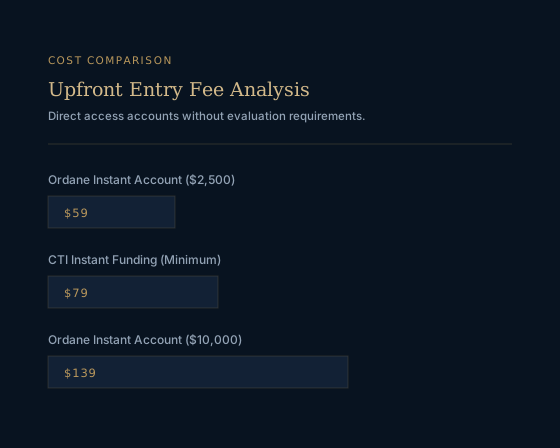
To calculate the initial capital commitment for access without an evaluation, a trader compares direct access models. The cheapest verified paid entry in the industry is $79.
| Account Type | Required Evaluation | Upfront Entry Fee |
|---|---|---|
| CTI Instant Funding | No | From $79 |
| Ordane Instant Account ($2,500) | No | $59 |
| Ordane Instant Account ($10,000) | No | $139 |
How Does the Ordane Instant Account Work?
The Ordane Instant Account eliminates evaluations entirely, offering direct access for a one-time fee with no recurring subscriptions.
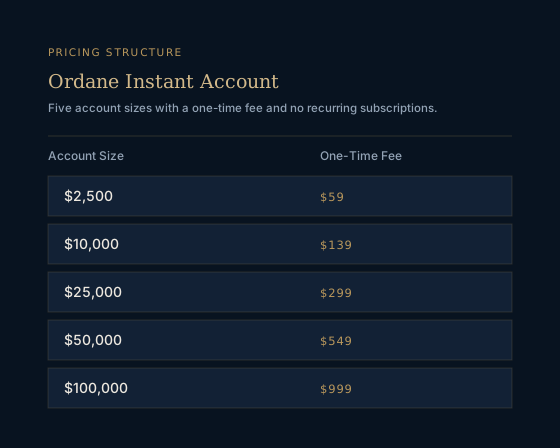
Ordane sells one product, the Ordane Instant Account: direct access, no evaluation phase and no challenge, on simulated capital.
One-Time Fee and Account Sizes
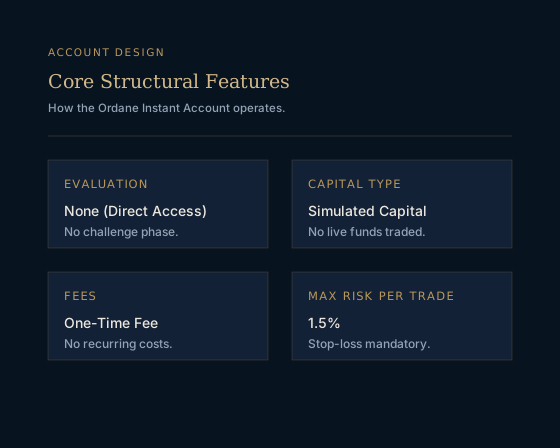
Ordane Instant Account comes in five sizes: $2,500, $10,000, $25,000, $50,000, and $100,000 (Ordane Rulebook v1.0, section 1, retrieved 2026-09-30). The fee is one-time: $59 for the $2,500 account, $139 for the $10,000 account, $299 for the $25,000 account, $549 for the $50,000 account, and $999 for the $100,000 account. There are no recurring fees, no hidden tiers and no charge to withdraw (Ordane Rulebook v1.0, section 1 price table, retrieved 2026-09-30).
Maximum risk per trade is 1.5 percent of current balance and a stop-loss is mandatory at entry. Two maximum losses equal the daily limit, which is the design rather than an accident (Ordane Rulebook v1.0, clause R-3, retrieved 2026-08-06).
Industry Entry Costs and Regulation
This multidimensional matrix compares entry conditions across the industry based on verified facts.
| Metric/Feature | Ordane (Simulated) | Industry Standard |
|---|---|---|
| Free Practice Trial | Not Offered | CTI offers a free trial account with no card required on MT5 or Match-Trader (City Traders Imperium, retrieved 2026-09-30) |
| Minimum Paid Entry | $59 one-time fee | The cheapest verified paid entry is CTI Instant Funding at $79 ([Instant Funding |
| Regulatory Posture | Accounts operate on simulated capital | The CFTC customer advisory warns that the leveraged foreign-currency market is volatile and carries substantial risks (CFTC)), retrieved 2026-09-30) |
Frequently Asked Questions
These frequently asked questions clarify the difference between free trials, free challenges, and paid direct access accounts.
What is a free prop firm challenge?
A free prop firm challenge is typically a simulated practice account that does not lead to a payout. Legitimate firms do not offer challenges that are entirely free and capable of generating withdrawals.
Can I get a prop firm challenge free of charge?
You can get a free trial to practice. CTI (prop firm) offers a free trial account with no card required on MT5 or Match-Trader (City Traders Imperium, retrieved 2026-09-30). The cheapest verified paid entry is CTI Instant Funding at $79, and a real 'free challenge' does not exist among major firms (Instant Funding | CTI, retrieved 2026-09-30).
Does any firm offer a free challenge prop firm experience with payouts?
No. Firms must generate fee revenue to fund payouts and infrastructure. Providing a free challenge that leads to real withdrawals is structurally impossible for a sustainable business model. The CFTC advises traders to beware 'free' offers in leveraged trading, as the risk remains (CFTC Customer Advisory, retrieved 2026-09-30).
Are there free prop firm challenges that waive the activation fee?
Some firms waive the activation fee but require a monthly subscription instead. You still pay for access, but the cost is spread out over time rather than charged upfront.
Why should I avoid a prop firm free challenge?
You should not necessarily avoid a free trial if your goal is to test the platform. However, you should avoid the expectation that a free entry will lead to a payout. Understanding the cost structure upfront prevents wasted time on evaluations that offer no financial return.
Sources
- City Traders Imperium citytradersimperium.com Retrieved 2026-09-30.
- Instant Funding | CTI citytradersimperium.com Retrieved 2026-09-30.
- CFTC Customer Advisory cftc.gov Retrieved 2026-09-30.
- Ordane Rulebook v1.0 ordanemarkets.com Retrieved 2026-09-30.
- Finance Magnates financemagnates.com Retrieved 2026-09-30.