Home · The Ordane Journal · Pricing and cost · Cheap Prop Firms: Fees and Hidden Rules
Cheap Prop Firms: Fees and Hidden Rules
A cheap prop firm provides access to a simulated trading environment for a low upfront evaluation fee, removing the traditional capital barrier for retail traders. By charging a smaller initial price for an evaluation challenge, these firms allow undercapitalized individuals to test their strategies without risking large amounts of personal funds.
Ordane accounts operate on simulated capital. No live funds are traded and no deposits are accepted. Ordane sells one product, the Ordane Instant Account: direct access, no evaluation phase and no challenge, on simulated capital. When evaluating different providers in the market, the upfront price tag is only one part of the equation. Understanding the underlying mechanics of the rules, the frequency of rule changes, and the regulatory standing of the provider is necessary to determine the true cost of an account.
What Makes a Prop Firm Cheap?
A cheap prop firm offers a low upfront fee for an evaluation challenge, removing the capital barrier required by traditional brokers. The cost typically ranges from $30 to $200, allowing undercapitalized traders to access simulated trading environments without depositing the large sums mandated by pattern day trading regulations.
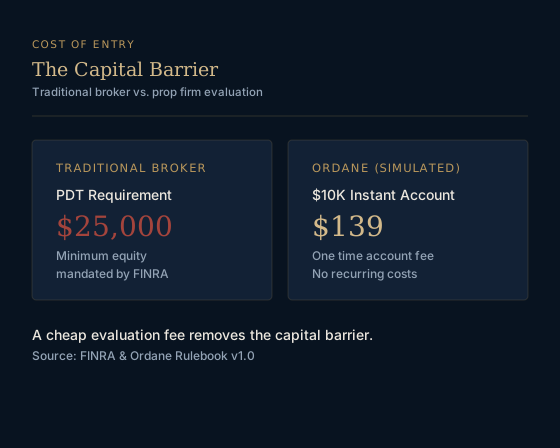
The retail trading industry operates under strict capital requirements in many jurisdictions. FINRA requires pattern day traders to maintain a minimum equity of $25,000, which drives many undercapitalized retail traders toward proprietary trading firms that offer funded accounts for a lower upfront evaluation fee (FINRA, retrieved 2026-09-13). This capital barrier prevents many individuals from executing high-frequency or day trading strategies in standard brokerage accounts. Consequently, the proprietary trading model emerged to fill this gap, offering access to simulated capital environments where traders pay an upfront fee rather than depositing the entire margin requirement.
When traders assess the market, the initial fee is the most visible metric. Firms price their evaluation phases based on the simulated account size, the number of phases required to pass, and the stringency of the risk parameters. A lower fee often corresponds to a smaller simulated account balance or a more restrictive set of trading rules.
- The upfront cost is the price of the evaluation challenge.
- The failure rate defines the true acquisition cost.
- Complex rules increase the probability of a failed evaluation.
The architecture of a cheap evaluation phase relies on volume. Providers structure their pricing to attract a large number of applicants, knowing that the statistical probability of passing complex multi-phase challenges remains low. Traders benefit from the low barrier to entry, but they must possess a thorough understanding of the risk management constraints embedded in the contract. Ignoring the fine print transforms a cheap entry fee into a series of repeated purchases.
What Are the Hidden Rules That Inflate the Cost of Cheap Prop Firms?
The upfront price is a static number, but the rules governing the trading environment dictate the true probability of success. Reading the rulebook is essential to avoid surprises.
Consistency rules and hidden limits
Many proprietary trading firms enforce hidden consistency rules that can cause traders to fail evaluations even if they reach the profit target, representing an implicit cost beyond the upfront fee (Finance Magnates, retrieved 2026-09-13). A consistency rule generally mandates that no single trading day can account for a disproportionate percentage of the total profit generated during the evaluation cycle. This mechanism is designed to filter out traders who pass the challenge through a single lucky trade.
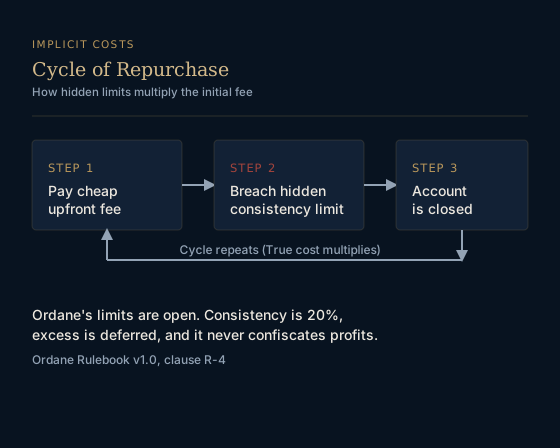
However, the implementation of consistency rules varies significantly across the industry. Some providers bury these clauses deep within their terms of service, applying them only at the moment a trader requests a withdrawal. When a consistency rule is triggered retrospectively, the trader loses the account and the initial fee. Ordane's consistency rule is 20 percent: at the moment of a withdrawal request, no single trading day may account for more than 20 percent of the cycle's total profit. If a day exceeds 20 percent, the excess profit from that day is deferred to the next cycle. It is never confiscated, and the remainder of the cycle pays out normally.
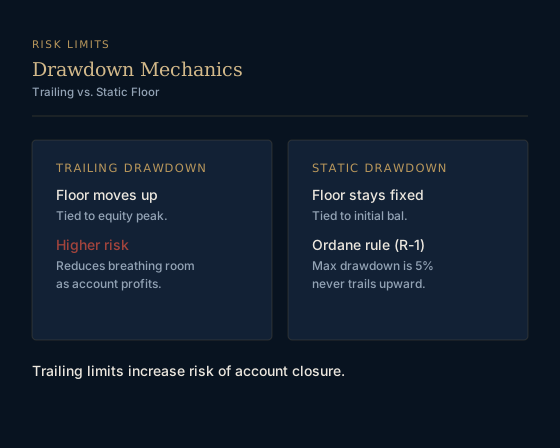
Furthermore, hidden limits often extend to drawdown calculations. A trailing drawdown that follows the highest recorded equity peak is mathematically more restrictive than a static drawdown based on the initial balance. Firms offering cheap evaluations frequently employ trailing drawdowns to increase the difficulty of the challenge. Ordane's maximum drawdown is 5 percent and static: account equity may never fall below 95 percent of the initial balance. The floor is fixed on day one, never trails upward, and a breach closes the account.
<a id="quote"></a>
Traders must also evaluate the treatment of specific trading styles, such as news trading. Ordane's rulebook does restrict one thing around news: clause R-6(d) prohibits straddling news releases with paired opposing orders. Because R-6 is a closed list, no other clause restricts trading during news or high-impact events. Overnight and weekend holding is allowed at Ordane. It is not on the R-6 closed list, and what is not listed is not a violation.
Implicit costs of repeated evaluation failures
The business model of cheap evaluations depends heavily on trader attrition. The initial fee is low, but the rules are calibrated to ensure a high failure rate. When a trader breaches a hidden rule, the account is terminated. A breach closes the account. That is the whole consequence: no partial confiscations, no surprise fees, no renegotiation. The trader then purchases another evaluation, believing they are only paying a small fee.
This cycle of failure and repurchase is the implicit cost of the cheap prop firm model. Traders focus exclusively on the single purchase price, ignoring the expected value of the transaction based on their historical pass rate. A low evaluation fee that requires five attempts to pass multiplies the original expense, not including the time spent trading the failed accounts. This expenditure is a direct result of aggressive marketing that highlights the low entry cost while obscuring the difficulty of the risk parameters.
Inactivity clauses also represent a risk to the trader's capital. Accounts with no trading activity for 30 consecutive days are closed. The 30 consecutive days in clause R-5 are calendar days (dias corridos), not business days. Under clause R-5, trading activity means at least one filled order. Pending orders and platform logins do not count.
To evaluate the true cost, traders must build a numerical model of their expected performance. The Ordane rulebook is public, numbered and versioned, and no rule is ever applied retroactively to an open account. Changes produce a new version with a dated changelog entry, and the version you sign up under is the version that governs your account.
What Is the Regulatory Risk of Unvetted Funding Platforms?
The proprietary trading industry operates in a complex regulatory environment. Unlike traditional brokerage firms, many prop firms do not hold client funds for live trading, operating exclusively in simulated environments. The structure of the business model and the marketing practices employed attract intense scrutiny from financial regulators.
In September 2023, the CFTC charged the proprietary trading firm My Forex Funds (prop firm) with operating a fraudulent scheme, highlighting the regulatory risks and potential loss of evaluation fees associated with unvetted firms (CFTC, retrieved 2026-09-13). When a regulatory agency freezes the assets of a provider or orders it to cease operations, traders lose access to their simulated accounts, their pending payouts, and any fees they have paid. The low upfront cost provides no protection against structural failure at the corporate level.
The primary risk arises from firms that misrepresent their operations, implying that traders are managing live funds in real markets when they are actually operating in a purely simulated environment. Transparency regarding the nature of the capital is a critical indicator of longevity. Ordane trades under the legal name Ordane Markets Ltd (in formation). Payouts are paid in real money from company fee revenue. No client deposits are taken and no client capital is traded. Rulebook v1.0 clause PR-1 commits Ordane to publish the payout reserve on-chain; the live rulebook and homepage publish the TRON address.
Traders must investigate the legal entity behind the platform, its jurisdiction of incorporation, and the clarity of its terms of service. A cheap fee is irrelevant if the firm ceases to exist before processing a payout.
- Regulatory intervention can freeze operations without notice.
- Misrepresentation of simulated capital attracts regulatory scrutiny.
- Transparent proof of reserves establishes credibility.
Ordane's payout reserve is published at a public TRON address on ordanemarkets.com and in Rulebook v1.0 clause PR-1. The page carries a dated observed balance and states that the reserve is not a promise, it is an address. Rulebook v1.0 commits Ordane to a dated payout ledger from payout number one, and to payout performance metrics published with dates on a fixed monthly schedule. As of 2026-07-25 the ledger is empty, because no payout has happened yet. Ordane is new. Its live homepage says it will not fake a history; the rulebook says payout performance metrics begin with the first month in which a payout is requested.
How Do Cheap Prop Firm Fees Compare Against the Baseline?
To evaluate whether a fee is genuinely cheap, the market requires a standard baseline. For years, the industry standard has been defined by established firms with long operating histories.
The FTMO baseline benchmark
FTMO (prop firm) charges a refundable fee of €155 for its $10,000 funding challenge, which serves as a baseline benchmark for evaluation costs in the proprietary trading industry (FTMO, retrieved 2026-09-13). This price point reflects a balance between accessibility for retail traders and the operational costs of providing the infrastructure, support, and eventual payouts.
When analyzing prices, the €155 figure for a $10,000 simulated account establishes the standard ratio. Firms charging significantly less for the same simulated balance must offset that revenue reduction elsewhere in their business model. They achieve this through stricter rules, trailing drawdowns, or lower payout ratios. Comparing a cheap fee against the baseline requires a line-by-line analysis of the respective rulebooks, not just a comparison of the checkout cart totals.
The baseline also establishes expectations for customer service, platform stability, and payout reliability. Firms operating at the baseline price point generally possess the margins necessary to maintain robust technology stacks and dedicated support teams. Ordane Instant Account comes in five sizes: $2,500, $10,000, $25,000, $50,000, and $100,000. The fee is one-time: $59 for the $2,500 account, $139 for the $10,000 account, $299 for the $25,000 account, $549 for the $50,000 account, $999 for the $100,000 account. There are no recurring fees, no hidden tiers and no coupon games.
Low-cost funding alternatives
Below the baseline, a segment of the market competes aggressively on price, targeting traders with very limited capital. Funding Pips (prop firm) offers a $5,000 evaluation account for an upfront fee of $32, positioning itself among the lowest-cost entry points in the retail proprietary trading market (Funding Pips, retrieved 2026-09-13). This tier of pricing appeals to beginners and traders looking to forward-test strategies in a structured environment.
Declared inputs for this check: 155 (FTMO baseline fee), 32 (Funding Pips fee), and 123 (difference). Worked arithmetic: 155 - 32 = 123.
<a id="table"></a>
| Metric / Feature | Ordane (Simulated) | Industry Standard |
|---|---|---|
| Upfront Cost | $139 for $10,000 Instant Account | €155 for $10,000 Challenge (FTMO, retrieved 2026-09-13) |
| Evaluation Phases | Zero | Two Phases |
| Drawdown Type | 5% Static | 10% Trailing or Static |
| Capital Required | None beyond fee | $25,000 for PDT (FINRA, retrieved 2026-09-13) |
| Payout Guarantee | The Ordane Guarantee | None |
When evaluating these low-cost alternatives, traders must scrutinize the payout terms and the transaction costs. Ordane charges no commission, no spread and no swap. The account fee is the only cost the trader pays. The reason is structural, not promotional: accounts run on simulated capital, so no order is routed to an exchange and nothing is financed overnight, which means neither line has an underlying bill behind it. Ordane lists four asset classes: FX pairs (majors and minors), metals, indices and crypto. No exotics.
Furthermore, the withdrawal schedule is a critical factor. Ordane's profit split starts at 60 percent and rises 5 percentage points with every completed withdrawal, reaching 100 percent from the ninth withdrawal onward. Withdrawals #1 and #2 are each capped at 3 percent of initial balance. From withdrawal #3 onward there is no cap. The first withdrawal is available 7 calendar days after account activation, and the cycle thereafter is every 14 days. Withdrawals reduce the account balance, and the R-1 drawdown floor stays anchored to the initial balance.
Every withdrawal request is approved, or denied in writing citing the exact rule breached by section number, within 24 clock hours. Past that deadline the request is treated as approved and the G-1 clock starts. A payout approved and not paid within 48 clock hours, not business hours, triggers automatic compensation: a 100 percent refund of the account fee, plus the payout owed in full. Both G-2 exclusions (documented fraud or KYC review, and declared force majeure) are capped at 10 business days each. Past that deadline, G-1 applies regardless. The Ordane Guarantee ensures that the firm is held accountable to its published timeline.
Frequently Asked Questions
What is a cheap prop firm?
A cheap prop firm is a company offering access to a simulated trading environment for a low upfront fee, typically below the industry baseline of €155 for a $10,000 account. These firms allow retail traders to bypass the capital requirements mandated by regulatory bodies like FINRA (FINRA, retrieved 2026-09-13). They operate by charging for evaluation challenges, where the trader must prove their profitability under strict risk management rules.
What is the cheapest prop firm challenge?
The cheapest challenges in the market often start around $30 to $40 for small simulated account balances, such as $5,000. For example, Funding Pips offers a $5,000 evaluation for $32 (Funding Pips, retrieved 2026-09-13). However, the cheapest challenge is not necessarily the most cost-effective. Traders must evaluate the difficulty of the rules, the maximum drawdown limits, and the presence of hidden consistency parameters to determine the actual probability of passing the challenge.
How to find the best cheap prop firms?
Finding the best option requires analyzing the public rulebook, the payout history, and the clarity of the terms of service. Traders should look for firms with versioned rulebooks, transparent consistency rules, and a verifiable history of processing withdrawals. A firm with a slightly higher fee but a static drawdown and no hidden rules often represents a better value than the absolute cheapest option that employs trailing drawdowns.
Are low cost prop firms legitimate?
Many low-cost firms are legitimate businesses that use volume to sustain their operations. However, the sector also contains unvetted platforms that pose significant regulatory risks. The CFTC action against My Forex Funds in September 2023 demonstrates that firms misrepresenting their operations or acting fraudulently face severe regulatory consequences (CFTC, retrieved 2026-09-13). Traders must verify the firm's transparency regarding simulated capital before paying any evaluation fee.
Do cheap prop firms charge hidden fees?
Most firms do not charge hidden monetary fees on top of the upfront evaluation cost. However, they enforce hidden rules, such as consistency limits, that act as implicit costs (Finance Magnates, retrieved 2026-09-13). If a trader breaches an undisclosed rule and loses the account, the necessity to purchase a new evaluation constitutes a hidden cost. Reading the rulebook carefully to understand the drawdown mechanics and prohibited practices is the only way to avoid these structural traps.
| Regulatory and Cost Milestones | Data Point |
|---|---|
| FINRA Equity Requirement | $25,000 (FINRA, retrieved 2026-09-13) |
| FTMO Baseline Evaluation | €155 (FTMO, retrieved 2026-09-13) |
| Funding Pips Entry Fee | $32 (Funding Pips, retrieved 2026-09-13) |
| CFTC Fraud Charges (MFF) | September 2023 (CFTC, retrieved 2026-09-13) |
| Industry Consistency Rules | Enforced to filter traders (Finance Magnates, retrieved 2026-09-13) |
To further illustrate the mechanics of trading within these environments, consider the impact of the daily loss limit. The daily loss limit is 3 percent, measured against the balance at the start of the server day. A breach closes the account. This rule requires precise position sizing. Maximum risk per trade is 1.5 percent of current balance and a stop-loss is mandatory at entry. Two maximum losses equal the daily limit, which is the design rather than an accident. These parameters force discipline upon the trader, ensuring that the simulated capital is managed with strict risk controls.
Furthermore, the structure of the prohibited practices list is vital for trader security. Ordane's prohibited-practice list is closed. Clause R-6 names six practices: latency, reverse or hedge arbitrage; high-frequency or bulk automated exploitation; copy trading between Ordane accounts; straddling news releases with paired opposing orders; platform or data-feed exploitation; and gap abuse. If a behavior is not listed in that section, it is not a violation. Discretion is not a rule. This closed list protects the trader from arbitrary account closures, a common issue in firms offering extremely cheap evaluations with vague terms of service.
When analyzing automation and algorithmic trading, the rules must be explicit. Expert Advisors are fully permitted at Ordane: a trader may run an EA executing the trader's own strategy on an Ordane account. The R-6 prohibition on copy trading between Ordane accounts applies only between different people. Copy trading is permitted exclusively between Ordane accounts that belong to the same person, meaning the same account holder and ultimate beneficial owner. Copy trading between person A and person B is always prohibited.
Ordane runs on a trading platform it designed and built with its own engineering team, and licenses no third-party terminal: not MatchTrader, not MetaTrader, not any external vendor. The distinction is structural, not cosmetic. A firm that licenses its terminal can be closed by a decision it does not control.
If you are evaluating environments based on clear rules rather than just entry price, read the public Ordane Rulebook before making a decision.
Sources
- Day Trading Margin Requirements finra.org Retrieved 2026-09-13.
- Understanding Consistency Rules in Prop Trading financemagnates.com Retrieved 2026-09-13.
- FTMO Evaluation Process and Fees ftmo.com Retrieved 2026-09-13.
- Funding Pips Account Pricing fundingpips.com Retrieved 2026-09-13.