Home · The Ordane Journal · Pricing and cost · Does a Prop Firm Subscription Stop After You Pass?
Does a Prop Firm Subscription Stop After You Pass?
A prop firm subscription is a recurring charge for continued access to an evaluation account, and its cancellation trigger is a separate billing rule that may or may not fire when the trader passes. Whether billing stops depends on which event the firm records, when that status is recorded against the rebill date, and which other charges remain attached.
Ordane accounts operate on simulated capital. No live funds are traded and no deposits are accepted. (Ordane Rulebook v1.0, clause P-2, retrieved 2026-08-28)
Passing a trading objective and stopping a subscription can be separate events. Topstep automatically cancels the subscription tied to a passed Trading Combine, but only when its dashboard shows the pass before the rebill date. Other active combines continue rebilling until manually canceled. (Topstep, retrieved 2026-08-28)
The practical question is not only, “Did I pass?” It is, “Which account changed status, when was that status recorded, and which separate account charges remain active?”
What Stops Billing After a Prop Firm Pass?
Passing stops billing only when the firm’s recorded account status reaches the cancellation trigger before the next rebill date; the trading result alone does not stop a subscription.
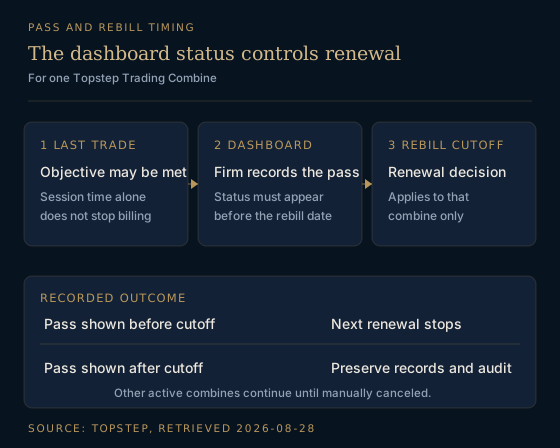
The dashboard status controls the Topstep trigger
Topstep states that its Trading Combine is a monthly subscription that rebills every 30 days from the original signup date. It remains active until the trader passes or cancels it. This distinction also matters when an evaluation offers unlimited time but continues monthly billing. (Topstep, retrieved 2026-08-28)
Three timestamps must be separated:
- The last trade needed to satisfy the objective.
- The dashboard’s recorded pass status.
- The subscription’s rebill cutoff.
At Topstep, the dashboard must show the pass before the rebill date for the passed Trading Combine to avoid its next renewal. (Topstep, retrieved 2026-08-28)
A completed trading session alone does not establish when the firm recorded the pass. Reaching an evaluation profit objective and recording the resulting account status are distinct events. The billing audit therefore starts with the account status and timestamp, not performance alone.
Do parallel accounts stop at the same time?
No. Topstep automatically cancels only the subscription attached to the passed Trading Combine. Other active combines continue rebilling until the trader manually cancels them. (Topstep, retrieved 2026-08-28)
A trader with three active combines should therefore audit three billing records. Passing one does not establish that the other two have ended. Before opening parallel combines, check the firm’s limits and rules for multiple accounts.
Which Charges Can Remain After Passing?
An evaluation subscription, activation charge, market-data charge and trading charge are separate billing records. Ending one does not prove that all four have ended.
Topstep states that its Express Funded Account has no monthly subscription fee after passing. A one-time activation charge can still apply unless the trader selected the No Activation Fee path. (Topstep, retrieved 2026-08-28)
Topstep lists a $149 one-time activation charge for each Express Funded Account earned through its Standard Path and a $0 activation charge for the No Activation Fee Path. (Topstep, retrieved 2026-08-28)
Topstep also lists Level 2 market data at $38 per month, billed on the 28th without proration. It states that commissions and fees are deducted from the account balance with each filled trade. (Topstep, retrieved 2026-08-28)
How do documented billing models compare?
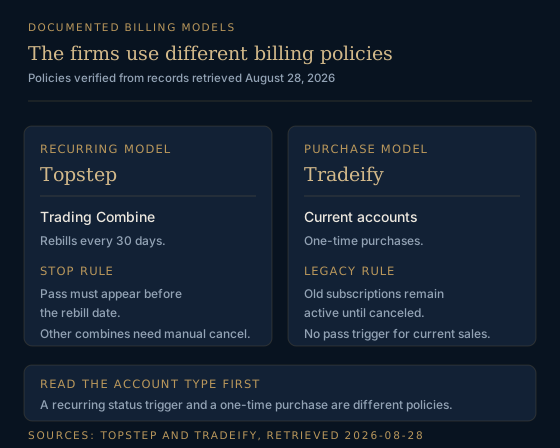
The comparison below covers only policies documented in the verified ledger retrieved on August 28, 2026. It compares billing mechanics, not account quality or total customer cost. For the structural distinction behind these charges, compare an instant account with an evaluation model.
| Firm | Billing model | Event that stops recurring billing | Required check |
|---|---|---|---|
| Topstep | Trading Combines rebill every 30 days. | The dashboard must show the pass before the rebill date for that combine. | Confirm the passed combine and manually cancel any other active combines that should not renew. |
| Tradeify | Current accounts are one-time purchases. Legacy subscriptions can remain active. | Current purchases have no recurring subscription to stop. A legacy subscription ends when canceled. | Determine whether the account is current or legacy, then cancel any unwanted legacy subscription. |
Tradeify states that its current accounts are one-time purchases without recurring subscription charges, while subscriptions created before Tradeify 3.0 remain active until canceled. (Tradeify, retrieved 2026-08-28)
“No recurring charge” and “a recurring charge that stops after passing” are therefore different policies.
What Do Consumer-Protection Rules Require of Recurring Billing?
A recurring evaluation subscription is a negative-option billing pattern, and consumer-protection law treats it as one. The U.S. Federal Trade Commission’s October 2024 “click-to-cancel” rule would have required sellers to disclose material terms before taking billing details, to obtain express informed consent before charging, and to make cancellation at least as easy as enrollment. (Federal Trade Commission, retrieved 2026-08-26)
A federal appeals court vacated that expanded rule in July 2025, before its main provisions took effect. (National Law Review, retrieved 2026-08-26) The older federal framework still applies: under the Restore Online Shoppers’ Confidence Act, an online seller using negative-option billing must disclose material terms, obtain express informed consent, and provide a simple mechanism for stopping recurring charges. (15 U.S.C. § 8403, via Cornell Law School, retrieved 2026-08-26)
The trader-side lesson survives every legal variation: a subscription ends at the documented cancellation event, not at the trading milestone. Preserve the terms, the consent record, and the cancellation confirmation.
How Can You Reproduce the Billing Check?
Declared inputs for this check: a $149 Standard Path activation fee, a $0 No Activation Fee Path activation fee, and a 30-day Trading Combine rebill cycle. Worked arithmetic: $149 + $0 = $149 total listed activation fees across these two hypothetical paths. (Topstep pricing, retrieved 2026-08-28; Topstep subscriptions, retrieved 2026-08-28)
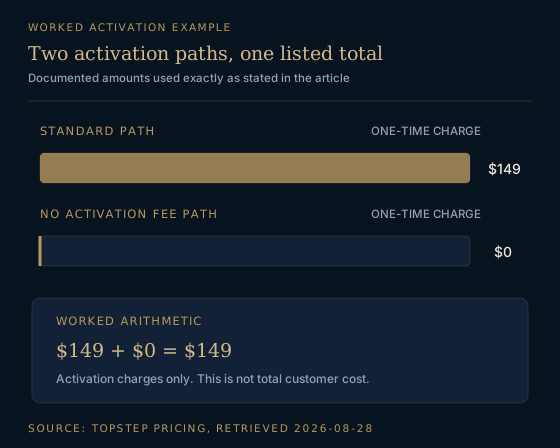
| Worked-example line | Value |
|---|---|
| Input 1: one Standard Path activation charge | $149 |
| Input 2: one No Activation Fee Path activation charge | $0 |
| Operation | $149 + $0 |
| Output | $149 |
| Separate timing input | 30-day rebill cycle |
The arithmetic classifies the two activation amounts. It does not calculate total customer cost because evaluation prices, parallel subscriptions, market data and trading charges require separate records.
A second declared-inputs check separates the trading event from the billing event: signup on day 0, a 30-day rebill cycle, and a dashboard-recorded pass on day 29 against one on day 31. Worked arithmetic: 0 + 30 = 30, so the first renewal falls on day 30. Under the documented Topstep trigger, a pass recorded on day 29 precedes the rebill and stops that renewal; a pass recorded on day 31 follows it, so one more renewal has already been charged. (Topstep, retrieved 2026-08-28)
| Timing scenario | Rebill event | Pass recorded | Next renewal |
|---|---|---|---|
| Pass recorded before the cutoff | Day 30 | Day 29 | Stopped for the passed combine |
| Pass recorded after the cutoff | Day 30 | Day 31 | Already charged for one more period |
The two outcomes differ by one recorded timestamp, not by trading performance.
How Should You Audit Billing on Pass Day?
Use an evidence timeline rather than relying on memory. A broader pre-purchase prop firm audit should confirm where billing terms, cancellation triggers and account-level records are published.
| Record | Evidence to preserve | Question answered |
|---|---|---|
| Last trading session | Timestamp and account identifier | When did the relevant trading activity finish? |
| Dashboard status | Exact status and timestamp | When did the firm record the pass? |
| Rebill record | Renewal date and payment reference | Was another subscription period scheduled? |
| Cancellation event | Confirmation number or dashboard notice | Which subscription actually ended? |
| Activation event | New-account identifier and charge description | Was the new charge recurring or one-time? |
For Topstep, the dashboard-status record is decisive because the pass must appear before the rebill date. (Topstep, retrieved 2026-08-28)
Apply this account-level decision sequence:
- Match the charge to an account identifier.
- Record whether that account is passed, active, canceled or legacy.
- Compare the recorded status timestamp with the rebill cutoff.
- Classify the charge as subscription, activation, data or trading-related.
- Preserve the cancellation confirmation for each account that should stop.
A screenshot of a profit target alone does not establish which billing account changed status, when the firm recorded the pass or whether another subscription remained active.
What evidence should a support request include?
Use six fields:
- Firm and product name.
- Account identifier.
- Displayed account status and timestamp.
- Scheduled rebill date.
- Charge date and payment reference.
- Cancellation confirmation and requested resolution.
This structure lets support compare the billing event with the recorded account state without confusing a subscription charge with an activation, data or parallel-account charge.
How Does Ordane Differ From an Evaluation Subscription?
Ordane sells one product, the Ordane Instant Account: direct access, no evaluation phase and no challenge, on simulated capital. (Ordane Rulebook v1.0, section 1, retrieved 2026-08-28)
Because Ordane has no evaluation phase, it does not publish a trigger for stopping an evaluation subscription after a pass. Its model should not be presented as equivalent to Topstep’s status-triggered subscription cancellation or Tradeify’s current one-time-purchase policy.
Questions About Billing After a Pass
Does billing stop immediately when a trader passes?
Not necessarily. At Topstep, the dashboard must show the Trading Combine as passed before the rebill date. (Topstep, retrieved 2026-08-28)
What if the dashboard records the pass after the rebill date?
The recorded trigger controls the documented Topstep policy. Preserve the trading timestamp, dashboard-status timestamp, rebill date and charge record separately. (Topstep, retrieved 2026-08-28)
Do a trader’s other accounts cancel automatically?
No. Topstep auto-cancels only the subscription tied to the passed Trading Combine. Other active combines continue rebilling until manually canceled. (Topstep, retrieved 2026-08-28)
Is an activation charge a recurring subscription?
No, when the firm expressly classifies it as one-time. Topstep lists $149 once per Express Funded Account on its Standard Path and $0 on its No Activation Fee Path. (Topstep, retrieved 2026-08-28)
Can a one-time-purchase account still have an old subscription?
Yes. Tradeify states that its current accounts are one-time purchases, but legacy subscriptions created before Tradeify 3.0 remain active until canceled. (Tradeify, retrieved 2026-08-28)
If direct access without an evaluation phase fits your comparison, review the Ordane Instant Account and inspect its published rules before deciding.
This article is for information only and is not investment, financial, or tax advice.
Ordane accounts operate on simulated capital. No live funds are traded and no deposits are accepted. Payouts depend on simulated performance under Rulebook v1.0; no level of performance is typical or assured.
Sources
- Trading Combine Subscriptions help.topstep.com Retrieved 2026-08-28.
- Express Funded Account™ Parameters help.topstep.com Retrieved 2026-08-28.
- Topstep Pricing and Payment Questions help.topstep.com Retrieved 2026-08-28.
- Common FAQs help.tradeify.co Retrieved 2026-08-28.
- Federal Trade Commission Announces Final 'Click-to-Cancel' Rule Making It Easier for Consumers to End Recurring Subscriptions and Memberships ftc.gov Retrieved 2026-08-26.
- Eighth Circuit Vacates FTC's 'Click-to-Cancel' Rule natlawreview.com Retrieved 2026-08-26.
- 15 U.S.C. § 8403 — Negative option marketing on the Internet law.cornell.edu Retrieved 2026-08-26.