Home · The Ordane Journal · Pricing and cost · FundedNext Discount Code: Rules & Limits
FundedNext Discount Code: Rules & Limits
A discount code is a promotional string applied during checkout to directly reduce the upfront evaluation fee for a simulated trading account. Ordane accounts operate on simulated capital. No live funds are traded and no deposits are accepted. (Ordane Rulebook v1.0, clause P-2, retrieved 2026-08-04)
Traders search for ways to reduce their initial costs. The evaluation fee is the first barrier to entry in the simulated trading industry, though traders should also account for prop firm hidden fees. Many firms use promotional campaigns to lower this barrier, but these campaigns come with specific rules and strict limitations.
Ordane sells one product, the Ordane Instant Account: direct access, no evaluation phase and no challenge, on simulated capital. (Ordane Rulebook v1.0, section 1, retrieved 2026-08-04) Other companies structure their products differently, often prompting traders to compare an instant account vs evaluation prop firm, requiring them to pass multi-step evaluations before accessing a simulated profit-share environment. Understanding the financial mechanics behind these offers and the difference between a prop firm margin call vs loss limit is necessary for proper risk management.
Does a Discount Code Reduce What You Pay?
A discount code directly reduces the upfront evaluation fee when applied during the checkout process. Traders enter the code before finalizing payment to lower the initial cost of access. The reduction applies only to the entry fee and does not alter trading rules or evaluation targets.
FundedNext allows traders to apply discount codes during the checkout process to reduce the upfront evaluation fee. This reduction changes the initial capital outlay required to begin the evaluation phase.
Evaluation fees serve as the primary revenue model for firms that require challenges. These fees cover infrastructure costs, technology licensing, and data feed expenses. When a trader uses a discount, the firm absorbs the difference as a customer acquisition cost.
Traders must evaluate the relationship between the discount offered and the rules enforced. A lower entry fee does not change the profit target required to pass the evaluation. It also does not change the maximum drawdown limits or the prop firm daily loss limit.
The simulated trading industry operates by allocating virtual capital to traders who prove their discipline. The evaluation phase acts as a filter. The firm charges a fee to cover the risk of processing thousands of evaluations, knowing that a significant percentage will breach the risk parameters.
The trader's objective remains identical regardless of the entry price. The profit target must be hit without violating the daily loss limit or the maximum drawdown. Proper risk management dictates treating every evaluation, regardless of the entry cost, as a strict exercise in capital preservation.
Every withdrawal request is approved, or denied in writing citing the exact rule breached by section number, within 24 clock hours. (Ordane Rulebook v1.0, clause G-0, retrieved 2026-08-04) A payout approved and not paid within 48 clock hours triggers automatic compensation.
What is the Hidden Rule on Promo Stacking?
The second fear traders face involves hidden rules. Promotions often carry restrictions that are not immediately obvious in the marketing material. The most common restriction involves stacking multiple offers.
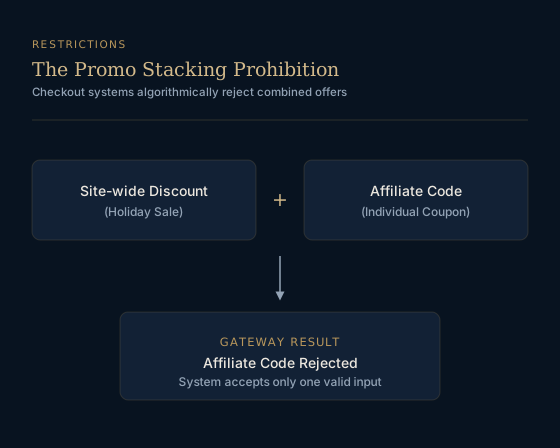
FundedNext explicitly prohibits stacking multiple discount codes or combining them with other active promotional offers. This means a trader cannot use a holiday discount code and an affiliate coupon on the same transaction to create a larger total reduction.
Firms enforce this rule to protect their unit economics. Every evaluation has a baseline cost for the provider. Allowing multiple discounts to stack could reduce the entry fee below the cost of provisioning the simulated environment, the trading platform license, and the data feed.
To manage this, checkout systems are programmed to accept only one valid input per transaction. If a trader attempts to enter a second code, the system will either reject it or replace the first code.
The enforcement of rules in simulated trading is entirely algorithmic, and understanding what happens when you breach a prop firm account is crucial for risk management. When a trader hits a daily loss limit, the trading platform's equity monitor triggers an automatic breach event. This system does not care whether the trader paid full price or used a discount code.
Ordane's prohibited-practice list is closed. Clause R-6 names six practices: latency, reverse or hedge arbitrage; high-frequency or bulk automated exploitation; copy trading between Ordane accounts; straddling news releases with paired opposing orders; platform or data-feed exploitation; and gap abuse. (Ordane Rulebook v1.0, clause R-6, retrieved 2026-08-04) If a behavior is not listed in that section, it is not a violation. Discretion is not a rule.
Will the Firm Still Exist?
The third fear is structural longevity. Will the firm still exist when it is time to process a payout? The simulated trading industry operates outside the traditional brokerage framework, which changes the risk profile for the consumer.
Without regulatory capital requirements, a firm's ability to operate depends entirely on its own financial management. A discount code strategy that is too aggressive can damage a firm's cash flow, threatening its long-term viability. Traders must look for verifiable proof of reserves rather than relying on promotional pricing as a sign of strength.
The regulatory landscape for simulated trading is fundamentally different from traditional retail forex or futures trading. Because no live funds are deposited for trading purposes, and the accounts operate in a simulated environment, these firms do not hold broker-dealer licenses.
The contract between the trader and the firm is a standard commercial agreement, not a regulated financial contract. Therefore, the clarity of the rulebook is the trader's only defense. A firm that relies heavily on marketing campaigns and deep discounts while maintaining a vague or discretionary rulebook presents a significant risk.
Ordane's payout reserve is published at a public TRON address on ordanemarkets.com and in Rulebook v1.0 clause PR-1. (Ordane Rulebook v1.0, clause PR-1, retrieved 2026-08-04) The page carries a dated observed balance and states that the reserve is not a promise, it is an address.
How to Apply a Promo Code?
Applying a discount requires navigating the specific checkout architecture of the provider. The process is mechanical and must be completed before the transaction settles.
The technical validation of a promotional code involves a database query. When the trader inputs the string, the checkout system checks the active campaigns table. It verifies the expiration date, the stacking rules, and the eligible products.
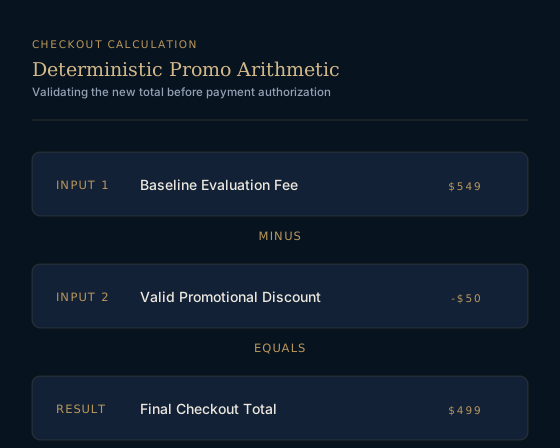
If the validation passes, the system calculates the new total. This calculation is deterministic. We can demonstrate the arithmetic of promotional limits using a standardized check.
Declared inputs for this check: 549, 50, and 499. Worked arithmetic: 549 - 50 = 499.
The total cost calculation requires exact inputs. If a code is invalid, the system reverts to the baseline price. Traders must confirm the final digit on the screen before authorizing the payment processor.
| Checkout Scenario | Promo Type A | Promo Type B | Gateway Result |
|---|---|---|---|
| Standard Checkout | Affiliate Code | None | Code Accepted |
| Holiday Sale | Site-wide Discount | Affiliate Code | Affiliate Code Rejected |
| Expired Campaign | November Code | December Code | November Code Rejected |
| Tier Exclusion | Small Account Code | Large Account Selected | Code Rejected |
The fee is one-time: $59 for the $2,500 account, $139 for the $10,000 account, $299 for $25,000, $549 for $50,000 and $999 for $100,000. (Ordane Rulebook v1.0, section 1, retrieved 2026-08-04) There are no recurring fees, no hidden tiers and no coupon games.
Ordane's profit split starts at 60 percent and rises 5 percentage points with every completed withdrawal, reaching 100 percent from the ninth withdrawal onward. (Ordane Rulebook v1.0, clause PA-2, retrieved 2026-08-04)
Frequently Asked Questions About Discount Codes
How do I find a valid FundedNext discount code?
Valid codes are typically distributed through official marketing channels. These include the company's direct email newsletter, official social media accounts, and authorized affiliate partners. Firms use them to drive immediate conversion. Codes found on third-party aggregation sites are often expired or invalid.
Can I use a FundedNext promo code twice?
Checkout systems log the application of promotional codes to prevent abuse. A code designed for a single use cannot be applied to subsequent purchases by the same user. The system tracks usage through several identifiers like the email address associated with the account.
What happens if a Funded next coupon is invalid?
When an invalid string is entered into the checkout field, the system will return an error state. The page will not proceed to the payment gateway until the error is resolved. The payment processor will only authorize the amount explicitly approved by the checkout logic.
Does a FundedNext discount apply to all account sizes?
Promotional strategies often segment products based on margins. A discount might apply to a small evaluation size but exclude the largest tier, or vice versa. Traders must read the fine print of the campaign to verify product eligibility.
Can I stack offers during a holiday promotion?
Holiday sales are usually configured as site-wide reductions. During these periods, the rule against combining offers remains active. A trader cannot take a site-wide holiday price and apply a separate affiliate code on top of it.
To see the complete list of rules that govern our simulated accounts, read the Ordane Rulebook.
This article is for information only and is not investment, financial, or tax advice.
Ordane accounts operate on simulated capital. No live funds are traded and no deposits are accepted. Payouts depend on simulated performance under Rulebook v1.0; no level of performance is typical or assured.
Sources
- FundedNext FAQ - Billing and Payments fundednext.com Retrieved 2026-09-06T14:53:30Z.
- FundedNext Terms and Conditions fundednext.com Retrieved 2026-09-06T14:53:30Z.