Home · The Ordane Journal · Before you pay · How Many Prop Firm Accounts Can You Have?
How Many Prop Firm Accounts Can You Have?
Ordane accounts operate on simulated capital. No live funds are traded and no deposits are accepted.
Most firms let you hold more than one account, and several publish no cap on the number at all. What they do restrict is copying the same trades across your own accounts to multiply a payout. That is a named violation at many firms, so the number you can have matters far less than how you trade them.
A prop firm account is a simulated trading account a firm sells to a trader, sized against rules like maximum drawdown and daily loss, with a profit split paid from the firm's own revenue rather than from client deposits.
That distinction, holding versus copying, is the whole article. Holding accounts is a purchase decision. Running correlated trades across them is a rules decision, and the rules are where accounts get suspended. Before you buy a second one, run the same pre-purchase check you would use to audit a prop firm against the multi-account clauses, not only the drawdown page.
FTMO states there is no limit to the number of accounts a trader may have (FTMO.com, retrieved 2026-07-31). That is one firm's answer to the count question, and it is worth reading in full because it does not stop at the number.
How Many Accounts Can a Trader Actually Hold?
Holding accounts vs copying trades across them
Two things get blurred whenever this question comes up.
The first is inventory: how many accounts your name is attached to. FTMO states there is no limit to the number of accounts a trader may have (FTMO.com, retrieved 2026-07-31). On the face of it, that sounds like a green light to buy as many as you can afford.
The second is behaviour: what those accounts do relative to each other. This is where the constraint actually lives. FTMO caps the total capital allocation across all of a trader's accounts at $400,000 per trader or strategy, prior to any scaling, rather than capping the number of accounts (FTMO.com, retrieved 2026-07-31). And that limit applies simultaneously across both its 1-Step and 2-Step Challenge products, not per product (FTMO.com, retrieved 2026-07-31).
So the honest reading of "no limit" is: no limit on the count, a hard limit on the exposure. If you are asking this question because you want more simulated capital working, that second number is the one that governs you. Whether you are buying another instant account versus sitting through another evaluation does not change that exposure math; it only changes what you paid to open the next seat.
How Many Accounts Do Firms Actually Allow?
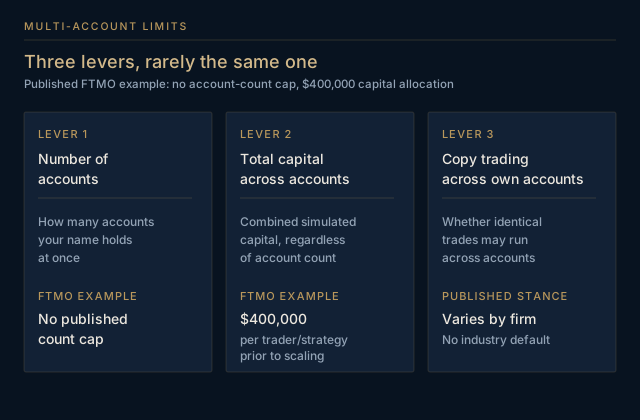
Firms restrict multi-account trading through three different levers, and they rarely use the same one. Reading a firm's answer to "how many accounts" without checking the other two levers is how traders get surprised at withdrawal.
| Limit type | What it constrains |
|---|---|
| Number of accounts | How many accounts your name holds at once |
| Total capital across accounts | Combined simulated capital, regardless of account count |
| Copy trading between your own accounts | Whether identical trades may run across accounts you control |
| Limit type | Published example |
|---|---|
| Number of accounts | FTMO states there is no limit to the number of accounts a trader may have (FTMO.com, retrieved 2026-07-31) |
| Total capital across accounts | FTMO caps total capital allocation at $400,000 per trader or strategy, prior to any scaling (FTMO.com, retrieved 2026-07-31), applied simultaneously across its 1-Step and 2-Step products (FTMO.com, retrieved 2026-07-31) |
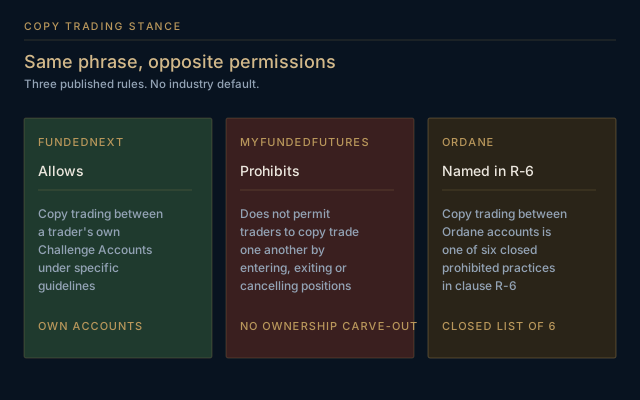
| Copy trading between your own accounts | FundedNext allows copy trading between a trader's own Challenge Accounts under specific guidelines (FundedNext Help Center, retrieved 2026-07-31); MyFundedFutures does not permit traders to copy trade one another by entering, exiting or cancelling trade positions (My Funded Futures Help Center, retrieved 2026-07-31) |
Note the third row. Two firms, both publishing a rule, and they land in opposite places. FundedNext permits copying between accounts the same person owns, while strictly prohibiting it between accounts not owned by the same individual, including those of relatives, family members, or friends (FundedNext Help Center, retrieved 2026-07-31). MyFundedFutures writes the restriction without that ownership carve-out (My Funded Futures Help Center, retrieved 2026-07-31).
There is no industry default here. Assuming a rule carries across firms is the mistake, and it is the one that costs an account. The same pattern shows up when traders ask whether prop firms are legitimate: the answer is firm-specific, documented, and worthless if you only read the marketing page.
Where a firm publishes none of these three, the correct conclusion is not "no limit." It is "unpublished," which is a different and worse answer, because an unpublished limit can be asserted at the moment you request a withdrawal.
Next step. Edge cases usually show up at payout. Read what a payout clawback looks like, then confirm the written model in Instant Account vs evaluation.
What Rule Actually Catches Multi-Account Traders?
Copying identical trades across accounts you control is the practice most firms name, and the reason is mechanical rather than moral.
One decision replicated across four accounts is not four decisions. It is one bet sized four times, and it converts a single call into several correlated payouts. From the firm's side, the distribution of outcomes it priced when it sold four accounts is not the distribution it actually holds. So the rulebooks reach for it directly.
FTMO's Forbidden Trading Practices prohibit performing, alone or in concert with others including between connected accounts or accounts held with other providers, simulated trades or combinations of trades for manipulative purposes (FTMO.com, retrieved 2026-07-31). The enforcement is stated too: FTMO reserves the right to suspend accounts if identically traded strategies are detected across multiple FTMO accounts and the total fictitious capital exceeds the maximum capital allocation limit (FTMO.com, retrieved 2026-07-31). That is the same class of outcome as what happens when you breach a prop firm account: the seat closes, and unpaid simulated profit does not travel with you.
Read that clause carefully, because it does two things at once. It names the trigger, identically traded strategies across multiple accounts, and it attaches a threshold, the capital allocation limit (FTMO.com, retrieved 2026-07-31). A trader who knows both can position deliberately. A trader who only read "no limit to the number of accounts" cannot.
That is the argument for a closed, named list rather than a discretionary one. A named practice tells you what to avoid. An unnamed judgment tells you nothing until it is applied to you, and it is applied at withdrawal, which is the worst possible moment to learn a rule. That is also why the question can a prop firm enforce an unwritten rule matters here: if the catch is unwritten, you cannot audit it before you pay.
Legitimate diversification looks different from a listed breach. Different instruments, different session windows, different holding periods and independently sized risk are separate decisions. Four accounts firing the same entry on the same pair at the same second are one decision, and it is the one the clause describes.
What Does Ordane Say About Multiple Accounts?
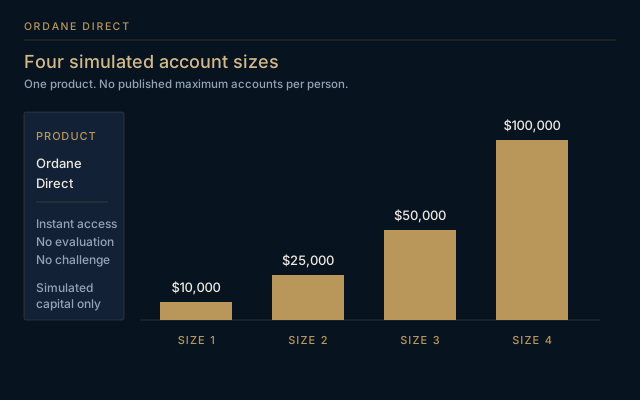
Ordane sells one product, the Ordane Instant Account: direct access, no evaluation phase and no challenge, on simulated capital. Ordane Instant Account comes in four sizes: $10,000, $25,000, $50,000 and $100,000 (Ordane Rulebook v1.0, section 1, retrieved 2026-07-31).
Ordane's prohibited-practice list is closed. Clause R-6 names six practices: latency, reverse or hedge arbitrage; high-frequency or bulk automated exploitation; copy trading between Ordane accounts; straddling news releases with paired opposing orders; platform or data-feed exploitation; and gap abuse. If a behavior is not listed in that section, it is not a violation. Discretion is not a rule (Ordane Rulebook v1.0, clause R-6, retrieved 2026-07-31).
So the answer for a trader holding more than one Ordane Instant Account is written rather than discretionary: copy trading between Ordane accounts is named in R-6. Running the same trades across your accounts to multiply a payout breaches a clause with a number, not a mood.
Two honest limits, stated because they are the sort of thing a scaling trader needs to know before paying, not after.
First, Ordane does not publish a confirmed maximum number of accounts per person. This article does not assert one, in either direction. If you need that number, it is not on the page yet.
Second, Rulebook v1.0 states that each prohibited practice is defined with examples in Appendix A. Appendix A of Rulebook v1.0 is published (changelog dated 2026-08-01) and defines each R-6 practice with examples on the live rulebook (Ordane Rulebook v1.0, clause R-6). This article will not invent edge cases beyond that appendix.
What the closed list does give you is the inverse guarantee. Because R-6 is closed, a behaviour not on it is not a violation. Overnight and weekend holding is allowed at Ordane. It is not on the R-6 closed list, and what is not listed is not a violation (Ordane Rulebook v1.0, clause R-6, retrieved 2026-07-31). That matches the broader question of whether prop firms let you hold overnight and over the weekend: at Ordane the answer is written by absence from a closed list, not by a support script.
| What you want to know | Where it stands at Ordane |
|---|---|
| Product range you would buy more of | One product, Ordane Instant Account, in four sizes: $10,000, $25,000, $50,000 and $100,000 |
| Maximum accounts per person | Not published as a confirmed number; this article does not assert one |
| Copy trading between your own accounts | Named as a prohibited practice in clause R-6 |
| Definition and examples of that practice | Referred to Appendix A (published 2026-08-01; see live rulebook) |
| Anything not on the R-6 list | Not a violation, because R-6 is a closed list |
The governing document is Ordane Rulebook v1.0, published 2026-07-23 (Ordane Rulebook v1.0, section 6 Changelog, retrieved 2026-07-31). The Ordane rulebook is public, numbered and versioned, and no rule is ever applied retroactively to an open account. Changes produce a new version with a dated changelog entry, and the version you sign up under is the version that governs your account (Ordane Rulebook v1.0, notice above section 0, and section 6 Changelog, retrieved 2026-07-31). So the multi-account rule you read today is the one that governs the accounts you buy today.
Ordane is new and has no payout history. There is nothing to show yet, and no payout history will be manufactured (ordanemarkets.com, payout ledger section, retrieved 2026-07-31).
Questions Traders Ask About Multiple Prop Firm Accounts
How many prop firm accounts can you have?
It depends on the firm, and the count is often not the binding limit. FTMO states there is no limit to the number of accounts a trader may have (FTMO.com, retrieved 2026-07-31), while capping total capital allocation across all accounts at $400,000 per trader or strategy, prior to any scaling (FTMO.com, retrieved 2026-07-31). Check the capital limit, not just the account limit.
Can you have two accounts at the same prop firm?
At firms that publish no cap on account count, yes. FTMO states there is no limit to the number of accounts a trader may have (FTMO.com, retrieved 2026-07-31). Where a firm publishes no number at all, treat that as unpublished rather than unlimited, because an unpublished limit can be asserted later, at withdrawal.
Is copy trading between your own prop accounts allowed?
It varies, and you must read the specific firm. FundedNext allows copy trading between a trader's own Challenge Accounts under specific guidelines (FundedNext Help Center, retrieved 2026-07-31). MyFundedFutures does not permit traders to copy trade one another by entering, exiting or cancelling trade positions (My Funded Futures Help Center, retrieved 2026-07-31). Ordane names copy trading between Ordane accounts in clause R-6 (Ordane Rulebook v1.0, clause R-6, retrieved 2026-07-31).
Does having multiple prop firm accounts break the rules?
Holding them usually does not. Trading them identically is what gets named. FTMO's Forbidden Trading Practices prohibit simulated trades or combinations of trades for manipulative purposes, including between connected accounts (FTMO.com, retrieved 2026-07-31), and FTMO reserves the right to suspend accounts where identically traded strategies push total fictitious capital past the allocation limit (FTMO.com, retrieved 2026-07-31).
What should you check before buying a second account?
Three things, in this order: whether the firm caps total capital across accounts rather than account count, whether copying trades between your own accounts is permitted or named as prohibited, and whether the rule is on a closed list or left to discretion. A closed list tells you the boundary in advance. Discretion tells you at withdrawal.
Do copy-trading rules change if the other account belongs to a relative?
At some firms, yes, and the distinction is explicit. FundedNext strictly prohibits copy trading between multiple accounts not owned by the same individual, including those of relatives, family members, or friends (FundedNext Help Center, retrieved 2026-07-31). Read the ownership wording, not just the word "copy trading," because the same phrase carries opposite permissions across firms. This article is for information only and is not investment, financial, or tax advice. Ordane accounts operate on simulated capital. No live funds are traded and no deposits are accepted. Payouts depend on simulated performance under Rulebook v1.0; no level of performance is typical or assured.
Sources
- How many accounts can I have? | FTMO.com ftmo.com Retrieved 2026-07-31.
- Does the maximum capital allocation apply across both 1-Step and 2-Step accounts? | FTMO.com ftmo.com Retrieved 2026-07-31.
- Forbidden Trading Practices | FTMO.com ftmo.com Retrieved 2026-07-31.
- What are the Restricted/Prohibited Trading Strategies? | FundedNext Help Center help.fundednext.com Retrieved 2026-07-31.
- Fair Play and Prohibited Trading Practices | My Funded Futures Help Center help.myfundedfutures.com Retrieved 2026-07-31.