Home · The Ordane Journal · Pricing and cost · MyFundedFutures Coupon Code
MyFundedFutures Coupon Code

A coupon code for a simulated trading evaluation is a promotional string that reduces the upfront assessment fee. Ordane accounts operate on simulated capital. No live funds are traded and no deposits are accepted. (Ordane Rulebook v1.0, clause P-2, retrieved 2026-09-05)
Traders seeking a MyFundedFutures (prop firm) coupon code want to lower the initial cost of entering a simulated trading evaluation. The checkout process includes a dedicated field for promotional codes, which reduces the upfront fee required to start the assessment process.
Ordane sells one product, the Ordane Instant Account: direct access, no evaluation phase and no challenge, on simulated capital. (Ordane Rulebook v1.0, section 1, retrieved 2026-09-05) In the broader industry, the evaluation model requires traders to pass a test before accessing a profit-generating simulated account. Navigating the costs associated with these tests is a primary concern for retail traders. Understanding the fee structure, the rules of the evaluation, and the long-term stability of the firm are critical steps before processing any payment.
This analysis examines the mechanics of evaluation fees, the application of promotional codes, the regulatory advisories surrounding simulated trading, and the essential rules traders must comprehend before committing capital to a test.
What Is the MyFundedFutures Evaluation Fee?
MyFundedFutures charges an upfront evaluation fee based on the selected account size, which serves as the base price before any active coupon codes are applied. (MyFundedFutures, retrieved 2026-09-05) This fee grants access to a simulated environment where traders must meet specific profit targets while managing drawdown limits to qualify.
The evaluation fee acts as a filter and a revenue source for the firm. When a trader purchases an evaluation, they acquire the parameters of a test, not an active earning account. The firm structures these fees in escalating tiers corresponding to the amount of simulated capital provided during the test. A larger simulated balance demands a higher upfront fee, reflecting the increased scale of the evaluation.
Traders continuously search for a discount code to mitigate this initial outlay, especially because the failure rate in evaluation programs is historically high. A lower entry cost allows a trader to attempt the test with less financial risk, but it does not alter the mathematical difficulty of the profit targets or the drawdown limits.
The baseline cost is established before any promotional reductions. Traders must understand this base price to calculate the true value of any offered discount.
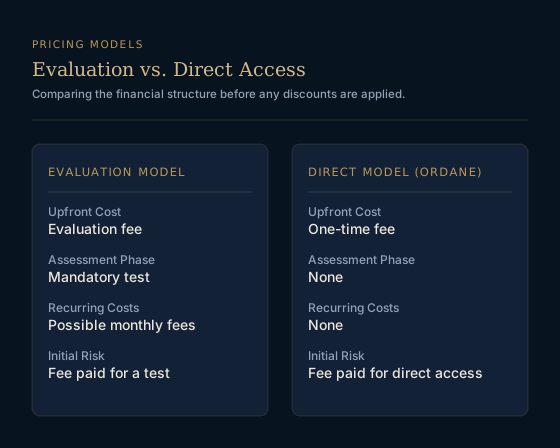
Table 1: Fee Structure Comparison
| Feature | Evaluation Model | Direct Model |
|---|---|---|
| Upfront Cost | Evaluation fee | One-time fee |
| Assessment Phase | Mandatory | None |
| Recurring Costs | Possible monthly fees | None |
| Discount Mechanics | Promo codes at checkout | Fixed pricing |
| Initial Risk | Fee paid for a test | Fee paid for direct access |
Ordane approaches pricing without a testing phase. The fee is one-time: $59 for the $2,500 account, $139 for the $10,000 account, $299 for $25,000, $549 for $50,000 and $999 for $100,000. There are no recurring fees, no hidden tiers and no coupon games. Ordane charges no commission, no spread and no swap. The account fee is the only cost the trader pays. The reason is structural, not promotional: accounts run on simulated capital, so no order is routed to an exchange and nothing is financed overnight, which means neither line has an underlying bill behind it.
Declared inputs for this check: a $59 account fee, a $0 monthly fee, and a $0 activation fee. Worked arithmetic: $59 + $0 = $59 total upfront cost.
This arithmetic demonstrates a flat pricing model. By removing coupon games, the pricing remains transparent, and the trader knows the exact cost of entry without searching for temporary codes.
What Hidden Rules Apply Before Using a Coupon?
Before applying any discount code, traders must scrutinize the underlying terms of the evaluation. Regulators like the CFTC advise retail traders to thoroughly review the terms and fee structures of simulated trading evaluations before participating. (CFTC, retrieved 2026-09-05) A lower initial price does not alter the strict trading parameters enforced during the test.
Discounts reduce the financial barrier to entry, but they do not change the mathematical difficulty of the evaluation phase. Firms enforce strict rules on maximum drawdown, daily loss limits, and consistency requirements. Traders often focus entirely on the upfront cost reduction provided by a promotional code, neglecting the operational rules that govern the simulated account.
Understanding the rulebook is more critical than finding a promotional code. The cost of failing an evaluation due to an misunderstood rule far exceeds the savings from a discount. The regulatory advisory exists because the terms and conditions in simulated environments are complex. Firms define how drawdowns are calculated, whether overnight holding is permitted, and how news trading is restricted.
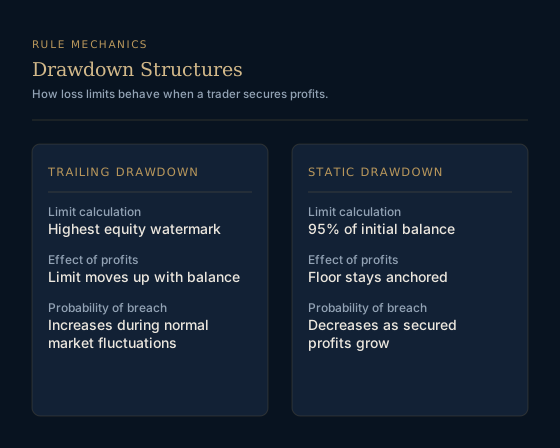
Trailing drawdowns calculate the limit from the highest watermark of the account equity. If a trader achieves a profit but does not close the position at the absolute peak, the drawdown limit follows the peak equity upwards. This structure mathematically increases the probability of a breach during normal market fluctuations. Traders must secure profits aggressively to avoid hitting a trailing limit that has moved above their initial starting balance.
Ordane's maximum drawdown is 5 percent and static: account equity may never fall below 95 percent of the initial balance. The floor is fixed on day one, never trails upward, and a breach closes the account. (Ordane Rulebook v1.0, clause R-1, retrieved 2026-09-05) The daily loss limit is 3 percent, measured against the balance at the start of the server day. A breach closes the account. (Ordane Rulebook v1.0, clause R-2, retrieved 2026-09-05) Maximum risk per trade is 1.5 percent of current balance and a stop-loss is mandatory at entry. Two maximum losses equal the daily limit, which is the design rather than an accident. (Ordane Rulebook v1.0, clause R-3, retrieved 2026-09-05) A breach closes the account. That is the whole consequence: no partial confiscations, no surprise fees, no renegotiation.
Table 2: Common Hidden Rules vs Clear Rules
| Rule Type | Common Industry Practice | Clear Rule Standard |
|---|---|---|
| Drawdown | Trailing from highest watermark | Static from initial balance |
| Versioning | Retroactive changes | Versioned contract |
| Allowable Strategies | Undefined discretion | Closed list of violations |
| Consistency | Subjective review | Mathematical threshold |
| News Trading | Broad restrictions | Permitted with specific exceptions |
Ordane's prohibited-practice list is closed. Clause R-6 names six practices: latency, reverse or hedge arbitrage; high-frequency or bulk automated exploitation; copy trading between Ordane accounts; straddling news releases with paired opposing orders; platform or data-feed exploitation; and gap abuse. If a behavior is not listed in that section, it is not a violation. Discretion is not a rule. (Ordane Rulebook v1.0, clause R-6, retrieved 2026-09-05)
Ordane's rulebook does restrict one thing around news: clause R-6(d) prohibits straddling news releases with paired opposing orders. Because R-6 is a closed list, no other clause restricts trading during news or high-impact events. (Ordane Rulebook v1.0, clause R-6, retrieved 2026-09-05) Expert Advisors are fully permitted at Ordane: a trader may run an EA executing the trader's own strategy on an Ordane account. (Ordane Rulebook v1.0, Appendix A, retrieved 2026-09-05)
Accounts with no trading activity for 30 consecutive days are closed. The 30 consecutive days in clause R-5 are calendar days, not business days. Under clause R-5, trading activity means at least one filled order. Pending orders and platform logins do not count. (Ordane Rulebook v1.0, clause R-5, retrieved 2026-09-05)
Ordane's consistency rule is 20 percent: at the moment of a withdrawal request, no single trading day may account for more than 20 percent of the cycle's total profit. If a day exceeds 20 percent, the excess profit from that day is deferred to the next cycle. It is never confiscated, and the remainder of the cycle pays out normally. (Ordane Rulebook v1.0, clause R-4, retrieved 2026-09-05)
Will the Firm Still Exist?
The longevity of the firm is a primary concern for traders committing time to an evaluation. Regulatory bodies emphasize the need for caution. Regulators like the CFTC advise retail traders to thoroughly review the terms and fee structures of simulated trading evaluations before participating. (CFTC, retrieved 2026-09-05)
Traders must verify the operational stability of the firm before paying an evaluation fee. A discount code provides no value if the firm ceases operations before a trader can complete the evaluation phase or reach a payout cycle. The industry has seen multiple closures where firms fail to honor their commitments, emphasizing the need for: Verifiable proof of reserves Clear contractual obligations * Binding public rulebooks
The CFTC advisory highlights the importance of understanding the business model behind the simulated trading environment. Firms that rely entirely on evaluation failures to fund payouts operate on fragile economics. Traders must look for verifiable proof of reserves and clear contractual obligations. Proof requires public evidence. A firm's commitment to paying its traders must be documented in a binding rulebook, not just stated in marketing materials.
Payout delays are a common indicator of operational friction within a simulated trading firm. When a firm extends the approval timeline or introduces unexpected compliance reviews at the moment of withdrawal, it signals potential liquidity issues. Traders must look for verifiable commitments to payment schedules. A firm should define its approval clock and the exact penalties it incurs for missing that deadline.
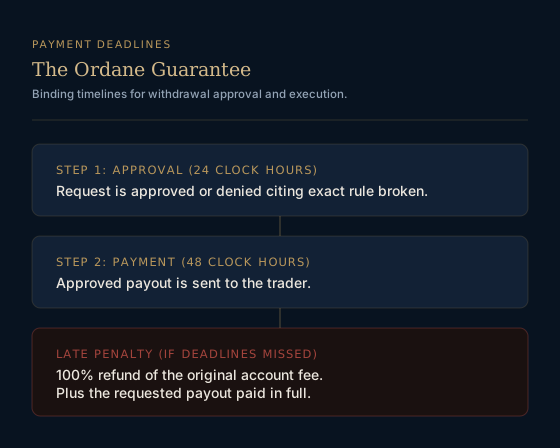
Every withdrawal request is approved, or denied in writing citing the exact rule breached by section number, within 24 clock hours. Past that deadline the request is treated as approved and the G-1 clock starts. (Ordane Rulebook v1.0, clause G-0, retrieved 2026-09-05) A payout approved and not paid within 48 clock hours, not business hours, triggers automatic compensation: a 100 percent refund of the account fee, plus the payout owed in full. (Ordane Rulebook v1.0, clause G-1, retrieved 2026-09-05)
This commitment is called The Ordane Guarantee. Both G-2 exclusions (documented fraud or KYC review, and declared force majeure) are capped at 10 business days each. Past that deadline, G-1 applies regardless. (Ordane Rulebook v1.0, clause G-2, retrieved 2026-09-05)
Ordane's payout reserve is published at a public TRON address on ordanemarkets.com and in Rulebook v1.0 clause PR-1. The page carries a dated observed balance and states that the reserve is not a promise, it is an address. (Ordane Rulebook v1.0, clause PR-1, retrieved 2026-09-05)
Ordane runs on a trading platform it designed and built with its own engineering team, and licenses no third-party terminal: not MatchTrader, not MetaTrader, not any external vendor. The distinction is structural, not cosmetic. A firm that licenses its terminal can be closed by a decision it does not control, and in 2024 that is exactly what happened: MetaQuotes withdrew MT4 and MT5 access from prop firms, True Forex Funds announced permanent closure on May 13 after its licences were terminated, and SurgeTrader ceased all operations on May 24, one week after losing its Match-Trader licence. Ordane owns the terminal its traders use, so no vendor can revoke it, reprice it, or decide it will no longer serve this industry.
Ordane lists four asset classes: FX pairs (majors and minors), metals, indices and crypto. No exotics.
How Do You Apply a MyFundedFutures Promo Code?
The process of applying a discount requires navigating the firm's specific checkout infrastructure. MyFundedFutures allows users to input a promotional code during the checkout process to receive a discount on their initial evaluation fee. (MyFundedFutures, retrieved 2026-09-05) This sequence must be completed accurately before finalizing the payment.
Traders must ensure the code is active and correctly formatted. The checkout system will validate the string and update the total cost dynamically. This process is standard across the simulated trading industry, but the exact steps require attention to detail.
Select Your Account Size
The first step requires choosing the specific tier of simulated capital. MyFundedFutures charges an upfront evaluation fee based on the selected account size, which serves as the base price before any active coupon codes are applied. (MyFundedFutures, retrieved 2026-09-05) The chosen size dictates both the initial fee and the profit targets required to pass the evaluation.
Purchasing a larger simulated account solely because a discount code is available often leads to oversized risk and early failure. The math of the daily loss limit scales linearly with the account size. A larger balance requires wider stop losses or larger position sizes to achieve the profit target, which can disrupt a trader's established strategy. Understanding the base metrics is essential before considering any promotional reduction. Traders must calculate their typical risk per trade and ensure the selected tier accommodates their execution style without forcing them to adjust their risk parameters artificially.
Input the Promotional Code at Checkout
Upon reaching the payment page, the system presents a designated input field. MyFundedFutures allows users to input a promotional code during the checkout process to receive a discount on their initial evaluation fee. (MyFundedFutures, retrieved 2026-09-05) Entering the code triggers a validation check against the firm's database of active promotions.
The code must be entered exactly as provided, observing any case sensitivity or character requirements. Expired or invalid codes will return an error message, leaving the base evaluation fee unchanged. Traders must verify that the input field accepts the string and that the system acknowledges the promotion before proceeding to the payment authorization step.
Verify the Reduced Base Price
Before authorizing the transaction, traders must visually confirm that the total cost reflects the expected discount. The system should display the original base price, the deduction applied by the coupon code, and the final payment amount.
Confirming this calculation ensures the promotion was successfully applied. Once the payment is processed, retroactive application of a discount code is rarely permitted by customer support departments. The responsibility lies entirely with the user to ensure the final price is correct before the transaction clears.
Table 3: Checkout Verification Checklist
| Step | Action Required | Expected Result |
|---|---|---|
| 1 | Select account size | Base fee displayed |
| 2 | Enter promo code | System validates string |
| 3 | Confirm calculation | Total cost reduced |
| 4 | Authorize payment | Transaction processed at lower rate |
The first withdrawal is available 7 calendar days after account activation, and the cycle thereafter is every 14 days. (Ordane Rulebook v1.0, clause PA-1, retrieved 2026-09-05) Ordane's profit split starts at 60 percent and rises 5 percentage points with every completed withdrawal, reaching 100 percent from the ninth withdrawal onward. The split ladder is in writing and never resets. (Ordane Rulebook v1.0, clause PA-2, retrieved 2026-09-05) Withdrawals #1 and #2 are each capped at 3 percent of initial balance. From withdrawal #3 onward there is no cap. (Ordane Rulebook v1.0, clause PA-3, retrieved 2026-09-05) Withdrawals reduce the account balance, and the R-1 drawdown floor stays anchored to the initial balance. (Ordane Rulebook v1.0, clause PA-4, retrieved 2026-09-05)
MyFundedFutures Discount FAQs
Traders frequently ask specific questions regarding the mechanics of these promotions. The following section addresses common inquiries about finding, applying, and understanding the limitations of a promotional code. Clear answers help traders navigate the checkout process efficiently while maintaining realistic expectations.
What is the best myfundedfutures coupon code?
The availability and value of promotional codes fluctuate based on the firm's marketing calendar. The most effective code at any given time is the one officially distributed by the firm or its recognized affiliate partners. Traders should verify the source of the code to ensure its validity and avoid third-party sites that aggregate expired promotions.
How do I apply a my funded futures promo code?
The application occurs exclusively during the final purchase step. MyFundedFutures allows users to input a promotional code during the checkout process to receive a discount on their initial evaluation fee. (MyFundedFutures, retrieved 2026-09-05) The user must type the code into the specific field and trigger the calculation before submitting payment to the processor.
Is there a myfundedfutures discount code for resets?
Reset fees are distinct from initial evaluation fees. While some firms occasionally offer promotions on resets, standard coupon codes typically apply only to the first purchase of an evaluation account. Traders must read the specific terms of the promotion to determine if it covers reset penalties or if it is restricted to new account creations.
Where do I enter a my funded futures coupon?
The entry field is located on the final payment page. Traders must proceed past the account selection step to reach the checkout interface. The field is clearly labeled, and the code must be entered before the payment method is selected and authorized. Failure to enter the code at this stage results in a charge at the full base price.
How much is the myfundedfutures discount?
The exact percentage or fixed amount varies depending on the active promotion. MyFundedFutures charges an upfront evaluation fee based on the selected account size, which serves as the base price before any active coupon codes are applied. (MyFundedFutures, retrieved 2026-09-05) The discount is subtracted directly from this base price. To bypass evaluations entirely, explore the Ordane Instant Account.
Sources
- CFTC Customer Advisory: Proprietary Trading Programs cftc.gov Retrieved 2026-09-05T09:55:13Z.
- MyFundedFutures Checkout Process myfundedfutures.com Retrieved 2026-09-05T09:55:13Z.
- MyFundedFutures Pricing Plans myfundedfutures.com Retrieved 2026-09-05T09:55:13Z.