Home · The Ordane Journal · Pricing and cost · Best Prop Firms for Futures: Rules and Cost
Best Prop Firms for Futures: Rules and Cost
A futures prop firm is a company that sells access to a simulated futures trading account, usually behind a paid evaluation, and keeps a share of whatever simulated profit the trader produces, charging either a one-time activation fee or a subscription that runs until the evaluation is passed or cancelled.
Ordane sells one product, the Ordane Instant Account: direct access, no evaluation phase and no challenge, on simulated capital.
Ordane accounts operate on simulated capital. No live funds are traded and no deposits are accepted. (Ordane Rulebook v1.0, clause P-2, retrieved 2026-08-28)
What Does "Best" Actually Mean for a Futures Prop Firm?
"Best" is not a single number. It is four separate published facts, and a firm can rank well on one and poorly on another. The National Futures Association tells investors directly to learn the risks, mechanics and fees of a product before committing money or sharing sensitive information (National Futures Association, retrieved 2026-08-28), which is the regulator's own version of the comparison this article runs: mechanics and fees first, marketing last.
The three published facts worth comparing before you pay
Before naming a firm "best," compare three things each one has actually published:
- Drawdown type. End-of-day drawdown and intraday drawdown are measured differently, and some firms switch the type between the evaluation and the funded stage.
- Profit split and minimum payout. A split can be a single flat number or a tiered structure that changes with account profit, and a firm can set a dollar floor below which no payout request is possible.
- Fee structure. A one-time charge and a recurring monthly charge are not the same cost even when the sticker price looks similar, especially once resets and platform surcharges are added.
A fourth fact, registration disclosure, decides whether the firm and the account are likely to still be there next year. It gets its own section below because it changes how much weight to put on everything else a firm claims.
Will You Actually Get Paid, and How Much?
The first fear any trader has is simple: will the firm actually release the money. TradeDay and Bulenox have both published split figures; Take Profit Trader has not published a split percentage in the sources checked for this comparison, so it is left out of the split table below rather than filled in with a guess.
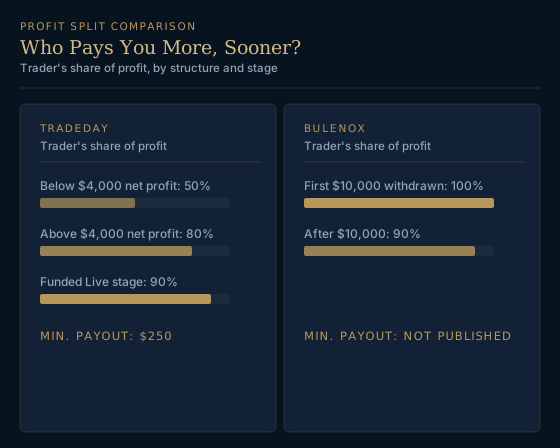
Bulenox's 100% first $10,000 then 90/10 split
Bulenox structures its split around a milestone instead of a threshold. The first $10,000 a trader withdraws is paid at 100 percent, and every payout after that runs 90/10 in the trader's favor (Bulenox, retrieved 2026-08-28). That front-loads the highest split at the start of a payout history rather than the end, which is the opposite design choice from a split that only improves with time.
| Firm | Split structure | Minimum payout request |
|---|---|---|
| TradeDay | 50/50 below $4,000 net profit, 80/20 above, 90/10 in Funded Live (TradeDay, retrieved 2026-08-28) | $250 (TradeDay, retrieved 2026-08-28) |
| Bulenox | 100% of the first $10,000, 90/10 after (Bulenox, retrieved 2026-08-28) | Not published in the sources checked here |
| Take Profit Trader | Split percentage not published in the sources checked here | Not published in the sources checked here |
Which Rule Can Still Change After You Pass?
The second fear is the hidden rule: the one that shifts the moment a trader passes. Drawdown type is exactly that kind of rule, because it can change stage to stage or lock permanently on day one, and those are opposite outcomes for a trader planning a strategy.
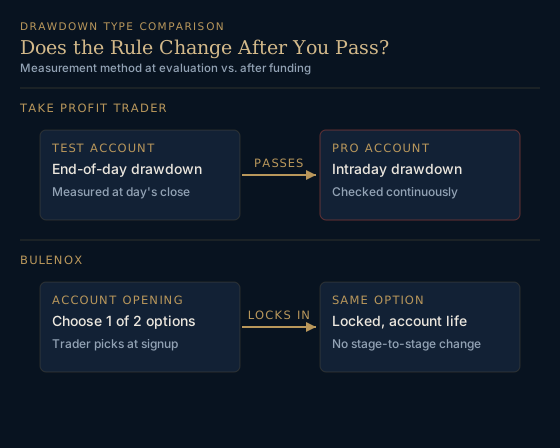
Bulenox: two drawdown options, locked for the life of the account
Bulenox runs the opposite design. It publishes two drawdown options, and whichever one a trader picks at account opening is locked for the life of the account (Bulenox, retrieved 2026-08-28). The end-of-day option among the two updates once a day at the close on realized profit, scales contract size with cash on hand, and pauses the trading day with a daily loss limit instead of closing the account outright (Bulenox, retrieved 2026-08-28).
| Firm | Drawdown at evaluation | Drawdown after passing | Can it change? |
|---|---|---|---|
| Take Profit Trader | End-of-day (Take Profit Trader, retrieved 2026-08-28) | Intraday (Take Profit Trader, retrieved 2026-08-28) | Yes, stage to stage |
| Bulenox | Trader's choice of two options (Bulenox, retrieved 2026-08-28) | Same option, locked (Bulenox, retrieved 2026-08-28) | No, locked at opening |
Will the Firm and Your Account Still Be There Next Year?
The third fear is survival: will the firm, and the account, still exist in a year. That is partly a regulatory question and partly a cost question, because a recurring bill that outlasts a trader's patience is its own kind of survival risk.
TradeDay's own disclosure: not registered with the SEC or CFTC
TradeDay states this on its own site: TradeDay LLC is not registered with the SEC or the CFTC as a broker-dealer, investment advisor, futures commission merchant, or commodity trading advisor (TradeDay, retrieved 2026-08-28). That is not an accusation; it is the firm's own published disclosure, and it is worth reading in full before assuming a prop firm evaluation carries the same oversight as a regulated brokerage account.
How to check a firm's registration yourself with NFA BASIC
None of this has to be taken on the firm's word. The National Futures Association runs BASIC, a free public search tool that carries registration status, disciplinary history, membership details and contact information for derivatives industry firms and individuals (National Futures Association, retrieved 2026-08-28). Checking a firm in BASIC before paying takes a few minutes and confirms or corrects whatever the firm's own marketing claims. A separate walkthrough of that lookup process, and of what to do when a firm does not appear in it, is worth reading before buying any evaluation.
What Does It Cost in Total, Firm by Firm?
Price only means something once the mechanics and the recurring charges are on the table, because the headline number rarely is the total number.
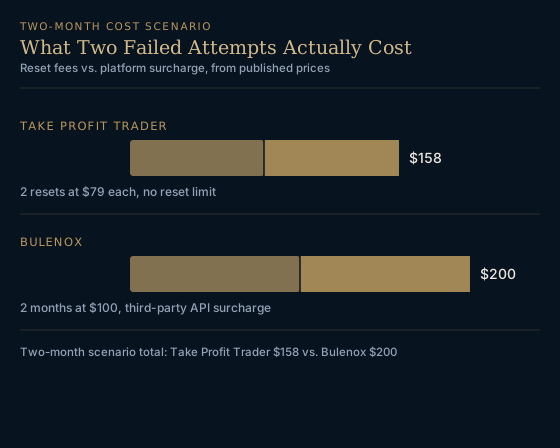
Take Profit Trader: reset price from $79 with no limit on resets
Take Profit Trader lets a trader reset any test account starting from $79, depending on account size, describes the reset as optional, and places no limit on how many resets a trader can buy (Take Profit Trader, retrieved 2026-08-28). Unlimited resets remove a hard ceiling on retries, but each reset is a fresh charge, so a trader who breaches the drawdown twice pays that fee twice before ever reaching the PRO stage.
Bulenox: $100 per month third-party API surcharge on top of the account
Connecting a Bulenox account to Rithmic through a third-party API or composite software adds $100 per month on top of the account itself (Bulenox, retrieved 2026-08-28). A trader who wants to run automated execution or a third-party charting platform is paying for that connection separately from the account fee, and that charge continues every month the connection stays active.
TradeDay: a membership that recurs every 30 days until you pass or cancel
TradeDay's 30-day recurring membership, already described above, is also a total-cost line: it does not stop because an evaluation attempt failed, only because the trader passes or actively cancels (TradeDay, retrieved 2026-08-28). That makes the real cost of a TradeDay evaluation a function of how many 30-day cycles it takes to pass, not the price of a single cycle.
Declared inputs for this check: two Take Profit Trader test-account resets at $79 each (Take Profit Trader, reset price from $79 with no limit on resets), and Bulenox's $100 monthly third-party API surcharge charged across two consecutive months. Worked arithmetic: $79 + $79 = $158 in Take Profit Trader reset fees for two failed attempts, and $100 + $100 = $200 in Bulenox API surcharges over the same two months.
| Cost driver | Firm | Amount | Two-month scenario total |
|---|---|---|---|
| Test account reset | Take Profit Trader | $79 per reset (Take Profit Trader, retrieved 2026-08-28) | $158 for two resets |
| Third-party API surcharge | Bulenox | $100 per month (Bulenox, retrieved 2026-08-28) | $200 for two months |
| Evaluation membership | TradeDay | Recurs every 30 days until passed or cancelled (TradeDay, retrieved 2026-08-28) | Amount not published in the sources checked here |
None of the three published a single headline account price in the sources checked for this comparison, which is itself the point: a sticker price without the reset cost, the platform surcharge, or the recurring-membership term attached is not a total cost, only a starting one. A fuller list of the recurring and add-on charges that prop firms publish beyond the headline account price is worth reading before comparing any two firms on price alone, and a general explanation of how tiered profit splits are calculated is worth reading before assuming TradeDay's and Bulenox's tiers work the same way.
Traders comparing evaluation structures like these can also review Ordane's Instant Account terms, published in the same one-price, one-set-of-rules format compared above.
Which One Fits, Given How You Trade?
There is no winner to name, because no firm publishes an auditable pass rate or payout total and a ranking without those numbers is opinion wearing a table. What the published rules do settle is which firm suits which trader.
If you close flat every session, an end-of-day drawdown is the cheaper constraint, and Take Profit Trader's test account and Bulenox's end-of-day option both compute it once at the close. If you scale into a position intraday, the intraday variant on Take Profit Trader's PRO account will stop you on an unrealised move that an end-of-day rule would never see, so it is the rule to read first.
If you expect to take money out early and often, Bulenox pays the first 10,000 dollars withdrawn at 100 percent, while TradeDay's split rises with the profit already in the account and its payout requests start at 250 dollars. And if you are unsure how long the evaluation will take, the cost question flips: TradeDay's membership recurs every 30 days until you pass or cancel, while Bulenox's Master Account has no monthly fee and one activation charge.
FAQ
What is the difference between end-of-day and intraday drawdown?
End-of-day drawdown is measured once, at the close of the trading day, against realized profit, so unrealized losses during the session do not trigger a breach the way they can under intraday drawdown, which is checked continuously through the session (Take Profit Trader, retrieved 2026-08-28). A strategy built around wide intraday swings that close green can survive under end-of-day measurement and breach under intraday measurement even with an identical trade log.
Can a futures prop firm's drawdown rule change after I pass the evaluation?
Yes, at least at one of the three firms compared here. Take Profit Trader measures its test account on end-of-day drawdown and its PRO account on intraday drawdown, so the rule a trader is held to changes the moment they pass (Take Profit Trader, retrieved 2026-08-28). Bulenox does the opposite: whichever drawdown option a trader selects at account opening is locked for the life of the account (Bulenox, retrieved 2026-08-28).
Is a futures prop firm regulated by the CFTC or SEC?
Not necessarily, and it should never be assumed. TradeDay states on its own site that TradeDay LLC is not registered with the SEC or the CFTC as a broker-dealer, investment advisor, futures commission merchant, or commodity trading advisor (TradeDay, retrieved 2026-08-28). Separately, CFTC Regulation 4.41(b) requires that any presentation of simulated or hypothetical performance carry a prescribed statement that those results do not represent actual trading (17 CFR 4.41, retrieved 2026-08-28), which is a useful line to look for on any firm's simulated-performance marketing.
How do I check a prop firm's registration status myself?
The National Futures Association's BASIC system is a free public search tool covering registration status, disciplinary history, membership details and contact information for derivatives industry firms and individuals (National Futures Association, retrieved 2026-08-28). Running a firm's name through BASIC before paying an evaluation fee confirms whatever the firm's marketing claims about its own standing, in a few minutes, from a source the firm does not control. A step-by-step walkthrough of verifying a firm's registration status independently, and of checking a firm's spread and execution claims the same way, is worth reading before wiring any evaluation fee, and understanding what a firm can still require before releasing even a minimum payout closes the loop once a payout is finally on the table.
Sources
- NFA Investor Advisory—Conducting Due Diligence (National Futures Association, October 9, 2025) nfa.futures.org Retrieved 2026-08-28.
- Make It Take It (TradeDay) tradeday.com Retrieved 2026-08-28.
- Quick Pay Funded Sim Payout Policy | TradeDay Knowledge Base tradeday.freshdesk.com Retrieved 2026-08-28.
- FAQ — Bulenox bulenox.com Retrieved 2026-08-28.
- Take Profit Trader - FAQs try.takeprofittrader.com Retrieved 2026-08-28.
- How does monthly billing work? | TradeDay Knowledge Base tradeday.freshdesk.com Retrieved 2026-08-28.
- 17 CFR 4.41 Advertising by commodity pool operators, commodity trading advisors, and the principals thereof (eCFR, Title 17, Chapter I, Part 4) ecfr.gov Retrieved 2026-08-28.