Home · The Ordane Journal · Pricing and cost · How to Check a Prop Firm Spread Before You Pay
How to Check a Prop Firm Spread Before You Pay
Ordane accounts operate on simulated capital. No live funds are traded and no deposits are accepted.
Ordane sells one product, the Ordane Instant Account: direct access, no evaluation phase and no challenge, on simulated capital.
The CFTC warns that forex and leveraged trading involve substantial risk of loss. (CFTC, retrieved 2026-08-15)
A spread is the gap between the price you can sell at and the price you can buy at, measured in points, at one specific moment. That is the whole cost picture only if a bill has one line, and a prop firm's bill has three. (Ordane Rulebook, retrieved 2026-08-11)
The advertised spread on a prop firm's marketing page is a claim about one line of a bill that has three lines. The spread itself is measurable in the terminal, in points, right now, without asking anyone's permission. The commission is published per lot or per contract and does not move with the market. The swap only shows up if a position survives the overnight rollover, and most trades in a prop firm evaluation never see it. A firm can be fully honest about all three numbers and still turn out to be the expensive choice for the specific trade you plan to place, because the three lines do not weigh the same for every strategy (Ordane Rulebook, retrieved 2026-08-11).
This article separates the three lines, shows you how to read the spread yourself in under two minutes, and prices one identical trade through two different cost structures so you can see where the difference actually comes from.
What Is a Prop Firm Spread?
A prop firm spread is the live difference between the bid and ask for one instrument. It is not a fixed property of a brand. The number can change by symbol, session, liquidity, volatility and the moment at which you take the reading. A homepage phrase such as "raw," "low" or "from zero" therefore cannot replace a timestamped measurement in the platform.
That distinction matters when you search for a prop firm spread comparison, which prop firm has best spread, or which prop firm has lowest spread. Those questions have no universal answer without naming the instrument, trade size, time and the commission charged beside the spread. A prop firm raw spread, prop firm low spread or prop firm with tight spread can still produce a higher total bill after commission. Likewise, a zero spread prop firm list is only a list of marketing labels until every entry is tested on the same declared inputs. The useful question is not "which brand says zero?" but "what did this exact trade cost?"
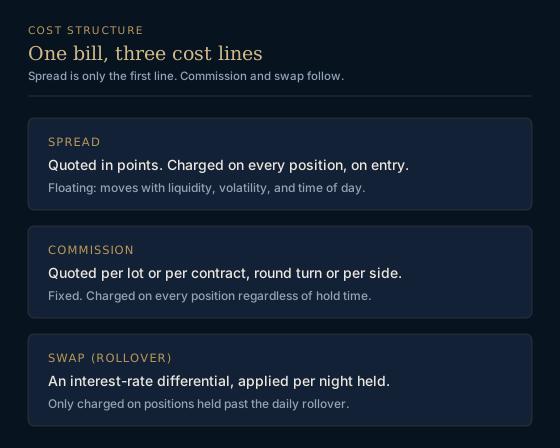
Table 1: The Three Cost Lines and Who Charges Which
| Cost line | Unit it's quoted in | When it's charged | Where it typically appears |
|---|---|---|---|
| Spread | Points (pips) | Every position, on entry | CFD / retail-style accounts (MT5, cTrader) |
| Commission | Per lot or per contract, round turn or per side | Every position, fixed regardless of hold time | CFD accounts with raw/zero spread; all futures accounts |
| Swap (rollover) | Interest-rate differential, applied per night | Only on positions held past the daily rollover | CFD accounts holding overnight; absent on same-day futures |
When Does the Spread Number Actually Move?
FTMO names the three conditions under which your executed price departs from what you expected: periods of low market liquidity, periods of increased volatility such as important news releases, and weekend gaps from holding a position over the close (FTMO.com, retrieved 2026-08-11). Those same three conditions are exactly when spreads widen, for the same underlying reason: liquidity providers pull back their tightest quotes when the risk of getting picked off rises.
Practically, that means: sample the spread at your normal trading hour, then sample it again 30 minutes before a scheduled high-impact release, and once more right after a weekend reopen. If a firm's spread triples during the news window and yours is a news-based strategy, the "from" number on the homepage told you nothing about the cost you will actually pay.
Swap is a separate mechanic entirely, tied to holding time rather than to volatility. FTMO defines the size of the swap as based on the interest rates of the central banks of the countries whose currencies you are trading (FTMO.com, retrieved 2026-08-11). If your strategy closes every position same-day, this line is zero for you regardless of what the firm publishes about it, and you can stop comparing it across firms altogether.
How Can You Run a Prop Firm Spread Test in MetaTrader 5?
Run the prop firm spread test on the instrument and during the session you actually trade. In MetaTrader 5, open Market Watch, select the symbol and record the bid and ask shown at the same moment. The platform also exposes the current spread in points and whether the symbol uses a floating spread through its symbol properties (MQL5 Documentation, retrieved 2026-08-11). Those two properties answer different questions: the first records the current reading; the second tells you whether that reading is expected to move.
Use a small log with four declared fields: symbol, local time, spread in points and floating yes/no. Take one normal-session reading, one reading around the high-impact window relevant to your strategy and, if you hold across the weekend, one after reopening. Keep the screenshots. A best prop firm with raw spread claim is useful only when the same test, instrument and time window can reproduce it. If the result cannot be reproduced, treat it as advertising rather than evidence.
Why Do Futures Firms Have No Spread Line At All?
A Round Turn Broken Into Three Parts
Futures-style prop firms do not quote a spread because futures contracts trade on a central exchange with one visible bid and ask for everyone, not a price stream from a liquidity provider. Instead, the cost shows up as a round-turn fee, meaning the cost of entering and exiting the position, and it is fixed regardless of volatility.
Topstep (futures prop firm) charges that round-turn cost when a trader completes both sides of a trade, with each side incurring half the total, also called a per-side fee (Topstep Help Center, retrieved 2026-08-11). Part of that round turn is commission: Topstep publishes $1.00 round turn, or $0.50 per side, on standard contracts (Topstep Help Center, retrieved 2026-08-11).
What That Changes About Comparison
You cannot put a CFD spread in points next to a futures round-turn fee in dollars and call it a comparison. They are different units measuring different mechanisms. The only honest comparison is to convert both into a dollar cost for one specific trade of one specific size, which is what the next table does.
Table 2: The Same Trade Priced Two Ways
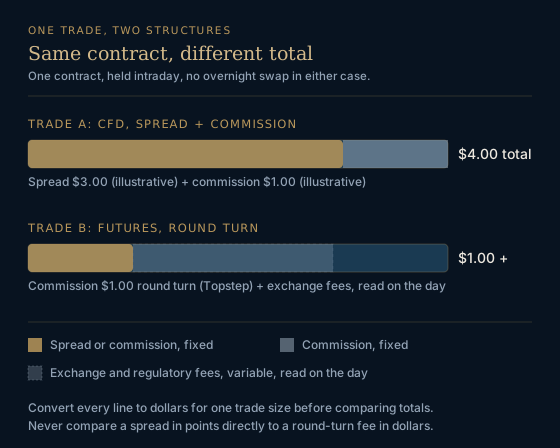
Declared inputs: one contract, held intraday, no overnight rollover, so the swap line is zero in both scenarios. Trade A prices a CFD-style spread-plus-commission account. Trade B prices the same directional exposure through a futures round-turn structure, using Topstep's published $1.00 round-turn commission on a standard contract (Topstep Help Center, retrieved 2026-08-11). Both the CFD spread and the exchange-fee portion of a futures round turn are numbers you read on the day you trade, not constants.
| Cost line | Trade A: CFD, spread + commission | Trade B: Futures, round turn |
|---|---|---|
| Spread cost | 3 points at $1/point = $3.00 (illustrative) | Not applicable, no spread line exists |
| Commission | $1.00 (illustrative, per-lot commission not universal on CFD accounts) | $1.00 round turn on a standard contract (Topstep Help Center, retrieved 2026-08-11) |
| Swap | $0 (closed same day) | $0 (closed same day) |
| Exchange and regulatory fees | Not applicable | Read on the day, varies by product |
| Total cost, this trade | $3.00 + $1.00 = $4.00 | $1.00 plus the exchange and regulatory lines |
The arithmetic is the entire point: $3.00 in spread plus $1.00 in commission equals $4.00 on the CFD side, against a commission line of $1.00 plus exchange and regulatory fees on the futures side. Expressed in cents so the calculation is directly reproducible, 300 + 100 = 400. Rerun this with your own broker's live spread reading and your own commission schedule, because the 3-point spread and $1 CFD commission above are illustrative placeholders you should replace with a screenshot-verified number from your own terminal. What does not change is the method: convert every line to dollars, add them, then compare totals, never compare a spread in points to a round-turn fee in dollars directly.
Six Steps to Price a Prop Firm Before You Pay
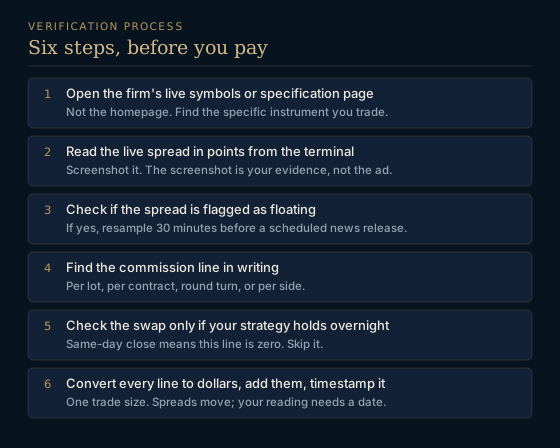
- Open the firm's live symbols or specification page, not the homepage. Look for the specific instrument you trade, not a category average.
- Load that symbol in a demo or the firm's platform, and read the current spread in points directly from the terminal, the same property MetaTrader 5 exposes for exactly this purpose (MQL5 Documentation, retrieved 2026-08-11).
- Check whether the spread is flagged as floating (MQL5 Documentation, retrieved 2026-08-11). If it is, take a second sample thirty minutes before your next scheduled high-impact news event.
- Find the commission line in writing: per lot, per contract, round turn or per side. If the page does not state it plainly, that is itself a data point, not an oversight to assume away.
- Check the swap only if your strategy holds overnight. If it closes same-day, skip this line entirely; it costs you nothing and comparing it wastes your time.
- Convert every applicable line to a dollar amount for one specific trade size, add them, and record the date you took the reading next to the total. Spreads move; your screenshot needs a timestamp to mean anything six months from now.
What Has Ordane Published About Spread?
Spread Source Not Published
Ordane charges no spread, no commission and no swap; the account fee is the only cost the trader pays (Ordane, Trading Specification, retrieved 2026-09-01). The reason is structural rather than promotional: the account runs on simulated capital, so no order is routed to an exchange and no position is financed overnight, which means none of the three has an underlying bill behind it. That does not answer the check this article describes, it removes it. With no spread quoted there is no source to trace and no markup to compare, and a timestamped terminal reading shows the same number on both sides.
The Commission Line That Is Not Confirmed
This used to be a second open question, tracked separately from the spread: whether Ordane charges a per-lot commission. It no longer is. The same specification update that zeroed the spread zeroed this line too (Ordane, Trading Specification, retrieved 2026-09-01). There is one line on the bill now, the account fee, and both questions this article used to treat separately resolve to the same answer.
Questions
Is a Zero-Spread Account Really Free?
No. "Zero spread" describes one line of the bill, not the total. An account advertising zero or near-zero spread almost always recovers that cost through a per-lot or per-contract commission instead, the same structure Topstep publishes openly on its futures accounts at $1.00 round turn on standard contracts. Add the commission before comparing a zero-spread account against a spread-plus-commission account; the zero-spread label alone tells you nothing about the total.
Does the Spread Count Against My Drawdown?
Yes, indirectly. The spread is a real cost paid at entry, and it comes out of your account equity the same as any other loss. On an Ordane Instant Account, the maximum drawdown floor is fixed and static at 5 percent below the initial balance, so every spread you pay narrows that same fixed buffer rather than a floor that moves with you.
Why Is My Fill Worse Than the Quoted Spread?
Because the quote you read a moment ago is not a guarantee of the price you get when the order executes. FTMO names three conditions that separate the executed price from the expected one: low liquidity, high volatility around important news, and weekend gaps from holding through the close.
Can a Firm Be Honest and Still Be the Expensive Choice?
Yes. A firm can publish an accurate spread, an accurate commission, and an accurate swap rate, and still cost more for your specific trade than a firm with a wider spread but no commission, if your strategy trades small and frequently.
Does Ordane Charge a Markup on Top of the Spread?
Ordane charges no spread and no separate per-lot commission. Both are zero, for the same structural reason: the account runs on simulated capital, so no order reaches an exchange and nothing is financed overnight. The account fee is the only cost.
See also static vs trailing drawdown, prop firm profit split explained, how prop firms make money, prop firm overnight and weekend holding, and what you can trade on a prop firm account.
Sources
- Symbol Properties | MQL5 Documentation mql5.com Retrieved 2026-08-11.
- Symbols | FTMO.com ftmo.com Retrieved 2026-08-11.
- What's consuming all your profits? | FTMO.com ftmo.com Retrieved 2026-08-11.
- TopstepX™ — Commissions and Fees | Topstep Help Center help.topstep.com Retrieved 2026-08-11.
- Ordane Rulebook v1.0 ordanemarkets.com Retrieved 2026-08-18.
- Ordane Rulebook v1.0 ordanemarkets.com Retrieved 2026-08-11.