Home · The Ordane Journal · Rules and mechanics · What Can You Trade on a Prop Firm Account?
What Can You Trade on a Prop Firm Account?
Most prop firms list four asset classes: FX majors and minors, metals, indices and crypto. Exotic FX pairs, single stocks and exchange-listed futures are the usual gaps. A prop firm's instrument list is the set of tradable symbols on its platform, and it is a separate document from the rulebook that decides what you may actually do with each symbol.
Ordane accounts operate on simulated capital. No live funds are traded and no deposits are accepted. (Ordane Rulebook v1.0, clause P-2, retrieved 2026-08-09)
What Is the Difference Between a Listed Instrument and a Permitted One?
The four common classes at a CFD-style prop firm are FX majors and minors, metals, indices and crypto (FTMO, prop firm, retrieved 2026-08-09). The three usual gaps are exotic FX pairs, single stocks and exchange-listed futures, the last of which belongs to a separate business model entirely (Topstep, prop firm, retrieved 2026-08-09). The trap sits underneath the menu: a symbol appearing on the platform tells you what you can click, not what you are allowed to do with it once you have clicked it. For how prop firms operate on simulated capital, read Is a Prop Firm Account a Demo Account?.
A 45-word definition, quotable as written
A prop firm's instrument list is the set of tradable symbols on its platform, split by asset class. It is not the same document as the firm's rulebook. The rulebook, not the symbol list, decides which of those symbols you may actually use, and how.
Why the same instrument is not the same product at two firms
Two firms can both list gold and still sell a different product. One firm marks up the spread on gold before you see the price. Another passes the liquidity provider's spread through unchanged. Same symbol, different cost, and the difference never shows up on the instrument list itself, only on a separate cost disclosure the firm may or may not publish. To learn more about how trading costs impact your account, see How Trading Costs Reduce Prop Firm Drawdown.
What Asset Classes Do Prop Firms Typically List?
| Asset class | Typically available | Usual caveat |
|---|---|---|
| FX majors | Yes, at most CFD-style firms | Tight spreads, high liquidity, rarely restricted |
| FX minors | Yes, at most CFD-style firms | Wider spreads than majors, still standard |
| FX exotics | Inconsistent | Often excluded, or carries wider limits and thinner liquidity when included |
| Metals | Yes, common | Leverage and margin terms vary by firm and are not always published |
| Indices | Yes, common | Session hours and gap-risk rules vary |
| Crypto | Common, but narrower than the name suggests | "Crypto" can mean a handful of coins, not a full book, and weekend hours can vary by platform maintenance schedule (FTMO, retrieved 2026-08-09) |
| Single stocks | Firm-dependent | Present at some CFD-style firms, absent from futures-only firms entirely (Topstep, retrieved 2026-08-09) |
| Futures | Firm-dependent | The entire product at futures-only firms, absent at most CFD-style firms |
FTMO's own FAQ states the CFD-style pattern plainly: traders can trade all the instruments and assets available on the platform, naming Forex, Indices, Commodities, Stocks and Crypto as the classes (FTMO FAQ, retrieved 2026-08-09). Topstep sits on the other side of the industry split entirely: futures products only, listed on CME, COMEX, NYMEX and CBOT, with stocks, options, spot forex, spot cryptocurrency and CFDs all prohibited by name (Topstep, Forex vs futures: trade smarter, not harder, retrieved 2026-08-09). Those are not two versions of the same menu. They are two different businesses that both call themselves prop firms, and the word "instruments" means something different at each one (Topstep, retrieved 2026-08-09).
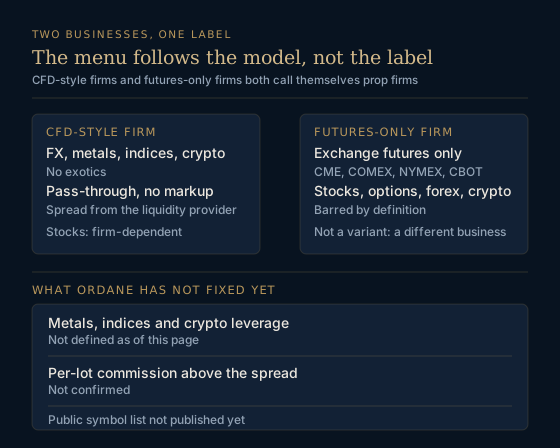
The two gaps that catch people are exotics and crypto. Exotic FX pairs are the class most often excluded or capped, precisely because they carry the thinnest liquidity and widest spreads, which makes them the easiest place for a firm to absorb cost or risk it does not want to carry. Crypto is the class most often oversold by name: a firm advertising "crypto" may mean Bitcoin and Ethereum, not a full altcoin book, and the symbol list is the only document that tells you which.
Even the geography of the same firm can change the menu. FTMO's global list is broad, but US traders access FTMO through a partnership with OANDA (broker) that significantly restricts the instruments available (QuantVPS, FTMO vs E8 Markets: Evaluation Structure, Platforms & Scaling Options, retrieved 2026-08-09). The lesson is not about FTMO specifically. It is that "what does this firm let you trade" has no single answer until you know which version of the firm you are actually buying.
Why Does Listed Not Mean Permitted?
An instrument list answers one question: what is on the platform. It does not answer a second, separate question: what are you allowed to do with it. Those two questions get conflated constantly, and the gap between them is where a trader who read the symbol list and nothing else gets closed out on a technicality they never saw coming. For a broader discussion on unwritten rules, read Can a Prop Firm Enforce a Rule That Isn't Written Down?.
The rule layer that sits on top of the menu
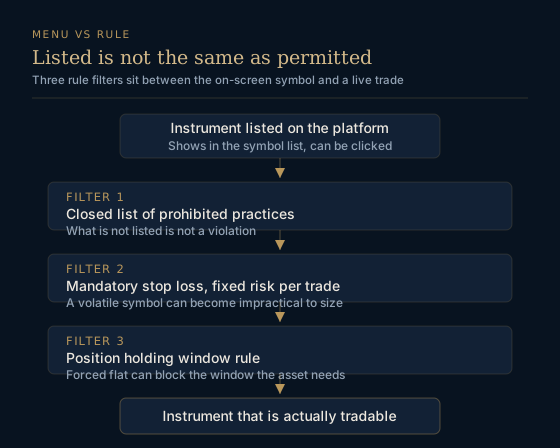
Three mechanisms decide whether a listed instrument is practically tradable, and none of them live on the symbol list.
The first is a prohibited-practice list. Ordane's clause R-6 names six practices and the list is closed: what is not listed is not a violation. That closed structure means an instrument being on the menu is not enough on its own, but it also means the boundary is knowable in advance, in writing, rather than left to a case-by-case call.
The second is a mandatory stop-loss combined with a fixed risk cap. Ordane sells one product, the Ordane Instant Account: direct access, no evaluation phase and no challenge, on simulated capital. (Ordane Rulebook v1.0, section 1, retrieved 2026-08-09) Under clause R-3, maximum risk per trade is 1.5 percent of current balance and a stop-loss is mandatory at entry. On a wide-spread or high-volatility symbol, that combination can make an otherwise listed instrument impractical to trade at any meaningful size, because the stop distance required to survive normal noise on that instrument may consume most or all of the allowed risk in a single position. For more on mandatory stop-losses, see Prop Firm Stop Loss Slippage Buffer.
The third is a holding-window rule. This is where the direction runs the other way: a class can be listed and still get ruled out in practice by a forced flat-by-Friday policy elsewhere in the industry, but at Ordane overnight and weekend holding is permitted under ordinary risk, with gap abuse prohibited (Ordane Rulebook v1.0, clause R-6(f) and Appendix A entry A-6, retrieved 2026-08-09), precisely because ordinary holding is not on the R-6 closed list. That matters specifically for crypto, whose market trades through the weekend: a rule that forces a flat position by Friday effectively blocks weekend crypto trading even though crypto sits on the symbol list. For more on holding rules, read Can You Hold Trades Overnight or Over the Weekend at a Prop Firm?.
Three ways a listed instrument becomes untradable in practice
- A named practice on that instrument is prohibited, even though the instrument itself is listed. Ordane's R-6 list is closed and covers six specific practices, so this risk is at least fully knowable in advance rather than left open-ended.
- The risk math does not work at the size you need. A mandatory stop-loss under a fixed 1.5 percent risk cap can make a volatile or wide-spread symbol impractical to size properly.
- A holding-window rule blocks the schedule the instrument actually needs. A weekend-trading crypto position needs weekend holding to be allowed; a forced flat-by-Friday rule elsewhere in the industry would rule that out even with crypto sitting on the menu.
Contrast matters here. A firm whose rulebook uses discretionary language, undefined terms like "abusive strategy" applied case by case, leaves this third boundary unknowable until it is applied to you. A closed list, by definition, does not.
Does the Same Instrument Cost the Same at Every Firm?
The same symbol at two firms can carry two different real costs, and the instrument list never shows you which. The variable is spread treatment: whether the firm marks up the raw spread from its liquidity provider before showing it to you, or passes that spread through unchanged.
Ordane charges no spread, no commission and no swap. All three are zero for the same reason: the account runs on simulated capital, so no order reaches an exchange and no position is financed overnight, and none of the three has a bill behind it to recover (Ordane, Trading Specification, retrieved 2026-09-01). That settles both questions this article used to treat separately: the markup question and the commission question resolve to the same answer.
The honest move is to ask, in writing, before paying: is the spread marked up, and is there a separate commission on top. Two firms quoting the "same" spread on the "same" symbol can produce different total costs once commission is added, and total cost is what a strategy actually has to overcome to be profitable.
What Ordane Lists, and What Is Not Set Yet
Confirmed today
- Instrument classes: FX pairs, majors and minors, metals, indices and crypto. No exotics (Ordane, Trading Specification, retrieved 2026-08-09).
- Cost treatment: Ordane charges no spread, no commission and no swap. (Ordane, Trading Specification, retrieved 2026-09-01)
- Ordane's settled leverage is 1:50 on FX majors and minors. Leverage for metals, indices and crypto has not been set yet. (Ordane, Trading Specification, retrieved 2026-08-09)
- Overnight and weekend holding: allowed under ordinary risk, with gap abuse prohibited under R-6(f) (Ordane Rulebook v1.0, clause R-6(f) and Appendix A entry A-6, retrieved 2026-08-09).
Open today, and why we are not filling it in
Ordane is new, and this article will not manufacture a completed answer where the specification sheet does not have one. Three things stand open:
- Leverage for metals, indices and crypto has not been set. No number is written here for any of the three, because none is confirmed (Ordane, Trading Specification, retrieved 2026-08-09).
- Whether a per-lot commission applies on top of the pass-through spread is not confirmed. No "no commission" claim is made anywhere in this article.
- No public symbol list is published yet. By the same standard this article asks the reader to hold every firm to in the next section, that is a real gap in Ordane's own disclosure, and it is named here rather than left for the reader to discover after paying.
| Item | Status | Confirmed source |
|---|---|---|
| Asset classes listed | Confirmed | FX majors/minors, metals, indices, crypto, no exotics |
| Spread markup | Confirmed | No markup, pass-through from liquidity provider |
| FX majors/minors leverage | Confirmed | 1:50 |
| Metals/indices/crypto leverage | Open | Not set |
| Per-lot commission | Open | Not confirmed |
| Public symbol list | Open | Not published |
| Overnight/weekend holding | Confirmed | Allowed under ordinary risk |
How Do You Verify an Instrument List Before You Pay?
The four-question symbol check
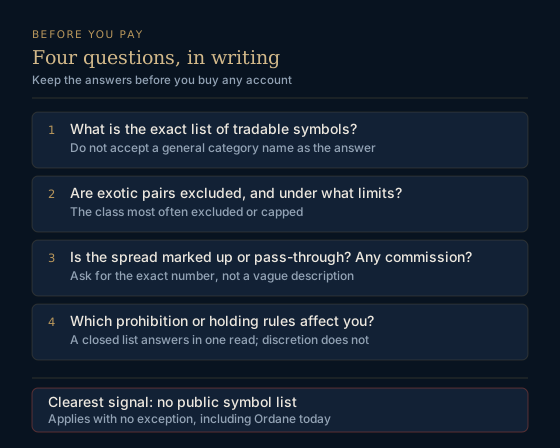
Put these four questions to any firm in writing before you pay, and keep the answers:
- What is the exact symbol list for the asset classes you trade, not a general category name?
- Are exotic pairs excluded, and if included, what limits apply to them specifically?
- Is the spread marked up or passed through, and is there a per-lot commission on top? Ask for the number, not a description.
- Which prohibited-practice or holding-window rules touch the instruments you trade? A closed list answers this in one read. A discretionary list does not answer it at all until it is applied to you.
The tell: no published symbol list
A firm that will not publish a symbol list before you pay is asking you to buy the menu blind. That is the single clearest tell in this whole check, and it applies with no exceptions, including to Ordane, which does not yet have one published. The standard does not bend for a firm you like. To learn more about vetting a prop firm, read Audit a Prop Firm in 5 Checks Before You Pay, Ordane Included.
Questions Traders Ask About What You Can Trade
What can you trade on a prop firm account?
It depends on the firm's business model. CFD-style firms typically list FX, indices, commodities, stocks and crypto as tradable instruments (FTMO FAQ, retrieved 2026-08-09). Futures-only firms restrict trading to exchange-listed futures contracts and exclude stocks, options, forex and crypto entirely (Topstep, retrieved 2026-08-09).
Can you trade crypto on a prop firm account?
Often, but "crypto" varies by firm and can mean a small handful of coins rather than a full book. Weekend trading hours on crypto can also vary by platform due to scheduled maintenance, so a listed crypto symbol is not always tradable on the same schedule every week (FTMO, Symbol Specifications & Trading Hours, retrieved 2026-08-09).
Are exotic forex pairs allowed, and why are they often excluded?
Exotic pairs are the class most often excluded or capped, because they carry thin liquidity and wide spreads, which is the same profile that makes them costly and risky for the firm to carry.
Can you trade single stocks or futures on a prop firm account?
It depends entirely on the business model. Futures-only firms trade nothing but exchange-listed futures on named exchanges and exclude stocks by rule (Topstep, retrieved 2026-08-09). CFD-style firms may list stocks as one class among several (FTMO FAQ, retrieved 2026-08-09).
Does a prop firm mark up the spread?
Some do, some pass it through unchanged. Ordane does neither: it charges no spread and no commission, both zero, because the account runs on simulated capital and neither line has a bill behind it (Ordane, Trading Specification, retrieved 2026-09-01).
Can a firm stop you from trading an instrument it lists?
Yes, indirectly, through rules that sit above the symbol list: a prohibited-practice rule on that instrument, a stop-loss and risk cap that makes it impractical to size, or a holding-window rule that blocks the schedule the instrument needs. A closed prohibited-practice list, like Ordane's R-6, at least makes that boundary knowable in advance rather than discovered after the fact. This article is for information only and is not investment, financial, or tax advice. Ordane accounts operate on simulated capital. No live funds are traded and no deposits are accepted. Payouts depend on simulated performance under Rulebook v1.0; no level of performance is typical or assured.
Sources
- Which instruments can I trade and what strategies am I allowed to use? | FTMO FAQ ftmo.com Retrieved 2026-08-09.
- Forex vs futures: trade smarter, not harder | Topstep topstep.com Retrieved 2026-08-09.
- FTMO vs E8 Markets: Evaluation Structure, Platforms & Scaling Options | QuantVPS quantvps.com Retrieved 2026-08-09.
- Trading Specification | Ordane Instant Account ordanemarkets.com Retrieved 2026-08-09.
- Symbol Specifications & Trading Hours | FTMO ftmo.com Retrieved 2026-08-09.