Home · The Ordane Journal · Before you pay · Prop Firms for Options: Rules
Prop Firms for Options: Rules
A prop firm for options trading is a company providing simulated capital for traders to buy and sell options contracts. Ordane accounts operate on simulated capital. No live funds are traded and no deposits are accepted. (Ordane Rulebook v1.0, clause P-2, retrieved 2026-09-26)
Traders search for a funded account to trade options, but the structure of derivatives makes risk management complex for the firm providing the capital. Options on futures are derivative contracts that grant the buyer the right, but not the obligation, to buy or sell a specific underlying futures contract at a predetermined price. (CME Group - Options on Futures, retrieved 2026-09-26) Because options have non-linear risk profiles, traditional proprietary trading firms restrict them.
What Is a Prop Firm for Options Trading?
A prop firm for options trading is a company that provides simulated capital specifically for buying and selling options contracts. These firms evaluate risk management skills and share simulated profits, requiring strict adherence to complex risk parameters and specialized platforms to monitor non-linear price movements.
When a trader looks for a firm offering options, the evaluation encompasses how the trader manages the Greeks: Delta, Gamma, Theta, and Vega. If the firm cannot monitor these metrics accurately, they will not offer the product.
Ordane sells one product, the Ordane Instant Account: direct access, no evaluation phase and no challenge, on simulated capital. (Ordane Rulebook v1.0, section 1, retrieved 2026-09-26) Ordane lists four asset classes: FX pairs, metals, indices and crypto. Options are not on the permitted instrument list.
Why Are the Greeks and Risk Management Hidden Rules?
The hidden rules of options prop trading center entirely around the Greeks and non-linear risk exposure. Proprietary trading firms that allow options trading require advanced risk management platforms to monitor non-linear risks and options Greeks. (Options Trading Risk Management, retrieved 2026-09-26)
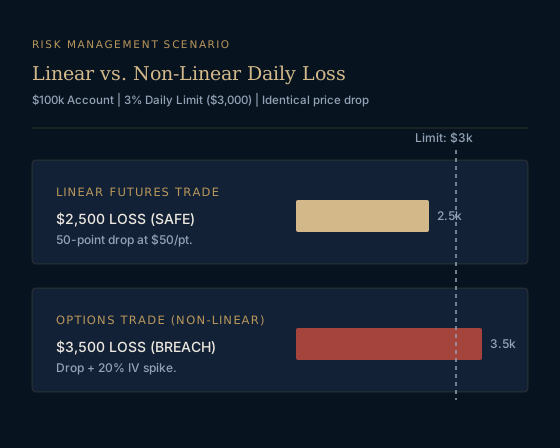
A linear daily loss limit is straightforward. If the asset drops ten ticks, the account loses a fixed amount. Gamma accelerates the risk as the underlying asset moves, meaning a position that is safe at market open might breach a loss limit shortly after due to volatility expansion (Vega) or time decay (Theta).
Consider a reproducible numerical scenario for a $100,000 account with a 3 percent daily limit. In a linear futures trade, a 50-point drop at $50 per point produces a $2,500 loss, staying within the $3,000 limit. In an options trade, identical price movement paired with a 20 percent spike in implied volatility can expand the premium loss to $3,500, immediately breaching the account parameters.
At Ordane, the drawdown rules are designed for linear instruments. Ordane's maximum drawdown is 5 percent and static: account equity may never fall below 95 percent of the initial balance. The floor is fixed on day one, never trails upward, and a breach closes the account. (Ordane Rulebook v1.0, clause R-1, retrieved 2026-09-26)
Which Prop Firms Allow Options Contracts?
Maverick Trading permits options through its Options Division; Topstep does not permit options and offers futures products instead. (Maverick Trading FAQ, retrieved 2026-09-27; Topstep Disclosures & Notices, retrieved 2026-09-27)
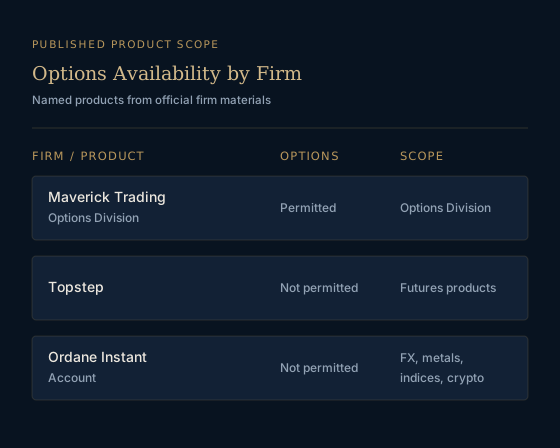
Ordane's Instant Account does not permit options. Its published instrument list covers FX pairs, metals, indices and crypto. This is a product-scope disclosure, separate from any consequence another firm may apply after a rule breach.
| Firm/product | Options contracts | Published scope |
|---|---|---|
| Maverick Trading Options Division | Permitted | Options Division |
| Topstep | Not permitted | Futures products |
| Ordane Instant Account | Not permitted | FX pairs, metals, indices and crypto |
Sources: Maverick Trading FAQ, Topstep Disclosures & Notices, and Ordane Rulebook, retrieved 2026-09-27.
What Is the Role of Trading Platforms in Options Prop Firms?
Trading platforms dictate what a prop firm can offer in the options market by monitoring real-time risk. A firm cannot offer options if its terminal cannot calculate portfolio risk dynamically.
An options-capable platform needs to display option chains, calculate implied volatility and model multi-leg positions. What happens after a risk limit is exceeded depends on the firm's current published rules; this article does not establish a universal automatic-liquidation policy.
Ordane runs on a trading platform it designed and built with its own engineering team, and licenses no third-party terminal. Direct control lets the firm implement its own published rules. Platform stability still depends on operation and testing.
Why Do Overnight Rules Matter for Options?
Holding an options contract overnight exposes the position to events that occur while the market is closed. A gap in the underlying asset or a change in implied volatility can change the option's value at the next open.
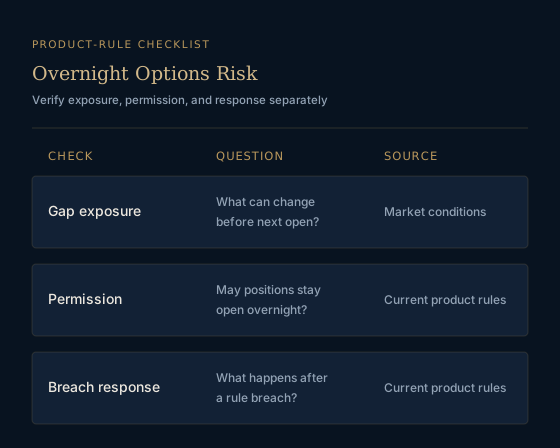
Overnight permissions and breach responses are product-specific. Check the firm's current overnight holding rules for whether positions may remain open and what action follows a breach; no universal closure or liquidation rule is established here.
Ordane disclosure. Overnight and weekend holding is allowed at Ordane. It is not on the R-6 closed list, and what is not listed is not a violation. (Ordane Rulebook v1.0, clause R-6, retrieved 2026-09-26) This disclosure concerns Ordane's linear-asset product and does not describe another firm's restrictions or enforcement.
FAQ: Prop Trading Firms for Options
How to find a prop firm for options trading?
To find a prop firm for options trading, you must filter out standard futures and forex firms. Search specifically for firms advertising an Options Division or explicitly stating they support options on futures or equity options.
Are there specific prop firms for options trading only?
Yes. Some firms focus entirely on the options market. These firms require traders to demonstrate proficiency in options strategies, Greeks, and volatility modeling, rather than simple directional trading.
Why do overnight rules matter for options trading?
Overnight news, a gap in the underlying asset and changes in implied volatility can affect an option's value at the next open. Whether holding is allowed, and what happens after a breach, depends on the firm's current product rules.
What platforms are required for options trading?
Options trading requires platforms capable of displaying options chains, modeling multi-leg strategies, and calculating Greeks in real-time. You must use the specific platform mandated by the prop firm.
Does Topstep permit options trading?
No. Topstep's official disclosures prohibit options, while Maverick Trading's official FAQ describes an Options Division. (Maverick Trading FAQ, retrieved 2026-09-27; Topstep Disclosures & Notices, retrieved 2026-09-27)
This article is for information only and is not investment, financial, or tax advice.
Ordane accounts operate on simulated capital. No live funds are traded and no deposits are accepted. Payouts depend on simulated performance under Rulebook v1.3; no level of performance is typical or assured.
Sources
- CME Group - Options on Futures cmegroup.com Retrieved 2026-09-26T00:46:14Z.
- Options Trading Risk Management financemagnates.com Retrieved 2026-09-26T00:46:14Z.
- Topstep Permitted Products topstep.com Retrieved 2026-09-26T00:45:36Z.
- Maverick Trading Options Division mavericktrading.com Retrieved 2026-09-26T00:45:36Z.
- Maverick Trading Options Division mavericktrading.com Retrieved 2026-09-26T00:46:14Z.