Home · The Ordane Journal · Before you pay · What is the Best Prop Firm? Objective Comparison
What is the Best Prop Firm? Objective Comparison

The best prop firm is the trading program whose payment conditions, loss limits, restrictions, and total cost fit the trader’s strategy, rather than the brand advertising the largest profit split. The comparison must separate payment eligibility from processing time and distinguish entry charges from later fees.
Ordane accounts operate on simulated capital. No live funds are traded and no deposits are accepted.
Ordane sells one product, the Ordane Instant Account: direct access, no evaluation phase and no challenge, on simulated capital.
What is a prop firm and how does it work?
For this comparison, a retail prop-firm offer is a paid trading program with rules governing evaluation, account access, and eligibility for performance-based payments.
The label alone does not establish what you buy. FTMO (prop firm) defines its 2-Step Challenge loss allowances against initial simulated capital. (FTMO, retrieved 2026-09-27) Topstep (prop firm) does not permit spot forex or swing trading. (Topstep, retrieved 2026-09-27)
Read each offer as a sequence: what you pay, what you must complete, which rules govern the subsequent account, and what makes a payment request eligible. Passing an evaluation does not explain the conditions of the next stage.
This comparison uses research retrieved on September 27, 2026. It covers specified FTMO 2-Step and Topstep Standard Path terms, not every product either firm offers. Documented conditions are not independently verified payment performance or evidence of solvency.
Do you really get paid?
Published payout conditions explain eligibility and profit sharing; they do not prove that a particular request was paid.
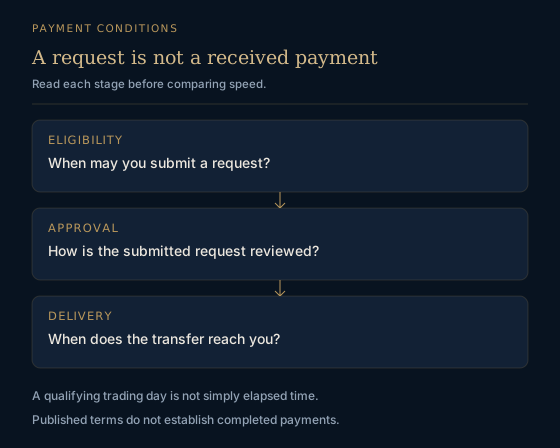
Request eligibility, approval, and delivery are separate clocks. A waiting period, winning-day requirement, and processing estimate answer different questions. Treating them as interchangeable creates a misleading speed comparison.
Profit splits and eligibility. FTMO’s base 2-Step profit share is 80%, and a trader may request a Reward on or after the 14th day following the first trade on that account. (FTMO, retrieved 2026-09-27)
Topstep’s payout policy gives the trader 90%. Its Express Funded Account Standard path requires five non-consecutive winning days with at least $150 net profit each. Positive net profit since the previous payout is also required, except for the first payout. (Topstep, retrieved 2026-09-27)
A qualifying-day requirement measures performance, not simply elapsed time. Ask whether your usual trading produces qualifying days without changing your risk discipline. Increasing position size to qualify can make a seemingly attractive payment condition incompatible with your strategy.
What restrictions can change the outcome?
Consistency conditions, payment caps, and position-holding restrictions can affect different stages and carry different consequences.
A published restriction is not hidden merely because it is inconvenient. The question is whether you understood it before paying and whether it applies to your exact product.
Consistency and caps. Topstep’s Trading Combine requires the best single day to remain below 55% of the Profit Target to avoid increasing the Consistency Target. The denominator is the Profit Target; the stated consequence is a higher target, not automatic account closure. (Topstep, retrieved 2026-09-27)
Topstep’s 50K XFA Standard limits a request to 50% of the balance, capped at $2,000. A qualifying new Trading Combine purchase with a Daily Loss Limit selected at checkout doubles the dollar cap under the cited offer. Adding that limit during XFA activation does not qualify. (Topstep, retrieved 2026-09-27)
FTMO lists transfer-method ceilings of $20,000 for Visa Direct/Mastercard Send and $3,000 for Skrill. Those ceilings concern payment methods, not a universal cap on earned profit. (FTMO, retrieved 2026-09-27)
News and holding permissions. Topstep requires weekday position closure by 3:10 PM CT and does not permit swing trading. (Topstep, retrieved 2026-09-27) FTMO applies selected-news restrictions to Standard accounts after evaluation; its Swing account type has no such news restriction. That exemption alone does not document every overnight or weekend condition. (FTMO, retrieved 2026-09-27)
Verify holding permissions separately. Never transfer a permission from one account type to every account offered by the same firm.
Comparing Ordane with the documented alternatives
A useful decision matrix distinguishes documented differences from questions the available evidence cannot settle. The short cells below keep the comparison scannable; source scope and retrieval dates follow the table.
| Decision point | Ordane Instant Account | Named comparison |
|---|---|---|
| Account description | Simulated; no deposits | FTMO 2-Step: simulated-capital reference |
| Entry path | Direct access; no challenge | Topstep: pass, then activate XFA |
| Payment evidence | Not independently assessed | FTMO and Topstep: terms only |
| Continuity evidence | Not established | FTMO and Topstep: not established |
Table sources: Ordane Rulebook, FTMO Trading Objectives, and Topstep pricing and payment questions, retrieved 2026-09-27. The final two rows state the limits of this comparison rather than positive claims about any firm.
Will the prop firm still exist next year?
The evidence available for this comparison cannot establish whether a firm will remain operating next year.
The CFTC describes speculation in commodity futures and options as complex, volatile, and risky, with limited suitability for retail customers. This concerns trading risk, not the solvency of FTMO or Topstep. (CFTC, retrieved 2026-09-27)
Separate the questions. Can your strategy operate within the contract? Can you afford the fees without receiving a payment? What dated evidence supports the firm’s ability to meet its obligations? A favorable answer to one does not settle the others.
Look for payment records, the contracting entity, and obligations if service ends. Missing evidence remains an unanswered question. This article supplies neither audited financial statements nor independently verified payment histories, so it cannot assign a stability score.
How much does an evaluation actually cost?
The relevant cost includes entry charges, recurring evaluation payments, and activation fees, while refunds remain conditional.
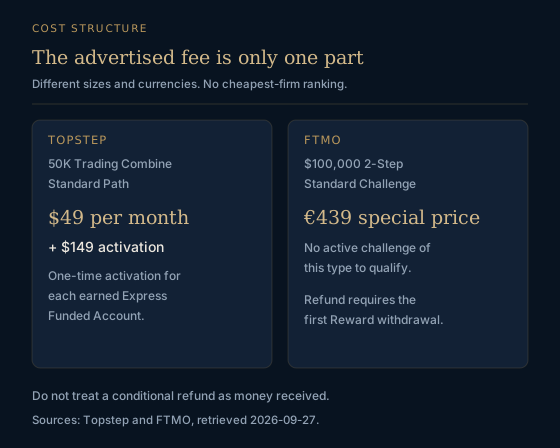
Topstep lists its 50K Trading Combine Standard Path at $49 per month, followed by a one-time $149 activation fee for each earned Express Funded Account. (Topstep, retrieved 2026-09-27)
FTMO displayed a €439 special price for its $100,000 2-Step Standard Challenge, restricted to customers without an active one. (FTMO, retrieved 2026-09-27) FTMO’s fee refund depends on receiving the first Reward withdrawal. (FTMO, retrieved 2026-09-27)
Different account sizes, currencies, and billing structures prevent a like-for-like cheapest-firm verdict. Budget for the evaluation time you may need. Do not subtract a conditional refund as though receipt were certain, and confirm promotional eligibility before treating an advertised price as your purchase price.
How do maximum and daily loss limits differ?
Maximum loss limits constrain the overall loss allowance; daily limits impose a separate boundary using their own reference amounts and reset rules.
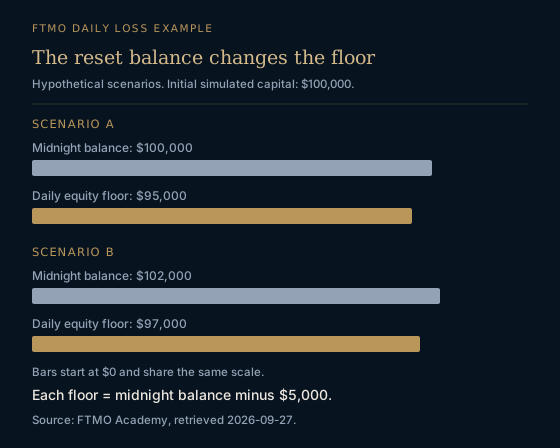
A static reference stays fixed. A trailing reference moves according to the specified performance measure. Neither the advertised account size nor the percentage alone explains the usable boundary.
FTMO’s 2-Step maximum loss amount is 10% of initial simulated capital, while its daily loss amount is 5%. (FTMO, retrieved 2026-09-27) Topstep’s 50K Trading Combine starts with a $2,000 Maximum Loss Limit that trails upward with end-of-day gains. (Topstep, retrieved 2026-09-27)
Topstep’s Daily Loss Limit is optional in the Trading Combine and Express Funded Account; when selected for a 50K account, it is $1,000. (Topstep, retrieved 2026-09-27)
Reproducible daily-loss example. For FTMO’s $100,000 example, the daily allowance is $100,000 × 0.05 = $5,000. The equity floor is the midnight CE(S)T balance minus that allowance. Closed results, floating profit or loss, commissions, and swaps count. (FTMO Academy, retrieved 2026-09-27)
The following assumptions illustrate that formula; they are hypothetical balances, not observed trading results. Initial simulated capital remains $100,000 throughout.
| Assumed balance at midnight CE(S)T | Calculation | Daily equity floor |
|---|---|---|
| $100,000 | $100,000 − ($100,000 × 0.05) | $95,000 |
| $102,000 | $102,000 − ($100,000 × 0.05) | $97,000 |
The allowance stays $5,000 while the reset balance changes the daily floor. An open loss counts before a position closes, and a midnight reset can turn an overnight position into a breach. (FTMO Academy, retrieved 2026-09-27)
Topstep monitors realized and unrealized Net PnL, with commissions and fees deducted as trades fill. (Topstep risk limits, retrieved 2026-09-27; Topstep fees, retrieved 2026-09-27)
Topstep’s DLL session runs from 5 PM to 3:10 PM CT. Reaching the selected limit closes positions and prevents trading until the next 5 PM session; that event alone is not a rule violation. (Topstep, retrieved 2026-09-27)
FAQ: Finding the best prop firm
The strongest choice is the specific product whose documented conditions fit your requirements; the evidence here does not establish a universal winner.
What is the best prop firm?
Choose by permitted activity, loss mechanics, payment eligibility, and total cost before comparing splits. For example, Topstep’s prohibition on swing trading makes that product incompatible with a strategy requiring multi-day positions. (Topstep, retrieved 2026-09-27)
Which prop firm has the lowest fees?
This comparison cannot identify a universal cheapest option. Topstep’s cited 50K Standard Path costs $49 monthly plus $149 activation per earned XFA. (Topstep, retrieved 2026-09-27) FTMO’s cited $100,000 special offer is €439 with eligibility restrictions. Account sizes and billing structures differ. (FTMO, retrieved 2026-09-27)
Which prop firm pays out the fastest?
The cited estimates do not establish a universal winner. Topstep internal approval can take 1-3 business days. Eligible US Aeropay transfers can arrive instantly after approval when the bank supports real-time payments; otherwise delivery may take 1-3 business days. ACH is estimated at 1-3 business days and international wire at 5-10, excluding weekends and holidays. (Topstep, retrieved 2026-09-27)
FTMO reviews requests within 1-2 business days and typically sends the Reward within 1-2 business days after invoice approval. Sending is not bank receipt. Compare eligibility, approval, and delivery separately. (FTMO, retrieved 2026-09-27)
Do prop firms allow swing trading?
Permissions depend on the product. Topstep requires weekday closure by 3:10 PM CT and prohibits swing trading. (Topstep, retrieved 2026-09-27) FTMO’s Swing exemption from selected-news restrictions does not alone establish its complete holding policy. (FTMO, retrieved 2026-09-27)
Are prop firm profit splits real?
Profit splits are documented allocation terms, not proof of completed payments. FTMO’s base 2-Step share is 80%. (FTMO, retrieved 2026-09-27) Topstep’s cited policy gives the trader 90%. Eligibility and payment evidence must be assessed separately. (Topstep, retrieved 2026-09-27)
Sources
- Love for Trading | FTMO promo.ftmo.com Retrieved 2026-09-27.
- Do we charge any other fees? Are the fees recurrent? | FTMO ftmo.com Retrieved 2026-09-27.
- Trading Objectives | FTMO ftmo.com Retrieved 2026-09-27.
- How do I withdraw my reward? | FTMO ftmo.com Retrieved 2026-09-27.
- FTMO Challenge: 2-Step | FTMO ftmo.com Retrieved 2026-09-27.
- Topstep Pricing and Payment Questions | Topstep Help Center help.topstep.com Retrieved 2026-09-27.
- What is the Maximum Loss Limit? | Topstep Help Center help.topstep.com Retrieved 2026-09-27.
- Daily Loss Limit in the Trading Combine and Express Funded Account | Topstep Help Center help.topstep.com Retrieved 2026-09-27.
- Trading Combine Parameters | Topstep Help Center help.topstep.com Retrieved 2026-09-27.
- Topstep Payout Policy | Topstep Help Center help.topstep.com Retrieved 2026-09-27.
- When and What Products Can I Trade? | Topstep Help Center help.topstep.com Retrieved 2026-09-27.
- Basics of Futures Trading | CFTC cftc.gov Retrieved 2026-09-27.
- ftmo.com ftmo.com Retrieved 2026-09-27.
- academy.ftmo.com academy.ftmo.com Retrieved 2026-09-27.