Home · The Ordane Journal · Before you pay · Proprietary Trading Platform: Compare Systems and Verified Rules
Proprietary Trading Platform: Compare Systems and Verified Rules
What Is a Proprietary Trading Platform?
A proprietary trading platform is the core software infrastructure that firms use to provide market access to retail traders, enforcing risk limits and tracking performance across all accounts. Ordane accounts operate on simulated capital. No live funds are traded and no deposits are accepted.
Most firms use either challenge/evaluation accounts or instant funding with stricter risk rules (Prop Firm Rules Explained, retrieved 2026-09-29). The platform tracks performance, enforces limits, and manages the simulated environment where traders execute their strategies.
Ordane sells one product, the Ordane Instant Account: direct access, no evaluation phase and no challenge, on simulated capital.
Traders access these systems to apply their methods without risking personal assets. The firm provides the software, the data feed, and the rules of engagement. When you connect to a proprietary trading platform, you are subject to the specific configuration chosen by the provider. Every order, stop loss, and holding time is measured against the firm's specific rulebook. Understanding how these platforms operate is the very first step before you commit your time and capital.
Do You Actually Get Paid?
The most prominent fear every trader has is passing the evaluation and never receiving a payout. The industry contains firms that delay payments or invent reasons to deny withdrawals. When you use a proprietary trading platform, the software records your performance, but the firm ultimately decides when to release the money.
You must look for documented payout mechanics. A promise on a sales page is meaningless without a binding contract. At Ordane, the rules are public. Every withdrawal request is approved, or denied in writing citing the exact rule breached by section number, within 12 clock hours. Past that deadline the request is treated as approved and the G-1 clock starts.
This is enforced by The Ordane Guarantee. A payout approved and not paid within 24 clock hours, not business hours, triggers automatic compensation: a 100 percent refund of the account fee, plus the payout owed in full. The Ordane Guarantee has two objective exclusions: documented fraud or KYC review, and declared force majeure. Both G-2 exclusions (documented fraud or KYC review, and declared force majeure) are capped at 10 business days each. Past that deadline, G-1 applies regardless.
What Hidden Rules Close Accounts?
The second prevalent fear is the elastic clause. Some firms hide subjective rules in their documentation, allowing them to close your account right when you request a withdrawal. A reliable proprietary trading platform should enforce objective, mathematical limits.
Ordane's prohibited-practice list is closed. Clause R-6 names six practices: latency, reverse or hedge arbitrage; high-frequency or bulk automated exploitation; copy trading between Ordane accounts; straddling news releases with paired opposing orders; platform or data-feed exploitation; and gap abuse. If a behavior is not listed in that section, it is not a violation. Discretion is not a rule.
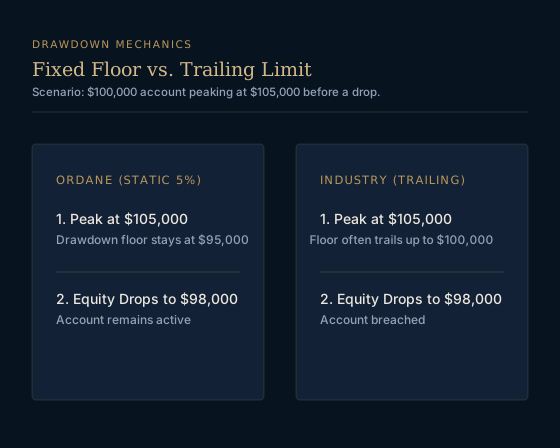
The drawdown limits must be equally clear. Ordane's maximum drawdown is 5 percent and static: account equity may never fall below 95 percent of the initial balance. The floor is fixed on day one, never trails upward, and a breach closes the account. The daily loss limit is 3 percent, measured against the balance at the start of the server day. A breach closes the account. Maximum risk per trade is 1.5 percent of current balance and a stop-loss is mandatory at entry. Two maximum losses equal the daily limit, which is the design rather than an accident. A breach closes the account. That is the whole consequence: no partial confiscations, no surprise fees, no renegotiation.
To illustrate how the mathematical limits work in practice, consider this reproducible numeric scenario of a drawdown calculation.
| Scenario: $100,000 Account | Ordane Limit (Fixed 5%) | Industry Standard (Trailing) |
|---|---|---|
| Initial Balance | $100,000 | $100,000 |
| Account Reaches $105,000 | Drawdown floor stays at $95,000 | Floor often trails up to $100,000 |
| Equity Drops to $98,000 | Account remains active | Account breached if trailing |
Why Do Prop Firms Disappear?
The third fear is the firm vanishing with fees and payouts. In recent years, numerous providers have shut down overnight. The proprietary trading platform goes offline, and traders lose their pending withdrawals. You need proof of capitalization.
Ordane is new. Its live homepage says it will not fake a history; the rulebook says payout performance metrics begin with the first month in which a payout is requested. To address the fear of closure, the firm provides verifiable on-chain evidence. The payout reserve address is disclosed on-chain for any purchase bound to this version of the Ordane Rulebook. Rulebook v1.3 commits Ordane to a dated payout ledger from payout number one, and to payout performance metrics published with dates on a fixed monthly schedule. As of July 25, 2026, the ledger is empty, because no payout has happened yet.
Payouts are paid in real money from company fee revenue. No client deposits are taken and no client capital is traded. Rulebook v1.3 clause PR-1 commits Ordane to publish the payout reserve on-chain; the live rulebook and homepage publish the TRON address. Rulebook v1.3 clause PR-3 commits Ordane to independent third-party attestation of payout records, entering effect per the public roadmap milestone.
What Trading Software Do Firms Use?
A proprietary trading platform relies on specific software interfaces to connect the trader to the simulated market. For instance, Topstep (prop firm) focuses exclusively on futures products.
However, relying on third-party licenses introduces risk. If the vendor revokes the license, the prop firm must shut down operations. Ordane runs on a trading platform it designed and built with its own engineering team, and licenses no third-party terminal: not MatchTrader, not MetaTrader, not any external vendor. The distinction is structural, not cosmetic. A firm that licenses its terminal can be closed by a decision it does not control, and in 2024 that is exactly what happened: MetaQuotes withdrew MT4 and MT5 access from prop firms, True Forex Funds announced permanent closure on May 13 after its licences were terminated, and SurgeTrader ceased all operations on May 24, one week after losing its Match-Trader licence. Ordane owns the terminal its traders use, so no vendor can revoke it, reprice it, or decide it will no longer serve this industry.
This infrastructure supports various markets. Ordane lists four asset classes: FX pairs (majors and minors), metals, indices and crypto. No exotics.
What Are the Documented Rules and Costs?
Before committing to any proprietary trading platform, you must understand the exact cost and the profit split structure. Prop firm traders typically keep 70-90% of profits, with top firms in 2026 offering 80-100% splits (2026 Guide to Prop Firms, retrieved 2026-09-29).
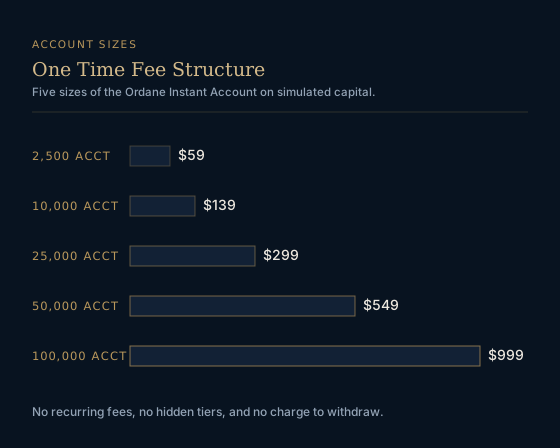
Ordane Instant Account comes in five sizes: $2,500, $10,000, $25,000, $50,000, and $100,000. The fee is one-time: $59 for the $2,500 account, $139 for the $10,000 account, $299 for the $25,000 account, $549 for the $50,000 account, $999 for the $100,000 account. There are no recurring fees, no hidden tiers and no charge to withdraw. The Ordane rulebook is public, numbered and versioned, and no rule is ever applied retroactively to an open account. Changes produce a new version with a dated changelog entry, and the version you sign up under is the version that governs your account. The governing document is Ordane Rulebook v1.0, published July 23, 2026. The current public version is v1.3, effective September 21, 2026, and the version you sign up under is the version that governs your account.
Ordane's profit split starts at 80 percent and rises 2.5 percentage points with every completed withdrawal, reaching 100 percent from the ninth withdrawal onward. The split ladder is in writing and never resets. Withdrawals #1 and #2 are each capped at 3 percent of initial balance. From withdrawal #3 onward there is no cap. Withdrawals reduce the account balance, and the R-1 drawdown floor stays anchored to the initial balance. The first withdrawal is available 7 calendar days after account activation. Each later withdrawal is available 14 calendar days after the preceding withdrawal is completed, not on a fixed recurring cycle. A pending, declined or unknown request does not start the next 14-day period.
What Should You Verify Before Paying?
Before you pay an evaluation fee, you must verify the operational foundation of the proprietary trading platform. The CFTC strongly urges the public to verify a company's registration with the Commission (CFTC Customer Advisory, retrieved 2026-09-29). You should inspect the firm's legal standing, the clarity of its rulebook, and the software it uses.
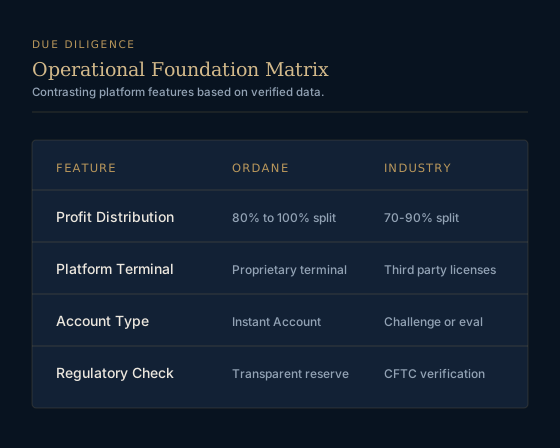
The multidimensional decision matrix below contrasts platform features based on verified data.
| Metric/Feature | Ordane (Simulated) | Industry Standard |
|---|---|---|
| Profit Distribution | 80% to 100% split | 70-90% split |
| Platform Terminal | Proprietary terminal | Third-party licenses |
| Account Type | Instant Account | Challenge or evaluation |
| Regulatory Check | Transparent reserve | CFTC urges verification |
In addition to external checks, read the provider's specific rules carefully. Expert Advisors are fully permitted at Ordane: a trader may run an EA executing the trader's own strategy on an Ordane account. Appendix A of Rulebook v1.3 is published and defines each R-6 practice with examples. A-2 states that R-6(b) does not ban all automation, only bulk or high-frequency exploitation: a single expert advisor or script placing discretionary or rules-based trades at human-scale frequency, with a stop-loss on every position under R-3, is the example that does NOT close the account.
FAQ: Proprietary Trading Platform
Clear answers to common questions about how these trading systems operate and enforce limits.
What happens if you breach a rule?
A breach closes the account. That is the whole consequence: no partial confiscations, no surprise fees, no renegotiation.
Are there recurring fees?
The fee is one-time: $59 for the $2,500 account, $139 for the $10,000 account, $299 for the $25,000 account, $549 for the $50,000 account, $999 for the $100,000 account. There are no recurring fees, no hidden tiers and no charge to withdraw.
Can you hold trades over the weekend?
Overnight holding is permitted at Ordane, but weekend holding is not. Clause C-7 defines the two Instant Core trading windows: a 10-minute exclusion around high-impact scheduled releases on the affected instrument, and no weekend holding. Overnight holding during the trading week remains permitted under the same clause.
How do payouts scale?
Ordane's profit split starts at 80 percent and rises 2.5 percentage points with every completed withdrawal, reaching 100 percent from the ninth withdrawal onward.
Sources
- Topstep topstep.com Retrieved 2026-09-29.
- CFTC Customer Advisory cftc.gov Retrieved 2026-09-29.