Home · The Ordane Journal · Before you pay · Best Futures Prop Firms: Payouts
Best Futures Prop Firms: Payouts
What Are Futures Prop Firms?
Futures prop firms are entities that provide traders with access to simulated capital for trading futures contracts. They design evaluation programs where traders must navigate specific profit targets and maximum drawdown limits. The firm monitors every position to ensure adherence to strict risk rules before approving any advancement through the structured challenge.
Ordane accounts operate on simulated capital. No live funds are traded and no deposits are accepted.
Ordane sells one product, the Ordane Instant Account: direct access, no evaluation phase and no challenge, on simulated capital. (Ordane Rulebook v1.3, section 1, retrieved 2026-09-29)
Traders who pass the evaluation receive a profit split on the simulated gains they generate, while the firm retains a portion of those earnings. The model relies on an evaluation phase where traders pay an upfront fee to prove their discipline against a set of rules. This fee grants access to a simulated environment connected to live market data. If the trader breaches a rule, the account is closed. If the trader meets the profit target without breaching any rules, they progress to a payout stage, which remains simulated but qualifies for withdrawals based on performance. The market is saturated with options, each presenting different rules, pricing tiers, and payout conditions. Traders evaluating these firms must look beyond the marketing material and analyze the specific terms governing withdrawals.
How Do Futures Evaluation Accounts Work?
Evaluating a futures prop firm requires understanding how their challenges are structured. The industry standard involves one or two steps of simulated trading where specific profit targets must be reached. During this phase, traders are bound by drawdown limits, daily loss limits, and consistency rules. These parameters dictate the risk environment and the statistical probability of passing the test.
When comparing options, the evaluation structure dictates the difficulty of reaching the payout stage. Firms specify the maximum drawdown, which can be trailing or static, and the daily loss limit, which dictates how much equity can be lost in a single trading session. A trailing drawdown that follows open profit can close an account even if the trader closes the position in profit, making the evaluation significantly harder. Traders must carefully read the rulebook to understand exactly how and when drawdowns are calculated.
Traditional futures firms generate revenue from subscription fees and resets as traders attempt to pass the stringent rules of the evaluation phase.
Do Futures Prop Firms Actually Pay?
The primary concern for any trader is whether the firm honors payout requests after the evaluation is passed. The industry features firms that highlight high profit splits to attract users, focusing marketing efforts on the potential upside. For example, Apex Trader Funding (prop firm) offers 100% payout split on approved payouts for current End-of-Day (EOD) Performance Accounts (Apex PA Payout Parameters, retrieved 2026-09-29).
However, a high advertised split is only relevant if the payout is actually processed. Traders often fear passing the challenge, requesting a withdrawal, and facing indefinite delays or sudden account reviews. The focus must shift from the advertised percentage to the verifiable payout mechanism. A firm's commitment to paying its users should be backed by a clear, published timeframe and a strict penalty for failure to meet that deadline. The industry advertises the split, but the mechanism for ensuring that split reaches the trader is often left vague.
How Do Profit Splits and Payout Rules Work?
Profit splits dictate how much of the generated simulated profit the trader keeps. While initial splits might be high, the terms governing when and how those splits can be withdrawn are crucial. Many firms implement a payout ladder, where the split percentage changes based on the number of completed withdrawals or the total amount withdrawn over time. The terms of these ladders determine the actual cash flow a trader can expect.
Traders must also verify if there are caps on the initial withdrawals. Some firms limit the first few payouts to a small percentage of the initial account balance, regardless of the total profit generated during the period. This restricts early liquidity and forces the trader to maintain the account longer to access significant funds. Furthermore, the schedule for withdrawals varies greatly. Some firms restrict payouts to specific days of the month, while others allow withdrawals only after a set number of active trading days. Withdrawals reduce the account balance in most structures, and traders must check how the drawdown floor is anchored.
Withdrawals #1 and #2 are each capped at 3 percent of initial balance under Ordane's rules. From withdrawal #3 onward there is no cap (Ordane Rulebook v1.0, clause PA-3, retrieved 2026-08-10).
What Are Active Account Limits?
The second major fear involves hidden rules that can cause an account to be closed during the payout phase. Firms often impose restrictions on the number of accounts a single trader can operate to prevent massive exposure from a single strategy. These caps are documented in each firm's terms of use, and the exact limit varies over time, so confirm the current number before opening additional accounts.
These limits are designed to control the firm's exposure, but they must be clearly stated in the rulebook. Beyond account limits, traders must scrutinize the documentation for consistency clauses, restrictions on trading around news events, and prohibitions on specific trading styles. A firm with a closed list of prohibited practices provides clarity, as anything not explicitly banned is permitted. Vague rules allow firms to apply subjective judgment at the time of a payout request, which introduces unacceptable risk for the trader.
Why Does Platform Connectivity Matter?
The third critical question is whether the firm will remain operational in the long term. A prop firm's longevity is closely tied to its infrastructure and vendor relationships. Firms relying entirely on third-party trading platforms are vulnerable to license revocations and sudden changes in vendor terms. Topstep focuses exclusively on futures products. The firm supports popular retail trading platforms for charting and execution.
While connecting to established platforms provides a familiar interface, structural independence offers a different layer of security. A firm that licenses its terminal can be closed by a decision it does not control. Owning the proprietary trading infrastructure ensures that no external vendor can revoke access, alter the pricing model, or decide it will no longer serve the prop firm industry.
How Can You Verify Financial Stability?
Longevity is also determined by financial transparency and the capitalization of the firm. A firm that publicly proves its ability to pay its users demonstrates a higher level of stability than one relying solely on marketing claims and user testimonials. The industry standard often involves sharing screenshots of payouts, but verifiable proof requires on-chain visibility or audited ledgers that anyone can inspect independently.
This level of transparency directly addresses the fear of a firm vanishing with fees and accumulated payouts. When a reserve is public, any trader can inspect the balance before purchasing an account, ensuring that the capital required to honor payout requests is available and verifiable.
How Much Do Futures Prop Firms Cost?
Pricing structures in the futures prop firm industry vary widely, typically scaling with the size of the simulated account. Evaluation fees are usually charged on a monthly subscription basis until the trader passes the challenge, fails, or cancels the subscription. Topstep Trading Combine costs $49/month for 50K, $99-149 for 100K, $199-229 for 150K (Topstep Pricing, retrieved 2026-09-29).
Account sizes dictate the purchasing power and the corresponding risk parameters. Apex Trader Funding offers evaluations from $25K to $300K accounts (Apex Help Center, retrieved 2026-09-29). The monthly cost of an evaluation must be carefully weighed against the strictness of the rules. A cheaper monthly fee might accompany a trailing drawdown that is difficult to manage, leading to multiple resets and a significantly higher total cost over time. The true cost includes the subscription time required to pass and any reset fees incurred along the way.
Ordane Instant Account comes in five sizes: $2,500, $10,000, $25,000, $50,000, and $100,000 (Ordane Rulebook v1.0, section 1, retrieved 2026-08-10). The fee is one-time: $59 for the $2,500 account, $139 for the $10,000 account, $299 for the $25,000 account, $549 for the $50,000 account, $999 for the $100,000 account. There are no recurring fees and no hidden tiers (Ordane Rulebook v1.0, section 1, retrieved 2026-08-15).
What Is the True Cost of an Evaluation?
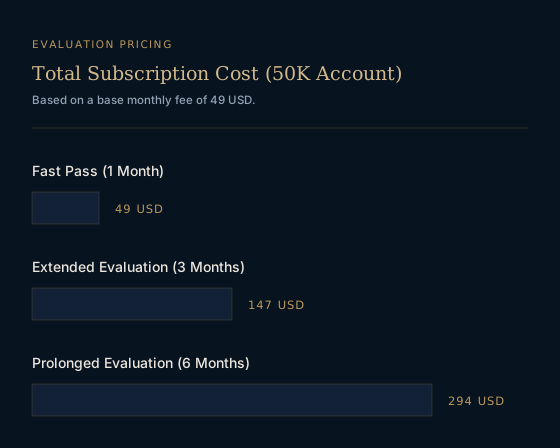
Understanding the total expense requires calculating the monthly subscription alongside potential reset fees over a realistic timeframe. Based on the $49 base monthly fee for a 50K account, total subscription costs scale directly with the evaluation duration.
| Scenario (50K Simulated Account) | Base Monthly Fee | Duration | Total Subscription Cost |
|---|---|---|---|
| Fast Pass | $49 | 1 Month | $49 |
| Extended Evaluation | $49 | 3 Months | $147 |
| Prolonged Evaluation | $49 | 6 Months | $294 |
How Do Competitor Pricing and Rules Compare?
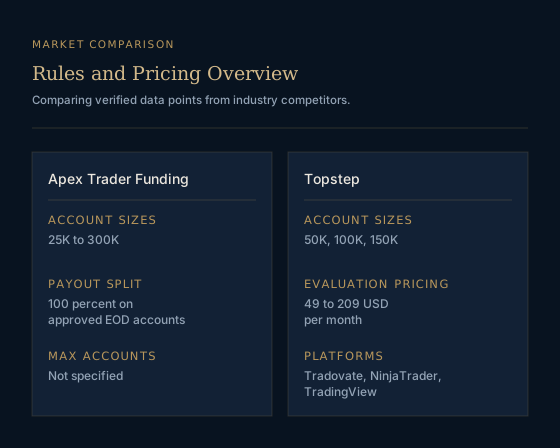
To provide a clear view of the market, the following table compares the essential rules, pricing, and features of the firms discussed in this analysis, focusing strictly on verifiable facts rather than marketing claims.
| Firm | Account Sizes Available | Evaluation Pricing | Payout Split | Max Active Accounts | Supported Platforms |
|---|---|---|---|---|---|
| Apex Trader Funding | $25K to $300K (Apex Help Center, retrieved 2026-09-29) | Varies by account size | 100% on approved EOD accounts (Apex PA Payout Parameters, retrieved 2026-09-29) | Not specified in this dataset | Varies |
| Topstep | 50K, 100K, 150K | $49 to $229/month (Topstep Pricing, retrieved 2026-09-29) | Varies by ruleset | Documented in the Terms of Use | Popular retail trading platforms |
How Does Ordane Compare to the Industry Standard?
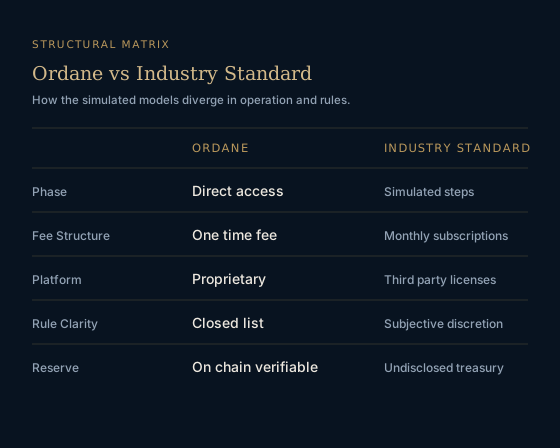
This matrix evaluates structural differences between the Ordane simulated model and the broader futures evaluation industry standard.
| Metric/Feature | Ordane (Simulated) | Industry Standard |
|---|---|---|
| Evaluation Phase | Direct access, no challenge | One or two steps of simulated trading |
| Fee Structure | One-time fee, no recurring charges | Monthly subscriptions and reset fees |
| Platform Independence | Proprietary trading platform | Licenses third-party platforms |
| Rule Clarity | Versioned rulebook, closed list | Subjective discretion, unlisted violations |
| Reserve Transparency | On-chain verifiable reserve | Undisclosed treasury, screenshot proof |
Structured Fact Summary
This table summarizes the verifiable claims regarding futures prop firms and their operational rules, ensuring all data points are sourced directly from documented policies.
| Claim Focus | Verifiable Fact | Firm |
|---|---|---|
| Account Limits | Documented in the Terms of Use; confirm current caps before opening multiple accounts | Topstep |
| Platforms | Popular retail trading platforms | Topstep |
| Pricing Tiers | Combine costs $49/month for 50K up to $229/month for 150K (Topstep Pricing, retrieved 2026-09-29) | Topstep |
| Capital Allocation | Offers evaluation accounts ranging from $25K to $300K (Apex Help Center, retrieved 2026-09-29) | Apex |
| Payout Conditions | Offers 100% payout split on approved payouts for current EOD accounts (Apex PA Payout Parameters, retrieved 2026-09-29) | Apex |
FAQ: Best Futures Prop Firms
This section answers common questions regarding the operation, pricing, and rules of futures prop firms, relying on documented facts.
Which futures prop firm pays 100% split?
Apex Trader Funding offers 100% payout split on approved payouts for current End-of-Day (EOD) Performance Accounts (Apex PA Payout Parameters, retrieved 2026-09-29). This high split is a significant factor for traders evaluating which firm to choose, though it is crucial to understand the specific conditions, such as the EOD requirement, needed to achieve and withdraw those funds successfully.
How much does a futures prop firm cost?
The cost depends on the firm and the chosen account size. For example, Topstep Trading Combine costs $49/month for 50K, $99-149 for 100K, $199-229 for 150K (Topstep Pricing, retrieved 2026-09-29). Traders must factor in these recurring monthly costs, along with any potential evaluation reset fees, when calculating the total expense of participating in a simulated challenge.
How many funded accounts can you have?
Most firms cap how many active accounts one trader may run at the same time, to keep total risk exposure controlled. These caps are strictly enforced, and trying to get around them with multiple registrations usually ends in account closure without refund.
Which platforms do futures prop firms use?
Platform connectivity varies by firm and their specific technology stack. Topstep focuses exclusively on futures products and supports popular retail trading platforms for charting and execution. Connecting to established software provides familiar charting and execution tools for the trader.
What are the account sizes for futures prop firms?
Account sizes represent the amount of simulated capital available for trading and dictate the position sizing and drawdown limits. Apex Trader Funding offers evaluations from $25K to $300K accounts (Apex Help Center, retrieved 2026-09-29). Larger accounts come with higher upfront fees and larger profit targets, but they also provide larger drawdown buffers during the trading period.
Sources
- Topstep topstep.com Retrieved 2026-09-29.
- Topstep Pricing help.topstep.com Retrieved 2026-09-29.