Home · The Ordane Journal · Before you pay · Compare Top Prop Trading Companies
Compare Top Prop Trading Companies

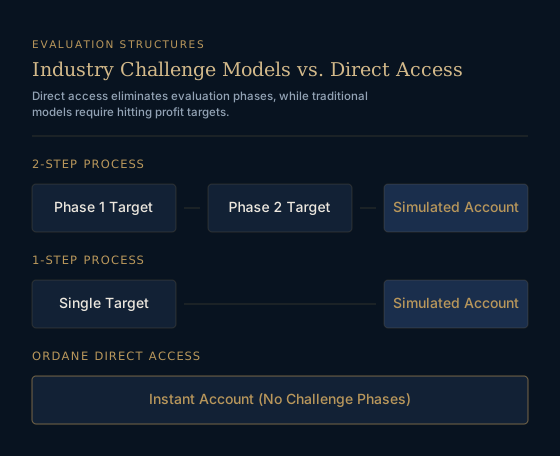
Proprietary trading companies provide simulated capital under risk rules, while the model compared here sets withdrawal decisions within 12 clock hours, payment within 24 clock hours after approval, and 100 percent fee compensation if an approved payout remains unpaid. Traditional 1-step and 2-step challenges require an evaluation, while direct-access models skip that phase.
Ordane accounts operate on simulated capital. No live funds are traded and no deposits are accepted.
Evaluating prop trading companies requires looking past the marketing to uncover hidden drawdown limits, payout caps, and real processing times to protect your capital. The right choice depends on understanding clear rules, verifiable payout reserves, and the exact consequence of failing a challenge or breaching a static loss limit. Payouts depend on simulated performance under Rulebook v1.3; no level of performance is typical or assured.
What Are Prop Trading Companies and Do They Actually Pay?
Prop trading companies are entities offering simulated trading environments, and their ability to pay depends entirely on verifiable reserves and strict adherence to rulebooks. These companies offer simulated capital environments where traders can earn a portion of the simulated profits generated, provided they follow strict risk management rules and the firm has a mechanism to actually process payouts.
Many traders fear passing an evaluation and never receiving their portion of the simulated profit. This fear is valid because the market relies on complex rules. When a firm has no public reserve, the trader relies entirely on trust. We see two areas where the contract determines if the firm pays.
Payout caps per account
Some firms strictly cap the number of payouts you can receive. Once a trader hits that ceiling, the account cannot generate further withdrawals, forcing them to purchase a new evaluation to continue.
Payout processing time guarantees
Firms may guarantee payout processing times with financial penalties if they fail. A firm with a written penalty for late processing gives the trader a contract to enforce.
Ordane sells one product, the Ordane Instant Account: direct access, no evaluation phase and no challenge, on simulated capital. Every withdrawal request is approved, or denied in writing citing the exact rule breached by section number, within 12 clock hours. Past that deadline the request is treated as approved and the G-1 clock starts. The Ordane Guarantee enforces this. A payout approved and not paid within 24 clock hours, not business hours, triggers automatic compensation: a 100 percent refund of the account fee, plus the payout owed in full. Both G-2 exclusions (documented fraud or KYC review, and declared force majeure) are capped at 10 business days each. Past that deadline, G-1 applies regardless.
What Hidden Rules Exist in Prop Firm Evaluations?
Evaluations often contain undisclosed rules like trailing drawdowns that make maintaining an account mathematically difficult. Every evaluation model comes with a rulebook. Traders often focus on the profit target and ignore the loss limits. The real evaluation happens in the drawdown mechanics. If a rule is not public, numbered and versioned, the firm can change it after the trader pays. The industry standard includes several variations of these risk parameters.
Daily drawdown limits
Daily loss limits restrict your trading flexibility during evaluations. The5ers (prop firm) High Stakes caps the maximum daily loss at 5 percent across its evaluation stages (The5ers High Stakes, retrieved 2026-09-29). A strict daily limit means a trader must control exposure precisely at all times. A breach closes the account.
Ordane's maximum drawdown is 5 percent and static: account equity may never fall below 95 percent of the initial balance. The floor is fixed on day one, never trails upward, and a breach closes the account. The daily loss limit is 3 percent, measured against the balance at the start of the server day. A breach closes the account. Maximum risk per trade is 1.5 percent of current balance and a stop-loss is mandatory at entry. Two maximum losses equal the daily limit, which is the design rather than an accident.
1-step vs 2-step evaluation models
Prop firms offer multiple evaluation structures, including single-step challenges. FTMO (prop firm) offers a 1-Step Challenge and a 2-Step Evaluation Process (FTMO Challenge, retrieved 2026-09-29). A two-step process requires the trader to hit a profit target twice before reaching the simulated funding stage. A one-step process requires a single phase but often features a tighter trailing drawdown.
Are These Prop Firms Sustainable or Will They Disappear?
Sustainability relies on transparent, on-chain payout reserves rather than closed-box marketing claims. The fear of the firm vanishing with fees and payouts is common. The industry saw many closures recently. A firm without transparent backing operates as a black box. Sustainability requires cash in view. A payout reserve at a public address anyone can inspect provides proof of capacity.
Ordane is new. Its live homepage says it will not fake a history; the rulebook says payout performance metrics begin with the first month in which a payout is requested. Rulebook v1.0 commits Ordane to a dated payout ledger from payout number one, and to payout performance metrics published with dates on a fixed monthly schedule. As of 2026-07-25 the ledger is empty, because no payout has happened yet. The payout reserve address is disclosed on-chain for any purchase bound to this version of the Ordane Rulebook. Payouts are paid in real money from company fee revenue. No client deposits are taken and no client capital is traded. Rulebook v1.0 clause PR-1 commits Ordane to publish the payout reserve on-chain; the live rulebook and homepage publish the TRON address. Rulebook v1.0 clause PR-3 commits Ordane to independent third-party attestation of payout records, entering effect per the public roadmap milestone.
How Do Prop Trading Plan Prices and Account Costs Compare?
Upfront fees vary widely, but true costs often hide in recurring charges, withdrawal fees, or spread markups. Evaluation plan prices can fluctuate and drop for larger account sizes. The upfront fee is usually the only transparent cost. Traders must look for recurring costs, withdrawal fees, and hidden markups.
Ordane Instant Account comes in five sizes: $2,500, $10,000, $25,000, $50,000, and $100,000. The fee is one-time: $59 for the $2,500 account, $139 for the $10,000 account, $299 for the $25,000 account, $549 for the $50,000 account, $999 for the $100,000 account. There are no recurring fees, no hidden tiers and no charge to withdraw. Furthermore, Ordane charges no commission, no spread and no swap. The account fee is the only cost the trader pays. The reason is structural, not promotional: accounts run on simulated capital, so no order is routed to an exchange and nothing is financed overnight, which means neither line has an underlying bill behind it.
How Do Verification and Consistency Rules Compare?
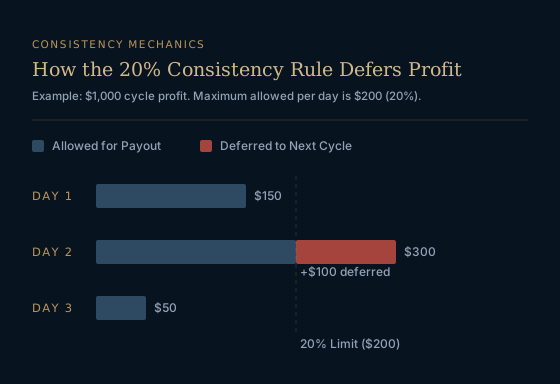
These rules dictate the pace of trading and how firms manage simulated profit extraction. Consistency rules dictate how much of the total simulated profit can come from a single trading day. Many firms use arbitrary percentages to deny payouts at the time of the withdrawal request. Ordane's consistency rule is 20 percent: at the moment of a withdrawal request, no single trading day may account for more than 20 percent of the cycle's total profit. If a day exceeds 20 percent, the excess profit from that day is deferred to the next cycle. It is never confiscated, and the remainder of the cycle pays out normally.
Verification is another hurdle. Some firms require a re-verification loop at every payout. KYC happens once, at the first withdrawal request, not at purchase. There is no re-verification loop at every payout.
Simulated Consistency Rule Scenario
Calculating consistency ensures no single day exceeds the limit. If a cycle generates $1,000 in simulated profit, a 20 percent rule caps any single day's contribution at $200 for that withdrawal.
| Trading Day | Daily Simulated Profit | Allowed for Payout (20% limit) | Deferred to Next Cycle |
|---|---|---|---|
| Day 1 | $150 | $150 | $0 |
| Day 2 | $300 | $200 | $100 |
| Day 3 | $50 | $50 | $0 |
How Do Profit Splits and Withdrawal Cycles Work?
These parameters dictate the timeline and percentage of simulated gains a trader can withdraw. Firms advertise large profit splits, but the fine print often dictates a long waiting period or a complex scaling plan. The split is only relevant if the withdrawal cycle is accessible. The first withdrawal is available 7 calendar days after account activation. Each later withdrawal is available 14 calendar days after the preceding withdrawal is completed, not on a fixed recurring cycle. A pending, declined or unknown request does not start the next 14-day period.
Ordane's profit split starts at 80 percent and rises 2.5 percentage points with every completed withdrawal, reaching 100 percent from the ninth withdrawal onward. The split ladder is in writing and never resets. Withdrawals #1 and #2 are each capped at 3 percent of initial balance. From withdrawal #3 onward there is no cap. Withdrawals reduce the account balance, and the R-1 drawdown floor stays anchored to the initial balance.
What Are the Prohibited Practices and Automation Limits?
Transparent firms use a closed list of prohibited practices to ensure traders know the exact boundaries. Most firms maintain an elastic clause allowing them to terminate an account for vague reasons like abusive trading. Ordane's prohibited-practice list is closed. Clause R-6 names six practices: latency, reverse or hedge arbitrage; high-frequency or bulk automated exploitation; copy trading between Ordane accounts; straddling news releases with paired opposing orders; platform or data-feed exploitation; and gap abuse. If a behavior is not listed in that section, it is not a violation. Discretion is not a rule. The Ordane rulebook is public, numbered and versioned, and no rule is ever applied retroactively to an open account. Changes produce a new version with a dated changelog entry, and the version you sign up under is the version that governs your account.
Appendix A of Rulebook v1.0 is published (changelog entry dated 2026-08-01) and defines each R-6 practice with examples. A-2 states that R-6(b) does not ban all automation, only bulk or high-frequency exploitation: a single expert advisor or script placing discretionary or rules-based trades at human-scale frequency, with a stop-loss on every position under R-3, is the example that does NOT close the account. Expert Advisors are fully permitted at Ordane: a trader may run an EA executing the trader's own strategy on an Ordane account. The R-6 prohibition on copy trading between Ordane accounts applies only between different people. Copy trading is permitted exclusively between Ordane accounts that belong to the same person, meaning the same account holder and ultimate beneficial owner. Copy trading between person A and person B is always prohibited.
How Do Firms Handle News Trading and Overnight Holding?
Policies vary drastically, with many firms banning news trading entirely to limit exposure. Traders must navigate different rules regarding significant macroeconomic events and market closes. Ordane's rulebook restricts trading around news in two ways. Clause R-6(d), part of the R-6 closed list of prohibited practices, prohibits straddling news releases with paired opposing orders on any account. For Instant Core accounts, clause C-7 adds a 10-minute exclusion around high-impact scheduled releases on the affected instrument. Clause C-7 governs the two Instant Core trading windows: a 10-minute exclusion around high-impact scheduled releases on the affected instrument, and no weekend holding, with overnight holding (between trading days, not spanning the weekend) permitted.
Overnight and weekend holding is allowed at Ordane. It is not on the R-6 closed list, and what is not listed is not a violation. Overnight and weekend holding is allowed at Ordane under ordinary risk; gap abuse is prohibited.
Industry Standard vs. Ordane Features
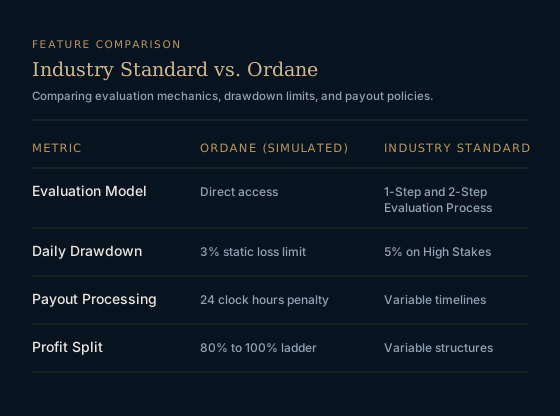
| Metric/Feature | Ordane (Simulated) | Industry Standard |
|---|---|---|
| Evaluation Model | Direct access | 1-Step and 2-Step Evaluation Process (FTMO Challenge, retrieved 2026-09-29) |
| Daily Drawdown | 3% static loss limit | 5% on High Stakes (The5ers High Stakes, retrieved 2026-09-29) |
| Payout Processing | 24 clock hours penalty clause | Variable timelines |
| Profit Split | 80% to 100% ladder | Variable structures |
How Do Instrument Variety and Leverage Impact Trading?
The selection of assets and fixed leverage parameters determine margin requirements and position sizing. The selection of tradable assets dictates the strategies a trader can deploy. Some firms restrict certain pairs entirely. Ordane lists four asset classes: FX pairs (majors and minors), metals, indices and crypto. No exotics. A defined list prevents confusion about what markets are available during volatile sessions.
Leverage determines how much capital is required to hold a position. Ordane's settled leverage is 1:50 on FX majors and minors. Leverage for metals, indices and crypto has not been set yet. By maintaining a firm 1:50 ratio on forex, the firm ensures traders cannot overextend their margin artificially, keeping the focus on precise execution rather than excessive exposure.
Accounts with no trading activity for 30 consecutive days are closed. The 30 consecutive days in clause R-5 are calendar days, not business days. Under clause R-5, trading activity means at least one filled order. Pending orders and platform logins do not count.
Frequently Asked Questions
Do prop trading companies trade live funds?
Ordane accounts operate on simulated capital. No live funds are traded and no deposits are accepted. Most of the industry operates on similar simulated models.
What is a static drawdown limit?
A static drawdown limit sets a fixed floor based on the initial balance that never trails upward as simulated profits increase. Ordane's maximum drawdown is 5 percent and static: account equity may never fall below 95 percent of the initial balance.
How do consistency rules affect payouts?
Consistency rules limit how much of a withdrawal cycle's total profit can come from a single day. Ordane's consistency rule is 20 percent: at the moment of a withdrawal request, no single trading day may account for more than 20 percent of the cycle's total profit.
Are expert advisors allowed in prop trading?
Policies vary by firm. Expert Advisors are fully permitted at Ordane: a trader may run an EA executing the trader's own strategy on an Ordane account.
Before paying any firm, verify its registration status, business background and disciplinary history with the regulator: the CFTC advises contacting them directly to check a company's registration status, business background, and disciplinary history (CFTC Fraud Advisory, retrieved 2026-09-29).
Sources
- FTMO Challenge ftmo.com Retrieved 2026-09-29.
- The5ers High Stakes the5ers.com Retrieved 2026-09-29.
- CFTC Fraud Advisory: Forex cftc.gov Retrieved 2026-09-29.