Home · The Ordane Journal · Before you pay · Prop Trading Platforms
Prop Trading Platforms
A prop trading platforms is a proprietary trading arrangement that gives traders access to simulated capital after meeting documented requirements. Participants pay a fee, trade under the firm's risk rules, and receive a verified share of any documented profits earned on the funded account.
Prop trading platforms are software environments where traders execute orders using capital provided by a firm rather than their personal funds. Ordane accounts operate on simulated capital. No live funds are traded and no deposits are accepted. (Ordane Rulebook v1.0, clause P-2, retrieved 2026-09-29)
These terminals connect to data feeds and matching engines to simulate real market conditions, allowing firms to evaluate performance and process withdrawals based on strictly documented trading rules. Ordane sells one product, the Ordane Instant Account: direct access, no evaluation phase and no challenge, on simulated capital. (Ordane Rulebook v1.0, section 1, retrieved 2026-09-29)
The industry advertises complex challenges, but skepticism is the only valid approach. You need to know if the firm pays, what hidden rule exists, and if the operation will survive the year. Trust requires evidence, not marketing. When you evaluate any provider, the platform infrastructure and the contractual obligations govern your daily execution.
Why Do Platform Licenses Matter?
Why Do Platform Licenses Matter? The reality of platform licensing is that firms relying on third-party vendors can lose their software access overnight without warning. Many firms lease their terminals instead of building them. Across the industry, some firms build proprietary terminals while others license popular retail platforms, and the licensing path carries vendor risk. However, a firm that licenses its terminal can be closed by a decision it does not control. Ordane runs on a trading platform it designed and built with its own engineering team, and licenses no third-party terminal: not MatchTrader, not MetaTrader, not any external vendor. The distinction is structural, not cosmetic. A firm that licenses its terminal can be closed by a decision it does not control, and in 2024 that is exactly what happened: MetaQuotes withdrew MT4 and MT5 access from prop firms, True Forex Funds announced permanent closure on 13 May after its licences were terminated, and SurgeTrader ceased all operations on 24 May, one week after losing its MatchTrader licence. Ordane owns the terminal its
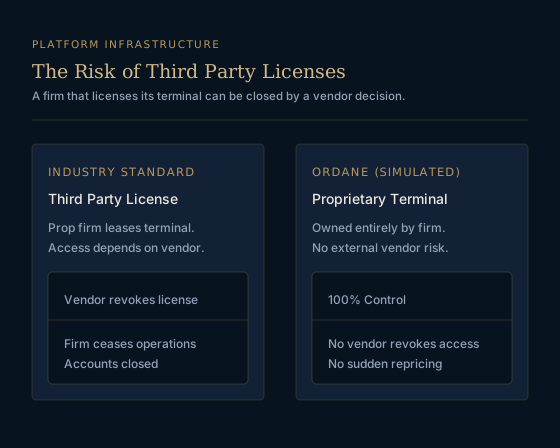
traders use, so no vendor can revoke it, reprice it, or decide it will no longer serve this industry. You execute your strategy on a system that the firm fully controls. Instruments: FX majors and minors, metals, indices, and crypto. No exotics. Leverage on FX majors and minors is 1:50; leverage for metals, indices, and crypto has not been set yet. Accounts are simulated: no commission, no spread and no swap. Ordane charges no commission, no spread and no swap. The account fee is the only cost the trader pays. The reason is structural, not promotional: accounts run on simulated capital, so no order is routed to an exchange and nothing is financed overnight, which means neither line has an underlying bill behind it.
| Firm | Platform Architecture | Infrastructure Control |
|---|---|---|
| Ordane | Proprietary terminal | Owned entirely by the firm |
| Topstep | TopstepX (affiliated development) | See current terms |
What Are the Documented Rules and Costs?
Documented rules and costs must be public, versioned, and completely transparent before any fee is paid to the provider.
The second fear traders face is discovering a hidden rule that denies their withdrawal. The Ordane rulebook is public, numbered and versioned, and no rule is ever applied retroactively to an open account. Changes produce a new version with a dated changelog entry, and the version you sign up under is the version that governs your account.
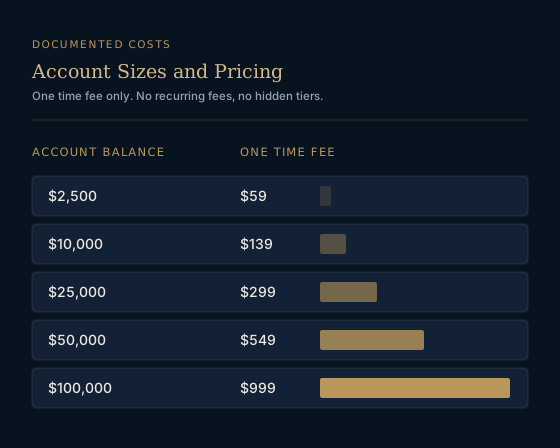
Most firms use either challenge evaluation accounts or instant funding with stricter risk rules (Prop Firm Rules Explained, retrieved 2026-09-29). Ordane accounts operate differently. Ordane Instant Account comes in five sizes: $2,500, $10,000, $25,000, $50,000, and $100,000. The fee is one-time: $59 for the $2,500 account, $139 for the $10,000 account, $299 for the $25,000 account, $549 for the $50,000 account, $999 for the $100,000 account. There are no recurring fees, no hidden tiers and no charge to withdraw.
Ordane's maximum drawdown is 5 percent and static: account equity may never fall below 95 percent of the initial balance. The floor is fixed on day one, never trails upward, and a breach closes the account. The daily loss limit is 3 percent, measured against the balance at the start of the server day. A breach closes the account.
Ordane's prohibited practice list is closed. Clause R-6 names six practices: latency, reverse or hedge arbitrage; high-frequency or bulk automated exploitation; copy trading between Ordane accounts; straddling news releases with paired opposing orders; platform or data feed exploitation; and gap abuse. If a behavior is not listed in that section, it is not a violation. Discretion is not a rule.
How Do Payouts Work in Prop Firms?
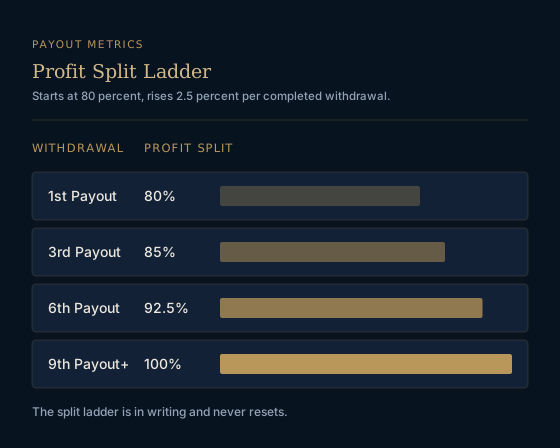
How Do Payouts Work in Prop Firms? Payouts work through clear timelines, guaranteed processing windows, and escalating profit splits based on completed cycles of successful trading. The primary question is always whether the firm actually pays. Prop firm traders typically keep 70 to 90 percent of profits, with top firms in 2026 offering 80 to 100 percent splits (2026 Guide to Prop Firms, retrieved 2026-09-29). Ordane's profit split starts at 80 percent and rises 2.5 percentage points with every completed withdrawal, reaching 100 percent from the ninth withdrawal onward. The split ladder is in writing and never resets. The first withdrawal is available 7 calendar days after account activation. Each later withdrawal is available 14 calendar days after the preceding withdrawal is completed, not on a fixed recurring cycle. A pending, declined or unknown request does not start the next 14-day period. Withdrawals 1 and 2 are each capped at 3 percent of initial balance. From withdrawal 3 onward there is no cap. Withdrawals reduce the account balance, and the R-1 drawdown floor stays anchored to the initial balance. Every withdrawal request is approved, or denied in writing citing the exact rule breached by section number, within 12 clock hours. Past that deadline the request is treated as approved
What Happens When a Rule Is Broken?
and the G-1 clock of The Ordane Guarantee starts. A payout approved and not paid within 24 clock hours, not business hours, triggers automatic compensation: a 100 percent refund of the account fee, plus the payout owed in full. G-2 of The Ordane Guarantee excludes documented fraud or KYC review and declared force majeure, each for at most 10 business days. Beyond those deadlines, G-1 applies regardless. The Ordane Guarantee has two objective exclusions: documented fraud or KYC review, and declared force majeure. Both carry a hard deadline, and beyond it G-1 applies regardless. KYC happens once, at the first withdrawal request, not at purchase. There is no reverification loop at every payout. To understand how rules affect payouts, consider a reproducible scenario for the 20 percent consistency rule on a $10,000 account. If a trader accumulates $1,000 in total profit across a cycle, the 20 percent consistency rule means no single day can contribute more than $200 to that total at the moment of withdrawal. If the trader makes $300 on day one and $700 spread across other days, the $100 excess from day one is not confiscated. The $900 complies with the rule and pays out according to the split, while the $100 defers to the next cycle.
What Should You Verify Before Paying?
What Should You Verify Before Paying? Before paying, you must verify the exact rules, the firm's platform infrastructure, and the regulatory or registration status of the entity. Do not rely on marketing claims. The CFTC strongly urges the public to verify a company's registration with the Commission (CFTC Customer Advisory, retrieved 2026-09-29). Verification means reading the actual contract you are signing. The third fear is whether the firm will still exist in twelve months. Trusting a dashboard number is not enough. Payouts are paid in real money from company fee revenue. No client deposits are taken and no client capital is traded. Rulebook v1.0 clause PR-1 commits Ordane to publish the payout reserve on-chain; the live rulebook and homepage publish the TRON address. The payout reserve address is disclosed on-chain for any purchase bound to this version of the Ordane Rulebook. Ordane is new. Its live homepage says it will not fake a history; the rulebook says payout performance metrics begin with the first month in which a payout is requested. We are new. We have no payout history to show, and we will not manufacture one. What you
can verify today is the reserve address. Ordane's consistency rule is 20 percent: at the moment of a withdrawal request, no single trading day may account for more than 20 percent of the cycle's total profit. If a day exceeds 20 percent, the excess profit from that day is deferred to the next cycle. It is never confiscated, and the remainder of the cycle pays out normally.
| Metric/Feature | Ordane (Simulated) | Industry Standard |
|---|---|---|
| Platform Control | Proprietary terminal owned by the firm | Third-party vendor licenses |
| Evaluation Phase | None (direct access) | Challenge or evaluation phases |
Platform Control | Proprietary terminal owned by the firm | Third-party vendor licenses | | Evaluation Phase | None (Direct access) | Most firms use challenge accounts | | Payout Split | Starts at 80 percent, scales to 100 percent | Typically 70 to 90 percent | | Consistency Rule | 20 percent, excess deferred to next cycle | Varies, often results in account denial | | Drawdown Floor | 5 percent static from initial balance | Often trailing or end of day | > "Verification means reading the actual contract you are signing to confirm the platform infrastructure, the rulebook version, and the exact payout timelines." > Ordane Research Desk
FAQ: Prop Trading Platforms
This section answers five common questions about prop trading platforms using strictly documented rules and verified facts.
What happens if I breach a rule?
A breach closes the account. That is the whole consequence: no partial confiscations, no surprise fees, no renegotiation. (ordanemarkets.com, FAQ, retrieved 2026-09-29)
Can I use an Expert Advisor?
Expert Advisors are fully permitted at Ordane: a trader may run an EA executing the trader's own strategy on an Ordane account. (Ordane Rulebook v1.0, Appendix A, retrieved 2026-09-29)
What is the risk limit per trade?
Maximum risk per trade is 1.5 percent of current balance and a stop-loss is mandatory at entry. Two maximum losses equal the daily limit, which is the design rather than an accident. (Ordane Rulebook v1.0, clause R-3, retrieved 2026-09-29)
How does the copy trading rule work?
The R-6 prohibition on copy trading between Ordane accounts applies only between different people. Copy trading is permitted exclusively between Ordane accounts that belong to the same person, meaning the same account holder and ultimate beneficial owner. Copy trading between person A and person B is always prohibited. (Ordane Rulebook v1.0, Appendix A, retrieved 2026-09-29)
What does inactivity mean?
Accounts with no trading activity for 30 consecutive days are closed. Under clause R-5, trading activity means at least one filled order. Pending orders and platform logins do not count. (Ordane Rulebook v1.0, clause R-5, retrieved 2026-09-29)
Sources
- CFTC Customer Advisory cftc.gov Retrieved 2026-09-29.